Duomo di Arezzo Visitor Guide: Free Church, Paid Museum
Plan a visit to Arezzo's Duomo: which areas are free, what the separate museum ticket covers, where to find Piero della Francesca's Magdalene, and how long to allow.
On this page
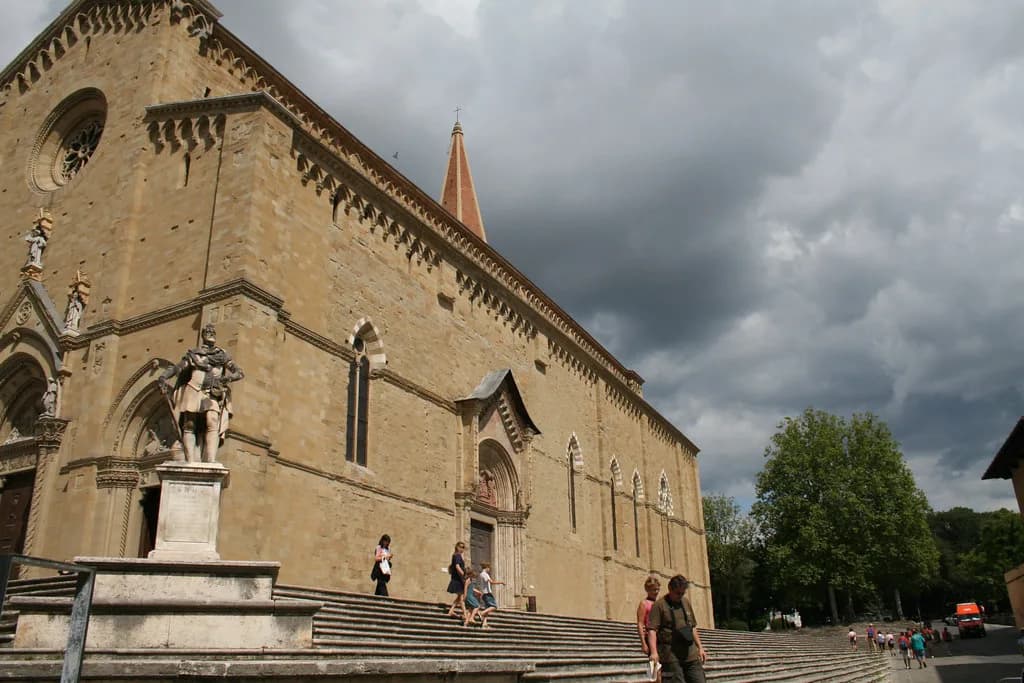
Arezzo's cathedral, dedicated to Saints Peter and Donato, sits at the highest point of the old town, closing the upper end of the historic centre with a wide flight of steps. The church itself is free to enter, while the adjoining museum is a separate, paid attraction with its own seasonal calendar. Sorting that out before you climb the hill saves a wasted walk and helps you decide how much of the morning to give it.
The single most common planning mistake is assuming a single ticket covers everything. The cathedral interior is free to walk into, and the works most people come for — the Magdalene by Piero della Francesca, the Tarlati cenotaph, the stained-glass windows — are inside that free space. The museum is a paid, separately ticketed visit, so budget and time it as its own stop rather than an extension of the church.
Where the Duomo Sits in Arezzo's Upper Town
Arezzo rises on a steep hill above the floodplain of the Arno, and the upper town keeps its medieval street pattern, with the cathedral, the town hall and the Medici fortress grouped near the summit. The Duomo faces Piazza del Duomo opposite the Palazzo Vescovile, and its staircase wraps around two sides of the building, so arriving from below means a final climb on foot. If you are coming up from the lower town, use the escalators that connect the large free car park in Via Pietri with the Duomo — the most direct way to reach the cathedral without tackling the streets.
The 13th-century rebuilding of the cathedral was ordered by Pope Innocent III, who in 1203 told the bishop to move the seat from the hill of Pionta inside the city walls. Construction dragged across centuries: the apse and first bays were up by 1289, work resumed under Bishop Guido Tarlati, and the interior reached its essential form in 1511. The facade stayed rough until 1900–1914, when Dante Viviani's neo-Gothic design was added and inaugurated in August 1914. That long, interrupted history explains why the exterior and the interior feel like different centuries.
Because the cathedral sits at the top, it works best as one stop in a walk that moves downhill through the centre. The Piazza Grande, the Romanesque Santa Maria della Pieve and the Basilica di San Francesco all lie below, so you can start at the Duomo and work your way down without retracing steps. Leaving the cathedral for last means you finish on the heights rather than climbing at the end of a long day.
Free to Enter: What the Cathedral Interior Gives You
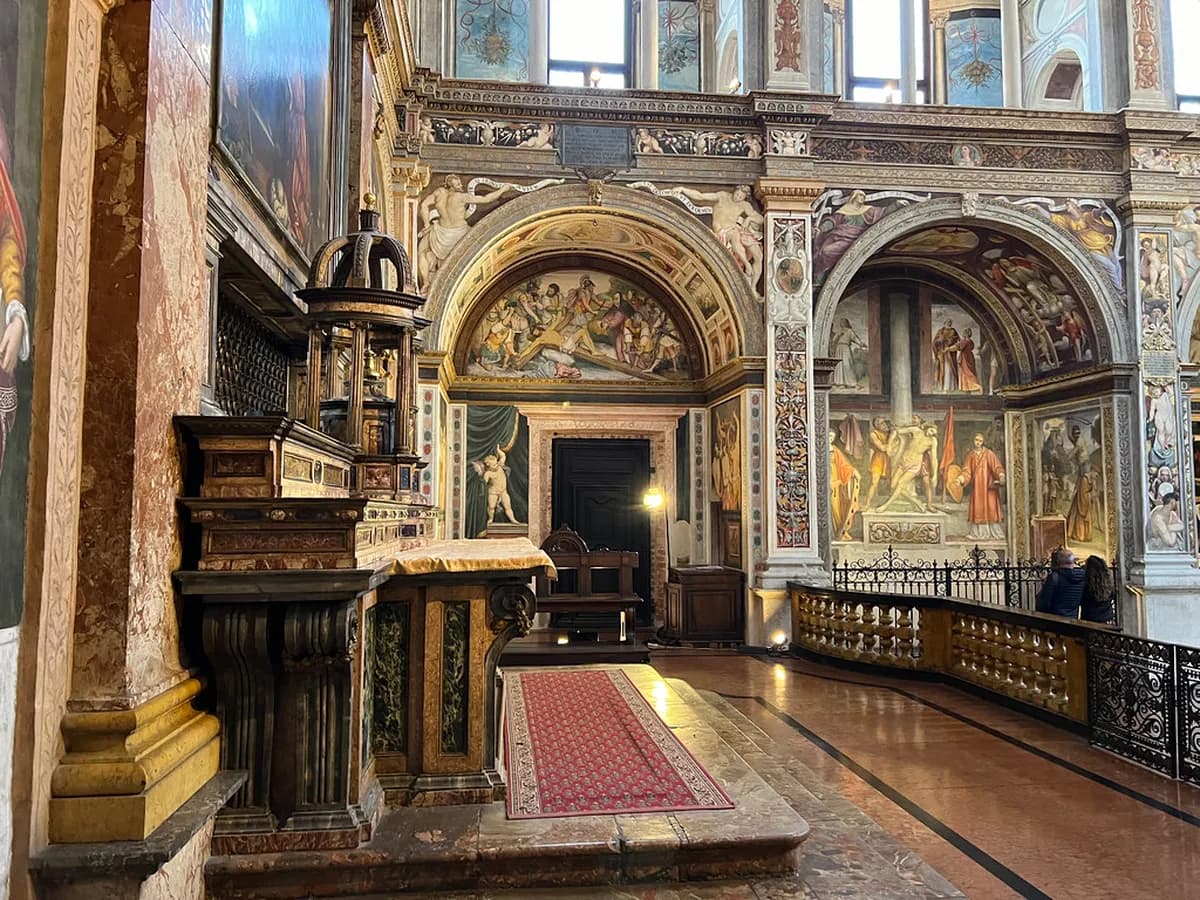
Walk in and the nave opens up: three aisles without a transept, five bays on bundled pilasters, and a polygonal apse at the far end. On the left wall of the nave, beside the sacristy door, hangs Piero della Francesca's Magdalene, painted around 1459 while the artist was in the city working on the fresco cycle in San Francesco. It is small, easy to pass, and the reason many art-minded visitors come to this church at all, so look for it deliberately rather than scanning the walls at random.
Beside the Magdalene stands the cenotaph of Guido Tarlati, carved in 1330 by the Sienese sculptors Agostino di Giovanni and Agnolo di Ventura, with sixteen relief panels recounting the bishop's life. Further along, the cantoria holding the old organ was sculpted in 1535–37 to a design by Giorgio Vasari, who took Michelangelo's tomb of Julius II as his model. These are permanent fixtures of the free interior, not part of any ticketed display.
The stained glass is the other thing to look up for: seven windows designed by the French master Guillaume de Marcillat, painted in two campaigns between 1516 and 1524, and considered a high point of the art in the city. At the high altar, the Arca di San Donato holds the relics of the city's patron saint, its marble ark finished before 1289 and the carved altarpiece added later in the 14th century. None of this requires a ticket.
The visit culminates in the chapel of the Madonna del Conforto, which opens off the left aisle and traces back to a miracle reported in February 1796; the chapel was begun that August and completed in 1817. Inside are glazed terracottas by Andrea della Robbia moved here from other Arezzo churches in 1811, including the Trinity with Saints Donato and Bernardino, finished in 1486. The chapel is a working focus of local devotion, so expect people praying as well as looking.
Paid and Separate: The Museum Next Door
The cathedral's museum, covering MuDAS and the Palazzo Vescovile, is a distinct attraction with its own admission, and the operator publishes prices separately from the church. At the time of writing the full ticket was listed at six euros, with a reduced rate of four euros for visitors aged 6 to 18 and for groups of 15 or more, and free entry for children up to 6, Arezzo residents, disabled visitors with a companion, accompanying teachers, licensed guides and journalists. Treat these figures as the schedule published at the time of checking rather than a fixed rule, because rates and categories can change.
An audio guide was listed at two euros, and groups above 15 people are required to use earphones inside the cathedral. Whether you need the audio guide depends on how much you want explained: the free church rewards a good description of the Magdalene and the Tarlati monument, but a short first visit can be done with a printed page. The museum is where a longer, slower look pays off, and it is the part you can skip without losing the cathedral's headline artworks.
If your interest is Piero della Francesca, weigh the museum against the frescoes at San Francesco, which are the larger draw and are managed on their own terms. Reading up on the cycle before you go makes the difference between seeing beautiful wall painting and following a narrative. Budget for both only if you have the better part of a day in Arezzo.
Opening Hours in Practice: Church Versus Museum
The church keeps a simple daily pattern while the museum runs on a seasonal calendar, and the two do not always overlap conveniently. On the operator page the cathedral is listed as open Monday to Saturday from 10:00 to 18:00, with last entry at 17:30, and on Sundays and public holidays from 13:30 to 18:00, again with last entry at 17:30. The museum, by contrast, is closed on Tuesdays in its high-season schedule and follows shorter windows in winter. Always read the two tables separately before setting out.
The museum's published pattern for the period from 1 April 2026 to 1 November 2026 is daily except Tuesdays, 10:00 to 18:00, with last entry at 17:30 and a brief midday closure of 13:45 to 14:15 on Mondays, Wednesdays and Thursdays. From 2 November to 31 March the winter schedule lists Friday, Saturday and Sunday only, split between 10:00 and 13:30 and 14:00 to 17:00, with last entry at 16:30, and the museum is listed as closed on 25 December and 6 January. Check these dates again close to your trip, since seasonal schedules are exactly the kind of detail operators revise.
Booking is offered online through the operator's site, but availability is not something to assume for a particular day. Use the booking page to confirm slots for your dates rather than treating an online system as proof that entry is instant or guaranteed. For the free church, no reservation is involved — you simply arrive within the published hours.
How Long to Spend: Two Suggested Tiers
These durations are editorial suggestions, not official guidance, and they assume unhurried looking rather than a checklist. For the free church alone, allow around 30 to 45 minutes: enough to find the Magdalene in the left nave, study the Tarlati cenotaph and the Marcillat windows, and sit for a few minutes in the Madonna del Conforto chapel. That pace suits most travellers who are fitting Arezzo into a wider Tuscan itinerary.
If you add the museum, plan on roughly two hours for the cathedral and museum together, with the bulk of the extra time in the museum collections. That figure leaves room for the audio guide and for reading the labels in the Palazzo Vescovile rather than walking past them. If you are squeezing Arezzo into a single day, the free church plus the Piazza Grande and San Francesco is a more satisfying combination than a rushed version of everything.
Etiquette and Logistics Inside a Working Cathedral
This is an active place of worship, and the Madonna del Conforto chapel is a devotional centre, not a gallery room. Keep voices low, dress with respect for a church interior, and avoid blocking the aisles during services. Photography norms are set locally, so follow any signage rather than assuming, and put the phone away in the chapel during prayer.
Group rules are unusually specific here: organised parties of more than 15 people must use earphones to enter the cathedral, which matters if you are travelling with a tour or a large family group. The operator also lists an audio guide for individual visitors, which is a reasonable spend if you want the works explained without a guidebook. Neither arrangement removes the need to check the current hours first.
Approach matters. The cathedral sits at the top of the hill and its forecourt is reached by steps, so plan the climb while you still have energy and combine it with the other upper-town sights rather than making a separate trip. The tourist office in the centre of Arezzo, run by the local destination foundation, can confirm what is open on the day you are there if the official pages leave you uncertain.
Pairing the Duomo With the Rest of Arezzo
Below the cathedral, the Basilica di San Francesco holds Piero della Francesca's Legend of the True Cross, the cycle he was painting when he produced the Magdalene now in the Duomo. The basilica is Tuscan Gothic in style, and its lower church is used for exhibitions, so it is worth more than a passing look. Seeing both gives you the small panel and the large cycle in a single day, which is the clearest way to understand the artist's range. Between the two, the sloping Piazza Grande with its Vasari Loggia and the Fraternita dei Laici anchors the middle of the old town.
The Romanesque Santa Maria della Pieve rises from the southern side of Piazza Grande, the city's oldest church, with a facade of loggias and a bell tower nicknamed for its many windows. A short walk away, the Badia di SS. Flora e Lucilla was rebuilt under Vasari's direction and holds an illusionistic painted dome by Andrea Pozzo. Pick one or two of these depending on your pace; the old town is compact enough to cross on foot between them.
Plan Your Visit
The Duomo di Arezzo is a rare combination: a major art-filled cathedral you can enter for free, with a modest paid museum beside it. Decide first whether you want the church alone or the church plus museum, then check the operator's current hours and prices for your dates before you climb the hill. Arriving in the morning, when the light through Marcillat's windows is at its best and the upper town is quiet, is the simplest way to do it justice.
If your time is short, prioritise the free interior, the Magdalene, and the walk down through Piazza Grande. If you have longer, let the museum and San Francesco's frescoes set the pace of the day. Either way, verify opening times on the official site the week you travel, because the seasonal museum calendar is the one detail most likely to change.
Frequently Asked Questions
Is the Duomo di Arezzo free to enter?
Yes, the cathedral interior is free to walk into during published opening hours. The artworks most visitors come for — Piero della Francesca's Magdalene, the Tarlati cenotaph and the Marcillat stained-glass windows — are inside that free space. The adjoining museum is a separate, paid attraction, so do not expect one ticket to cover both.
Do I need a separate ticket for the Duomo museum in Arezzo?
Yes. The museum, covering MuDAS and the Palazzo Vescovile, is ticketed separately from the church, and the operator publishes its own admission prices and reduced and free categories. Check the current rates on the operator's page before you go, as the published schedule can be revised.
Where is Piero della Francesca's Magdalene inside Arezzo Cathedral?
The Magdalene hangs on the wall of the left nave, next to the door of the sacristy. It is a small panel painted around 1459, while Piero was working on the fresco cycle at San Francesco, and it can easily be missed if you walk down the centre aisle looking up. Look for the Tarlati cenotaph beside it as a landmark.
How long does it take to visit the Duomo di Arezzo?
As an editorial suggestion, allow about 30 to 45 minutes for the free church alone, and roughly two hours if you add the museum. These are not official recommendations. If you are short on time, spend the visit on the Magdalene, the chapel of the Madonna del Conforto and the windows, then continue downhill to Piazza Grande.
Is the Duomo of Arezzo open on Sundays?
The cathedral is listed as open on Sundays and public holidays from 13:30 to 18:00, with last entry at 17:30. The museum's Sunday hours follow a separate seasonal calendar that differs between summer and winter, so check the operator's page for the date you plan to visit rather than assuming the two match.
Is the Arezzo Duomo worth visiting if I only have one day?
Yes, particularly because the church costs nothing to enter, so a short stop adds little to your schedule. Combine it with Piazza Grande and the Basilica di San Francesco, which holds Piero della Francesca's larger fresco cycle, and walk downhill through the old town. Skip the museum if time is tight and save it for a return visit.
Sources
Continue exploring
More guides you'll find useful