Badia di Arezzo Visitor Guide: Art and Old-Town Walk
Visit the Badia di SS. Flora e Lucilla in Arezzo: Vasari's remodelling, Pozzo's painted dome and medieval art, plus how to place it on an old-town walk.
On this page
The Badia di SS. Flora e Lucilla compresses several centuries of Arezzo's art into one modest interior. A painted Crucifix by Segna di Bonaventura is dated 1319, a St Lawrence fresco by Bartolomeo della Gatta is dated 1476, and Giorgio Vasari remodelled the church from 1565. As an editorial suggestion, allow twenty to thirty minutes for the main works, then continue your walk. No current opening hours or admission price for the Badia appear in the sources used here, so check at the door rather than assuming.
The abbey sits within Arezzo's walled upper town, an easy detour from the Corso and Piazza Grande. Where the Duomo occupies the city's highest ridge, the Badia belongs to the denser church-going route through the centre. If you are mapping the day around the main sights, the Arezzo Attractions hub gathers separate guides to the city's principal monuments.
The city's tourism foundation, Fondazione Arezzo Intour, is the coordinating body for destination information in Arezzo and is the sensible starting point for current citywide visitor services. Its site does not publish a Badia schedule, which is why this guide separates documented history from practical details you must confirm on site.
Fast facts: what the Badia is
The Badia is a Benedictine foundation whose church has had several building phases. A Gothic single-nave church of 1278 was followed by reconstruction of the monastery in 1315. A Crucifix painted by Segna di Bonaventura is dated 1319. In 1489 the cloister was built to a design by Giuliano da Maiano. From 1565 Vasari transformed the church, work continued into the seventeenth century, and the bell tower was built in 1650. The painted false dome by Andrea Pozzo was placed above the main altar in 1702.
That sequence explains what you see inside. The medieval paintings survive within a sixteenth-century envelope, and the Baroque additions sit on top of both. Vasari also left his mark elsewhere in Arezzo, including the Loggia on Piazza Grande, so the Badia is part of a wider local Vasari trail rather than an isolated curiosity.
Getting your bearings in the old town
Arezzo's historic centre is compact but steep, and most of it is best covered on foot. A free car park in Via Pietri connects to the upper town by escalator, a useful option if you arrive by car. For the street layout and how the main sights cluster, the Arezzo old town neighbourhood guide explains the geography of the centre.
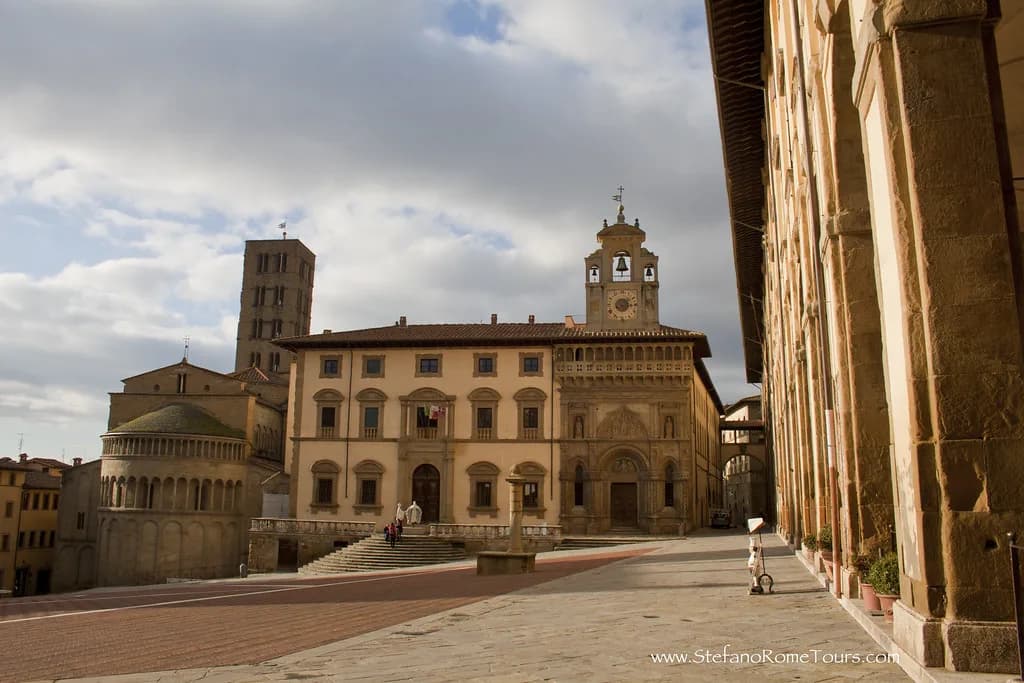
From Piazza Grande, the sloping medieval square with its Vasari Loggia, the Corso Italia runs down toward Santa Maria della Pieve. The Badia fits naturally as a short detour from that spine rather than a separate excursion. If you want to compare Romanesque carving before or after, the Santa Maria della Pieve visitor guide covers that church in detail.
Drivers should take the restricted traffic zone seriously. Local guidance notes that much of the centre is pedestrianised and controlled by cameras, and that entering a ZTL without a permit can bring a fine. Park outside the restricted area and walk in rather than trying to edge closer.
Vasari's family altar and how it arrived
Vasari built a monumental altar complex for his family chapel in Santa Maria della Pieve in 1563. In 1865 it was transported to the Badia, where it now dominates the presbytery. The move explains why a small abbey church has such an elaborate focal point, and it is a detail worth knowing before you walk in.
Documents cited by local history sources record that the remains of Vasari and his wife Nicolosa de Bacci rest in a tomb under the church floor. That makes the Badia a personal monument as well as an architectural one. Whether you seek out the exact spot or not, the detail changes how the interior reads.
The art to seek out
Four works anchor a visit. The Crucifix by Segna di Bonaventura, dated 1319, is the oldest significant painting. Bartolomeo della Gatta's St Lawrence fresco is dated 1476. A ciborium is attributed to Benedetto da Maiano. Above the altar, Andrea Pozzo's painted dome is the Baroque surprise. Together they span roughly four centuries in one room.
The St Lawrence fresco rewards close attention because it predates Vasari's campaign. Seeing it surrounded by later work is a lesson in how church interiors accumulate rather than replace. An Arezzo tourist-information page describes the Badia as a twelfth-century Benedictine foundation totally restored in the sixteenth century under Vasari, with the octagonal bell tower from 1650, the Pozzo canvas, the della Gatta fresco and the Segna Crucifix all noted.
Andrea Pozzo's painted dome
Above the main altar, Andrea Pozzo painted a false cupola on canvas in 1702. It is trompe-l'oeil in the Jesuit tradition, designed to suggest architecture the building does not have. Look up from the nave before approaching the altar so the illusion reads from a distance as well as close up.
Pozzo is best known for the ceiling of Sant'Ignazio in Rome, and the Arezzo canvas is a smaller, local example of the same technique. The contrast with the Duomo is instructive: the cathedral has genuine architecture and its own published visitor arrangements. The Duomo di Arezzo visitor guide sets out what that larger church contains and when it is open.
How to read the interior
Read the Badia as three periods in one space. The fourteenth-century paintings are the medieval layer, the Vasari remodelling is the Renaissance intervention, and the painted dome and bell tower are the Baroque additions. The pace of change is the point: Arezzo's churches were lived in and altered, not frozen as museum rooms.
If you want to continue that reading across the city, the hidden gems in Arezzo guide points to quieter corners of the centre, while Piazza Grande itself shows how medieval fabric and later façades sit side by side. Comparing the Badia with those outdoor spaces makes the interior easier to interpret.
A suggested old-town walk
The order below is an editorial suggestion, not an official route. Start at Piazza Grande, walk down Corso Italia to Santa Maria della Pieve, then cut to the Badia, and finish at San Francesco and its Piero della Francesca frescoes. Allow a morning for this sequence. The Bacci Chapel is the city's most visited interior, and the Basilica di San Francesco Arezzo visitor guide explains how that visit is organised.
The Basilica's frescoes are often visited by reservation, and the travel blog that describes them is undated, so treat any timings or prices published there as needing confirmation with the current ticket office. Build flexibility into the morning rather than locking to a fixed timetable.
You can extend the day with Casa Vasari, the artist's own house museum, which connects directly to the Badia's Vasari thread. The Casa Vasari Arezzo visitor guide covers that visit separately and pairs naturally with the abbey if you want to follow one artist across the city.
What is not published, and where to check
The sources used here describe the Badia's art and history but publish no current opening hours, admission price or booking rule for the abbey. Italian parish churches commonly open around services and close between them, so verify locally. Do not transfer the Duomo's published schedule to the Badia: those hours and ticket prices belong to the cathedral and are explained in its own guide.
The practical route is to check the parish notice board at the entrance or ask at the tourist information office near the railway station. Fondazione Arezzo Intour is the city's tourism foundation, and its site is the best place to start for current citywide visitor services. No advance-booking requirement for the Badia is documented in the sources reviewed.
Etiquette and pacing
This is a working church, not a museum. Dress modestly, keep voices low, and avoid photography during services. If in doubt, follow any posted instructions before raising a camera. Act as you would in any active place of worship.
Twenty to thirty minutes is enough to see the main works and the painted dome without hurrying. If you want to sit with the contrast between the fourteenth-century frescoes and the Mannerist altar, allow longer. Leaving unhurried makes the walk onward to San Francesco feel like a continuation rather than a dash.
Plan Your Visit
The Badia di SS. Flora e Lucilla is not the biggest name in Arezzo, but it packs four centuries into one room. The Vasari altar, the 1319 Crucifix, the 1476 St Lawrence and Pozzo's painted dome each represent a different era and a different way of thinking about sacred space. That range is why it earns a proper stop rather than a glance.
Build the Badia into a morning with Piazza Grande, Santa Maria della Pieve and San Francesco, and you will have seen the core of Arezzo's art within a few hours. Check the parish's own notices for hours and access before you go, since those details are not published online. The Duomo's schedule, by contrast, is published, and the Duomo di Arezzo guide explains it separately.
Frequently Asked Questions
Is the Badia di Arezzo the same as the Duomo?
No. The Duomo, or Cattedrale dei Santi Pietro e Donato, sits at the highest point of the city and is a separate building from the Badia di SS. Flora e Lucilla. The two are often confused because both are large churches with notable art inside, but their histories, schedules and entry arrangements are not linked.
What is the standout artwork inside the Badia?
For many visitors the painted false dome by Andrea Pozzo, made in 1702, is the most surprising work because it creates an illusion of architecture on canvas. The fourteenth-century Crucifix by Segna di Bonaventura and Bartolomeo della Gatta's 1476 fresco of St Lawrence are the other highlights. The altar complex moved here from Santa Maria della Pieve in 1865.
How long should I allow for a visit?
As a suggestion, allow twenty to thirty minutes. That is enough to see the main works, the Vasari altar and the painted dome without rushing. If you want to sit and compare the medieval and later layers, allow longer and build the visit into a wider old-town walk.
Do I need to book to visit the Badia?
No booking requirement is documented in the sources reviewed for this guide, so do not assume you must reserve in advance. The safest course is to check the parish notice board at the door or ask at the tourist information office by the railway station. If you need certainty on a specific day, phone the parish using the number displayed at the entrance.
How does the Badia fit into a walk around Arezzo's old town?
A suggested route is Piazza Grande, then Corso Italia to Santa Maria della Pieve, then the Badia, then San Francesco. This is an editorial suggestion rather than an official itinerary. Much of the centre is pedestrianised and covered by ZTL restrictions, so plan to park outside the restricted zone and walk.
Sources
Continue exploring
More guides you'll find useful