
Basilica di San Francesco Arezzo: Visitor Guide to Piero's Frescoes
Plan a visit to Arezzo's Basilica di San Francesco: what Piero della Francesca's Bacci Chapel frescoes show, what else to see, and how to time your stop.
On this page
The Basilica di San Francesco sits in the heart of Arezzo, a short walk from Piazza Grande, and its plain exterior gives little away. Inside, the Bacci Chapel holds Piero della Francesca's Legend of the True Cross, a fresco cycle painted between 1453 and 1459 and described by Italia.it as one of the greatest masterpieces of the Renaissance. Most travellers who come to Arezzo for art come for this chapel, so it pays to understand what you are walking into before you arrive.
This guide treats the basilica as one stop rather than an afternoon in itself. It covers what the fresco cycle depicts, the other works worth looking up for, why the church and the chapel are not quite the same visit, and how to confirm hours and entry arrangements from official sources instead of relying on third-party listings that often disagree.
Why This Modest Church Matters
The basilica is a Gothic building full of 14th-century frescoes, and it is an active place of worship rather than a museum. That dual identity shapes the visit: parts of the church can be seen as you would see any parish church, while the Bacci Chapel, the reason most people come, is managed separately and is commonly described as a ticketed, time-slotted experience. Italia.it gives a weekly pattern of opening hours for the basilica, but the sources we consulted do not agree on every detail, so treat any printed schedule as a starting point.
The frescoes were painted between 1453 and 1459 in the Bacci Chapel, according to Italia.it, and were brought back to visibility after a long restoration completed in 2000. A guided-tour operator working in Arezzo describes the same cycle as the basilica's defining masterpiece, with accredited guides building tours around it.
The Bacci Chapel and the Legend of the True Cross
The cycle tells the story of the wood of the cross, drawn from the medieval Golden Legend rather than from scripture alone. It runs from the death of Adam and the growth of the tree through to the Emperor Constantine's victory and Saint Helena's discovery of the cross, so it reads as a sequence rather than a set of isolated panels. Knowing the order of the scenes changes the experience: you stop looking at separate pictures and start following an argument about redemption.
The Bacci family, prominent Arezzo wool merchants, commissioned the chapel's decoration, and earlier fresco work by Bicci di Lorenzo survives only in fragments. Piero's contribution is admired for its use of perspective and its calm, luminous figures, qualities that art historians and travel writers repeatedly single out. This matters practically: the room is not large, and the frescoes reward slow looking rather than a quick circuit.
For readers who want to see the chapel as part of a broader Piero trail, the painter's footprint extends beyond Arezzo to Monterchi and Sansepolcro. A reputable guide service based in the region runs tours in the historic centre that pair the basilica with the Cathedral's Mary Magdalene fresco, which gives a sense of how the artist's work is distributed across the city.
What Else to See Inside the Basilica
Beyond the Bacci Chapel, the church holds a cluster of works worth planning time for. Italia.it lists the stained-glass windows by Guglielmo de Marcillat, the Tarlati Chapel with an Annunciation attributed to Luca Signorelli, a large wooden crucifix on the main altar attributed to the Master of St Francis, and frescoes by Spinello Aretino. Artsupp adds that the lower church, divided into three naves, doubles as an exhibition space for temporary shows.
These are not filler between the ticket desk and the chapel. The Marcillat window and the Spinello frescoes belong to an earlier layer of the building's decoration, and looking at them first makes Piero's innovations easier to register. If you have any interest in how Renaissance painting developed, build in a few minutes for them before or after the chapel slot.
Church, Chapel and Ticket Scope
The most common planning mistake is assuming one entry covers everything. The basilica is a working church with regular services, and the Bacci Chapel is managed as a separate fresco visit with its own arrangements; the lower church also hosts temporary exhibitions. Treat these as distinct experiences and check each one rather than assuming a single ticket opens every door.
Reservation rules are the detail most often reported inconsistently online. Forum posts describe difficulties buying fresco tickets through an official site, which is not the same as an operator confirming that booking is mandatory or that capacity is full. Before you travel, check the Arezzo tourism foundation's site and the dedicated Piero della Francesca event site, and contact the basilica directly if the answer is not explicit.
Prices are the other figure to verify rather than trust. Older travel writing quotes specific admission amounts and reduced rates, but those numbers age quickly and are not confirmed by the sources used here. Look for the current tariff on the ticket office or tourism site at the time you book, and budget for the possibility that the chapel visit is priced separately from the church.
Opening Hours: Check, Don't Assume
Published hours for the basilica do not agree with each other. Italia.it gives a weekly pattern that includes a Wednesday closure, while Artsupp lists Tuesday to Sunday openings from 10:00 to 18:00 with Monday closed and describes itself as tracking the museum's current schedule. Because two reputable listings conflict, treat any printed table as a starting point and confirm with the basilica or the city's tourism foundation before you build a day around it.
Religious use takes priority over tourism. If you arrive during a Mass, wait outside or come back rather than walking through the nave with a guidebook open. Sunday afternoons and weekday mornings are the kind of slots worth checking on the official sites, since church schedules shift around liturgical seasons.
How Long to Allow
Allow roughly an hour for the basilica as a whole, with most of it spent in front of the frescoes; that is a suggested planning figure, not an official duration. If you join a guided tour or use an audio commentary, budget closer to ninety minutes, because the cycle has around a dozen scenes and each rewards a second look. Short visits work if you accept that you are sampling rather than studying.
One practical approach is to book or inquire about the chapel first, then fill the waiting time with the rest of the church. That way a slot that runs late does not eat into the artworks you can see without a schedule.
Where the Basilica Fits in an Arezzo Walk
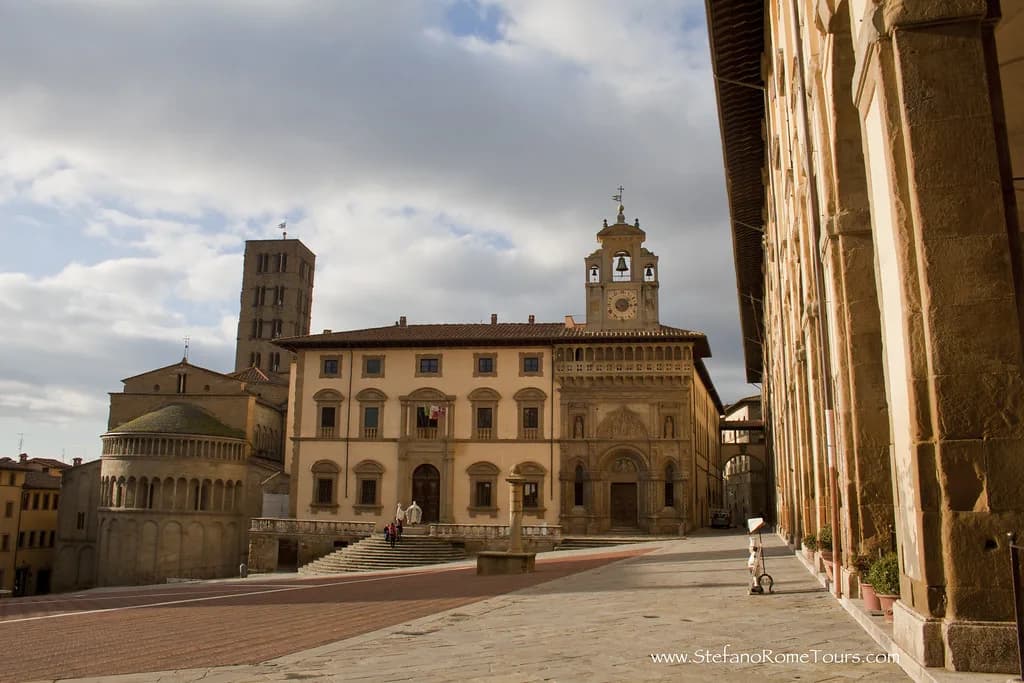
The basilica sits in the compact historic centre, within easy walking distance of the Cathedral and the shopping spine of Corso Italia. A sensible half-day route starts at Piazza Grande, drops to Santa Maria della Pieve, continues to San Francesco for the frescoes, and climbs to the Duomo, where Piero's Mary Magdalene is kept. Our Arezzo old town neighbourhood guide maps the streets between them so you are not doubling back.
Allow the fresco stop to anchor the day and let the rest flex around it. The Duomo, with its unfinished facade and Piero's Magdalene, deserves its own look rather than a rushed ten minutes, and the Duomo di Arezzo visitor guide covers what to see there in more detail.
Beyond the central churches, Arezzo rewards wandering. Piazza Grande's sloping arcade, the antique market held on the first weekend of the month, and quieter lanes toward the Medici fortress all work as extensions of the same walk, and our guide to hidden gems in Arezzo picks up the corners most day-trippers skip.
Pairings Nearby and a Note on Casa Vasari
Giorgio Vasari's house museum is a natural second art stop, a short walk from the basilica and full of frescoed rooms the artist decorated himself. It is a separate museum with its own hours and ticket, so do not plan to fold it into the same slot as the Bacci Chapel. Casa Vasari is well documented in art-historical writing for its painted interiors and small picture collection.
If you are building a full day rather than a half-day, a One day in Arezzo itinerary can sequence the basilica with the Cathedral, Piazza Grande and a long lunch. Keep the fresco slot fixed and treat everything else as movable, especially if you are travelling in a busy month. For wider planning, see One Day in Arezzo.
Etiquette and Crowd Timing
Photography rules vary and are usually posted at the entrance, so check the notices rather than assuming flash is allowed. Silence and modest dress are the baseline in an active church, and groups should keep voices low near the chapel. If you are visiting with children, explain beforehand that this is a place of worship as well as an artwork.
Quietest times are usually early openings and the middle of the afternoon, though that pattern depends on tour schedules and services. Because the chapel is small, even a modest queue moves slowly; arriving with a confirmed slot is more reliable than turning up and hoping.
Plan Your Visit
The Basilica di San Francesco rewards preparation more than most churches in Tuscany. Confirm the current hours and ticket arrangements on the Fondazione Arezzo Intour site and the Piero della Francesca event site, contact the basilica if anything is unclear, and treat the Bacci Chapel as the fixed point around which you build the rest of your day.
Then slow down. Read the cycle from Adam's death to Helena's discovery, look up at the Marcillat window, and leave time for the Duomo and Piazza Grande on the walk back. Our Arezzo attractions hub collects the rest of the city's sights if you want to extend the trip beyond a single morning.
Frequently Asked Questions
Do you need to book tickets in advance for the Piero della Francesca frescoes in Arezzo?
Booking rules change and the sources do not agree on how strict they are, so the only reliable answer is the one you get from the operator. Check the tourism foundation site and the dedicated Piero della Francesca event site before you travel, and if the chapel appears to require a timed slot, secure it early rather than arriving without one.
Is the Basilica di San Francesco free to enter?
The basilica is an active church, but the Bacci Chapel fresco visit is commonly described as managed separately with its own arrangements. Do not assume one ticket covers the whole building. Confirm the scope of entry, and any charge for the chapel, on the official ticket pages before your visit.
How long does it take to see the Legend of the True Cross frescoes?
Plan for around an hour in the basilica, most of it in the chapel, and closer to ninety minutes if you use a guide or audio commentary. That is a sensible allowance rather than an official figure; the cycle is dense and small rooms mean visitors move through slowly.
Which days might the basilica be closed?
Published schedules conflict, with one listing a Wednesday closure and another describing Monday as the closed day. Check the current hours on the tourism foundation site or by phone before setting out, and build your day so a closure does not wipe out your only chance to see the frescoes.
What else is worth seeing inside the basilica besides Piero's frescoes?
Look for the Marcillat stained-glass windows, the Tarlati Chapel with an Annunciation attributed to Luca Signorelli, the wooden crucifix on the main altar, and frescoes by Spinello Aretino. The lower church also hosts temporary exhibitions, which occasionally gives you a reason to linger longer than planned.
Is the basilica within walking distance of Arezzo's historic centre sights?
Yes. It sits inside the compact old centre, close to Piazza Grande, Santa Maria della Pieve and the climb up to the Cathedral, so it fits naturally into a half-day walk. Wear comfortable shoes for the sloping streets and cobbles rather than planning to drive between stops.
Sources
Continue exploring
More guides you'll find useful





