
Piero della Francesca Frescoes in Arezzo: True Cross Guide
Plan a thoughtful visit to Piero della Francesca's Legend of the True Cross in Arezzo: the Bacci Chapel setting, the scene order, and how to read the cycle.
On this page
The fresco cycle of the Legend of the True Cross, painted by Piero della Francesca in the main chapel of the Basilica di San Francesco, is the single strongest reason many travellers stop in Arezzo. It occupies the chapel the Bacci family commissioned, and it rewards a little preparation: the wall is dense, the registers overlap, and knowing the story turns a crowded surface into a legible sequence. This guide concentrates on the art and the setting rather than on logistics.
You can reasonably set aside a focused half hour inside the chapel after ten minutes of reading about the scenes beforehand, though that is a suggestion rather than an official figure. Because entry arrangements and conservation measures at the chapel can change, confirm current conditions before you set out rather than relying on older trip reports.
Why the Bacci Chapel Matters
The cycle sits in the main chapel of San Francesco, often called the Cappella Maggiore or Bacci Chapel, a short walk from the centre of Arezzo. It is not a separate museum room but the liturgical heart of a working church, which shapes how the visit feels: you are looking at one of the defining achievements of early Renaissance painting in the setting it was made for. Fondazione Arezzo Intour, the city's destination body, treats the Basilica and its Piero cycle as one of the destination's headline cultural draws.
The chapel was decorated for the Bacci, a wealthy Arezzo merchant family, and the choice of subject honoured a deep Franciscan devotion to the Cross. That helps explain both the scale of the programme and its placement in the most prominent chapel of the church. Understanding who paid matters here: this was a private commission with public visibility, not an anonymous civic project.
Where It Sits Inside San Francesco
Walk toward the high altar and you are in the right place: the frescoes wrap three walls of the main chapel, and the altar itself carries a large painted wooden crucifix attributed to the Maestro di San Francesco, an artist active in the era of Cimabue. The church also has a lower level now used as an exhibition space, so expect parts of the building to serve different functions.
Keep the geography straight before you arrive. Arezzo's cathedral, the Duomo, and Santa Maria della Pieve are distinct buildings elsewhere in the city; the Piero cycle belongs only to San Francesco. Travellers who conflate them waste time and often miss the chapel entirely.
The Commission: From Bicci di Lorenzo to Piero
The Bacci entrusted the chapel to the Florentine painter Bicci di Lorenzo in 1447. He completed the vault with the Evangelists, the Last Judgment on the entrance wall and two Doctors of the Church on the arch, then died in 1452. That handover explains the visual jolt many visitors feel: the upper zone belongs to a more conservative idiom than everything below it.
Piero della Francesca then continued the programme, working with assistants whose names appear in the documentation, among them Giovanni di Piamonte and probably Lorentino d'Arezzo. The theme itself, the Story of the Cross drawn from the Golden Legend, was most likely agreed before Bicci's death, so Piero inherited a plan rather than inventing one. That continuity is part of why the chapel reads as a single scheme despite the change of hand.
Dating the Cycle Honestly
You will see different date ranges in different places, and that is not sloppiness. Some accounts compress the main campaign into roughly 1452 to 1458, with the lunettes starting around 1452, middle-register scenes around 1455 to 1456 and the battle and Annunciation scenes around 1457 to 1458; others stretch the cycle to 1466. Treat all of these as scholarly ranges rather than a confirmed single year, because no source fixes the whole work to one date. Further visitor details appear in Guida per la Toscana | Basilica di San Francesco in Arezzo| Piero della Francesca | Storie della Vera Croce.
One popular blog account even suggests the paintings may have begun as early as about 1433 and finished by 1466. That widens the window considerably and illustrates the gap between accessible online summaries and documentary precision. Read the range as evidence of ongoing scholarly discussion, not as a puzzle you need to solve on site.
The Story Piero Was Told
The narrative source is the Legenda Aurea, the thirteenth-century collection of saints' lives assembled by Jacopo da Varagine, which recounts the legendary history of the wood of the Cross from the Garden of Eden to the seventh century. The subject suited the Franciscans, for whom devotion to the Cross was central, and it had already appeared in Tuscan painting. Piero's predecessors offered models, including Agnolo Gaddi's frescoes in Santa Croce in Florence and a cycle at San Francesco in Volterra.
What Piero did not do was follow the story in order. He chose scenes for visual and theological balance, grouping outdoor scenes, then court interiors, then battles across the three levels. Knowing this in advance stops you from trying to read the chapel like a comic strip and wondering why the sequence keeps jumping.
Two Ways to Read the Chapel
There are two defensible approaches, and choosing one deliberately makes the visit calmer. The natural or wall-by-wall order starts at the upper register on the left, moves to the two scenes flanking the window, then continues on the right wall, dropping down a level and repeating. It mirrors how your eye travels through the architecture, and it makes the chapel's symmetry legible.
The chronological order begins instead at the lunette on the right, tracing the legend's internal timeline and cycling back to end at the left lunette. If the story is your priority, read this way first and then step back for the symmetry. If composition is your priority, do the reverse; both reward a second pass.
The Scenes: From Adam to the Finding of the Cross
The cycle opens with the Death of Adam, in which Seth receives a shoot from the Archangel Michael and places it in his dying father's mouth; the tree that grows from it eventually supplies the Cross. Next comes the Adoration of the Cross and the meeting of Solomon and the Queen of Sheba, where the queen kneels before a beam that will become the instrument of the Passion. Then the Raising of the Wood, as Solomon orders the beam buried.
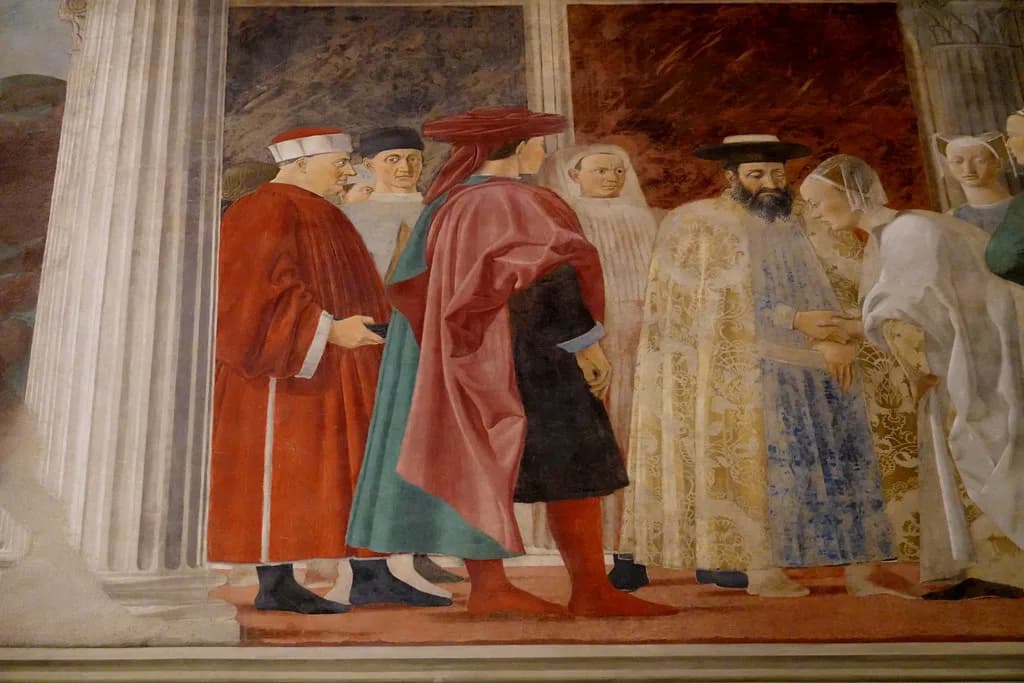
The Annunciation completes the upper zone. In the middle register, Helena, Constantine's mother, interrogates a man named Judas, lowering him into a well until he reveals where the Cross lies. The Finding and Verification of the Cross follows: three crosses are brought to a dead youth, who revives at the touch of the true one, and the crowd kneels. These two scenes are the emotional centre of the chapel for many viewers.
The final pair jumps forward: the Persian king Chosroes seizes the Cross and is defeated by the Byzantine emperor Heraclius, who then returns the relic to Jerusalem on foot in humility. That closing image of a barefoot emperor carrying the Cross is a deliberate counterweight to the battle scenes beside it.
The Battles and the Dream of Constantine
The lower register holds the two battle scenes, Constantine's victory over Maxentius and Heraclius's victory over Chosroes, and they are among the most influential images of the cycle. Together they make a claim about divine favour won through the Cross, which is the political argument running beneath the whole programme.
Between them sits the Dream of Constantine, a night scene with a tent, a sleeping emperor and an angel bearing a small cross. It is widely described as the first fully convincing nocturnal scene in European painting before Caravaggio, and it still reads as remarkably modern: the light source is internal to the picture, not borrowed from the chapel.
Details Worth Slowing Down For
Look for continuity of landscape between neighbouring scenes: Piero let the terrain run across panel edges so that paired episodes share one horizon. Look too at the light. The figures were calibrated to the real daylight entering the chapel's central window, which is why the two prophets flanking that opening seem lit from behind and seem to lean out toward you.
Small tricks reward a closer look: two angled houses between the Finding and the Torture scenes seem to form one irregular building, and the lowest register is painted with fake marble panels and a dentil cornice. These are painted illusions, not real architecture, and noticing them changes how you see the room.
Why There Is No Crucifixion
One scene is conspicuously absent from the cycle: the Crucifixion itself. The explanation is practical rather than theological. A large medieval painted crucifix, attributed to the Maestro di San Francesco, already hung above the high altar at the centre of the chapel, so a painted Crucifixion would have been redundant; the older object did the job.
Read this as an insight into how such programmes were negotiated: the fresco cycle was designed around existing furnishings, not in isolation. If you visit after this guide was written, check whether that crucifix is in its usual position, since church interiors are rearranged for conservation and liturgical reasons.
What This Guide Deliberately Does Not State
This guide gives no opening hours, no ticket prices, no ticket scope, no booking channel and no visitor caps for the chapel. Those details are volatile, they change with conservation practice, and available listings conflict; some carry headline hours and prices that may not apply to the frescoes at all. Publishing them would mislead you.
Instead, verify directly before you travel. Check the Basilica's own communications or the Diocesan museums circuit for chapel access, and use the Fondazione Arezzo Intour site for destination-level notices about Arezzo's museums and events. If a third-party page quotes a viewing time limit or a reservation number, treat it as unverified.
Pacing Your Time in Front of the Frescoes
A workable approach is to read the scene list once at home, then pick three scenes on site and stay with them. Constantine's Dream rewards the most time because of its lighting; the Finding and Verification rewards attention to faces; the paired landscapes reward a slow walk along the wall. That is a suggestion, not an official itinerary.
Expect noise and movement if the church is busy with visitors or services, and accept that your viewing may be interrupted. Letting a guided group pass and then returning to a scene often works better than trying to hold a spot. If the chapel is closed for restoration when you arrive, the church itself still offers the painted crucifix and the lower exhibition level as a fallback.
Adding the Rest of Piero's Arezzo
Piero's Magdalene hangs in Arezzo's cathedral, a short walk away, and seeing it after San Francesco gives you a sense of his range. The Cathedral also holds Renaissance work by Andrea della Robbia and Vasari, so the detour is worth an hour. Check the Duomo's conditions separately from San Francesco's.
Giorgio Vasari, born in Arezzo in 1511, left his mark across the city, and Arezzo marked the anniversary of his death in 2024. Beyond churches, the city centre rewards a slow walk. Arezzo's hidden gems lie mostly in the lanes and small squares away from the main axis, and the Badia di Arezzo is another worthwhile stop for those with time.
Plan Your Visit
Treat the Bacci Chapel as the anchor of an Arezzo stay rather than an item on a checklist. Read the story beforehand, decide whether you want the wall-by-wall or chronological order, and then allow yourself to revisit two or three scenes instead of scanning all thirteen. The investment of preparation is what separates a confusing wall from one of the great experiences of Italian painting.
Before travelling, confirm current chapel access, any conservation restrictions and how entry is managed through official channels. Then build the rest of your day around the visit rather than squeezing it in.
Frequently Asked Questions
Which chapel in San Francesco holds Piero della Francesca's frescoes?
The frescoes of the Legend of the True Cross occupy the main chapel, also called the Cappella Maggiore or Bacci Chapel. It sits at the far end of the church, wrapped around the high altar, and is not a separate museum room, so access depends on the church's own arrangements.
What story do the Legend of the True Cross frescoes tell?
They trace the legendary history of the wood of the Cross, from the Death of Adam through the meeting of Solomon and the Queen of Sheba, the finding of the Cross by Helena, Constantine's victory, and the return of the relic by Heraclius. The narrative comes from the Legenda Aurea, a medieval collection of saints' lives.
In what order should you look at the fresco scenes?
Piero did not arrange them chronologically, so you have two options. The wall-by-wall order starts upper left, moves across the central wall, then continues right and drops a register; the chronological order starts at the right lunette and works through the story before returning. Choose one deliberately, then step back for the symmetry.
When were the frescoes painted?
The commission went to Bicci di Lorenzo in 1447, and he painted the vault and entrance wall before his death in 1452. Piero then continued with assistants, and scholarly ranges place the main campaign between about 1452 and 1458, with some accounts extending it to 1466. No single year is confirmed for the whole cycle.
Why is there no Crucifixion fresco in the chapel?
A large medieval painted wooden crucifix, attributed to the Maestro di San Francesco, already hung above the altar in the chapel. A painted Crucifixion scene would have competed with it, so the existing object served that role within the programme.
Is the fresco cycle free to visit, and do you need to book?
Current admission arrangements, ticket scope and any booking process are not stated here because published information is inconsistent and changes with conservation practice. Check the Basilica's own notices and the Diocesan museums circuit before travelling, and treat aggregator pages as unverified.
How long should you allow for the chapel?
There is no official recommended duration. A focused visit of roughly half an hour inside the chapel, after ten minutes of preparation beforehand, is a sensible personal plan rather than a published rule. Add time if the church is busy or if you want a second pass in the other reading order.
Sources
Continue exploring
More guides you'll find useful





