Hidden Gems in Noto: Quiet Corners, Views and Nearby Escapes
Look past Noto's Corso for bell-tower views, the Nicolaci balconies, Caffè Sicilia granita and half-day trips to Noto Antica and the Vendicari beaches.
On this page
Noto is small enough that most visitors see the whole Baroque centre in a few hours, which means the better question is not where the obscure sights are but where to slow down. The rewards here are a bell tower with a straight-line view down the Corso, palace balconies read from the street, and two escapes outside town that most day-trippers skip. Plan a half-day in the centre and keep a second half for either the old town ruins or the coast.
The town sits in southeast Sicily and was rebuilt on a new site after the 1693 earthquake, laid out in three parts by architects including Labisi, Sinatra and Gagliardi. Its compact limestone buildings glow gold in late light, so timing your walk for the hour before sunset changes the experience more than any single stop.
Start with the free, unhurried layer: the streets themselves, the church steps and the gardens. Paid interiors can come later if time allows, since several palazzi offer guided tours while churches generally open their doors to passers-by. This article treats each stop as a decision — climb it, admire it from outside, or save it for another visit.
Reset Expectations: What Counts as a Lesser-Known Noto Experience
Noto's historic centre is not a maze of concealed corners; it is a legible grid where the main artery, Corso Vittorio Emanuele, runs west from the Porta Reale through three piazzas, each with its own church. That clarity is the pleasure. What feels less visited is simply anything off that axis, particularly the quieter lanes and the second artery, Via Cavour, which runs parallel to the Corso.
The realistic plan for a short visit is a few hours on foot, and travellers who have stayed longer suggest two to four nights if you want to use Noto as a base for the wider Val di Noto. That trade-off matters: a rushed afternoon gives you the cathedral facade and a granita, while an overnight stay buys you an empty Corso at dusk and time for a coast or countryside trip the next morning.
If you have only a single day, do not try to bolt the out-of-town sites onto a walking circuit. Choose one: either the abandoned original settlement or a Vendicari beach. Splitting attention between the two leaves no time to enjoy either, and both involve a drive.
Side Streets off Corso Vittorio Emanuele and Around the Piazzas
Walk the Corso once in each direction. East to west you pass the gardens, the Monastero del Santissimo Salvatore with its tower, Palazzo Ducezio facing the cathedral, the Church of San Francesco and the Jesuit church and college, ending at Palazzo Nicolaci di Villadorata. Doing the route in reverse in the evening gives you the facades lit low and far fewer people on the pavement.
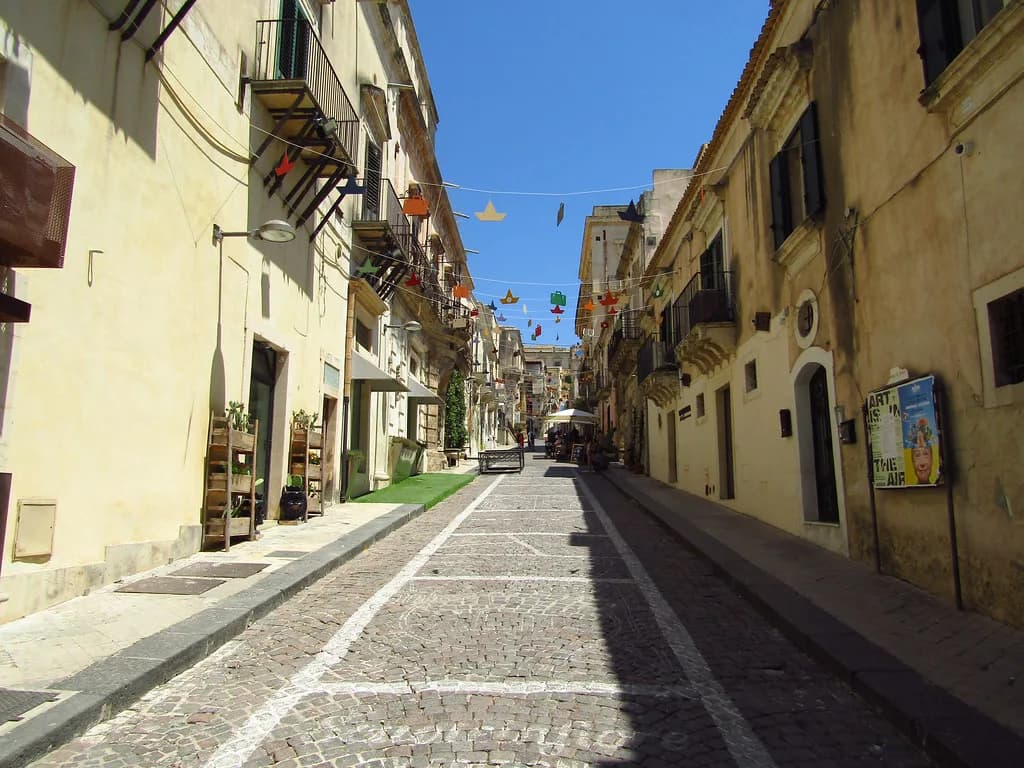
The lanes between the Corso and Via Cavour are where the town becomes ordinary again: small doorways, scooter parking, laundry and shuttered windows, all set in the same honey-coloured stone. These are not attractions so much as the texture between them, and they are the reason to leave twenty minutes unplanned. Carry water in warm months, as shade on these side streets is patchy.
Approach the churches as a series of short stops rather than a checklist. The Cathedral of San Nicolò anchors Piazza del Duomo; nearby San Francesco d'Assisi all'Immacolata was designed by Rosario Gagliardi, the architect behind much of the post-earthquake rebuilding; and San Domenico faces the gardens near the small theatre. Decide in advance which interiors you actually care about, then spend the saved time sitting in a piazza instead.
Climb San Carlo al Corso for the Straight-Line View
The Church of San Carlo al Corso sits along Corso Vittorio Emanuele, and its practical value is the climb to the top of the bell tower. From there you look straight down the street to the cathedral, which is the one genuinely elevated view of the town's layout available to a casual visitor. If you only pay for one interior experience in Noto, this is the strongest candidate.
Treat the ascent as a short, physical stop rather than a museum visit: it takes minutes, the payoff is the view, and the church interior is secondary. Check access on the day, since tower openings can depend on staffing and season, and no reliable published schedule is available for planning months ahead.
Palazzo Nicolaci: Read the Balconies, Then Decide on the Interior
Palazzo Nicolaci di Villadorata is the most exuberant facade in town, built in the eighteenth century by Gagliardi for a wealthy family and finished with carved balconies and wrought-iron railings that amount to Baroque excess on a domestic scale. You can enjoy it entirely from Via Nicolaci at no cost, and many visitors should.
If you want to go inside, do it deliberately. Several palazzi in Noto, including Palazzo Nicolaci and Palazzo Castelluccio, offer guided tours, but this is a separate decision from admiring the exterior, and interiors are not covered by some shared town ticket. Ask at the entrance about current tour times and cost rather than assuming availability.
Palazzo Ducezio, facing the cathedral across Piazza del Duomo, is the other exterior-first stop: an eighteenth-century palace with French-inspired design and a Hall of Mirrors inside. Its rooftop terrace reportedly gives views back toward the cathedral, but closures happen, so plan to admire the building from the piazza and treat entry as a bonus.
The Granita Stop People Plan Trips Around
Caffè Sicilia on Corso Vittorio Emanuele is the address that appears in almost every account of Noto, and the order to copy is an almond granita with whipped cream and a brioche alongside. The peach and basil version is a summer option. Tables are limited, so going early in the morning or between meal times is more reliable than arriving at midday.
Prices are not published in a stable form across sources, so check the counter or menu when you arrive rather than budgeting from older trip reports. For a broader picture of what to eat in town beyond granita, from savoury lunches to finer dining, use a dedicated eating guide to choose your one big meal.
Golden-Hour Viewpoints and Where to Be as the Light Drops
Noto's rebuilt plan deliberately ran three east-west roads across the town so the streets would catch the sun, and the local limestone turns a soft honey colour as the light lowers. The practical consequence is that the facades along the Corso look best in late afternoon and early evening, not at noon. Schedule your second walk, or your return to a favourite piazza, for that window.
For a wider view, the cathedral steps are the classic foreground: the building's scale against the piazza reads better from below than from inside. The bell tower of San Carlo al Corso offers the complementary look along the street itself. Between the two you have the town's two best free or low-cost vantage points covered.
Late September and May are commonly recommended for warm but manageable weather, and early October keeps much of the light and warmth with fewer people. Summer heat makes a midday climb and an unshaded Corso walk genuinely uncomfortable, so shift the walking to morning and evening in July and August.
Day Trip: Noto Antica on Mount Alveria
The town you are standing in is the replacement. The original settlement, now called Noto Antica, dates back centuries and was abandoned after the 1693 earthquake levelled the area; its ruins sit on Mount Alveria, roughly a twenty-minute drive from the modern centre. Ancient tombs cut into the rock are among what remains visible.
This is the trip for travellers who want landscape and silence rather than curated interiors. Bring sturdy shoes, water and a car, and treat it as a half-day rather than a quick add-on. Because it lies outside town, it does not fit between a lunch reservation and a cathedral visit.
Check current access arrangements before driving up, as site conditions and any on-site facilities are not reliably documented in visitor sources. Set expectations accordingly: the appeal is the setting and the sense of a town interrupted, not interpretation panels or services.
Day Trip: The Vendicari Beaches at Calamosche and Eloro
South of Noto, the Vendicari Nature Reserve protects a stretch of coast with walking trails and sandy beaches, and the drive opens up a very different half-day from the Baroque centre. Calamosche is a sheltered cove often described among Italy's best beaches; Eloro sits near the reserve's edge with ancient ruins close to the sand.
Facilities are thin, so bring water, food and sun protection, and expect a walk from parking to the sand rather than a doorstep drop-off. Beach club chairs and reserve opening times vary by season and are not reliably published in a single place, so confirm locally or via the reserve before setting out. Do not count on arriving late in the day and finding easy access.
Eloro beach also puts you beside the ruins of a Greek city, and the reserve's protected status keeps the water clear and the mood low-key. If you are choosing one beach over another, pick Calamosche for the cove and short walk, or Eloro for the archaeology and slightly easier approach.
If Your Dates Align: The Infiorata on Via Nicolaci
For a few days in May, Via Nicolaci becomes a carpet of flower-petal mosaics designed by artists around a yearly theme, with markets and performances filling the town. The festival is tied to a specific weekend in May, usually described as the third Sunday, so it is a timing constraint rather than a permanent sight.
If you are in Noto for the Infiorata, expect crowds and book accommodation early; if you are not, avoid that weekend because the flower carpets block the very lane you came to see. Either way, confirm the current year's dates with the organiser rather than relying on a general rule, since the calendar is set each year.
Practical Logistics: Parking, Trains and How They Shape Your Day
Parking in Noto is the recurring frustration. Drivers report ending up along the approach road on a first visit and later paying for a lot a short walk from the centre, where the ticket machine was unreliable with notes, so carry coins. Aim for the edge of the historic centre and walk in rather than circling the Corso.
Trains reach Noto from Siracusa in a short ride and from Catania with a longer journey, which makes the town feasible without a car for the centre alone. A car only becomes necessary for Noto Antica and the Vendicari beaches. If your plan is purely the Baroque streets, arrive by rail and save yourself the parking problem.
By road, Catania airport is the natural gateway and Siracusa is close enough for an easy half-day transfer. Roads in the region are generally good, though a car with reliable navigation helps on the smaller routes. Note that some sources for these logistics date from earlier visits, so verify current services before relying on them.
Where to Base Yourself for Slow Exploring
Staying inside the centre buys you empty streets before breakfast and after dinner, which is precisely when the Baroque facades look their best. Hotels and palazzo conversions cluster around the Corso and Piazza del Duomo. The trade-off is that you will be parking on the edge and walking in with luggage.
Countryside stays a short drive out offer pools, olive groves and quiet, and they make sense if you plan day trips to the reserve or Noto Antica. Hotels in the surrounding countryside are also an option for families who want space. Choose based on whether your priority is walking to dinner or driving to the coast each morning.
For a Val di Noto base, Noto sits within easy range of Ragusa, Modica, Scicli and Siracusa, all part of the same UNESCO-listed Baroque story. Spending two to four nights lets you see each town in an afternoon without repacking daily. If you only have one night, stay in the centre and skip the day trips entirely.
Plan Your Visit
The most useful way to see Noto is to accept its size. Walk the Corso and its quieter parallel lanes, climb the bell tower of San Carlo al Corso for the street view, read the Nicolaci balconies from outside, and let an almond granita with brioche be the leisurely pause rather than a checklist item.
Then decide what your second half-day buys you: the ruins of the original town on Mount Alveria for silence and landscape, or a Vendicari beach for water and walking. Both require a car and both reward an early start. Sort your parking and coins before anything else, and confirm seasonal details locally on the day.
More Noto guides
- Best Time to Visit Noto and Avoid Crowds
- Day Trips from Noto
- Getting Around Noto and Arriving
- Noto Baroque Self-Guided Walk
- Noto Centro Storico vs Collina
- Noto Food Guide
- Noto One Day Itinerary
- Cattedrale di San Nicolò in Noto
- Chiesa del Crocifisso Noto
- Chiesa di San Carlo al Corso in Noto
- Chiesa di San Domenico in Noto
- Chiesa di Santa Chiara in Noto
- Palazzo Nicolaci in Noto
Frequently Asked Questions
Is Noto worth visiting, and how much time do you need?
Yes. Noto's historic centre is compact and can be covered on foot in a few hours, which is enough for the Corso, the cathedral and a granita. Staying two to four nights makes more sense if you want to add Noto Antica or the Vendicari beaches and use the town as a base for Ragusa, Modica and Siracusa.
Can you climb a bell tower in Noto for views?
The Church of San Carlo al Corso on Corso Vittorio Emanuele has a bell tower you can climb, and the top gives a direct view down the street to the cathedral. Treat it as a short stop rather than a museum visit, and confirm access on the day, since openings can depend on staffing and season.
What is Noto Antica and how far is it from the town?
Noto Antica is the original settlement, abandoned after the 1693 earthquake that destroyed the area. Its ruins lie on Mount Alveria, roughly a 20-minute drive from the modern town, and include tombs carved into the rock. You need a car and should allow a half-day, and it is best to check access arrangements before driving up.
Which beaches near Noto are worth a day trip?
Calamosche and Eloro, both within or near the Vendicari Nature Reserve south of town, are the usual choices. Calamosche is a sheltered cove with a short walk from parking; Eloro has sand close to ancient Greek ruins. Facilities are limited, so bring water and food, and confirm current reserve access and hours locally.
When is the Infiorata in Noto?
The Infiorata turns Via Nicolaci into flower-petal mosaics during a weekend in May, typically described as the third Sunday. It is a specific few days rather than a season-long display, so confirm the current year's dates with the organiser. If you are not attending, avoid that weekend because the flower carpets fill the lane.
Where do you park in Noto?
Parking near the historic centre can be chaotic. Drivers often end up along the approach roads on a first attempt and later use paid lots a short walk from the centre, where the ticket machine may not accept notes reliably, so carry coins. Park on the edge and walk in rather than driving the Corso.
Is Noto a good base for exploring southeast Sicily?
Yes, if you have a car and at least two nights. Noto sits within easy reach of the other Val di Noto towns, including Ragusa, Modica and Scicli, as well as Siracusa and the Vendicari coast. With only one night, stay in the centre and skip the day trips rather than rushing between towns.
Sources
- Guide to Noto, Sicily
- Things to do in Noto, Italy: A Guide to Sicily's Baroque Gem - Travel Folk
- Why Noto, Sicily Is Our Italy Destination of the Summer | Condé Nast Traveler
- 2026 Noto Travel Guide: must-see attractions, popular food, hotels, transport & travel experiences (updated in October)| Trip Moments
Continue exploring
More guides you'll find useful