Chiesa di Santa Chiara Noto: Visitor Guide to the Baroque Church
Plan a visit to Chiesa di Santa Chiara in Noto, Rosario Gagliardi's Baroque church, and learn its raised bricked-up door, oval nave and terrace views.
On this page
Chiesa di Santa Chiara sits on Noto's main thoroughfare, Corso Vittorio Emanuele, in the same stretch of honey-coloured Baroque that pulls most visitors along the street. The feature almost everyone notices first is architectural, not ornamental: the original main entrance is bricked up and sits more than two metres above today's pavement, leaving a side door on Via Capponi as the working way in. Understanding why turns a quick doorway stop into one of the better stories on a Noto walk.
The building is also a useful case study in how Noto's Baroque is organised, since the church, a terrace and the Civic Museum occupy overlapping spaces but do not share a single admission arrangement. The building is an active place of worship, the adjoining former Benedictine convent now houses the Civic Museum, and the terrace is described as separately ticketed. Treat those as three distinct things to plan rather than one bundled attraction.
Where Santa Chiara Sits on the Corso
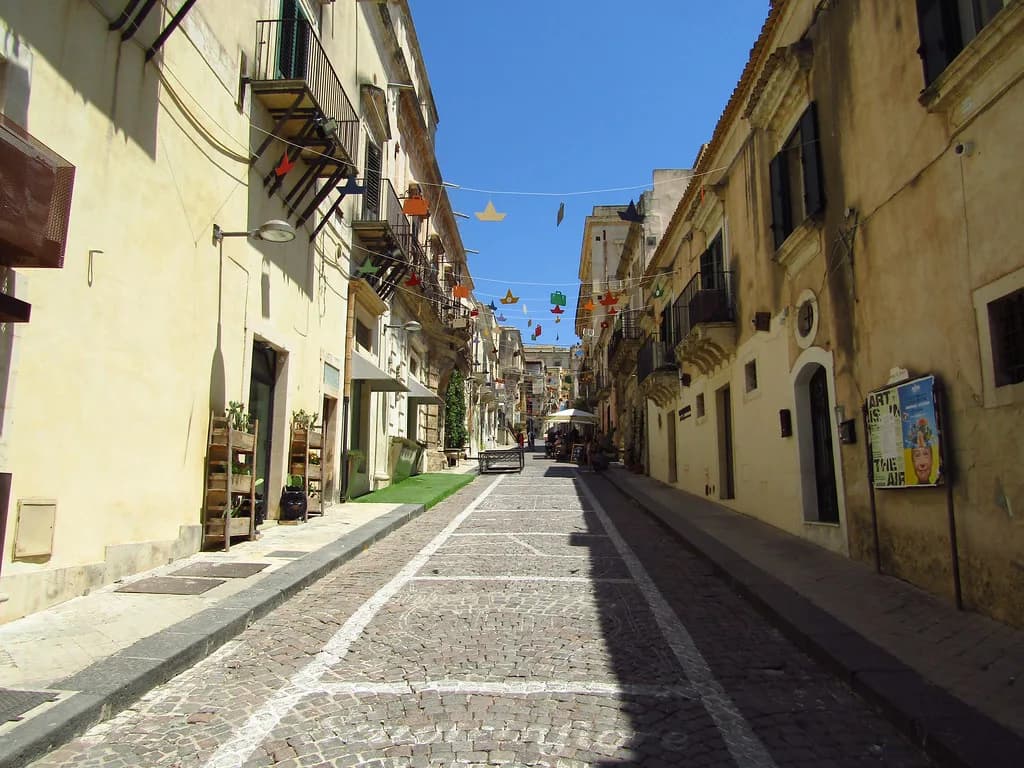
The church stands on Corso Vittorio Emanuele, the spine of rebuilt Noto, which makes it easy to fold into a walk rather than a detour. The street is also the route to the city's other Baroque set pieces, so most visitors meet Santa Chiara incidentally, often while heading toward the cathedral at the top of the town. If you are mapping a route, our guide to hidden gems in Noto is a sensible companion for the side streets around the Corso.
Arriving from the Corso, look for the grand portal set high in the facade; the door you actually use is around the corner on Via Capponi. That two-entrance arrangement is the single most practical thing to know before you arrive, because the obvious frontage looks closed. Budget a few minutes to look up at the stranded portal before you go in, since the street-level story is as interesting as the interior.
A Rebuilt Town and a 1730 Design
Santa Chiara belongs to the post-earthquake city. The 1693 Val di Noto earthquake destroyed the older settlement, Noto Antica, and the town was rebuilt roughly four miles away, giving architects a near-blank slate in the late Baroque style. That history explains why so much of central Noto reads as a single coordinated townscape rather than layers of centuries.
The church itself was designed in 1730 by Rosario Gagliardi, a Syracuse-born architect central to Sicilian Baroque, and completed in 1758. Its curved facade is the reason it fits so comfortably into the street: it bends with the Corso rather than asserting a flat front, which is typical of how Gagliardi shaped Noto's public spaces. Keep the dates in mind as history, not as a current-site fact; the fabric and access arrangements can change over time. Further visitor details appear in Chiesa di Santa Chiara: Noto's Baroque Gem - Noto, Italy | Ciceru - Travel Stories & Adventure Guides.
Why the Main Door Is So High
The elevated, bricked-up portal exists because the ground moved, not because the design was odd. In the 19th century, earthworks significantly lowered the level of Corso Vittorio Emanuele, which left the original main entrance stranded above the new pavement and unusable. It was walled up, and access was permanently moved to the side entrance on Via Capponi, which the source describes as the way in.
Look at the proportions and the effect is unmistakable: a grand doorway hovering above head height, facing a street that has since dropped away from it. It is a rare chance to see a town's infrastructure history written directly on a church facade, and it rewards a moment's pause before you turn the corner. No special access is needed to see it; it is visible from the public street. Further visitor details appear in Chiesa di Santa Chiara: Noto's Baroque Gem - Noto, Italy | Ciceru - Travel Stories & Adventure Guides.
Inside: An Oval Nave and Gagliardi's Decorators
Inside, the church has a single, oval-shaped nave, a plan the source describes as rare for churches in Sicily at the time of construction. It is worth correcting a common claim here: the interior is oval in plan, not octagonal, and the distinction matters when you are trying to picture the space before you arrive. The oval shape gives the room a close, wrapping feel that differs from the long nave of a cathedral.
The decoration is dense: ornate stucco work and cherubs fill the interior, and twelve statues of the Apostles by the decorator Basile crown the columns that line the nave. Other works include an 1854 altarpiece by Salvatore Lo Forte showing San Benedetto and Santa Scolastica, and a 16th-century marble Madonna and Child attributed to Antonello Gagini. Give the columns and the altarpiece a close look rather than scanning the room in one sweep.
UNESCO Status, Explained Plainly
In 2002, Santa Chiara was included, along with other monuments in the city, in the UNESCO World Heritage Site listing for the Late Baroque Towns of the Val di Noto. That recognition covers the town's post-earthquake reconstruction and its architecture, not a single building in isolation. In practice, you are looking at an urban achievement as much as a church.
The listing also does not imply that every monument in the town is open, free or managed the same way. Santa Chiara is an active place of worship, and the Civic Museum in the former convent is a separate institution with its own arrangements. Read UNESCO status as context for the streetscape, not as a visitor-services promise. Further visitor details appear in Chiesa di Santa Chiara: Noto's Baroque Gem - Noto, Italy | Ciceru - Travel Stories & Adventure Guides.
Free Church, Paid Extras: Keeping the Tickets Straight
Santa Chiara is an active place of worship, and the adjoining former Benedictine convent now houses the Noto Civic Museum. The terrace, which offers panoramic views of Noto's skyline including the cathedral, is accessible for a separate fee. Nothing in the available descriptions suggests one ticket covers the church, the terrace and the museum together, so plan each element separately.
Current admission arrangements are not published in a form we can verify here, so check with the Diocesi di Noto and the Comune di Noto before you set a budget or promise a terrace visit to your group. Ask specifically whether the terrace and the Civic Museum are open on your date, since they are separate from the church. Our Noto Attractions hub is a useful place to compare what else in town charges for entry.
Is the Terrace Worth the Extra Stop?
The terrace's appeal is straightforward: it gives you a raised view over Noto's roofline, with the cathedral in the frame, from a building you are already standing in. Whether that is worth an additional ticket depends on how much time you have and whether you plan another high viewpoint later in the day. If you are doing a short Corso walk between meals, the terrace is the kind of optional add-on worth deciding on the spot. Further visitor details appear in Chiesa di Santa Chiara: Noto's Baroque Gem - Noto, Italy | Ciceru - Travel Stories & Adventure Guides.
Because the terrace is accessed separately, do not assume your church visit includes it, and do not assume it is open simply because the church is. Confirm current access at the entrance before paying, and check whether the Civic Museum in the former convent is part of your plan. The convent's reuse as a museum is a different visit from the church itself.
Santa Chiara and Noto Cathedral: A Trade-off, Not a Ranking
Santa Chiara and the cathedral reward different kinds of attention. Santa Chiara gives you an unusual oval interior, the raised-door story and a modest-scale visit; the cathedral is the town's central monument and the anchor of the Corso. Neither is a box to tick in place of the other, and a short trip does not have to choose one exclusively.
If your interest is architectural detail and street-level history, Santa Chiara is the more distinctive stop; if you want the defining set piece and the main square, the cathedral comes first. Read the Cattedrale di San Nicolò Noto visitor guide before you set your route so you know what you are trading against. Neither needs a ranking to be useful.
Pairing Santa Chiara with Other Baroque Stops
The church's position on the Corso makes it a natural stop on a Baroque self-guided walk, and the surrounding streets hold enough to fill a half day at an easy pace. If you are stitching a route together, our Noto Baroque self-guided walk sets out a sequence that keeps the main Corso sights in view. Add Santa Chiara as a short interior stop rather than a destination in itself.
Two nearby churches are worth knowing about if you want more of the same style without crossing town: the Chiesa di San Carlo al Corso in Noto and the Chiesa del Crocifisso Noto. Our Chiesa di San Carlo Noto visitor guide and Chiesa del Crocifisso Noto visitor guide explain what distinguishes each from Santa Chiara. Check each one's current access before you build it into a tight schedule.
Checking Times and Planning Your Time
Opening times for the church, the terrace and the Civic Museum are not published in a verified form here, and hours can change with the liturgical calendar and staffing. Before you go, check the Diocesi di Noto site for the church and the Comune di Noto for the museum, and ask directly about the terrace if it is a priority. Do not rely on third-party listings for current times.
As a planning suggestion rather than an official figure, allow around 15 to 30 minutes for the church interior, plus 20 to 30 minutes if you add the terrace and 30 to 60 minutes if you also visit the Civic Museum. That keeps the visit proportional to what it offers and leaves room for the rest of the Corso. If you are short on time, the church alone is a quick, worthwhile stop.
Plan Your Visit
Santa Chiara is best treated as a short, high-value stop on a Corso walk: arrive expecting the side entrance on Via Capponi, look up at the bricked-up portal, and take time over the oval nave and the Apostle statues. Keep the church, the terrace and the Civic Museum in the former convent separate in your plans, because they are arranged separately.
Before you go, confirm current access and opening arrangements with the Diocesi di Noto and the Comune di Noto, and check what the terrace or museum costs on the day. With those details settled, the church slots neatly into a Baroque itinerary that includes the cathedral and the nearby Corso churches.
Frequently Asked Questions
Why is the main door of Chiesa di Santa Chiara so high above the street?
The original main entrance on Corso Vittorio Emanuele was built before the street was lowered. In the 19th century, earthworks significantly dropped the pavement level, leaving the portal stranded more than two metres above the ground. It was bricked up, and the working entrance was moved to the side of the building on Via Capponi.
Who designed Chiesa di Santa Chiara and when was it completed?
The church was designed in 1730 by Rosario Gagliardi, a Syracuse-born architect associated with Sicilian Baroque, and construction was completed in 1758. The curved facade is one of the features that help it fit into the Corso's streetscape.
Is the interior of Santa Chiara octagonal or oval?
It is oval. The church has a single, oval-shaped nave, a plan described as rare for churches in Sicily at the time it was built. Descriptions of an octagonal interior are not supported by the available sources.
Is Chiesa di Santa Chiara part of a UNESCO World Heritage Site?
Yes. In 2002 the church was included with other monuments in the UNESCO listing for the Late Baroque Towns of the Val di Noto, recognising the town's post-earthquake reconstruction and its late Baroque architecture. The listing covers the wider townscape, not just this building.
Does one ticket cover the church, the terrace and the Civic Museum?
There is no indication that a single ticket covers all three. The church is an active place of worship, the terrace is described as accessible for a separate fee, and the Civic Museum occupies the former Benedictine convent as a separate institution. Check current arrangements at the entrance and with the relevant bodies.
How do I check opening times before visiting?
Consult the Diocesi di Noto for the church and the Comune di Noto for the Civic Museum, and ask about the terrace directly if it is a priority. Current hours are not published in a form that can be reliably reproduced here, and times can vary with the liturgical calendar.
Sources
Continue exploring
More guides you'll find useful