Noto in One Day: A Slow Baroque Itinerary
One day in Noto: a walkable baroque route along Corso Vittorio Emanuele, a proper coffee pause and one realistic late-afternoon choice, coast or hill town.
On this page
Noto is one of Sicily's UNESCO-listed baroque towns, built in honey-coloured limestone and best understood on foot. The historic centre is compact and highly walkable, with most of its main churches, palaces and museums sitting within a short stretch of Corso Vittorio Emanuele, so a day here works better as a half-day of sightseeing plus a relaxed afternoon than as a rushed checklist.
The two real risks are over-scheduling interiors until the architecture blurs together, and underestimating the cobblestones and sun. Build in shade, water and a seated break, and treat any terrace or rooftop viewpoint as conditional rather than guaranteed.
A Realistic Shape for One Day in Noto
A sensible structure is a morning of architecture, a seated coffee pause around midday, a slower early afternoon, and then a fork: the coast or a second baroque town. The town's official website lists a rolling programme of events across the year, including a concert season, the Festa di San Corrado and summer programming, so an evening concert or festival can reshape your afternoon if something is on.
Choose one afternoon commitment, not two. If you want to linger over interiors, plan two to three days in Noto rather than one; the town rewards a second morning. If you only have a single day, accept that you will see the essential streetscape well and one or two interiors properly, and leave the rest for next time.
Morning Route: Porta Reale to Piazza del Duomo
Start at Porta Reale, the ceremonial gateway into the old town, and walk up Corso Vittorio Emanuele towards Piazza del Duomo. Along the way you pass churches and palaces in quick succession; pick two to step inside rather than every doorway, and let the rest be facade-watching. Our Noto Baroque self-guided walk follows this axis in more detail if you want a house-by-house sequence.
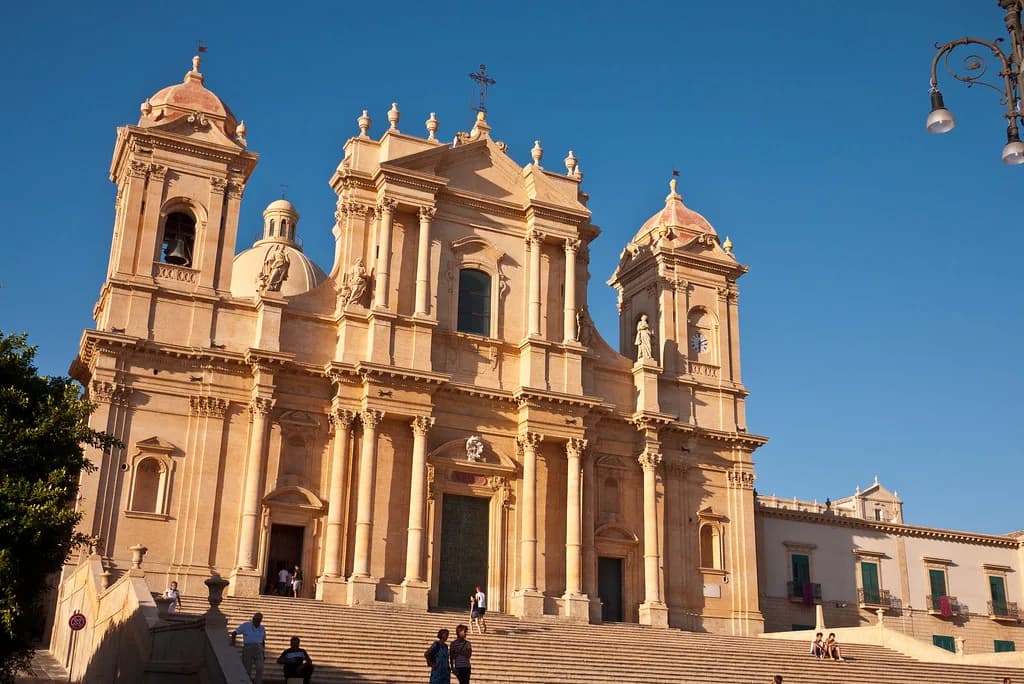
The Cathedral of San Nicolò rises above the corso in full baroque splendour, with a sweeping staircase, twin bell towers and a honey-toned limestone facade. Climbing the steps costs nothing and gives one of the classic views back down the street; whether the interior is open when you arrive is a separate question best checked that morning.
Directly opposite stands Palazzo Ducezio, the neoclassical town hall with its double colonnade. Treat the upper terrace as conditional: it may be open for views, it may be closed for civic use or ceremonies, so ask at the entrance rather than planning your day around it. If it is shut, the cathedral steps and the corso itself already deliver the panorama.
Palazzo Nicolaci and the Via Nicolaci Balconies
Turn off the corso onto Via Nicolaci to see Palazzo Nicolaci di Villadorata, whose balconies are held up by sculpted cherubs, lions and mythical creatures. This is one of the town's most photographed corners, and it is free to admire from the street. Interior access and any ticketed rooms are published by whoever operates the palace, so check at the door on the day rather than assuming a fixed timetable.
In spring, Via Nicolaci becomes the setting of the Infiorata di Noto, when the street is covered with elaborate flower mosaics designed by local artists. Treat it as a seasonal window in May, not something a generic day visit will see; if flowers are the draw, build the trip around that period and check the town's own announcements for dates.
Church Cluster: San Domenico and San Francesco
The Church of San Domenico, attributed to Rosario Gagliardi, is one of the town's boldest baroque facades, with a rippling curve that reads almost like movement. The Chiesa di San Francesco sits on a rising stairway towards the eastern end of the corso, framing a short climb with views back over the rooftops.
Budget for two interiors at most before fatigue sets in. Churches are free to enter but may have limited visitor hours or be closed for services, so do not assume a fixed timetable. Rest your eyes on the piazzas between visits rather than queueing for a third nave.
The Coffee Pause, Scheduled Properly
Sicilian coffee culture deserves a proper stop, not a takeaway cup. Noto is known for its granita, almonds and pasticceria, with Caffè Sicilia frequently named among the town's essential addresses. Whether you sit there or elsewhere, schedule the break for the hottest hour so the afternoon does not collapse.
Order a granita with a brioche or an espresso at the bar, talk through lunch rather than committing to a long tasting menu, and use the sit-down to decide your afternoon. Our Noto Food Guide covers what is worth ordering and how a Sicilian day is structured around food.
Afternoon Choice A: Toward the Coast
Lido di Noto sits a short drive south of the city, with sandy beach, shallow water and relaxed beach bars. Further out, Eloro Beach marks the northern tip of the Vendicari Nature Reserve and offers golden sand, pine shade and scattered ancient ruins, with the reserve's protected status keeping the water clear. Both are best reached by your own transport or an arranged taxi, since no verified bus or train data is available.
Eloro has no busy beach clubs, so plan to bring water, snacks, sun protection and to carry out your rubbish. Parking is paid in a nearby lot, which keeps the sand itself uncluttered. Leave Noto by mid-afternoon if you want real beach time before the light turns.
Afternoon Choice B: A Second Baroque Town
Inland, Modica is roughly a 50-minute drive from Noto and another UNESCO-listed town, famous for its chocolate made using traditional methods and for the baroque Cathedral of San Giorgio. Scicli is about an hour away, smaller and quieter according to travel reports, with peaceful streets and a relaxed atmosphere that suits a slow final hour.
The honest trade-off is that you cannot do both Modica and Scicli in one late afternoon without rushing both. Pick Modica if food and cathedral architecture win, Scicli if you want quieter alleys. If this is your only baroque day, stay in Noto and let the coast serve as your afternoon out instead.
Quieter Alternative: Noto Antica
Noto Antica is the site of the original town, destroyed in the 1693 earthquake, and sits among wild Mediterranean vegetation away from the crowds. It suits travellers who prefer ruins, landscape and quiet over beaches and museum interiors, and it pairs naturally with a slow morning in the modern town.
Treat it as a half-afternoon rather than a full stop, and check locally what is accessible on the day. It is a site rather than a served attraction, so bring water, sun protection and suitable shoes.
Getting There and Day-Trip Logistics
Catania Fontanarossa is the nearest major airport, and the train connection typically involves a change in Syracuse, which makes a car more flexible if you also want the coast or a second town. Syracuse is often mentioned as a manageable drive or day trip, and Catania is comfortably further.
If you are driving in from Syracuse, leave early enough to have the corso nearly to yourself. Stay overnight if you want to see the old town lit up, since the atmosphere after day-trippers leave is part of the appeal. Check the town's own pages for current cultural events that could shift your plans.
Suggested Timeline by Part of Day
A working shape: start with Porta Reale and the corso in the morning, add the cathedral core and Palazzo Nicolaci before lunch, sit for coffee, then resume with one church or palace, and finish with the coast, Noto Antica or a second town. None of these are official hours; they are simply a way to avoid arriving at 4pm without a plan.
Common Mistakes to Avoid
The most common mistake is trying to enter every church and museum, which flattens the day and makes anything special disappear. Cobblestones wear on the feet, and honey-coloured limestone reflects heat; comfortable shoes, a hat and a refillable bottle matter more than a third palace. Finally, do not treat the coast as a spontaneous afterthought: it is a drive, so it needs its own planning or you will arrive as the light goes.
Plan Your Visit
Noto works best when you give the old town generous time and let the afternoon be a genuine choice. Walk the corso early, step inside the cathedral core, take coffee seriously, and then commit to one direction: coast or second baroque town.
Before you go, confirm the essentials locally: which churches and interiors are open, whether the Palazzo Ducezio terrace is accessible on your day, and what events are on that week. Then read our guide to hidden gems in Noto for the quieter corners that most one-day visitors skip. For wider planning, see Noto Attractions: Visitor Guides to 7 Sights.
Frequently Asked Questions
How should I spend a day in Noto?
Plan a morning of baroque architecture along Corso Vittorio Emanuele, from Porta Reale towards Piazza del Duomo, with one or two interiors at most. Sit down for coffee or granita at midday, then choose one afternoon direction: the coast, Noto Antica, or a second baroque town such as Modica. Treat timings as suggestions and check openings locally on the day.
Is Noto walkable in one day?
Yes. The historic centre is compact and easily explored on foot, with most main sights within a short stretch of Corso Vittorio Emanuele. The streets are cobblestone, so wear comfortable shoes and take a seated break midday; reaching the coast or nearby towns needs a car or an arranged taxi.
Should I choose the beach or Modica for a Noto afternoon?
Choose the coast if you want sun and sea, choosing between Lido di Noto and the Eloro area in the Vendicari reserve, both of which need your own transport. Choose Modica if food, chocolate and cathedral architecture appeal more. Scicli is another option, but you cannot realistically do both in one late afternoon.
Can I visit Noto as a day trip from Syracuse or Catania?
Yes, Noto works as a day trip from Syracuse and from Catania. The nearest major airport is Catania Fontanarossa, and the train connection generally involves a change in Syracuse, so a car gives more flexibility for combining Noto with the coast or another town. Check current transport options and timetables with operators.
How many days should I spend in Noto?
Two to three days is a comfortable shape for the historic centre, food and nearby day trips, but one well-paced day covers the essential streetscape. If baroque interiors and the surrounding Val di Noto towns are the draw, plan to stay overnight.
When is the Infiorata in Noto?
The Infiorata di Noto is an annual May flower festival, when Via Nicolaci is covered with floral mosaics designed by local artists. Confirm the specific programme and dates through the town's own channels close to the time, since the exact schedule varies.
Sources
Continue exploring
More guides you'll find useful