Hadrian's Library Visitor Guide: 7 Essential Tips for Your Visit
Plan your trip with our Hadrian's Library visitor guide. Discover ticket prices, opening hours, historical highlights, and expert tips for exploring this Roman marvel in Athens.
On this page
Hadrian's Library Visitor Guide: 7 Essential Tips for Your Visit
Athens is a city where every corner holds a piece of the ancient world for curious travelers to discover. Exploring the ruins of Hadrian's Library offers a unique look into the Roman influence on classical Greek society — a site that once served as the intellectual heart of Roman Athens. This massive complex was Emperor Hadrian's grandest gift to the city he loved, built in AD 132 and still impressing visitors nearly 1,900 years later. Our Athens travel guide helps you navigate this historic landmark with ease and confidence.
The library stands as a testament to the deep bond between the Roman Empire and the cradle of democracy. Visitors often find themselves captivated by the massive marble west wall and the layers of history compressed into a single courtyard. Understanding the layout and historical sequence before you arrive will greatly enhance your appreciation of these weathered stones. This guide provides all the logistical details needed for a smooth and memorable visit in 2026.
History and Significance of Emperor Hadrian's Gift
Emperor Hadrian was known as a dedicated philhellene who deeply loved Greek culture and invested heavily in its cities throughout his reign. He commissioned this massive complex in AD 132 during his third visit to Athens, positioning it just north of the Roman Agora that had been built 150 years earlier. The entire structure measured approximately 122 by 82 metres and was designed as far more than a book repository. It was a grand civic forum: a colonnaded courtyard with gardens and a rectangular pool, lecture halls, reading rooms, and at the eastern end, the bibliostasion where papyrus scrolls were stored in cedar cabinets called armaria.
The ancient traveller Pausanias described it as the "Library of 100 Columns," noting its gilded cornices, marble decoration, and alabaster statues. That description gives a sense of the ambition involved — this was the largest structure Hadrian built anywhere in Athens, designed to rival the cultural monuments of the Classical era. The bibliostasion itself was two storeys high with an ornate marble floor, cedar roof, and a large niche housing a statue of Hadrian at the centre. On either side of the main scroll hall stood two lecture halls and two large reading rooms open to citizens. You can learn more about its construction via Hadrian's Library — Wikipedia.
The library suffered significant damage during the Herulian invasion of AD 267, which devastated much of the city. In the early 5th century, the Roman governor Herculius repaired parts of the complex and a Christian church was erected where the decorative pool had been. The site eventually transitioned through multiple religious phases during the Byzantine and Ottoman eras. Several churches were built within the courtyard — reflecting the changing spiritual landscape of medieval Athens — until the ruins were finally excavated and consolidated in the modern era.
One of the most notable additions was the 5th-century tetraconch (four-apsed) church, later succeeded by a 7th-century basilica and the 12th-century Megali Panagia, Athens' first cathedral. These layers of history make the site a fascinating compressed timeline of the city's long and complex evolution. Walking through the ruins allows you to see how each era repurposed the grand Roman marble for new uses. Today, the site remains one of the most significant archaeological locations in the Monastiraki district.
Getting to Hadrian's Library in Monastiraki
The site sits at Areos 3 in Monastiraki, directly beside the bustling Monastiraki Square in the heart of the historic city centre. Most travelers arrive via the Monastiraki Metro Station, which serves both Line 1 (green) and Line 3 (blue). Use the Areos Street exit for the most direct route — the entrance gate is a one-minute walk from that exit, making it one of the easiest archaeological sites in Athens to reach without a map. The entrance is well-marked and faces the street, with a small ticket booth and information boards just inside.
If you are staying in the Plaka or Psirri neighbourhoods, the library is within easy walking distance through pedestrian-friendly lanes. Walking from the Ancient Agora or the Roman Agora takes under five minutes through scenic alleys. The Tower of the Winds in the Roman Agora is visible from the library entrance, so navigating between the two on foot is straightforward. This central location makes the library a natural anchor for a full morning of sightseeing in old Athens.
Buses stop frequently near Monastiraki Square, and the Athens Hop-On Hop-Off bus calls at Station A14 Monastiraki/Thissio, placing you a short walk from the gate. Taxis can drop you at the edge of the square, though pedestrian zones limit vehicle access near the entrance. Planning your arrival for the early morning helps you avoid the largest crowds that gather in the square from late morning onward, and the lower sun angle makes photographing the west facade much easier.
Tickets, Entrance Fees, and Opening Hours
Admission in 2026 is €6 for adults during the summer season (April–October) and €3 during winter (November–March). Reduced-rate entry applies to eligible visitor categories including seniors and full-time students with valid documentation. Children and young people under 25 from EU member states typically enter free. The ticket office accepts both cash and major credit cards, and tickets can also be purchased via the official Hellenic Heritage e-ticket service (hhticket.gr) to avoid the small queues that form in peak summer.
Opening hours are seasonal and matter if you are fitting the site into a packed itinerary. In summer (roughly April through October) the site is open daily 08:00–20:00, with last entry at 19:30. In winter (November through March) hours shorten to 08:00–15:00, with last entry at 14:40. The site is closed on 1 January, Easter Sunday, 1 May, 25 December, and 26 December. Arriving early morning in summer lets you avoid the midday heat and the busiest tour groups.
Free entry days operate on specific dates each year. The first Sunday of every month from November to March is free for all visitors. In addition, free entry applies on 6 March, 18 April (International Monuments Day), 18 May (International Museums Day), 28 October, and the last weekend of September. These free days are popular and draw larger crowds, so factor in extra time at the ticket area. For current hours, always check odysseus.culture.gr the day before your visit, as hours can shift on public holidays.
The first Sunday of every month from November to March offers free entry for all visitors. Plan your visit around these dates if you're budgeting your trip, though expect larger crowds.
- Summer ticket (April–October): €6 adults, reduced rate for eligible categories, free for qualifying EU visitors under 25
- Winter ticket (November–March): €3 adults, same reduced/free categories apply
- Summer hours: daily 08:00–20:00, last entry 19:30
- Winter hours: daily 08:00–15:00, last entry 14:40
- Free days: first Sunday of each month Nov–Mar; also 6 Mar, 18 Apr, 18 May, 28 Oct, last weekend of September
Note: the broad €30 combined Athens archaeological ticket that used to cover seven sites was discontinued in April 2025. As of 2026, Hadrian's Library is sold as a standalone ticket only. Check hhticket.gr for any updated multi-site pass arrangements before your visit.
Must-See Features: From the West Facade to the Tetraconch
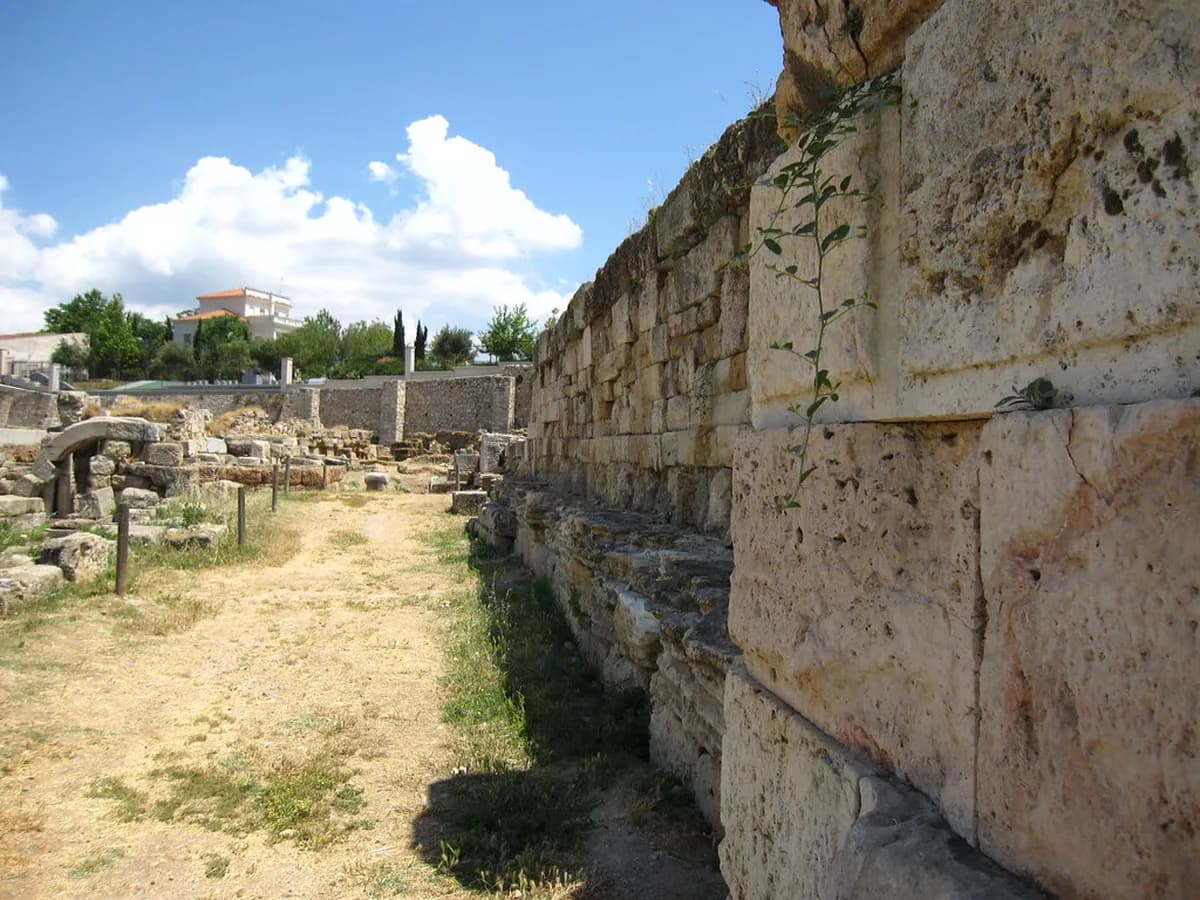
The west facade, facing Areos Street, is the most dramatic surviving element of the complex. Its Corinthian columns of pink Karystian marble and green Thessalian marble have stood for nearly two millennia, and the scale of the wall gives an immediate sense of the original building's ambition. You can examine the intricate column capitals from close range and see the propylon — the monumental gateway — that once marked the formal threshold between the busy city and the quiet interior of the complex. This wall is the most photographed element of the site and looks best in early-morning light.
Inside the large courtyard you can read the plan of the entire complex clearly, even though most of the superstructure is gone. The outlines of the central rectangular pool are visible, and interpretive panels explain the original arrangement of gardens, covered walkways, and open exedrae (semi-circular seating alcoves) on the north and south sides. Along the east wall, you can identify the niches where the cedar armaria once housed the papyrus scrolls. These storage alcoves were deliberately oriented to protect documents from western afternoon sun and moisture.
The ruins of the tetraconch church stand at the centre of the courtyard and represent one of the most legible phases of the site's long afterlife. This four-apsed early-Christian building replaced the decorative pool in the 5th century and is one of the clearest examples in Athens of a pagan monument transformed into a Christian sanctuary. You can walk around the curved foundations and see fragments of the original floor levels. The later basilica and Megali Panagia phases are also traceable in the masonry, making the courtyard a walk-through stratigraphy of Athenian history from Roman to Byzantine.
Many of the marble blocks from the outer walls were removed and reused to build the Tzistarakis Mosque (1759), which still stands just outside the site on Monastiraki Square. This visible reuse of material is a recurring theme throughout the history of urban Athens and is worth noticing as you walk from the site to the square. The small on-site display of architectural fragments and inscribed stones — including one mentioning Emperor Hadrian by name — provides useful context without requiring a separate museum visit. It is included in the standard admission price.
Do Not Confuse Hadrian's Library with Hadrian's Arch
A common mistake among first-time visitors is mixing up Hadrian's Library with Hadrian's Arch. They are two entirely separate monuments on opposite sides of the Acropolis. The Library is at Areos 3 in Monastiraki, right next to the Roman Agora. Hadrian's Arch stands on Vasilissis Amalias Avenue beside the Olympieion, roughly 1.5 kilometres to the southeast. The Arch was a triumphal gateway marking the boundary between the old city of Theseus and Hadrian's new extension; the Library was a civic and intellectual complex with no connection to that boundary.
Navigating to the wrong site is easy to do if you follow generic directions to "Hadrian's monument" without specifying which one. When searching or giving directions, always use "Hadrian's Library / Monastiraki" or "Library of Hadrian" to be precise. If you plan to visit both — and they are worth combining — allow at least 30 minutes of travel time between them through the Plaka district, which itself rewards a slow walk. The Kerameikos ancient cemetery and the Museum of Greek Folk Art in the nearby Monastiraki mosque are further distinct stops in the same neighbourhood that visitors sometimes conflate with the library site.
Planning Your Visit: Timing, Duration, and Photo Tips
Most visitors spend 30 to 45 minutes at the site, which is enough time to walk the perimeter, examine the west facade, circle the tetraconch ruins, and read the main interpretive panels. If you have a strong interest in Roman architecture or Byzantine history, allow up to an hour. The site is compact compared to the Ancient Agora, making it a very manageable addition to a day that also includes the Roman Agora next door and the Acropolis a ten-minute walk uphill.
Early morning (opening at 08:00) is the best time to visit in summer for three reasons: the direct sun has not yet hit the courtyard, tour groups have not yet arrived, and the low-angle light on the west facade picks up the texture of the marble columns beautifully. Afternoon visits in summer are uncomfortably hot inside the open courtyard, which has almost no shade. There is limited seating and no on-site cafe, so bring water. A hat and sunscreen are essential from April through October.
Arrive at opening time (08:00) in summer to beat the heat and crowds. The low-angle morning light is perfect for photographing the west facade's marble columns.
Photography is permitted throughout the complex. The best angles for the west facade are from the pavement on Areos Street, where you can frame the full height of the columns with the modern cityscape behind them — an effective contrast shot. Inside the site, try framing the columns with the Acropolis hill visible in the background. Later in the day, low shadows make the plan of the courtyard easier to read from ground level. Tripods for professional use may require a permit; ask at the ticket booth on arrival.
Wear comfortable shoes with grip, as the courtyard surface is uneven with gravel and ancient paving stones. The site is relatively level overall, but some sections near the tetraconch foundations are rough underfoot. Visitors with limited mobility should note that the terrain is not fully paved; check the official accessibility information at odysseus.culture.gr before your visit. Weekday mornings offer noticeably quieter conditions than weekend afternoons in peak season.
Nearby Attractions in the Heart of Athens
After your visit, the Roman Agora is located just steps to the south through a short lane. The Roman Agora features the Tower of the Winds — an octagonal marble clock and weather station built in the 1st century BC — and the Gate of Athena Archegetis. Together, Hadrian's Library and the Roman Agora form a natural pairing for a Roman Athens walking circuit that takes most people two hours in total. The Museum of Greek Folk Art is also situated very close by in the historic Tzistarakis Mosque on Monastiraki Square.
Monastiraki Square itself is a vibrant hub filled with flea markets, souvenir shops, and traditional Greek tavernas. You can find everything from handmade leather sandals to antique coins while wandering through the nearby streets. The square also offers a clear view of the Acropolis rising above the city skyline. It is a natural place to stop for a quick souvlaki or a frappe after your archaeological tour before heading uphill toward the Acropolis.
If you have more time, continue southeast through Plaka toward the Monument of Lysicrates, Hadrian's Arch, and the Olympieion for a broader survey of Hadrianic Athens. This route gives you a clear sense of Hadrian's urban programme in Athens as a whole. The Benaki Museum of Islamic Art is also within walking distance in the Psirri neighbourhood. Exploring these areas provides a deeper look into the daily life of modern and historic Athens within a compact area.
For those interested in more ancient history, Kerameikos — the ancient Athenian cemetery — is a short walk through the Thiseio neighbourhood to the northwest. This site offers a peaceful escape from the busy city centre and has a wonderful small on-site museum. You can easily spend a full day wandering between these various sites without needing a taxi or bus. The central location of Hadrian's Library makes it an ideal anchor for any cultural itinerary in the city.
Frequently Asked Questions
What is Hadrian's Library in Athens, and why is it significant?
Hadrian's Library was a massive cultural complex built by the Roman Emperor Hadrian in 132 AD. It served as a grand center for learning, housing thousands of papyrus scrolls and providing space for lectures. Its significance lies in its reflection of Roman investment in Greek culture and its role as a civic hub.
Can you go inside the library structure?
Yes, your ticket allows you to walk through the entire archaeological site, including the central courtyard and the ruins of the storage rooms. While the roof and upper floors are gone, you can explore the ground-level remains and the Byzantine churches. Most visitors spend about an hour inside the complex.
Is there a museum on site at Hadrian's Library?
There is a small indoor gallery located within the site that displays various architectural fragments and statues found during excavations. While it is not a large museum, it provides helpful context for the ruins you see outside. It is included in your standard admission price for the Athens site.
How much is the entrance fee for Hadrian's Library?
The single entry fee is currently 6 Euro during the summer season (April–October) and 3 Euro in winter (November–March). Reduced-rate and free-entry categories apply for eligible visitors including qualifying EU students under 25. Check hhticket.gr for the latest pricing and any updated pass arrangements.
Is Hadrian's Library included in the Acropolis combined ticket?
The broad €30 Athens combined archaeological ticket that previously covered seven sites was discontinued in April 2025. As of 2026, Hadrian's Library requires a standalone ticket. Check the official hhticket.gr service before your visit for any current multi-site pass arrangements.
Other Sites Every Later Empire Reused
Hadrian's Library became a Byzantine church, then an Ottoman governor's seat, and all three phases are legible in one enclosure. Seville's Antiquarium shows the Roman layer preserved under a twenty-first-century building. Rome's Basilica di San Clemente stacks the same sequence vertically, down to a Mithraic temple.
Visiting Hadrian's Library provides a fascinating window into the Roman chapter of Athens' long and storied history. The site offers a unique blend of grand imperial architecture and compressed layers of a changing city — Roman forum to Byzantine church to Ottoman-era ruin to archaeological site. With its central Monastiraki location, affordable single-ticket entry, and proximity to the Roman Agora next door, it remains a must-see stop for any traveler exploring Athens' historic core in 2026. We hope this visitor guide helps you make the most of your time at this remarkable landmark.
Remember to bring your camera and arrive early to enjoy the best light on the west facade's Corinthian columns. Whether you are a dedicated history fan or a casual traveler, the library's surviving marble walls will leave a lasting impression. Take your time to wander through the courtyard and imagine the scholars who once studied within these grand halls. Enjoy your journey through the ancient streets of Athens as you discover the legacy of Emperor Hadrian.
Continue exploring
More guides you'll find useful