Free Things to Do in Verona: A Budget Traveler's Guide
Free things to do in Verona: a walkable route past the Arena, Piazza delle Erbe and Ponte Pietra, plus what's worth paying to upgrade in 2026.
On this page
Free Things to Do in Verona
Last updated August 2026, this guide covers free things to do in Verona along one walkable route through the old town. Piazza Bra, the Arena exterior, Piazza delle Erbe, Ponte Pietra and the Roman gates all cost nothing to see, and worship-hour access opens several churches without a ticket. Interiors are where charges start, so this guide separates each no-cost stop from its paid upgrade, such as Juliet's House or Torre dei Lamberti, to keep the budget plan accurate.
Free Things to Do in Verona: Quick-Answer Summary
Verona's core sights cost nothing when viewed from the outside. Piazza Bra, the Verona Arena's exterior, Piazza delle Erbe, Piazza dei Signori, the Scaliger Tombs' fence-line view, Via Mazzini, the Roman gates, Ponte Pietra and the Adige riverside walk all sit inside one loop with no admission fee. Charges start at the interiors: the Arena floor, the Juliet's House museum, the Torre dei Lamberti climb and the paid daytime hours at San Zeno Maggiore each carry a separate ticket. Budget travelers can fill an entire day moving between free piazzas, bridges and viewpoints, then decide selectively which interior, if any, is worth paying for.
For deeper detours once this free circuit is done, lesser-known Verona highlights are worth pairing in. Quieter corners of Verona make a good follow-up once the main piazzas are covered. Off-the-beaten-path corners suit a second visit better than a first one. Unique Verona activities round out a longer stay beyond this list.
Piazza Bra and the Verona Arena Exterior
Piazza Bra is the natural starting point for a free day in Verona, roughly 1.5 kilometers from Porta Nuova train station, an 18-20 minute walk along Corso Porta Nuova. Access to the square is open at all hours, and the Arena's outer wall stands fully visible from the piazza without paying to go inside. Its elliptical footprint makes it a widely photographed Roman structure, with the marble tiers visible through the exterior arches even before buying a ticket. Neoclassical Palazzo Barbieri and Palazzo della Gran Guardia line the square too, both viewable at no cost, along with the ornate clock and stone arches of the I Portoni della Bra gate. A small garden sits at the piazza's center, a shaded, free spot to rest between sights. Sitting at a cafe table here runs €5-8 for an espresso, so standing or perching near the fountain is the free version of people-watching. Arena interior admission runs around €10 on a Tuesday-to-Sunday schedule. Summer opera-season tickets cost far more and are worth treating as a separate splurge rather than part of a free day. Music from performances is often audible from the piazza itself during opera season, so standing outside at showtime is a real way to catch some atmosphere without a ticket. Confirm current opening hours and the festival calendar directly before building a schedule around either one.
Piazza delle Erbe, Piazza dei Signori and the Scaliger Tombs
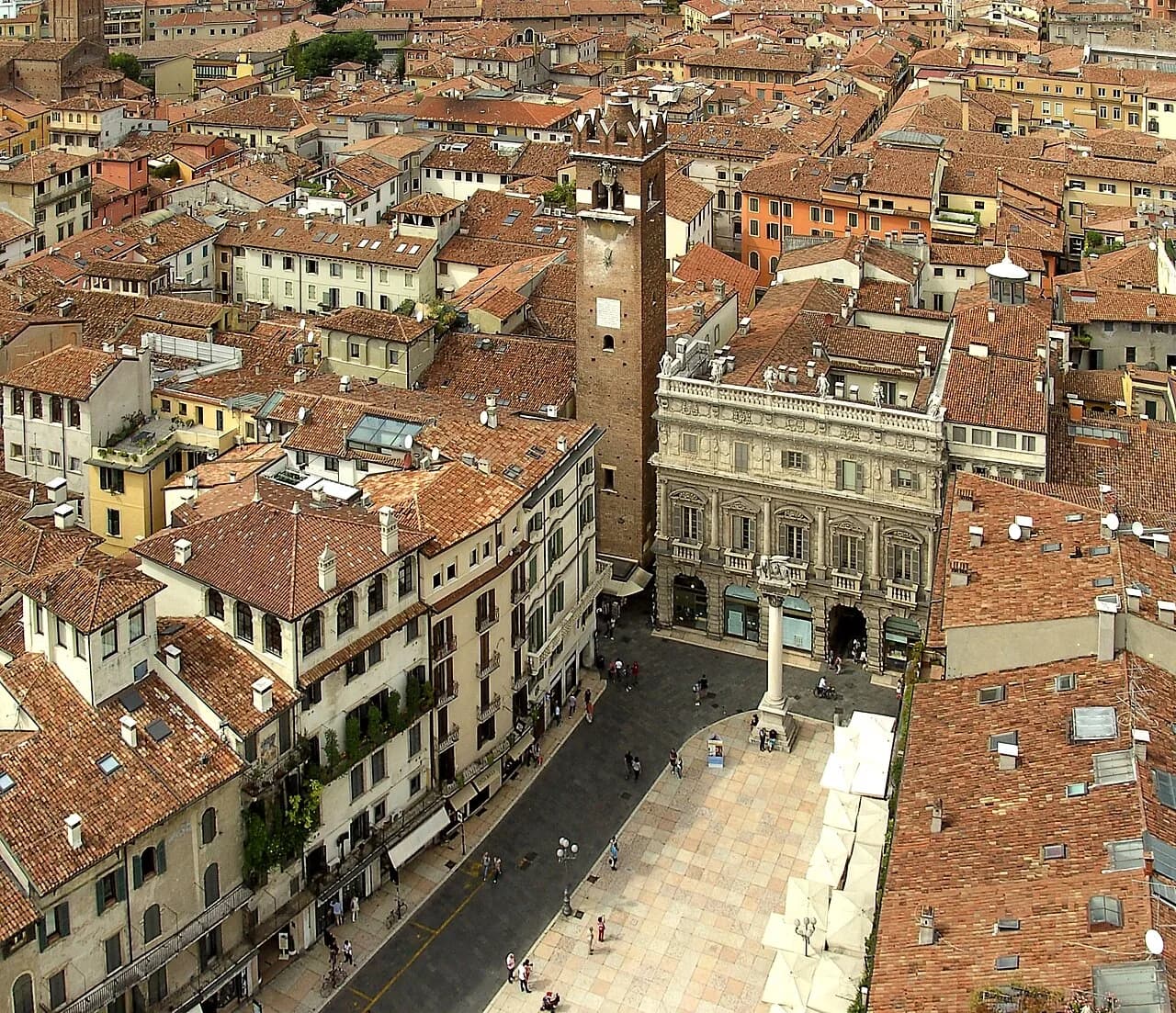
A short walk from Piazza Bra leads to Piazza delle Erbe, an elongated square built over the old Roman forum. A daily market runs Monday to Saturday from about 7am to 1pm, with stalls selling produce, bread and small souvenirs under white umbrellas; browsing is free, though a market breakfast of fruit or a pastry typically costs €2.50-4. Frescoed facades and Romanesque details cover the surrounding buildings, including the Casa dei Mazzanti and the Baroque Palazzo Maffei, both viewable without a ticket. At the square's center, the Madonna Verona fountain combines a Roman-era statue with a medieval basin, a free landmark to sit near while the market runs. An archway, the Arco della Costa, connects this square to Piazza dei Signori. Look up while passing through to spot the whale rib hanging from the arch, one of Verona's odder unsolved details. Piazza dei Signori itself is quieter than its neighbor, fronted by the Torre dei Lamberti and a statue of Dante, with arcades on every side. Just off this piazza, the Scaliger Tombs can be viewed through the surrounding iron fence at no cost. Stepping inside the enclosed courtyard requires a paid ticket. Nearby, the Pandoro sculpture on the Melegatti bakery facade is a quick, free stop worth pairing with either piazza. Casa di Romeo, a private medieval residence with no public interior access, is another free street-level stop tied to the Shakespeare legend.
Via Mazzini and Verona's Roman Gates
Via Mazzini links Piazza Bra to Piazza delle Erbe and functions as Verona's main pedestrian shopping street. Walking it costs nothing even if the boutiques lining it don't, and a public water fountain along the street is a reliable, free spot to refill a bottle. Around 6-8pm, the street fills with the passeggiata, the local habit of an evening stroll before dinner, and that hour is worth timing over the midday shopping crowd. Beneath one storefront on this street, a Roman archaeological site is visible through a glass floor, a reminder that ruins sit under everyday retail space across the old town. Verona's Roman gates extend the same free, self-guided route. Porta Borsari marks the city's old main entrance, with stonework and inscriptions from antiquity still legible above the street. Porta Leoni, a few steps from Juliet's House, sits above a street-level excavation visible through a viewing platform and railing. Porta Nuova and Porta Palio sit slightly outside the historic core, closer to the train station, worth a glance if that stretch is already part of the walk. The Arco dei Gavi, a relocated Roman arch by the Adige, rounds out the gate-and-ruin circuit and sits on the way toward Castelvecchio, whose courtyard can also be entered without a ticket even though its museum requires one.
Ponte Pietra and the Adige Riverside Walk
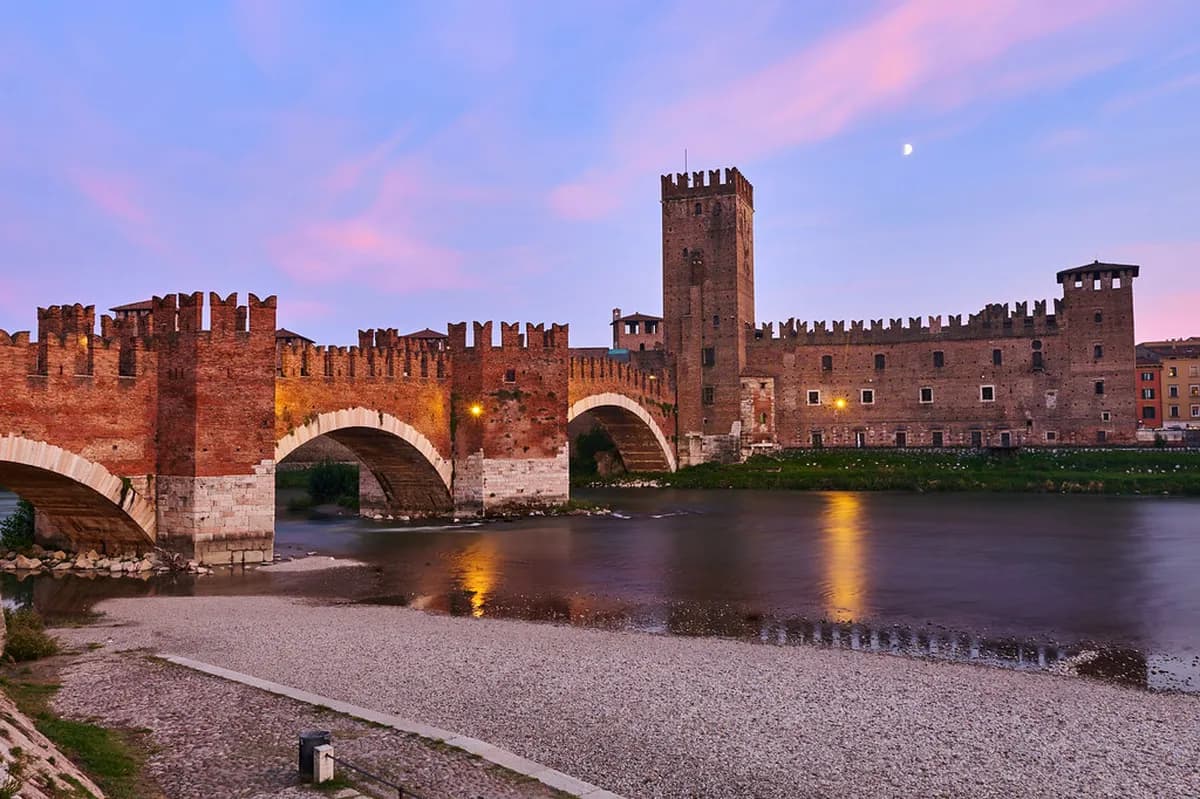
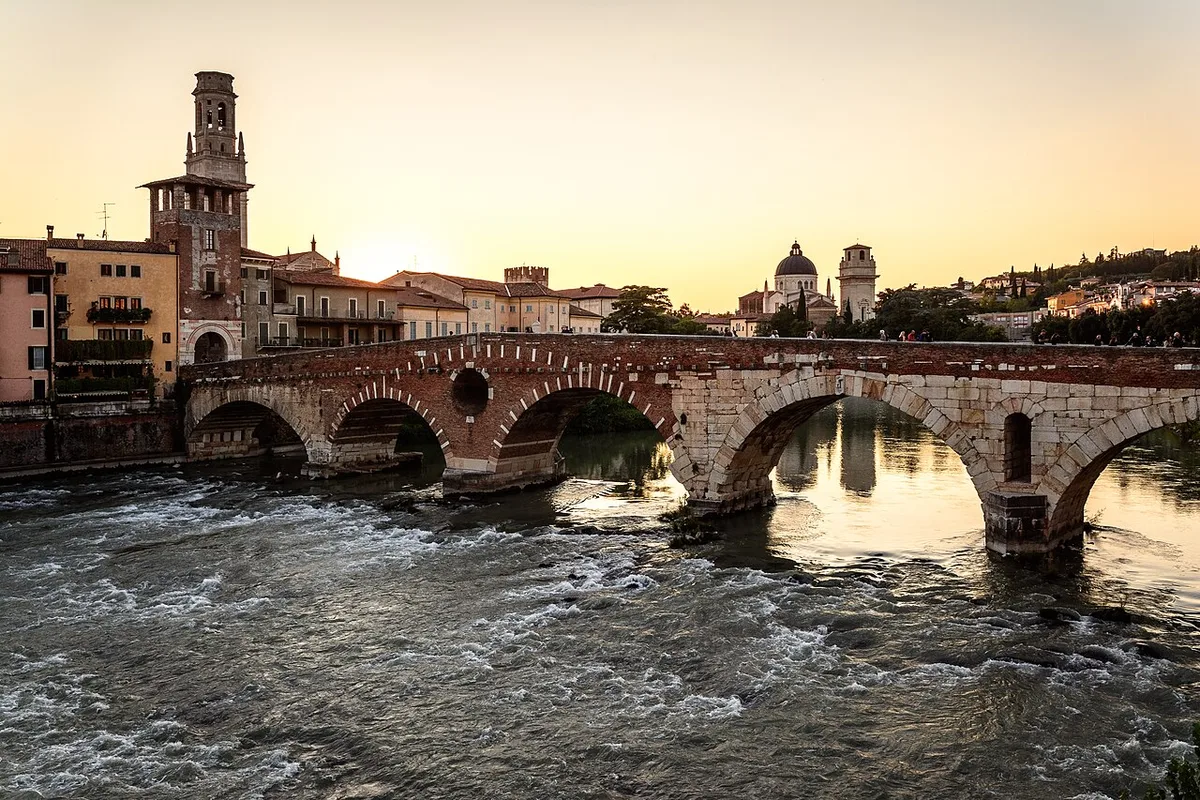
Ponte Pietra is a Roman-era stone bridge combining ancient arches with medieval brick reconstruction after wartime damage. Crossing it is free and pedestrian-only, and the central arch frames a clear view of the Adige River with the Teatro Romano hillside behind it. Sunrise and sunset both work well here, with warm light hitting the hillside architecture directly through the spring and summer months. From the bridge, paths run along both riverbanks, connecting north toward San Giorgio and south toward Castelvecchio, so a longer walk can be built without leaving the free route at any point. Via Sottoriva, a quieter street with porticoed trattorias just south of the bridge, gives a slower, less-trafficked view of the same riverside district. Crossing the bridge also marks the entry into Veronetta on the river's east bank. Veronetta's riverside district is a useful reference for a longer detour on that side.
Free Churches in Verona (and the Worship-Hours Rule)
Several of Verona's churches follow a similar pattern: free entry during morning mass and evening vespers, a paid visiting window in between, and a midday closure. Published patterns put free hours around 7-9am and 5-7pm, with a midday closure common from roughly 12:30-3pm, though this varies by parish and should be confirmed at each church rather than assumed citywide. San Zeno Maggiore, a Romanesque basilica with bronze door panels and a Mantegna altarpiece, charges roughly €2.50-3 for daytime admission but opens free during early mass and evening vespers outside those hours. Its facade, wheel-of-fortune rose window and bell tower remain visible from the piazza in front at any hour, ticket or not. Santa Anastasia, the Duomo and Chiesa di San Fermo follow a broadly similar split between paid daytime visiting and free worship-hour access, though exact fee amounts vary by parish, so check each one's posted schedule before planning around it. Do not assume every church in the old town keeps identical hours; a few operate on their own worship schedule entirely. Modest dress, covering shoulders and knees, is generally expected for entry at any of these churches, worship hours or not. Walking that far west pairs well with the San Zeno district guide for more detail.
Churches open free 7-9am and 5-7pm with midday closures, but fitting them into the 2-3 hour free circuit requires careful timing rather than a spontaneous stop.
Best Free Viewpoints in Verona, Compared
Verona has several free viewpoints, and they are not interchangeable. Effort, crowd level and view quality vary enough that picking one or two beats trying to fit in all four. Castel San Pietro sits on the eastern hillside across the river from the flat old-town loop, so pair it with the Ponte Pietra crossing rather than squeezing it into the piazza circuit on foot. Crowds build fastest there in the hour before sunset. Best times to avoid crowds are covered in a dedicated seasonal guide for travelers who want to dodge that rush rather than chase the golden-hour light.
- Castel San Pietro: roughly a 15-minute uphill walk past Roman theater ruins, gaining about 80 meters of elevation via public stairs, or a fast funicular ride to the same hilltop. Delivers the best-known panorama over the old town, the Adige and the church spires, with the heaviest crowds building in the hour before sunset. See the full Castel San Pietro route for stair-by-stair detail.
- Torricelle hills: a hillside walking area on the edge of the city, worth choosing over Castel San Pietro when avoiding crowds matters more than chasing the single best-known panorama. Torricelle hills route options are listed in the dedicated guide.
- Santuario della Nostra Signora di Lourdes: about a 30-minute hike, steep near the top, ending at a quiet sanctuary and garden with minimal foot traffic even in peak season.
- Giardino Giusti: not a free stop. Entry runs around €10, so budget it separately if the maze, topiary and hillside tower viewpoint are worth the admission. Giardino Giusti garden details are covered in the dedicated guide before deciding.
Free-Adjacent Food, Markets and Culture
None of Verona's food is free, but several options are low-cost enough to fit a tight daily budget alongside the sightseeing above. Piazza delle Erbe's morning market sells produce, bread and cheese for a picnic lunch that typically runs €8-12 for one person. Neighborhood bakeries sell focaccia and sandwiches for roughly €2.50-4, a fast and cheap midday option next to a sit-down meal. Supermarkets near the station, including Pam and Despar locations, price groceries at standard Italian rates for travelers assembling their own breakfast or lunch. Aperitivo hour, generally 6-8pm, pairs a €6-10 drink with a buffet of bread, pasta salad and vegetables at many bars, which can double as an inexpensive dinner a few nights a week. For a proper sit-down meal, trattorie in Veronetta run about €12-18 per person for a primo, secondo and drink. Where to eat on a budget is covered in more detail in a dedicated restaurant guide. Regional Veronese specialties to try are worth reading before picking a trattoria. Several of Verona's festivals cost nothing to attend, including Christmas market stalls, Valentine's Day street decorations and the Bacanal del Gnoco parade. Each turns the piazzas into free entertainment without a ticket.
Beyond Free: Day Trips from Verona
Lake Garda, Sirmione and the Valpolicella wine region are not free things to do in Verona itself, but they're worth flagging for travelers with an extra day and a transportation budget. Sirmione sits on Lake Garda and is a common half-day or full-day extension by car, bus or organized tour. A Sirmione day trip guide covers the logistics for getting there and back. Valpolicella, the hill country northwest of the city, is the source of Amarone wine and typically visited on a guided cellar tour rather than independently. A Valpolicella wine tour guide has route and booking details. Both add real cost, from transportation to tastings, so treat either as a planned add-on day rather than folding it into a no-spend itinerary. For a wider set of options beyond these two, a wider day-trip roundup covers the rest.
Free vs. Paid: What's Worth Upgrading
Several of Verona's best-known sights have both a free version and a paid interior. This table separates what each upgrade actually buys, so a decision to pay can be selective rather than automatic. Castelvecchio follows the same split as several other sights on this list: a free courtyard and a paid museum behind it. Prices reflect recently published rates and can shift year to year, so confirm current admission directly before counting on a specific figure.
| Sight | Free version | Paid upgrade | What the upgrade buys |
|---|---|---|---|
| Verona Arena | Exterior view from Piazza Bra, no charge | Interior admission around €10 | Walk the marble tiers and arena floor up close |
| Juliet's House | Courtyard, balcony view and bronze statue, open 24 hours | Interior museum around €6 | Furnished rooms and balcony staircase access |
| Teatro Romano | Public stairway views on the hillside, no charge | Site admission around €4.50 (€1 reduced) | Walk the actual stage and orchestra ruins |
| San Zeno Maggiore | Exterior and worship-hour entry, no charge | Daytime admission around €2.50-3 | See Mantegna's altarpiece and bronze doors mid-day |
| Torre dei Lamberti | Tower viewed from Piazza dei Signori, no charge | Climb or elevator around €8 | 84-meter panorama over the old town |
| Giardino Giusti | Skyline glimpse from the surrounding streets, no charge | Garden entry around €10 | Renaissance garden, maze and hillside tower viewpoint |
| Castelvecchio | Courtyard viewable free | Museum admission, confirm current pricing | Gothic architecture, frescoes and the art collection |
| Arena opera season | Music audible from Piazza Bra during performances | Seated ticket roughly €30-200 | A full seat inside the amphitheater |
Budget Planning: Sample Free Day and First-Sunday Museums
The core circuit links Piazza Bra, Piazza delle Erbe, Via Mazzini, the Roman gates and Ponte Pietra. It runs roughly 3-4 kilometers and takes about 2-3 hours at a moderate walking pace, enough for a focused half-day. A full day adds one viewpoint climb, either Castel San Pietro or the Torricelle hills, plus unhurried time in a piazza or at the market, without spending anything beyond food. Civic museums including Castelvecchio, Torre dei Lamberti and the Juliet's House interior reportedly open free on the first Sunday of the month, with online booking through the Verona Musei site opening about 30 days ahead. Confirm the current booking window and included venues directly before planning a visit around this. If accommodation sits outside easy walking distance, or Giardino Giusti is on the list, a single ATV Verona bus ticket costs €1.30 for 90 minutes or €4 for a 24-hour pass. Budget travelers pairing the free circuit with modest food spending can expect roughly €10-18 per person a day for meals alone, closer to €26-40 with one restaurant meal included. Treat both figures as estimates rather than a fixed number. Stacking the market picnic, one bakery snack and an aperitivo dinner keeps a full day's food near the lower end of that range. Which district to base in is covered in a dedicated neighborhoods guide for travelers choosing where to stay near this route. Borgo Trento is worth a look for travelers who want a quieter stay near the free route.
Piazza Bra sits an 18-20 minute walk from the train station, close enough for a focused half-day when combining free sightseeing with €10-18 daily food spending.
| Category | Typical cost | Notes |
|---|---|---|
| Free sightseeing | €0 | Piazza Bra, Arena exterior, piazzas, gates, bridges, worship-hour churches |
| Water | €0 | Public drinking fountains around the old town |
| Market breakfast or picnic | €8-12 | Piazza delle Erbe morning market, Mon-Sat 7am-1pm |
| Bakery snack | €2.50-4 | Focaccia or sandwich |
| Osteria sit-down meal | €12-18 | Veronetta trattorie, primo, secondo and a drink |
| Aperitivo dinner | €6-10 | Buffet-included drink, roughly 6-8pm |
| Local bus (optional) | €1.30 single / €4 day pass | ATV Verona, mainly for Giardino Giusti or distant lodging |
| Estimated daily total | €10-18 food only; €26-40 with one restaurant meal | Treat as an estimate, not a fixed figure |
- Assuming every church keeps the same hours all day: most switch to paid daytime visiting mid-morning and reopen free only for evening vespers.
- Showing up to a first-Sunday free museum slot without a reservation: online booking reportedly opens about 30 days ahead and fills quickly for the busiest venues.
- Treating the Verona Card as a requirement: it's a paid pass built for stacking several interiors, not something the free circuit in this guide depends on.
- Budgeting the Torre dei Lamberti climb and the elevator ride as separate free options: both use the same paid ticket, just a different way up.
Frequently Asked Questions
Is the Verona Card worth it for a trip built mostly around free things?
Not for a day centered on the free circuit in this guide. The card mainly pays off through paid interiors like the Arena, the Juliet's House museum and Torre dei Lamberti. It earns back its cost only when several of those are already on the plan.
Can you see the Verona Arena for free?
Yes, the exterior is visible from Piazza Bra at all hours with no charge. Going inside to see the tiers and the arena floor requires a separate ticket, priced around €10.
Is Juliet's balcony completely free to visit?
The courtyard, balcony view and bronze statue are open around the clock without an admission fee. Only the interior museum, with the furnished rooms and balcony staircase, requires a ticket, priced around €6.
Are there free museums in Verona on the first Sunday of the month?
Castelvecchio, Torre dei Lamberti and the Juliet's House interior reportedly waive admission on the first Sunday of each month. Booking online in advance is required, with reservations opening roughly 30 days ahead, so confirm the current process before counting on a walk-in visit.
What is the best free viewpoint in Verona?
Castel San Pietro gives the best-known panorama for the shortest effort, about a 15-minute uphill walk. Travelers willing to walk further can try the Torricelle hills for a wider view with fewer crowds at sunset.
How much time do you need for Verona's free attractions?
The main piazza-and-bridge circuit takes roughly 2-3 hours over 3-4 kilometers, enough for a focused half-day. A full day fits that circuit plus one hillside viewpoint and unhurried time to sit in a piazza.
What free Verona activities work well with children?
Piazza Bra's open square and the riverside path along the Adige both give kids room to move without an admission fee. Hunting for the whale rib near Piazza delle Erbe and the Roman ruins visible near Porta Leoni both work as a scavenger-hunt stop. The uphill stairs to Castel San Pietro suit most kids, and the funicular is a faster alternative for younger legs.
Continue exploring
More guides you'll find useful