Hidden Gems in Trieste: Overlooked Corners Worth Seeking Out
Discover Trieste's quieter corners, from castle hills and Roman ruins to farm taverns and a Karst walking path, with practical notes for a slower visit.
On this page
Trieste sits in Italy's north-east corner against the Slovenian border, and its streets carry the fingerprints of the Austro-Hungarian Empire that once used it as its main port. That layered identity shows up in Viennese-style cafés, neoclassical facades and street signs in more than one language, all within a compact centre you can cross on foot. One visitor who travelled from Rijeka described being dropped by bus right in the middle of town and starting with a coffee on the Canal Grande, which is as good a way as any to begin.
A reasonable shape for a first day is a morning in the lower city, an afternoon on the San Giusto hill and an aperitivo in Cavana: a suggested outline rather than an official schedule. Use the Trieste Attractions hub to plan the headline stops, and treat the suggestions below as the in-between hours that make a visit feel unhurried.
Why Trieste Rewards Slow Wandering
Much of what makes Trieste distinctive is outdoors and free to look at: the seafront square, the canal promenade and the staircases. Writers repeatedly note that the city moves at an unhurried pace compared with Venice, with café tables full of people chatting rather than posing. That rhythm is the real attraction, and it suits travellers who would rather spend an afternoon on one hill than rush through five sights.
The practical consequence is that you can structure a day around a single area and still feel you have seen something. Start low in the centre, climb to a viewpoint, then come back down for coffee or an aperitivo. Our Trieste 1 day itinerary follows that shape if you are short on time, while two or three days let you add the coast and the Karst hills without rushing.
Treat these suggestions as a menu rather than a checklist. Trieste's charm is in the pauses, and a plan that leaves room to follow a side street usually works better than one that pins every hour.
The Lower City: Canal, Staircase and Roman Stone
The Canal Grande was built so that ships could sail into the heart of the city and unload in front of the merchants' shops; a writer on the city describes it as an eighteenth-century waterway now given over to leisure and cafés. A statue of James Joyce stands on one of its bridges, a nod to the Irish writer who lived in Trieste for years. Come early for calm water and reflections; the canal side is also one of the few wide, sun-catching spots in a centre full of narrow lanes.
Nearby, the Giant Staircase sweeps up from the lower town towards the Piazza Unità d'Italia area, built in the early twentieth century to make an impression, and it still does. Treat it as a slow climb with pauses on the terraces rather than a shortcut. A few minutes away, the Roman Theatre sits openly among streets and apartment buildings, its seating cut into the slope of the hill.
On the Roman Theatre specifically, be careful about what you assume. Some blogs describe it as freely and permanently open, but that is not an official statement, so treat it as something to look at from the surrounding streets and check local signage on the day. Anyone charging for a guided viewing should be treated with the same caution as any other unverified offer.
To connect these pieces without backtracking, orient yourself by district before you set out. Our Trieste neighbourhoods guide explains how the centre, the Borgo Teresiano grid and the old lanes fit together, which saves a lot of aimless walking when you only have an afternoon.
Piazza Unità d'Italia and the Waterfront
The main square opens directly onto the sea, framed by grand Habsburg-era buildings including the town hall with its clock tower. It is the city's civic stage rather than a hidden corner, so the trick is timing: early morning and the hour before sunset give you space and better light than midday. Walk out onto the pier for the view back towards the facades and, on a clear day, mountains across the gulf.
Bars and restaurants with square-side tables charge for the view, and one long-term resident says the food is better value a few streets inland. Take your coffee or spritz elsewhere and use the square for what it does best: standing, looking, and letting the sea breeze do the rest.
The San Giusto Hill Circuit
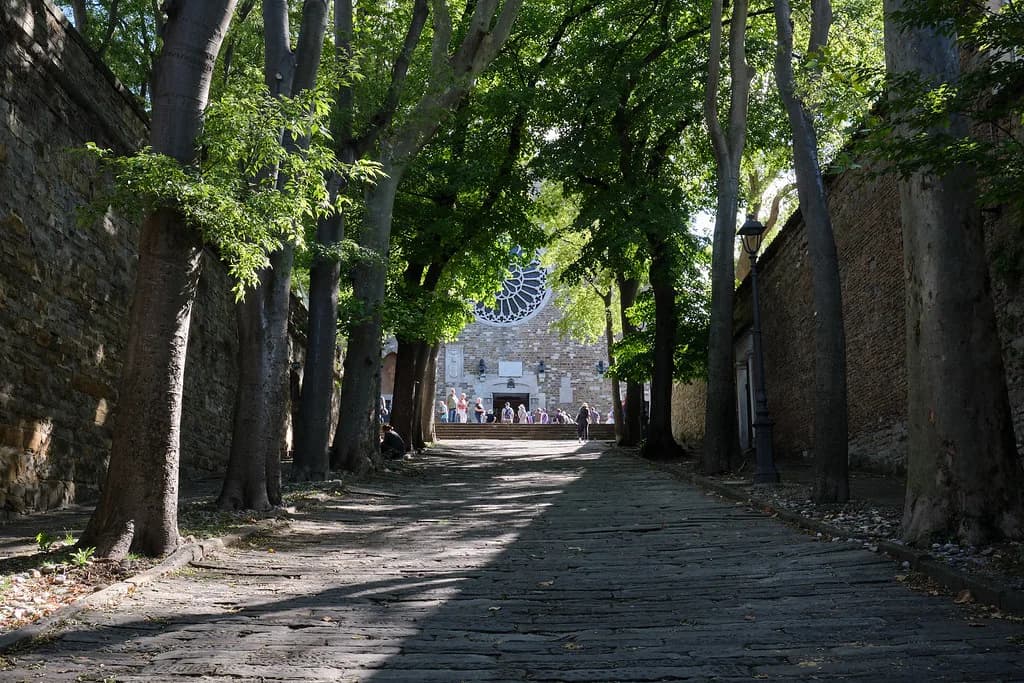
Climbing to Castello di San Giusto pays off twice: the Habsburg fortress on top, and the walk up through the Parco della Rimembranza or the tree-lined street to the cathedral. Outside the walls you pass Roman remains, including the forum area and monuments, and the hilltop gives you red rooftops falling away towards the Adriatic. Go up one way and down the other to see more of the hill.
Be careful about what you assume is included. The castle has a museum and paid interior, while the grounds and the surrounding hill paths can be enjoyed without buying anything; the same applies to the cathedral square. If you want to go inside, confirm current admission and hours with the castle before you build your day around it, since figures published in blogs go out of date.
Allow more time than you think for this half-day, because the pleasure is in the pauses: a bench above the rooftops, a look at the Roman stones, a coffee on the way down. Combine the hill with the lower city for a full walking day, as our Trieste 2 day itinerary suggests.
Coffee Culture and the Historic Cafés
Trieste's coffee trade grew out of its free-port status under the Habsburgs, and the city is still associated with major roasting brands. Ordering has its own vocabulary: a nero is an espresso, and a capo in B is a macchiato served in a glass, which is what many locals drink. Ask for a latte without specifying and you may simply get milk.
For atmosphere, the historic cafés are the point rather than the caffeine. Caffè San Marco has served writers and artists since the early twentieth century, and James Joyce is the city's most cited literary habitué. Sit down, order slowly and resist the urge to photograph everything; these rooms reward an hour of nothing much.
Cavana at Aperitivo Hour
The Cavana quarter, around Via di Cavana and down towards Via Torino, is a knot of narrow pedestrian lanes that comes alive in the evening. Bars range from small wine spots with platters of cheese and cured meat to livelier cocktail places, and many offer snacks with drinks, though not all do. A resident describes it as the most Italian-feeling corner of the city after dark.
The trade-off is noise. On a weekend the lanes get busy and loud, so if you want conversation, arrive early in the evening or pick a weekday. Drink local where you can: a spritz bianco made with white wine and soda, or a glass of Vitovska from the Karst vineyards just outside the city.
Barcola's Rocky Shore and the Walk to Miramare
Trieste does not have a classic sandy beach. What it has is Barcola, a stretch of rocky shoreline north of the centre where people swim from the rocks and a long park lines the coast. You can walk there from town, though the route is not especially scenic, or take a bus; in summer ferries also link the waterfront.
Off season, the promenade is quiet and many of the bars along it close, so bring water and a picnic if you plan to linger. The walk onwards towards Miramare is the reward, with the castle gradually coming into view on its promontory.
Miramare: Free Grounds, Ticketed Interior
Castello di Miramare was built in the mid-nineteenth century for Archduke Ferdinand Maximilian as a seaside residence, and the story attached to it is anything but a fairy tale: he left to become emperor of Mexico and was executed a few years later. The white stone building on its rocky point is the city's most photographed sight, and crowds concentrate in the middle of the day.
The important distinction for planning is between the park and the museum. The gardens are free to wander, with benches and sea views, while the preserved rooms require a ticket. Do not assume one ticket covers everything on the site, and check the castle's own published information for current admission and opening times before you travel.
Ferries, Muggia and the Coast Beyond
The Delfino Verde ferry network connects the city with Muggia, a small fishing town on the border with Slovenia, and in summer extends along the coast towards Barcola and Grignano. The crossing is a pleasant alternative to the industrial road route. Schedules shift with the season, so check the operator's current timetable rather than relying on any figure in a guidebook.
Muggia itself is small: a marina, lanes to wander and a meal by the boats. Treat it as a half-day rather than a full itinerary, and pair it with a slow morning in Trieste.
Osmize: Farm Taverns in the Karst Hills
An osmiza is a farm tavern rooted in the cross-border culture shared with Slovenia: you go to the farm, drink its wine and eat its cured meats and cheese, usually outdoors. It is one of the few experiences you genuinely cannot replicate elsewhere in Italy. The catch is timing, because these are working farms, not restaurants.
Opening days vary and are irregular, with many more options on summer weekends than in winter. Local listings publish which farms are open on a given day, so check shortly before you go and arrange transport, since the farms sit in the hills outside the city.
Strada Napoleonica and the Opicina Tram
The Strada Napoleonica is a mostly flat path linking the Obelisk near Opicina with Contovello, running along the ridge above the city. It delivers wide views over the Adriatic on one side and Karst rock faces on the other, where climbers gather on fine days. A resident describes the full one-way route as roughly five kilometres, which makes it a few leisurely hours with pauses; shorter sections suit families.
Reaching the trailheads is the awkward part. Buses serve both ends, and a historic tram climbs to Opicina, but its schedule is irregular enough that you should not build a tight plan around it. Check current operating information before setting out, and have a bus alternative in mind.
Practical Slow-Travel Notes
The centre is compact and walkable, so comfortable shoes matter more than transport tickets. Coastal Trieste is windy in almost any season, so pack a light layer even in summer; a jacket makes an evening on the waterfront far more pleasant.
Budget your attention by splitting free from paid. Outdoor squares, the canal, the castle grounds and the Miramare park cost nothing to see, while museum interiors and castle collections need tickets whose prices you should confirm directly. If you have three days, use our A Practical 3-Day Trieste Itinerary to fit the Karst day alongside the city days.
Where to Go Next
Trieste works best when you let one thing lead to another: coffee, then a hill, then the sea. Use the Trieste Attractions hub to match specific sights to your interests, and if your Italy trip also takes in the bigger names, compare our guides to hidden gems in Venice and hidden gems in Florence before you lock the route.
Book interiors and check ferry or tram timetables close to your dates rather than weeks ahead, and leave one afternoon deliberately unplanned. In a city this layered, the best moments are usually the ones you did not schedule.
More Trieste guides
- A Practical 3-Day Trieste Itinerary
- A Self-Guided Habsburg Walk Through Trieste
- A Self-Guided Roman Heritage Walk Through Trieste
- Best Time to Visit Trieste
- Free Things to Do in Trieste
- Trieste Coffee and Cafés Guide
- Trieste Day Trips to Miramare, Duino, Muggia and the Carso
- Trieste in 2 Days
- Trieste in One Day
- Trieste Neighbourhoods Guide
- Trieste Rainy Day Guide
- What to Eat in Trieste
- A Guide to Trieste's Synagogue
- Barcola Waterfront and Beaches
- Castello di San Giusto
- Grotta Gigante Visitor Guide
- Miramare Castle Visitor Guide
- Miramare Park Visitor Guide
- Museo Civico di Storia Naturale di Trieste
- Museo Sartorio Guide
- Piazza Unità d'Italia Guide
- Revoltella Museum Guide
- San Giusto Cathedral Guide
- Teatro Romano di Trieste
Frequently Asked Questions
Is Trieste worth visiting compared with Venice?
Yes, if you want a slower, calmer city break. Trieste has a distinctly Central European feel from its Habsburg past, a compact walkable centre, a seafront square and easy access to the coast and the Karst hills. It is not a substitute for Venice's canals and art, but it rewards travellers who prefer lingering over queueing.
How many days do you need in Trieste?
Two days cover the centre comfortably: the canal, the main square, the San Giusto hill and a historic café. Add a third day if you want the Miramare castle and gardens, a swim at Barcola or a walk on the Strada Napoleonica. Osmize farm taverns can fill a long lunch rather than a whole day.
Is Trieste crowded with tourists?
The main square and Miramare draw the biggest numbers, especially in the middle of the day and in high season. Elsewhere, the city feels noticeably quieter than Italy's headline destinations, and early mornings or evenings are the easiest way to have the waterfront and the hill paths largely to yourself.
Which Trieste sights are free and which charge admission?
Outdoor spaces are generally free: the canal, the main square, the San Giusto hill and the Miramare park. Expect to pay for museum interiors, including the state rooms at Miramare and the castle collections on San Giusto. Check each site's own published prices before you visit.
What is an osmiza and when are they open?
An osmiza is a farm tavern in the hills around Trieste, rooted in the cross-border culture shared with Slovenia, where you drink the farm's wine and eat its cured meats and cheese. Opening days vary and are more plentiful on summer weekends. Local listings publish which farms are open each day, so check shortly before you go.
Do you need a car to reach Strada Napoleonica?
No, but it helps. Buses serve Contovello and the Obelisk area, and a historic tram climbs to Opicina, though its schedule is irregular. A car gives more flexibility, particularly if you combine the walk with a visit to an osmiza. Verify current transport information before relying on the tram.
Sources
Continue exploring
More guides you'll find useful