
Castello di San Giusto Guide: Museum, Ramparts & Hilltop Views
Plan a visit to Castello di San Giusto in Trieste: what the museum, armoury, Lapidarium and ramparts hold, plus how it pairs with the cathedral next door.
On this page
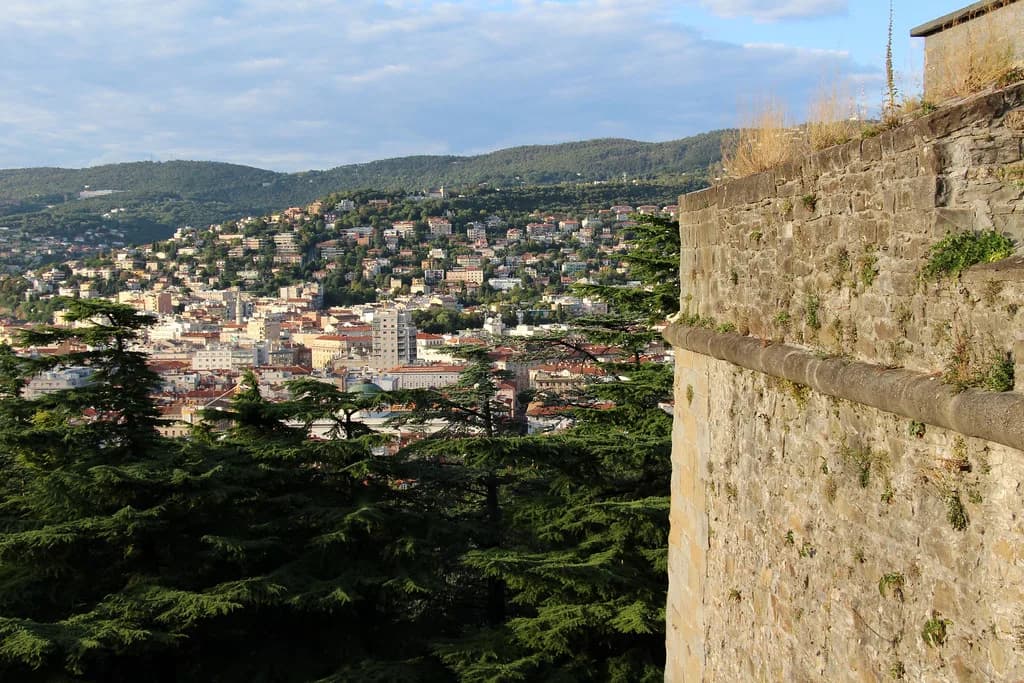
Castello di San Giusto crowns the hill that gave Trieste its first fortified settlement, looking down on the gulf and the city's rooftops. Building ran from 1468 to 1636, when the triangular fortress finally closed with its third bastion, and the complex became a museum in 1936. Today it holds armour, Venetian furnishings and Roman stones rather than soldiers, and it remains one of the city's defining landmarks.
The castle is not a single room or a quick photo stop. The Captain's House holds the Museum of the Castle of San Giusto and its Armoury, the Lalio Bastion shelters the Lapidarium of Tergeste, and the Fiorito Bastion hosts temporary exhibitions. Outdoor courtyards and sentry walkways connect them, so a visit mixes interiors with open-air views.
Where the Castle Sits and How to Orient Yourself
The castle address is Piazza della Cattedrale 3, on the San Giusto hill above the centre of Trieste. The tourism board lists phone numbers for information, and the castle site publishes its own contacts for guided group tours in English. Because the cathedral stands on the same square, the hill works best as one outing rather than two separate trips.
Plan the hill as a small cluster: castle, cathedral and the surrounding square. The castle's own pages describe the entrance, courtyard and exhibition route, which helps you picture the sequence before you climb. Check the castle website before setting out, since admission and hours are published there rather than repeated here.
From Imperial Fortress to City Museum
Frederick III of Habsburg ordered the fortress built in 1468 at the citizens' expense, as a residence for the imperial captain who represented Habsburg authority in Trieste. The first structure was the Captain's House, a fortified residence with an L-shaped tower. Three bastions were added over the following decades, each shaped by the defensive thinking of its moment.
The Round or Venetian Bastion went up in 1508-1509, followed by the polygonal Lalio Bastion in 1553-1557. The triangular Fiorito Bastion completed the perimeter in 1636. Austrian captains lived in the castle until 1750, after which it served as a garrison and a prison before its 1936 conversion into a museum.
The Museum of the Castle and Its Armoury
The museum occupies the fifteenth- and sixteenth-century rooms of the Captain's House, entered through the Round Bastion. An introductory room uses old views, photographs and a scale model to reconstruct Trieste before its later expansion. From there the route moves through period rooms and covered sentry walkways hung with the Armoury collection.
The Armoury traces European weaponry from the Middle Ages to the nineteenth century: pole-arms such as halberds and glaives, swords, daggers and bayonets, crossbows, and early firearms including muskets and pistols. Powder horns and cartridge holders fill out the display, alongside chests from the same periods. Allow time for the labels if weapons are not your usual museum subject, because the sequence explains how fighting technology changed.
The Caprin Room and the San Giorgio Chapel
The Caprin Room and its anteroom were created to hold furnishings once belonging to Giuseppe Caprin, a Trieste journalist, historian and publisher who died in 1904. The pieces follow Venetian taste from the sixteenth to the eighteenth century, including wedding chests and a carved gilt lantern said to come from a Venetian galley. The collection's centrepiece is a large canvas of the Triumph of Venice from the workshop of Andrea Celesti, dated to the end of the seventeenth century.
On the ground floor, the late Gothic chapel of San Giorgio has a cross-vaulted apse whose ribs rest on brackets carved as heads. At the centre of the vault sits the coat of arms of Frederick III of Habsburg, the ruler who ordered the fort in 1468. The chapel is small and easy to pass, so look for it deliberately on the way through the lower level.
The Lapidarium of Tergeste: Roman Trieste in Stone
The Lapidarium of Tergeste fills the Lalio Bastion, reached from the Soldiers' Courtyard. It gathers monuments from the Capitoline hill area, where the civic basilica, forum and propylaeum once stood, along with altars, stelae, urns and sarcophagi that carry the names of ancient inhabitants. Inscriptions to Jupiter, Cybele, Silvanus, Bona Dea, Hercules and Minerva show how many deities were honoured in Roman Tergeste.
One room is devoted to mosaic floors from a luxury maritime villa found at Barcola, which is no longer visible in situ. The mosaics date from the late first century BC to the mid-first century AD and imitate the residences of emperors such as Augustus, Tiberius and Nero. Treat this section as a Roman-history stop in its own right, not an annexe to the armour, and pair it with a wider look at the city's ancient layers.
Bastione Fiorito and Rotating Exhibitions
The Fiorito Bastion, completed in 1636, has exhibition halls and a panoramic terrace used for temporary shows. The tourism board notes that these rotating displays are included in the museum ticket, but the castle's permanent collection and the temporary programme are separate things. Check the castle website before travelling if a particular exhibition is your reason for going, because shows change and the permanent rooms remain the constant.
Temporary exhibitions also mean parts of the upper level may be arranged differently from one season to the next. Read the notices at the entrance and ask staff which route is open on the day. That small check prevents disappointment if you have come mainly for the terrace view.
Ramparts, Sentry Walkways and the View
The open-air sentry walkways run along the top of the fortress walls that enclose the Soldiers' Courtyard. From the parapets the view takes in the city, the Gulf of Trieste and the surrounding hills, which is why the castle reads as a symbol of Trieste as much as a museum. The climb between levels is part of the visit, so wear shoes you can manage on stone stairs and uneven surfaces.
The walkways are exposed, so weather matters more here than in the enclosed rooms. A windy or wet day changes how long you linger on the walls, and the courtyard is the natural place to pause between sections. Build in a breather rather than treating the ramparts as a quick exit route.
Admission, Hours and What to Confirm Before You Go
The tourism board directs visitors to the museum website for the admission fee, opening hours and admission price. This guide deliberately does not repeat figures, because published details can change and a stale number is worse than none. Check the official pages shortly before your visit and note whether the day you plan is covered.
Do not assume that one ticket covers the castle, the cathedral and other civic museums. The sources describe the castle's own museum route without confirming a shared ticket across the hill. Ask at the ticket desk what the day's ticket includes, especially if you plan to add another city museum later.
For contact details and official notices, the city's main site is a useful cross-check alongside the castle and tourism pages. Use it to confirm the castle is open before a special trip, and to look for any published disruption. Booking ahead is worth considering for groups, since guided tours in English are arranged through the museum's reservation contact.
Accessibility at the Castle
Disabled visitors can reach the castle via an elevator on Viale della Rimembranza, but access is arranged by phone in advance. The castle publishes a contact number for this purpose, so call before you go rather than arriving and hoping. The historic layout involves stairs and uneven surfaces, so ask staff which parts of the route suit your needs.
Because the lift arrangement depends on a phone request, it is the one practical detail worth sorting before the day of your visit. Mention any mobility needs when you call so staff can advise on the route. The museum also publishes accessibility information on its site.
Pairing the Castle with San Giusto Cathedral
San Giusto Cathedral stands next to the castle on Piazza della Cattedrale, making a combined visit the sensible way to see the hill. The cathedral is a separate building with its own history and its own arrangements, not an extension of the castle museum. Read a dedicated guide before you go so you know what you are looking at inside. For wider planning, see San Giusto Cathedral Guide.
The wider hill also repays a slower look beyond the two headline buildings. The castle website describes the atrium, courtyard and external spaces that frame the approach, and these are part of the experience even when you are moving between interiors. If you enjoy tracing the city's layers, the Habsburg story continues downhill in Trieste's streets and civic buildings.
A Suggested Half-Day on the Hill
This sequence is a suggestion, not an official itinerary. Start at the castle when it opens and go straight to the museum route through the Captain's House while the rooms are calm. Move on to the Lapidarium in the Lalio Bastion, then take the sentry walkways for the view before the weather or your energy changes.
Finish with the cathedral and the square, then wander back down through the city. Allow roughly half a day if you read labels and take photographs, but treat that as our estimate rather than a published figure. If temporary exhibitions are running in the Fiorito Bastion, add time for them.
Mistakes to Avoid
The most common error is assuming a single ticket covers everything on the hill. The castle, cathedral and other civic museums are separate, and the sources do not confirm one combined pass. Ask at the desk what your ticket includes before you pay.
Second, do not skip the Lapidarium because it sounds like a store of old stones. The Roman inscriptions, sarcophagi and Barcola mosaics explain the city's ancient past and form one of the castle's most distinctive sections. Third, never arrive without checking hours on the museum website, since opening arrangements are published there and can vary.
Plan Your Visit
Castello di San Giusto rewards a visit that treats it as three things at once: a Habsburg fortress, a museum of armour and Venetian interiors, and a Roman lapidarium with a view. Wear comfortable shoes, check the official site for hours and admission before leaving, and call ahead if you need the lift arrangement. The result is a hilltop stop that connects Trieste's ancient, imperial and modern layers in a single afternoon.
Frequently Asked Questions
What can you see inside Castello di San Giusto?
The museum route in the Captain's House includes the Armoury, the Caprin Room and the late Gothic chapel of San Giorgio. The Lalio Bastion holds the Lapidarium of Tergeste, with Roman inscriptions and mosaics, while the Fiorito Bastion hosts temporary exhibitions. Outdoor courtyards and sentry walkways connect the sections.
Is the armoury included in the castle museum?
Yes. The Armoury is part of the Museum of the Castle of San Giusto and is displayed in the fifteenth- and sixteenth-century rooms of the Captain's House and along the covered sentry walkways. Check the museum website for current admission details.
How long does a visit to Castello di San Giusto take?
Allow roughly half a day if you read labels, see the Lapidarium and spend time on the ramparts. That is our suggested estimate, not an official figure. Add time if temporary exhibitions are running in the Fiorito Bastion.
Is the cathedral next door part of the castle ticket?
San Giusto Cathedral is a separate building with its own arrangements. Do not assume a castle ticket covers it, and ask at the ticket desk what is included before you pay.
Can you visit the ramparts without entering the museum?
The sources describe the outdoor courtyard and walkways as part of the castle complex rather than a separately ticketed area. Ask at the entrance what access your ticket gives, and check the museum website before relying on a particular route.
Is Castello di San Giusto accessible for wheelchair users?
Access is possible via an elevator on Viale della Rimembranza, arranged by phone in advance. Call the published number before your visit to confirm the arrangement and ask which parts of the historic route suit your needs.
Do you need to book tickets in advance?
Booking is not described as compulsory for individual visitors in the sources. Guided tours for groups in English are arranged through the museum's reservation contact, so groups should enquire ahead. Check the museum website for current ticketing advice.
When was the castle built and by whom?
Frederick III of Habsburg ordered the fortress in 1468, and construction continued in phases until 1636. The Captain's House came first, followed by the Round, Lalio and Fiorito bastions. The castle became a museum in 1936.
Sources
Continue exploring
More guides you'll find useful





