
Trieste Synagogue Guide: Visiting the 1912 Tempio Israelitico
Trieste's 1912 Tempio Israelitico: Berlam design, Syro-Palestinian interior, guided visits arranged through the Jewish Community, plus dress and conduct notes.
On this page
Trieste's synagogue, the Tempio Israelitico, was inaugurated on 21 June 1912 after four years of construction, and it remains the most visible monument of a community that once made this Adriatic port one of Europe's most cosmopolitan Jewish centres. It is a working house of prayer first and a sight second, and the way you visit should follow from that. This guide separates what is documented about the building from what changes month to month, so you know what to read up on and what to confirm before you travel.
Where the Synagogue Stands
The synagogue occupies Via San Francesco d'Assisi in the Barriera Nuova district, on the edge of the historic centre rather than in the middle of the tourist flow. One travel description notes that it sits in a quieter residential quarter, roughly a kilometre from the heart of town, which makes the approach part of the experience. If you are working through a Trieste 2 day itinerary, slotting the synagogue into a morning walk gives you time to arrive unhurried rather than squeezing it between two cafés.
The Jewish Community of Trieste publishes its own contact details and office address on its site, which is the place to start when planning. Do not rely on third-party map pins alone for a building with controlled access; confirm the entrance arrangement with the community before setting out. The district itself rewards a slow walk, with the kind of unglamorous Habsburg-era streetscape that a Habsburg walk through the city tends to skip.
The Berlams and the Building
The design was entrusted to the Trieste architects Ruggero Berlam and his son Arduino, the same family responsible for the Faro della Vittoria, the Victory Lighthouse on the city's hillside. That pairing is a useful reminder that the synagogue belongs to a broader civic building programme rather than standing apart as an exotic exception. Both architects worked in a period when Trieste was still shaping its self-image as a major Habsburg port.
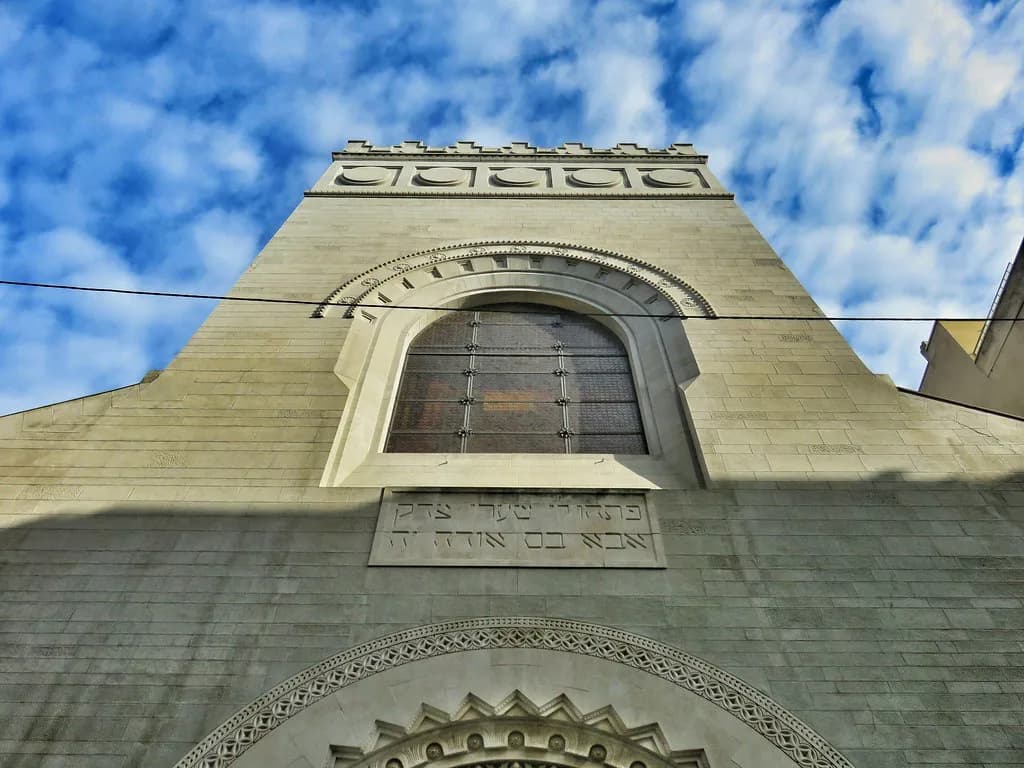
Outside, the building reads as heavy stone massing, with a large rose window and prominent portals rather than ornament for its own sake. Inside, that solidity gives way to a space described as Syro-Palestinian in inspiration, with extensive gilded mosaic surfaces and light falling from above onto the nave. The contrast between the austere exterior and the luminous interior is the single most remarked-on quality of the building, and it is the reason many visitors come at all.
Scale, Claims and Comparisons
One source describes the Tempio Israelitico as among the largest synagogues in Europe and ranks it second in size only to the one in Budapest. Treat that ranking as one guide's assessment rather than a measured fact; size comparisons between historic religious buildings are rarely standardised and often depend on what is being counted. What is not in dispute is that the building was conceived on a grand scale, which says a great deal about the confidence of the community that paid for it.
Inside, the liturgical focal points are the Aron ha-Kodesh, the ark that holds the Torah scrolls, and the bimah, the raised platform from which the service is led. Visitors should understand these as functioning elements of an active prayer space, not as exhibits to be approached at will. Photography, movement and conversation should all follow whatever instruction you are given on the day, and a visit may be shaped by a service rather than by a tour.
Before 1912: The Ghetto and the Free Port
Before this building existed, Trieste's Jews prayed in several small synagogues clustered in the ghetto area near Riborgo, a cramped arrangement that the new temple was designed to replace. The move from those rooms to a monumental temple on a new street tracks the community's rise during the period of the Habsburg free port, when Trieste's trade made it one of the wealthiest cities on the Adriatic. That economic story is what gives the architecture its meaning; without it, the gilded mosaics are just decoration.
If you want to place the synagogue in that wider urban history, the city's Habsburg-era layers are easy to trace on foot, from the neoclassical staircases to the insurance palaces and cafés of the old commercial core. Building a day around that context makes a short synagogue visit feel less like a checklist item. The city's hidden gems in Trieste are often the smaller traces of the same mercantile world.
How Visits Actually Work
Access to the interior is not a walk-up museum ticket. One travel guide describes visits as guided and held at set times, often arranged in cooperation with the Jewish Community of Trieste, and advises booking ahead rather than turning up. Days, hours, whether entry is charged and how you reserve are all things the community decides and adjusts, so check the community's own site for current visitor information instead of relying on a listing.
That caution matters because the sources disagree about the present. One commercial attraction listing marks the synagogue as temporarily closed with opening hours to be determined, while the community's own homepage carries notices about changing opening hours at the synagogue and about events at its museum. Neither settles the question for the week you plan to travel, and the community's published contact channels are the only reliable way to know. Send an enquiry well before your trip rather than building an itinerary around an assumption.
A further listing notes plainly that no confirmed hours are published for the building, which is a sensible working assumption: treat the schedule as something you obtain rather than something you look up once. The typical preparation is straightforward — pick the days you could visit, ask the community which of them have a guided slot, and keep a fallback plan. The museum a few steps away makes a sensible alternative if the timing does not work.
What to Expect on the Day
Security arrangements at Jewish institutions in Italy are not published in the travel sources consulted for this guide, and they can change at short notice, so do not plan around an assumption about what you will be asked to do at the door. Arrive with time to spare, carry identification, and follow staff instructions without debate. If you have specific needs, raise them when you make contact rather than on arrival, since the community can tell you what is possible.
Once inside, expect a working prayer hall rather than an interpretation centre. One guide suggests allowing around three-quarters of an hour for the visit, which is a planning suggestion rather than an official duration; add time if you intend to linger over the mosaics or ask questions. Groups move at the pace of whoever is hosting them, so a shorter visit than you imagined is normal.
Dress and Conduct
The same guide states that respectful clothing is required and that men may be asked to cover their heads. That is a low bar to meet and worth preparing for in advance, particularly in warm months when shorts and sleeveless tops are the default around the city. Carry a light scarf or cap so you are not caught out at the entrance.
Quiet behaviour is the other expectation. A synagogue is a place of prayer before it is a visitor attraction, and a space open to guests one hour may be given over to a service the next. Think of your visit as being hosted rather than admitted, and most of the etiquette questions answer themselves without a rulebook.
Pairing the Synagogue With the Wagner Museum
The Museo Carlo e Vera Wagner, run by the Jewish Community, sits on Via del Monte a short distance away and covers the history of Trieste's Jews in depth. Seeing the museum and the synagogue on the same trip gives you the narrative behind the building: the free-port prosperity, the community's institutions, and the twentieth-century ruptures that no architectural visit can convey.
Because the museum appears on the community's own site alongside its schools and services, that site is also the most reliable place to check what is currently running. Exhibitions and events there change; do not carry over dates from an old listing. If you are mapping the city's sights generally, the wider set of Trieste Attractions guides will help you decide what else deserves a slot.
Practical Planning Cautions
Several things you might want to know are simply not settled in public sources: whether entry is free or charged, how bookings are taken, whether online reservation exists, accessibility provisions, and current security procedures. Rather than guess, ask the community directly using the contact details published on its site. This is normal for an active religious building and not a sign that something is wrong.
Build your day so the synagogue is not the only reason for the trip. The waterfront, the Roman theatre and the historic cafés are all within a walk, and the Barcola Waterfront and Beaches give you somewhere to decompress afterwards. If the visit falls through, the city still fills the time easily.
Approach It as a Community First
The Tempio Israelitico is one of the clearest statements Trieste ever made about itself, and that is exactly why it deserves more than a photo stop. Go with the expectation of a hosted visit, dressed appropriately, with a booking confirmed and a fallback plan in your pocket. Know its 1912 date, its architects and its interior before you arrive, and let the community set the terms of the visit.
Frequently Asked Questions
When was the Trieste synagogue inaugurated and who designed it?
It was inaugurated on 21 June 1912 after four years of construction. The design was by the Trieste architects Ruggero Berlam and his son Arduino, described as the same team behind the city's Victory Lighthouse.
Is the Trieste synagogue free to visit?
Public sources do not give a reliable current answer on whether entry is charged or included in a guided visit. Ask the Jewish Community of Trieste directly when you enquire about a visit, and treat any figure on a third-party listing as unverified.
Do you need to book a visit to the Trieste synagogue?
One travel guide describes visits as guided and held at set times, often arranged through the Jewish Community, and advises booking in advance. There is no confirmed walk-up arrangement, so contact the community before planning your day around it.
Is the synagogue currently open to visitors?
The evidence is mixed: one commercial listing marks it as temporarily closed with hours to be determined, while the community's own site publishes synagogue notices about opening hours. Check the community's site and contact them for the week you intend to travel.
What should you wear when visiting the synagogue in Trieste?
One guide states that respectful clothing is required and that men may be asked to cover their heads. Plan for modest dress and bring a scarf or cap, particularly in summer.
How long does a visit take, and what else is nearby?
One guide suggests allowing about 45 minutes, which is a planning suggestion rather than an official figure. The Carlo e Vera Wagner Jewish museum is a short walk away and makes the natural companion visit.
How do I get to the synagogue?
It stands on Via San Francesco d'Assisi in the Barriera Nuova district, described by one source as a quieter residential area roughly a kilometre from the centre. Confirm the entrance and any access arrangements with the community when you make contact.
Sources
Continue exploring
More guides you'll find useful





