
Teatro Romano di Trieste: A Guide to the Roman Theatre Below San Giusto
Guide to Trieste's Roman theatre below San Giusto hill: what survives of the cavea and stage, its 1814 identification and 1938 excavation, and where the finds went.
On this page
Trieste's Roman theatre is easy to walk past. It sits at Via del Teatro Romano in the historic centre, below San Giusto hill, and it reads as a short stop rather than a museum visit. That is exactly why it rewards a little preparation: knowing what you are looking at turns a fragmentary ruin into one of the city's clearest links to its ancient past.
The structure is often labelled an amphitheatre, but it is a theatre in the Roman sense, built for performances rather than gladiatorial games. It was raised in the first century BC, expanded in the second century AD, and is estimated to have seated between 3,500 and 6,000 spectators. Over the following centuries it disappeared beneath ordinary houses, was identified again in 1814, and was unearthed in 1938 during demolition of that part of the old city. Further visitor details appear in Roman Amphitheatre, Trieste, Italy - SpottingHistory.
Plan it as the lower half of a San Giusto morning: the theatre below, the cathedral and castle above. Budget more time for the hill than for the theatre itself, and check the official tourism and city pages before you go, since not everything about access at street level can be confirmed in advance. Further visitor details appear in Discover Trieste - La tua guida online alla città di Trieste.
Where the Theatre Sits and How It Fits a San Giusto Walk
The address is Via del Teatro Romano, in the historic centre of Trieste, in the flat streets just below San Giusto hill. The ruins are embedded in the urban block rather than laid out as a fenced archaeological park, with later buildings pressing close around the ancient structure. Approach from the pedestrian lanes of the old town rather than treating it as a destination in its own right.
Because the theatre sits low on the hill, it works naturally as the first stop of an upward walk. Historic-site listings place the cathedral and castle about 300 metres away, so the theatre gives context and the hill gives the collection. That proximity is the practical argument for combining the two. Further visitor details appear in Roman Amphitheatre, Trieste, Italy - SpottingHistory.
Treat the theatre as one element of a wider look at the city rather than an isolated monument. The Trieste Attractions hub collects focused guides to the city's main sights, which helps you decide how much of a half-day the hill deserves before you commit.
What the Sources Say About the Building
The chronology is broadly consistent across the descriptions available. Construction dates to the first century BC, with a substantial expansion in the second century AD, and the capacity is estimated at between 3,500 and 6,000 people. That range is wide, a reminder that capacity figures for partially excavated Roman buildings are reconstructions rather than records.
The theatre is sometimes linked to Quinto Petronio Modesto, a figure associated with the emperor Trajan's administration in the city, although such attributions should be read as scholarly suggestion rather than settled fact. What matters for a visitor is the scale: this was a civic building designed for a large share of the town's population, not a private curiosity.
What Survives Today and What to Look For
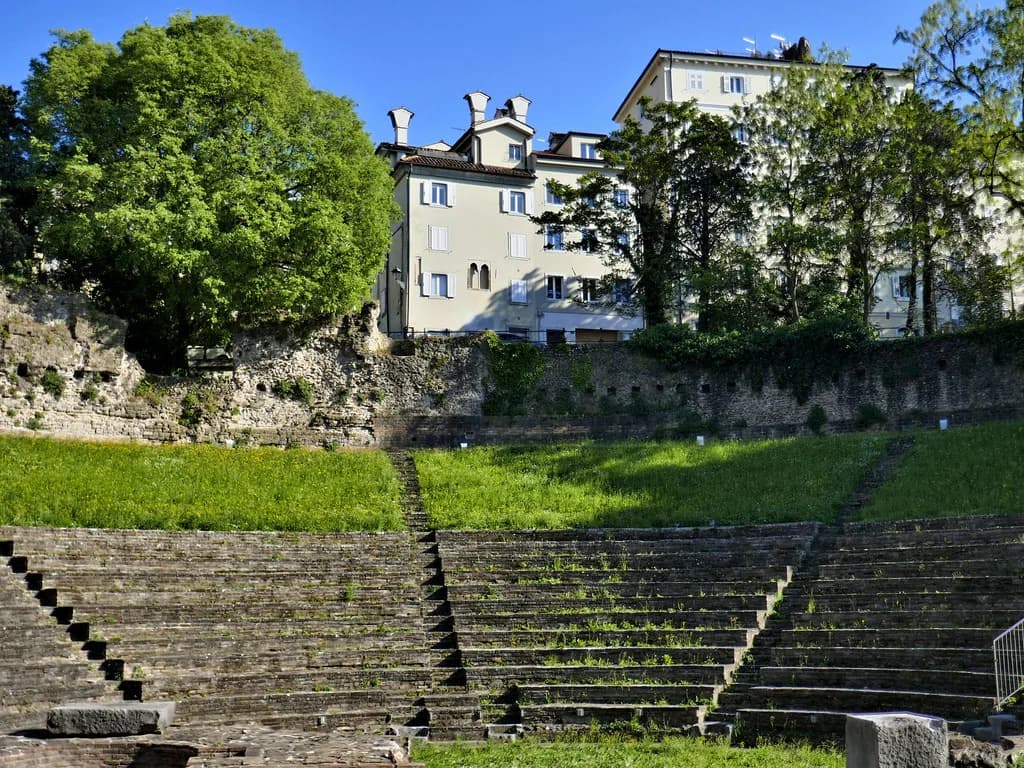
What you see is partial but legible. Visitor descriptions point to surviving rows of seating, the area of the stage and columns decorated with statues, all set below the level of the modern street. Look for the curve of the cavea, the tiered seating bank, because that shape is what makes the structure read as a theatre rather than a random stretch of ancient masonry. Further visitor details appear in Via del Teatro Romano, Trieste, Italy - Reviews, Ratings, Tips and Why You Should Go – Wanderlog.
Set your expectations about the decorative elements. The most impressive finds, including statues and inscriptions recovered during excavation, were not left in place at the theatre but are kept at San Giusto Castle. If carved Roman stonework is the reason for your interest, the castle collection is the place to see it, while the street-level ruin is the setting that explains it.
Photograph it in flat light if you want the masonry to read clearly, since the site sits in a hollow surrounded by buildings and contrast can be harsh in the middle of the day. A short pause in the surrounding lanes gives a better sense of how the ancient structure sits under the modern city than a quick glance from above.
The Disappearance and Rediscovery of the Theatre
The most interesting part of the story is the long gap. Over the centuries the theatre was built over, with houses raised above the ancient structure, and knowledge of it effectively lapsed. It was identified again in 1814 and then unearthed in 1938 when that part of the old city was demolished, which is why the monument now appears as an open excavation rather than an intact building. Further visitor details appear in Roman Amphitheatre, Trieste, Italy - SpottingHistory.
That timeline explains the site's slightly awkward character. It is not a restored showpiece, and the surrounding street pattern still reflects the buildings that once covered it. Reading the ruins as the product of a 1930s clearance, rather than as a Roman site preserved by chance, makes the layout far easier to interpret.
Where the Finds Went: San Giusto Castle
The excavated statues and inscriptions are kept at San Giusto Castle, which sits above the theatre with the cathedral alongside it. That separation is the single most useful thing to know before visiting: the street-level site shows you the architecture, while the castle holds the objects that once decorated it. Plan them as two stops of one outing, not one.
The castle is a layered building, with prehistoric origins on the hill and later additions, so allow time for the grounds and the views as well as the collections. The castle has its own visitor guide covering what to see and how to plan the stop. For wider planning, see Castello di San Giusto.
The walk up from the theatre passes the cathedral, which is worth entering on its own terms. If you want to understand it before you climb, the San Giusto Cathedral guide sets out what to notice inside. Reading it on the way up is a better use of ten minutes than deciding at the door whether to go in.
A Suggested Visit Duration and Timing
As an editorial suggestion rather than official guidance, allow about fifteen to twenty-five minutes at the theatre and two to three hours for the hill including the cathedral and castle. Early morning or late afternoon is generally more comfortable for the climb, and the light on the upper city is better then too. These are planning estimates, not opening times.
Check the official tourism portal for current events before fixing your day, because the theatre has occasionally been used for outdoor summer performances and the surrounding streets can be busier during city-wide happenings. The portal also lists broader city events, which helps you avoid clashing with a major festival. Further visitor details appear in Discover Trieste - La tua guida online alla città di Trieste.
The city council site is the other place to look for authoritative updates on municipal heritage and any works affecting it. Neither source should be assumed to publish the theatre's visiting arrangements permanently, so a quick check close to your visit date is worth the effort. Further visitor details appear in Official event website.
Using the Theatre as a Starting Point for Roman Trieste
Trieste's Roman remains are scattered and modest, so it pays to approach them thematically. The theatre is the largest surviving piece, but the Arco di Riccardo, an ancient arch absorbed into the later street fabric, makes a natural companion idea for anyone tracing the city's Roman layer. Treat this as a suggested pairing rather than a signposted route, and check the arch's location yourself before setting out.
The Roman heritage walk outline is the place to start if you want to link the theatre with other ancient fragments in a single circuit. It keeps the walking realistic for a city where Roman material is often built into later walls rather than displayed on its own. For wider planning, see A Self-Guided Roman Heritage Walk Through Trieste.
Beyond the Roman layer, Trieste rewards slow wandering between the hill and the waterfront. The hidden gems in Trieste guide covers quieter corners and overlooked details that suit the same unhurried half-day, including the Canal Grande di Trieste area.
Practical Cautions Before You Rely on a Visit
Do not assume unrestricted access or a fixed daily opening pattern. The available descriptions do not establish opening hours, ticket arrangements or access restrictions for the theatre, so confirm the current situation locally or through the city's tourism pages before building a day around it. If the site is closed off for works or a performance, the hill and castle still justify the walk. Further visitor details appear in Discover Trieste - La tua guida online alla città di Trieste.
The ground around the ruins is uneven, and the approach and the climb involve steps and changes of level. Anyone with mobility concerns should ask at a city information point before committing to the hill walk. Keep that as a sensible precaution rather than an assumption about the site's facilities.
Nearby: Cathedral and Castle Within a Few Hundred Metres
The cathedral and castle sit about 300 metres from the theatre, which makes a combined visit the obvious plan. San Giusto Cathedral is dedicated to Saint Justus and the castle holds the excavated material, so the trio forms a coherent sequence from ancient street level to medieval and later layers on the hill. For wider planning, see San Giusto Cathedral Guide.
If your interests run to the city's religious and cultural layers more broadly, the Trieste synagogue guide covers a later and very different monument that pairs well with a second morning in the centre. It is a reminder that Trieste's history is stacked rather than linear.
Plan Your Visit
Treat the Teatro Romano as the opening move of a San Giusto morning rather than a standalone sight. Arrive knowing the key facts, the first-century BC origin, the second-century AD expansion, the 1814 identification and the 1938 unearthing, and the fragmentary street-level remains will make sense almost immediately.
Then climb to the cathedral and castle to see the statues and inscriptions that came out of the excavation, and leave time for the views. Check the official tourism and city pages shortly before you go for any change to access or events, and keep the visit flexible.
Frequently Asked Questions
What is the Teatro Romano di Trieste?
It is the remains of a Roman theatre in the historic centre of Trieste, at Via del Teatro Romano below San Giusto hill. It was built in the first century BC, enlarged in the second century AD, and is estimated to have held between 3,500 and 6,000 spectators.
When was the Roman theatre in Trieste rediscovered?
The structure was identified in 1814 after centuries of being built over by houses, and it was unearthed in 1938 during demolition of that part of the old city. That clearance is why the monument now appears as an open excavated site in the street grid.
Are the statues and inscriptions still at the theatre?
No. The statues and inscriptions found during excavation are kept at San Giusto Castle rather than left at the theatre. Visitors who want to see the carved material should plan a stop at the castle as well as the street-level ruins.
Can you visit the theatre and San Giusto Castle together?
Yes, and it is the sensible way to see both. The castle and cathedral stand a few hundred metres uphill from the theatre, so a half-day walk from the Roman remains to the hill covers the architecture and the excavated collection in one outing.
Is the Teatro Romano free to see?
The available descriptions do not confirm ticket arrangements or opening hours for the theatre, so do not assume free or unrestricted access. Check the city tourism pages or a local information point for the current situation, and confirm any castle ticket separately.
How long should you spend at the Roman theatre?
As an editorial suggestion rather than official guidance, about fifteen to twenty-five minutes is enough for the ruins themselves. Allow two to three hours in total if you continue to the cathedral and castle, and check current access before setting out.
Sources
Continue exploring
More guides you'll find useful





