Pisa Baptistery Guide: Tickets, the Pisano Pulpit and the Echo
Plan a visit to Italy's largest baptistery in Pisa: what your ticket covers, Nicola Pisano's 1260 pulpit, the echo demonstration and how long to allow.
On this page
Most visitors to Piazza dei Miracoli photograph the round marble building at the west end of the square and move on. That is a mistake: the Baptistery of San Giovanni holds Nicola Pisano's 1260 pulpit, a vast octagonal font and one of the strangest acoustic effects in Tuscany. As a rough suggestion rather than an official figure, allow 30–45 minutes inside so you can hear the echo demonstration and still climb the gallery. A Hop on Roues attraction page supports both the suggested duration and the interior highlights described below.
What the Baptistery Actually Is
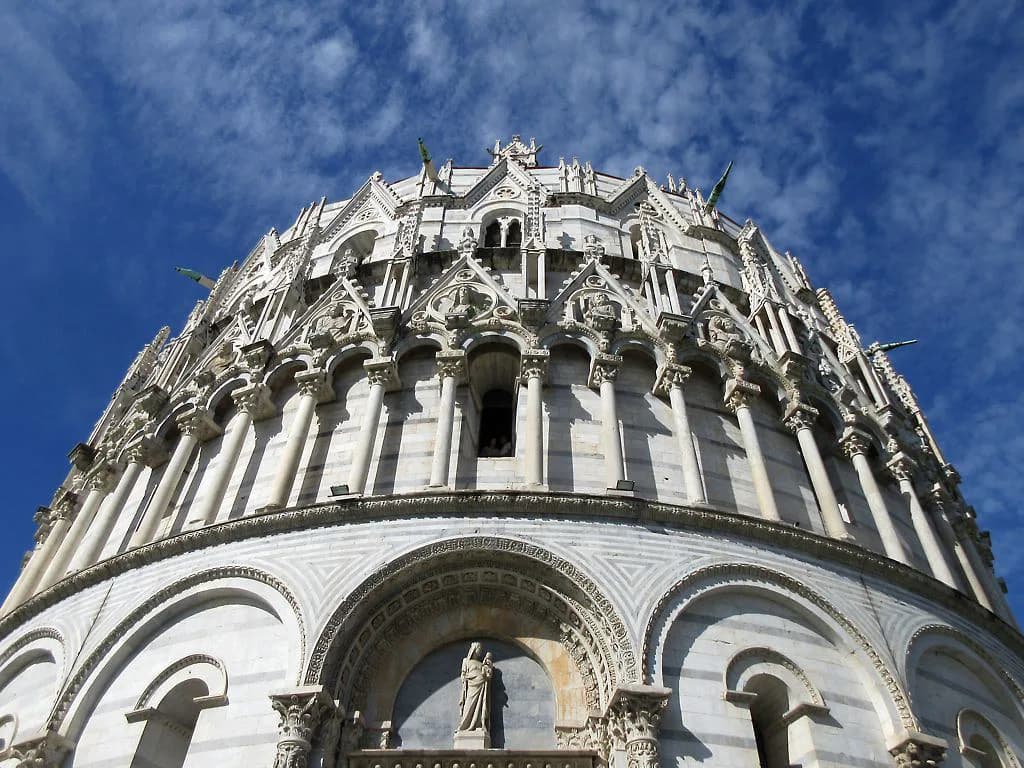
The building is a round marble drum almost 55 metres high and roughly 107 metres around, begun in 1152 under the architect Diotisalvi, whose name is carved on one of its pillars. Construction stretched past a century, with later work by Nicola and Giovanni Pisano that lifts the design from Romanesque arcades to Gothic gables. It is commonly described as the largest baptistery in Italy, a claim you will see repeated across visitor sources rather than in the Opera della Primaziale Pisana's own ticket text. Read it as a striking scale comparison, not an official designation.
Position matters when you plan the day. The Baptistery sits at the western edge of the square, facing the Cathedral façade, so it is the natural first or last stop on a circuit of the monuments. If you are building a wider itinerary, the Pisa Attractions hub maps the other sights around the same lawn. Approach from the west and the building's scale reads before the crowds do.
Tickets: What the Official Rules Say
The Opera della Primaziale Pisana's official advice separates the Cathedral from everything else, and that distinction is the one most visitors get wrong. Cathedral admission is by free pass; buying any monument ticket includes an untimed pass for the Cathedral, while a Cathedral-only visit needs a free timed pass issued only at the ticket offices on site and not bookable in advance. The Baptistery is not described as free with any ticket, so do not assume the Cathedral arrangement applies to it.
For the Baptistery, Camposanto, Sinopie Museum and Opera del Duomo Museum, the official site states that a ticket is valid from the chosen date for one year, if the site is open and within opening hours. That flexibility rewards travellers who want to spread the monuments over two days rather than rushing one morning. Check the current price and any bundled offers on the Opera della Primaziale Pisana tickets page before buying elsewhere, because resellers set their own terms.
Third-party operators sell combined monuments tickets that include the Baptistery, Cathedral, Camposanto and both museums with an audio guide and no time slot, clearly excluding the Tower climb. Those bundles can suit someone who wants one QR code and a single checkout, but they are not the same as buying directly from the Opera. Read the inclusion list carefully: a bundle that promises the Cathedral may still rely on the free-pass system described above.
Who Enters Free, Precisely
Free admission without a ticket is limited to visitors under 11 accompanied by an adult and to disabled visitors with their helper, with valid ID or proof of entitlement in Italian or English required. The official text groups the Baptistery with the Camposanto, Sinopie Museum and Opera del Duomo Museum for this rule, so the concession applies to those interiors. A passport or identity card for each child is worth carrying, because staff can ask.
Reduced-price tickets are described only for school groups of at least ten students with an adult and a numbered list on school letterhead. Family visits with children do not fall into that category unless the children qualify under the under-11 rule. If you are travelling with a school party, bring the list to the entrance as well as to the ticket desk, since the official advice says entry can be refused without it.
Nicola Pisano's 1260 Pulpit
The pulpit is the reason to slow down inside. Nicola Pisano carved it in 1260, drawing on Roman sarcophagus reliefs for the figures and drapery, and the result became a model for pulpits elsewhere in Italy. Look first at the whole structure, then move close to the panels and follow one scene across the narrative before moving to the next. This is sculpture meant to be read in sequence, not photographed in a single frame.
Pisa's Roman past is the key to the style. The city reused Roman stones in its cathedral walls and its sculptors studied Roman sarcophagi closely, which is why the pulpit's figures have a weight and posture that feel classical rather than purely medieval. The Baptistery as a whole makes more sense once you notice that conversation between antiquity and the Gothic. It also explains why the interior deserves more than a five-minute loop.
The Echo Demonstration
An attendant sings a few notes and the double dome turns them into a long, layered echo. Third-party visitor pages report this demonstration happening every 30 minutes, but the Opera della Primaziale Pisana does not publish a fixed interval, so treat the timing as indicative and ask staff or wait inside for the next one. The effect is best heard from the centre of the floor rather than near the walls. Keep voices low so everyone can hear it.
Build the demonstration into your pacing. A practical order is to enter, walk the perimeter once, then stand near the font for the singing, then return to the pulpit with fresh ears. If you arrive just after a demonstration, you may have half an hour to explore before the next one, which is about right for the interior. Groups can be asked to use radioguides, so guided visits may sound different from independent ones.
The Interior Beyond the Pulpit
Guido Bigarelli da Como worked on the octagonal font, which was made for baptism by immersion and still dominates the centre of the floor. Behind it lies a 13th-century pavement of inlaid coloured marble, easy to miss if you keep your eyes at chest height. Walk around the font rather than stopping in front of it, and the relationship between font, pulpit and floor becomes clear. The building was designed as a working baptistery, and that function shapes the space.
The gallery above is reached by a spiral staircase and gives a view down over the font and the pulpit. Restoration work is under way and some areas can be closed, according to visitor sources, so the climb is not guaranteed on every day. If the staircase is open and your knees are willing, it changes how you understand the building's height. The view down also shows how the octagonal font anchors the whole plan.
Practical Rules and Dress Code
The Baptistery is a place of worship, and the official advice asks visitors to dress and behave appropriately, with covered shoulders and knees the safest choice. During Mass and ceremonies, mainly on Sundays and religious holidays, visitors reach only part of the church and cameras cannot be used. Check the day's pattern before you commit to a late afternoon slot. Modest dress is not a formality here; it is the condition of entry.
Bags are the other practical trap. The free cloakroom is reserved for Tower climbers, so visitors heading only to the Baptistery must travel light, with small bags up to roughly 20 by 30 by 38 centimetres and no large luggage. If your plan includes Climbing the Leaning Tower of Pisa, the cloakroom becomes available and the bag rules change, because everything must be left there before the climb. Decide your order of visits with that in mind.
Photography is generally permitted outside services, but the rules tighten during Mass and ceremonies. Keep your phone on silent and avoid flash in the interior. If a guard or attendant asks you to move, do so without argument; the building is a working church as well as a monument. The best photographs are often from the gallery anyway.
How Long to Allow and How to Fit It In
A 30–45 minute visit is a reasonable suggestion, not an official figure, and it covers the pulpit, the font and at least one echo demonstration. Add 15 minutes if you climb the gallery, and more if you are travelling with children who want to linger. The Baptistery rarely needs a half-day on its own. The temptation is to over-schedule the square and under-schedule the interiors.
For a half-day on Piazza dei Miracoli, pair the Baptistery with the Cathedral and the Camposanto Monumentale in Pisa, which holds Buffalmacco's Triumph of Death and a cloister of Roman sarcophagi. The Sinopie Museum and the Museo dell'Opera del Duomo reward anyone with another hour. The Pisa Cathedral Visitor Guide: Free Entry, Interior and Practical Tips explains the free-pass system in detail, which is the piece most likely to trip you up. Plan the Cathedral for a weekday if you can, because Sunday services limit access.
Getting There and Orientation
The Baptistery faces the Cathedral across the lawn at the west end of Piazza dei Miracoli, and Pisa San Rossore station is a short walk away. From Pisa Centrale the walk is longer, perhaps 20 to 30 minutes on foot, though exact timing depends on your route and pace. Buses and taxis also serve the square, but confirm current services locally rather than relying on an old timetable. The walk from San Rossore is pleasant and puts you at the western edge first.
If you have time before or after, the hidden gems in Pisa guide points to quieter corners of the city beyond the tourist circuit. The Campo dei Miracoli rewards a slow loop, but the streets toward the river offer a different Pisa. Wear comfortable shoes; the square is larger than it looks on a map. A bottle of water in summer is not optional.
Sundays, Holidays and Restoration
Hours for the Baptistery can vary on Sundays and religious holidays, and restoration work can close parts of the interior. The Opera della Primaziale Pisana publishes opening and closing times on its site, so check the day before you go rather than relying on a blog post. If you are visiting in the late afternoon, leave a margin so a closed gallery does not derail the plan. The Baptistery is not a place to squeeze into the last 20 minutes of the day.
The city's tourism portal lists events across Pisa, including temporary exhibitions that can change the rhythm of the square. None of them is essential to a Baptistery visit, but a quick look can save you from clashing with a ceremony or a crowd. Use the city calendar as a planning check, not as a substitute for the Opera's own information. Local news and notices at the ticket office fill any remaining gaps.
Plan Your Visit
The Baptistery of San Giovanni rewards a deliberate visit: read the ticket scope first, check the day's hours, then give the pulpit and the echo demonstration the time they deserve. Buy through the Opera della Primaziale Pisana unless a third-party bundle genuinely suits your group, and carry ID for children. If you want the wider context, the Pisa Attractions collection places the Baptistery alongside the Cathedral, the Tower and the museums.
Frequently Asked Questions
Is the Pisa Baptistery free to enter?
No, not in general. The Baptistery is covered by paid monument tickets, while free admission without a ticket is limited to visitors under 11 with an adult and disabled visitors with a helper, with valid ID required. The Cathedral has a separate free-pass system, so do not assume the same rule applies to the Baptistery.
Do you need a separate ticket for the Baptistery?
Usually not. The Baptistery is included with the other paid monuments, and the official site states that tickets for the Baptistery, Camposanto, Sinopie Museum and Opera del Duomo Museum are valid from the chosen date for one year, subject to opening times. Check the current inclusions on the Opera della Primaziale Pisana site before booking.
What is the echo demonstration in the Pisa Baptistery?
An attendant sings a few notes, and the double dome produces a long, layered echo. Visitor sources report the demonstration happening roughly every half hour, but the official site does not publish a fixed interval, so ask staff or wait inside for the next one.
How long does a Baptistery visit take?
A 30–45 minute visit is a sensible suggestion rather than an official figure, and it covers the pulpit, the font and at least one echo demonstration. Add time if you climb the gallery or visit with children.
Can you climb to the upper gallery of the Baptistery?
Yes, a spiral staircase leads to the gallery and a view down over the font. Restoration work can close parts of the interior, so the climb is not guaranteed every day. Check on arrival before you plan around it.
What should you wear when visiting the Baptistery?
Dress modestly, with covered shoulders and knees, because the Baptistery is a place of worship. During Mass and ceremonies, visitors may reach only part of the church and cameras cannot be used.
Is the Baptistery wheelchair accessible?
The official site does not publish detailed accessibility information for the Baptistery specifically, so contact the Opera della Primaziale Pisana before you go. Disabled visitors with a helper are admitted free with valid certification, which suggests staff can advise on practical access.
Is the echo demonstration guaranteed?
No. It depends on staff and timing, and the official site does not publish a fixed schedule. Treat it as the highlight of an interior visit rather than a timed event you can book.
Sources
- Opera della Primaziale Pisana: sito ufficiale – Tickets
- Pisa Baptistery, Pisa: tickets and tours · Hop on Roues
- Piazza dei Miracoli Monuments Ticket with Audio Guide: Cathedral, Baptistery, Camposanto & Museums (No Tower Climb) — Pisa · Hop on Roues
- Home | Comune di Pisa - Turismo
- Opera della Primaziale Pisana: sito ufficiale – A few words of advice before you buy your ticket
Continue exploring
More guides you'll find useful