Camposanto Monumentale Pisa Guide: Frescoes, Cloister, Tickets
Plan a visit to Pisa's Camposanto Monumentale: its Gothic cloister, chapels, Roman sarcophagi and restored frescoes, plus how the official ticket pages work.
On this page
The Camposanto Monumentale is a monumental cemetery and religious museum on the northern side of Piazza dei Miracoli in Pisa, the historic square the surrounding sources also call Campo dei Miracoli. It is not a single artwork or a chapel but a long walled enclosure with an inner courtyard, three chapels and a sculpture collection, so the visit rewards a little context before you step inside. Read it as a burial ground that doubles as a museum and the building makes far more sense.
The name means holy field, and the site carries a long legend about soil brought back from the Holy Land. Whatever you make of that story, the structure itself is Gothic, oblong and built over decades. A travel guide reports construction beginning in 1278 and completion in 1464, which explains why the western part and the eastern part feel slightly different.
Where the Camposanto Sits on Piazza dei Miracoli
The Camposanto closes the northern edge of the square, the same open ground that holds the Cathedral, the Baptistery and the Leaning Tower. That means you can see it without special effort while walking the piazza, even if you decide not to go in. Treating the four monuments as one stop is efficient, but each has its own character.
One attraction listing places the site about 0.9 kilometres north-west of the Pisa centre, a distance computed from map coordinates rather than measured on foot. In practice you reach it as part of a circuit around the square rather than as a separate excursion. If your time in Pisa is short, decide in advance whether the cemetery interior belongs on your list.
The Gothic Cloister: Blind Arches, Doorways and a Tabernacle
From outside, the Camposanto presents a long brick wall pierced by a series of blind arches. One travel guide counts 43 of them, describing the effect as a defining feature of the exterior. Look along the wall before entering; it is the clearest signal that this is a designed enclosure rather than a simple church facade.
There are two doorways, and the right one is crowned by a Gothic tabernacle showing the Virgin Mary with the Child, flanked by four saints. The same guide attributes the tabernacle to a follower of Giovanni Pisano in the later fourteenth century, and notes that it was the original entrance. Pause at this doorway rather than walking straight through, because it frames the transition from the piazza to the burial ground.
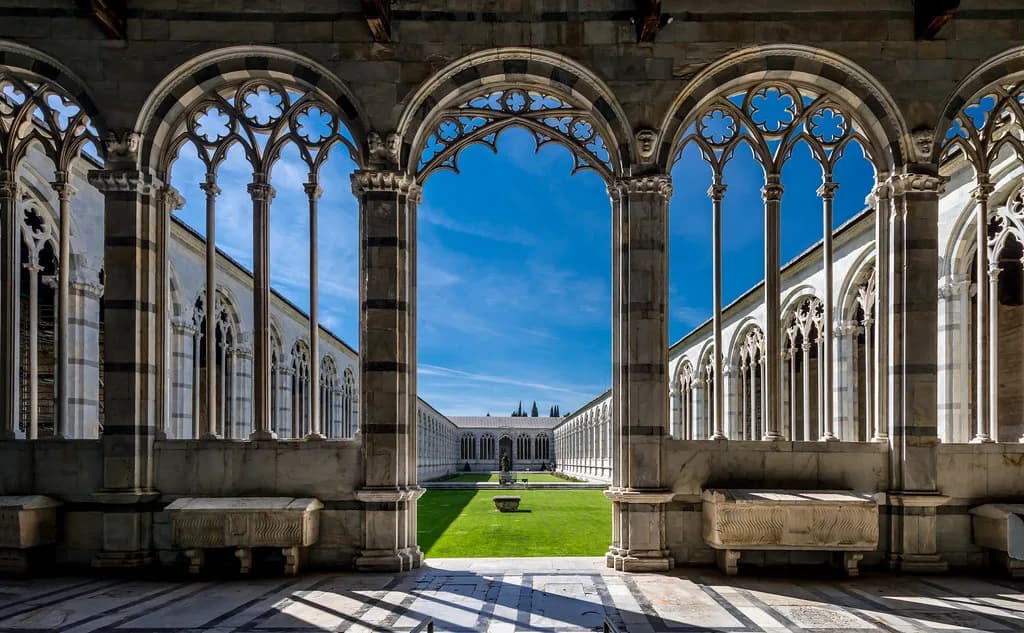
Inside, the courtyard is ringed by arcades with round arches, slender mullions and multilobed tracery. The central lawn is the open space the arcades surround, with tombs set under the arches and a few built on the grass itself. Walk the perimeter first, then cross the lawn, so that the rhythm of the cloister registers before you start looking at individual tombs and sculpture.
The Three Chapels: Ammannati, Aulla and Dal Pozzo
Three chapels line the Camposanto, and each comes from a different moment in the building's history. The Chapel Ammannati dates from 1360 and is named after Ligo Ammannati, a teacher at the University of Pisa, according to the travel guide. Knowing the names helps you read the interior as a layered complex rather than a single room.
The Chapel Aulla holds an altar made by Giovanni della Robbia in 1518, and the guide reports that the original lantern Galileo Galilei observed is kept there. That detail makes the chapel worth a deliberate stop rather than a glance. If you are moving quickly, this is one of the interior features most likely to be missed.
The Chapel Dal Pozzo was built on the orders of Carlo Antonio Dal Pozzo, Archbishop of Pisa, in 1594. It has its own altar and a small dome dedicated to Saint Jerome, which gives it a different architectural feel from the earlier Ammannati chapel. Visiting all three in sequence is a compact way to see how patronage changed across two centuries.
The Frescoes and the 1944 Bomb Damage
The wall paintings are the reason many visitors come, and they are also the reason the interior can look fragmented. The travel guide dates the frescoes to around 1360 and reports that a bomb strike in 1944 caused a fire that damaged them badly. That history matters when you look at the walls: you are seeing a rescued cycle, not an untouched one.
After the war, restoration work rebuilt the damaged roof and frescoes, and the guide notes that restored panels were progressively returned to their original positions. Some surfaces therefore read as patched or incomplete, and that is part of the story rather than a failing. Approach the frescoes slowly and at close range instead of scanning the whole room at once.
The preparatory drawings made for frescoes of this kind belong to a separate tradition, and Pisa displays such material in a dedicated Sinopie Museum rather than inside the Camposanto itself. If the mechanics of fresco-making interest you, plan that as its own stop instead of expecting the cemetery to explain the technique.
Sarcophagi and Relics: A Collection That Moved
The Roman sarcophagi you see today were not always arranged this way. The guide explains that the cemetery was originally meant to be surrounded by a large collection of Roman sarcophagi that had stood around the cathedral and were sometimes attached to the building itself. The current display is therefore a curatorial arrangement, not the original setting.
To preserve 84 remaining sarcophagi along with Etruscan and Roman sculptures and urns, relics were moved to a vestry museum, according to the same source. That split means some of the sculpture once associated with the Camposanto is now seen elsewhere. Reading labels carefully pays off here, because a sarcophagus in front of you may be in a secondary position.
The Camposanto also holds a collection of religious relics, which the guide reports was expanded in 2009 to include around eleven of the twelve Apostles and objects connected with the Crown of Thorns, the True Cross and the Virgin Mary's garment. Treat these claims as the guide's account and confirm details on site. Relic collections change display and interpretation, so labels and official notices are the reliable authority.
Tickets: Check the Official Pages Before Buying
The Opera della Primaziale Pisana runs the monuments of Piazza dei Miracoli, and its ticket pages are organised around a before-you-buy section, a prices section and separate information on reduced and free categories. In the extracted text the tower, baptistery, Camposanto, cathedral, Opera del Duomo Museum and Sinopie Museum all appear in the site navigation. Start with the operator's before-you-buy page rather than a resale site, because the operator sets the rules.
Do not assume that a single ticket covers every site on the square, and do not assume the Camposanto is or is not part of a particular combination. The extracted official text does not spell out how the cemetery is bundled, so the honest answer is to verify on the operator's ticket page before you commit. That sequence gives you the current price and eligibility in one place.
The same site also publishes a reserved area for viewing, editing or cancelling a booking, which tells you the operator handles changes directly. If your plans might shift, book through that system rather than a third-party seller. Prices, reduced rates and free categories are all listed there, so there is no need to rely on outdated figures.
Combining the Camposanto With the Rest of the Square
A sensible plan is to treat the Cathedral and Baptistery as one pair and the Camposanto as a separate interior stop, since each has its own entry arrangements. The Pisa Cathedral Visitor Guide: Free Entry, Interior and Practical Tips explains how the cathedral works, and the Pisa Baptistery Visitor Guide: Tickets, Acoustics and Nicola Pisano's Pulpit covers the round building beside it. Reading both in advance stops you from wasting time at the wrong entrance.
Exploring the square through the Leaning Tower of Pisa Visitor Guide: Tickets, Climbing and What to Expect helps you judge whether the climb fits your day. If you want both, give the Camposanto the calmer slot and the tower the timed one.
Beyond the square, Pisa has corners that reward anyone with a spare half-day, and the hidden gems in Pisa guide is useful for planning that extra time. Keeping one afternoon free from monument tickets makes the day less brittle if queues or entry slots run late. Build the square first and the rest of the city around it.
What to Skip if Time Is Short
With under an hour on the square, the exterior wall, the tabernacle doorway and a circuit of the cloister give you the essential shape of the place. The Roman sarcophagi along the arcades can be seen on that same loop. Save the chapels and the frescoes for a longer visit, because they need unhurried attention.
If you only have time for one interior beyond the cathedral, weigh the Camposanto against the Baptistery on what you actually want to see: a burial ground with sculpture and wall painting, or a round building with acoustics and a pulpit. Neither is a substitute for the other, and the official ticket pages show what each currently requires. Decide before you reach the entrance rather than at the turnstile.
Plan Your Visit
The Camposanto Monumentale works best when you arrive knowing it is a cemetery, a museum and an architectural enclosure at once. Look at the blind arches and tabernacle outside, walk the cloister perimeter, then give the chapels and frescoes the time their complicated history deserves. The 1944 damage is part of what you are seeing, not an obstacle to enjoying it.
Before you travel, use the official Opera della Primaziale pages to confirm current prices, reduced and free categories and how the Camposanto is currently ticketed, since those details are set by the operator and can change. Do not carry old figures in your head or rely on resale listings. A few minutes of checking on the operator's site is the most practical preparation you can make.
Frequently Asked Questions
Where is the Camposanto Monumentale located in Pisa?
It stands on the northern side of Piazza dei Miracoli in Pisa, the same square as the Cathedral, the Baptistery and the Leaning Tower. You reach it on foot as part of a walk around the square, which one listing places roughly 0.9 kilometres north-west of the city centre. It is inside Pisa, not in a separate town.
What can you see inside the Camposanto Monumentale?
The visit covers an oblong Gothic cloister with arcades around a central lawn, tombs under the arches, three chapels named Ammannati, Aulla and Dal Pozzo, a collection of Roman sarcophagi and a damaged-then-restored cycle of wall paintings. The Chapel Aulla is also associated with an altar by Giovanni della Robbia and the lantern Galileo observed.
Are the frescoes in the Camposanto original?
They are historic wall paintings, but many were badly damaged when a bomb strike in 1944 caused a fire, and restoration afterwards rebuilt the roof and worked on the paintings themselves. Restored panels were progressively returned to their positions. Expect surfaces that look patched or incomplete, and treat that as evidence of the building's wartime and postwar history.
Do you need a separate ticket for the Camposanto?
That depends on the operator's current ticketing, and the official pages should be checked before you buy. The Opera della Primaziale Pisana publishes a before-you-buy section, prices and separate reduced and free categories on its site. Do not assume one ticket covers every monument on the square.
Who is buried in the Camposanto in Pisa?
The building is a monumental cemetery with tombs set under the arcades and a few on the central lawn. A legend holds that soil brought from the Holy Land meant bodies buried there dissolved within a day, and the enclosure was designed to hold significant Pisan burials. Individual names are best read from the tombs and on-site labels rather than from secondary guides.
How long does a visit to the Camposanto take?
No official duration is published, so plan by what you want to see. A quick loop of the cloister and sarcophagi fits into a short stop, while the chapels and the fresco cycle deserve considerably longer. If you are also visiting the Cathedral, Baptistery or Tower, give the Camposanto its own slot rather than squeezing it between timed entries.
Sources
Continue exploring
More guides you'll find useful