Ortigia Guide: Walking Syracuse's Historic Island District
Slow-walk Ortigia, Syracuse's island quarter: Temple of Apollo, the Duomo, Arethusa and Maniace Castle, with a labelled suggested duration and one eating tip.
On this page
Ortigia is the oldest part of Syracuse, an island quarter joined to the mainland by a bridge and set between the two historic harbours of the ancient city. Approaching it as a neighbourhood rather than a checklist changes the visit: Greek ruins, Norman ramparts and baroque lanes sit within a few hundred metres of each other.
One traveller who visited in June 2021 rated Ortigia a must-see and suggested a full day there. That is a personal recommendation, not official guidance. Use it as a benchmark and adjust for your own pace, since the island is compact but its layers of history are dense.
The city of Syracuse publishes visitor information and event notices through its own portal, which is the right place to check current local conditions before a trip. Further visitor details appear in Comune di Siracusa.
Orientation: An Island Between Two Harbours
Ortigia sits between the two historic ports of ancient Syracuse, the large and the small harbour, and is joined to the rest of the city by a bridge. Its Greek name refers to a quail, and in antiquity the island was one of five districts of the Greek city alongside Neapolis, Achradina, Epipoli and Tiche.
That geography explains why the street grid rewards wandering. Water frames the edge almost everywhere, so you are never far from a view back across the harbours or out to sea. Pick one long axis and one cross lane rather than a fixed route, and let dead ends become viewpoints.
If you are deciding where to base yourself, the trade-off is atmosphere against convenience. Staying on the island puts the lanes and piazzas on your doorstep; staying in mainland districts may suit travellers who want easier access to the wider city. Our guide to where to stay in Syracuse weighs those options district by district. For wider planning, see Where to Stay in Syracuse, Sicily.
First Impressions: The Temple of Apollo and White Limestone
Just after crossing onto the island you meet the remains of an ancient gate and, beside it, the Doric Temple of Apollo from the sixth century BC. The temple measures roughly 55 by 21 metres and originally carried six columns on the short sides and seventeen on the long ones; a few capitals and columns still stand.
The dominant colour of the quarter comes from limestone quarried in the Iblei mountains, used for palaces, paving, walls and ramparts. In strong morning light the effect is almost glaring, which is part of why the streets feel so bright. Bring sunglasses and treat the middle of the day as a slower stretch.
This first stretch sets the tone for the island: ruins sit directly in the fabric of everyday streets rather than behind fences. You can see the temple without committing to a ticket queue, which makes it a good orientation landmark before the denser lanes further in.
The Duomo Square: A Greek Temple Inside a Cathedral
The cathedral on Piazza Duomo is the single most remarkable building on the island because it wraps a fifth-century BC Doric temple to Athena. The temple was dedicated after the victory over the Carthaginians at Himera in 480 BC, and many of its columns now define the nave of the church.
The result is a genuine fusion rather than a decorative nod: Doric elements are visible on the exterior and even more obvious inside. Our dedicated guide to Piazza del Duomo, Ortigia: A Guide to Syracuse's Baroque Square explains how the square was rebuilt after the 1693 earthquake that reshaped the Val di Noto.
One traveller recommends seeing the piazza at different times of day: the white stone is at its brightest in the morning, turns pinkish at sunset, and shows its strongest contrast against the sky at night. That is an opinion rather than a rule, but it is a practical way to structure a day around a single square.
Be aware that the cathedral's interior and any adjoining religious spaces may follow their own visiting arrangements. The sources here do not state hours, closure days or admission conditions, so check locally or with the city before planning a visit around a specific time.
Arethusa and the Papyrus: A Spring by the Sea
At the far edge of the island, the Fonte Aretusa is a freshwater spring almost at the waterline, and papyrus grows there — a rarity in Europe. The spring has been described by writers from Cicero and Ovid to Milton and Pope, and it appears in Cicero's Verrine orations as a fountain teeming with fish.
The literary weight of the place is unusual for what is essentially a small pool behind a wall. Read a line or two beforehand and the stop becomes more than a photo opportunity. It is also a natural pause point before turning back into the denser streets or continuing along the ramparts.
Maniace Castle and the Ramparts
The main military building on the island is Maniace Castle, commissioned by Frederick II of Swabia and built at the start of the thirteenth century. One visitor found its exterior more powerful than its interior and suggests appreciating it largely from outside.
Walk the ramparts that rise above the sea and the city's naval history becomes legible: Greeks, Romans, Arabs, Ottomans and Normans all passed through these waters. The route along the walls is free and open in feel, which makes it a good counterpoint to the enclosed spaces elsewhere on the island.
Entry arrangements for the castle interior are not documented in these sources, so do not assume it is always open or always free. Confirm current access with the city or on site before building a plan around going inside.
Beyond the Headline Sights: Side Lanes and Minor Facades
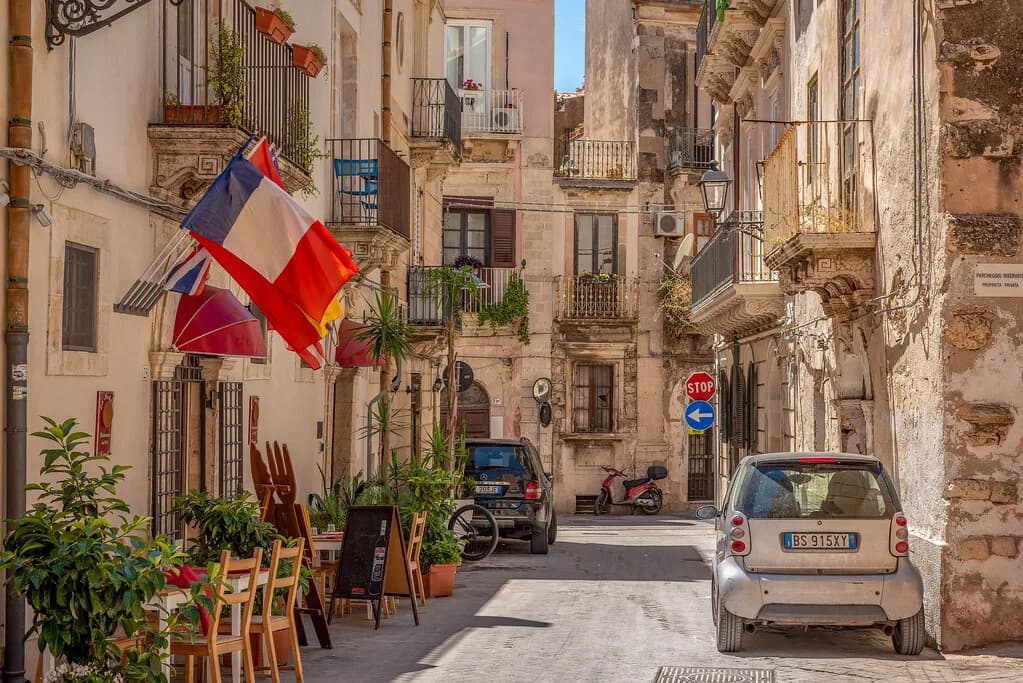
Once you leave the Duomo square and the waterfront, Ortigia becomes quieter in the ordinary sense: residential lanes, small churches and baroque facades with far less foot traffic. These are not hidden, and it would be misleading to call them secret; they are simply less crowded than the headline stops.
Aim for the lanes between the two main axes rather than circling the island edge twice. Look up at balconies and doorways, which carry much of the architectural detail, and accept that some streets will lead you back to where you started. That is a feature of a small island, not a navigational failure.
If you want more specific alternatives, our selection of hidden gems in Syracuse covers quieter corners across the wider city as well as the island. Treat such lists as options to weigh against your own energy rather than a second checklist to complete.
The Neapolis Park: A Deliberate Excursion Off the Island
The Neapolis archaeological park lies off the island, so treat it as an excursion rather than part of an Ortigia stroll. Inside, the Greek Theatre is the largest in Sicily and among the biggest anywhere, with a seating area of 46 steps divided into nine sectors by lateral stairs.
The park also holds the Roman amphitheatre, carved into rock and once measuring about 140 by 90 metres, the Latomia del Paradiso quarry, and the Ear of Dionysus, a funnel-shaped artificial cave some 23 metres high. Allow several hours if you want to see more than one of them.
Do not assume one ticket covers everything in the area, and do not rely on this page for admission details — none are given. Our Syracuse Attractions hub sets out separate guides so you can check each site's own arrangements before committing a day to the park.
For a deeper look at the surrounding district, the Neapolis Neighbourhood Guide: Syracuse's Archaeological District covers how the park sits within the modern city rather than only what stands inside the fences.
A Suggested Duration and How to Pace It
The only duration figure here is one traveller's own rating of a full day for Ortigia, offered after a June 2021 visit. Treat it as a suggestion, not official guidance, and adjust for heat, crowds and how much time you want inside buildings.
A workable split is an early orientation loop past the Temple of Apollo and the Duomo square, a slower middle of the day for interiors or a long lunch, and late afternoon along the ramparts toward Arethusa and Maniace Castle. Keep one flexible block for wandering the side lanes, since that is where the island's character sits.
If you add the Neapolis park, give it its own half-day rather than squeezing it between island stops. The distance is short on a map but the site is large in practice, and rushing it defeats the purpose of going.
Eating in Ortigia: Seafood and Sicilian Plates
Seafood dominates the local table, and one visitor singles out the Ortigia Fish Bar for traditional Sicilian fish cooking, praising in particular its tagliolini with cuttlefish ink and an impepata di cozze. That reflects a single 2021 visit and is a suggestion, not a current ranking or a promise that it is still trading as described.
Caponata, the sweet-and-sour aubergine dish, appears across menus and is a reliable way to eat well without ordering fish. For a wider survey of dishes and where to find them, the Syracuse Local Food Guide: What to Eat and Where is a better starting point than any single restaurant.
No prices or opening hours are stated here because none are verified for the current period. Check menus on arrival and book ahead in high season if a particular place matters to you, since small rooms fill quickly.
Practical Framing Before You Go
Transport details such as airport transfers, bus or train lines, journey times and parking on the island are not published on this page. The city homepage is the right place to check current transport options and any restricted traffic zone rules before driving or arriving with a car.
The city homepage carries time-sensitive notices, including transport and civic information, but those change constantly and should not be reused as fixed travel facts. Read it close to your dates rather than months in advance.
Accessibility details for monuments and the island's lanes are not published on this page. Travellers with specific mobility needs should contact individual sites or the city's information services to confirm step-free routes and interior access before relying on a plan.
Plan Your Visit
Ortigia works best as a slow walk with a few fixed anchors: the Temple of Apollo at the entrance, the Duomo square, the Arethusa spring and the ramparts toward Maniace Castle. Everything between them is the point, and the side lanes are where the island feels lived-in rather than staged.
Keep the Neapolis park as a separate excursion and verify admission arrangements for any paid site yourself, since no reliable current details are available here. For the wider picture, browse the Syracuse Attractions hub to plan each monument on its own terms.
Finally, decide where to sleep before you lock in a daily rhythm: the island suits early risers who want the piazzas to themselves, while mainland districts can make the rest of the city easier to reach. For related planning, see Temple of Apollo in Syracuse: Ortigia Visitor Guide.
Frequently Asked Questions
How long do you need to walk around Ortigia?
There is no official figure. One traveller who visited rated the island a must-see and suggested a full day, which is a personal recommendation. A half day covers the Temple of Apollo, the Duomo square and the waterfront; a full day leaves room for the side lanes, a long lunch and the ramparts. Add a separate half day if you also want the Neapolis park.
Can you see the Greek temple inside Syracuse's cathedral?
Yes, the Doric temple to Athena is built into the cathedral on Piazza Duomo, and many of its columns line the nave. Doric elements are visible both outside and inside. Visiting arrangements for the interior are not documented in these sources, so confirm locally before planning around a specific time.
Is it better to stay in Ortigia or in Syracuse?
Staying on the island puts the lanes, piazzas and waterfront within walking distance and suits travellers who want atmosphere first. Staying in a mainland district can make the wider city and the archaeological park easier to reach. Weigh how much time you will spend on the island against how much you plan to explore beyond it.
Why is Syracuse famous?
Syracuse was one of the most powerful cities in the Mediterranean in the fifth century BC and later capital of Sicily for around a thousand years. Its surviving Greek, Roman, Norman and baroque layers, including the temple inside the cathedral and the Neapolis park, are why the city and Ortigia hold UNESCO World Heritage status.
What food is Syracuse known for?
Seafood is central, from peppered mussels to cuttlefish dishes, and caponata — a sweet-and-sour aubergine preparation — appears widely. One traveller particularly praised the tagliolini with cuttlefish ink at a small Ortigia fish tavern, but that reflects a single visit rather than a current ranking.
Do you need a ticket to walk around Ortigia?
No ticket is needed to walk the island's streets, piazzas and ramparts, based on how these are described in the sources. Individual monuments and the Neapolis park off the island may have their own admission arrangements, and no verified details are available here, so check with each site or the city before you go.
Sources
Continue exploring
More guides you'll find useful