10 Best Things to See in Milan, Italy: A Complete Travel Guide (2026)
Discover the top 10 things to see in Milan, from the iconic Duomo to hidden canals. Includes local tips on booking, timing, and avoiding tourist traps.
On this page
10 Best Things to See in Milan, Italy
Milan rewards visitors who plan ahead and look past the obvious. After six visits across the last decade, I have seen the city shift from an overlooked business hub to one of Italy's most exciting destinations. The same streets that host Fashion Week in March become quiet, walkable corridors between world-class museums by June.
This guide was refreshed in May 2026 to reflect the latest entry prices, booking windows, and neighborhood changes. Whether you are here for the art, the canals, or the aperitivo culture, the ten stops below cover the essential Milan — with honest notes on what to skip and what to book three months early.
Milan Must See: The Magnificent Duomo Cathedral
The Duomo di Milano is the undisputed heart of the city and the third-largest cathedral in the world. Construction began in 1386 and took nearly six centuries to complete, leaving behind a facade bristling with more than 3,000 marble statues and 135 spires. Every street in the historic center radiates outward from Piazza del Duomo, so you will pass through this square multiple times no matter what you are doing.
The interior earns its own hour. The stained-glass windows are among the finest in Europe, and the nave feels genuinely enormous at ground level. Tickets for the cathedral alone cost around €7. Most visitors, however, come for the terraces, where you can walk among the spires at rooftop level and see the Alps on a clear day. The official Duomo website provides the most current ticket pricing and hours.
The "Terraces Only" ticket (€14 by stairs, €19 by elevator) is the smart pick for anyone short on time. You skip the long interior queue and get the definitive Milan viewpoint in under 45 minutes. Book online at duomomilano.it — the terraces open at 09:00 daily and close at 19:00. Arrive before 08:30 if you want the square to yourself for photos.
Book Duomo terraces at least one week ahead; two weeks during July and August when demand peaks. Check the small balcony above the main entrance for a pre-1886 Statue of Liberty replica said to have inspired the New York original.
- Booking tip: timed tickets for both the interior and the terraces sell out quickly in summer. Book at least one week ahead; two weeks in July and August.
- Before entering, check the small balcony above the main entrance for a pre-1886 Statue of Liberty — it is said to have inspired the New York original.
- The Duomo Museum across the square (separate ticket, €12) provides context on construction and houses original sculptures brought indoors for preservation.
Galleria Vittorio Emanuele II: Shopping and Architecture
Directly to the right as you exit the Duomo sits the Galleria Vittorio Emanuele II, opened in 1877 and widely regarded as the world's oldest active shopping gallery. The four-storey iron-and-glass arcade stretches 196 metres between Piazza del Duomo and Piazza della Scala, covered by a central octagonal dome that floods the interior with natural light.
Access is free at all hours, which makes it an effortless addition to any itinerary. The gallery is also the main pedestrian shortcut between the Duomo and La Scala, so you will walk through it regardless. Flagship boutiques for Prada, Gucci, and Louis Vuitton line the arcade — the original Prada store at the south entrance opened in 1913 and is worth a glance for its Art Nouveau display cases alone.
The most photographed floor detail is the mosaic bull (the symbol of Turin) set into the pavement beneath the central dome. Locals and tourists alike spin on its horns for good luck — the ritual has worn a visible depression into the marble over decades. A morning visit before 09:00 is the only time you can see the mosaics without a crowd standing on them. Coffee at Biffi or Savini café costs up to €30 for a pastry and cappuccino, but the setting — unchanged since 1867 — is part of the experience.
- The Galleria rooftop walkway (Highline Galleria) offers a bird's-eye view of the glass dome; tickets are around €15 and can be skipped on a tight schedule.
- The Leonardo3 museum at the north entrance has full-size replicas of Da Vinci's inventions and is better for families with children than for adult art enthusiasts.
| Attraction | Ticket Price | Tip |
|---|---|---|
| Duomo Cathedral (Terraces) | €14–€19 | Book 2+ weeks ahead in July–August; visit before 08:30 for solo photos |
| Duomo Museum | €12 | Provides context on construction; see original sculptures |
| Galleria Vittorio Emanuele II | Free | Visit before 09:00 to see mosaics without crowds; spin the bull for luck |
| Galleria Rooftop (Highline) | €15 | Can be skipped if short on time; visit is brief |
Leonardo da Vinci's Masterpiece: The Last Supper
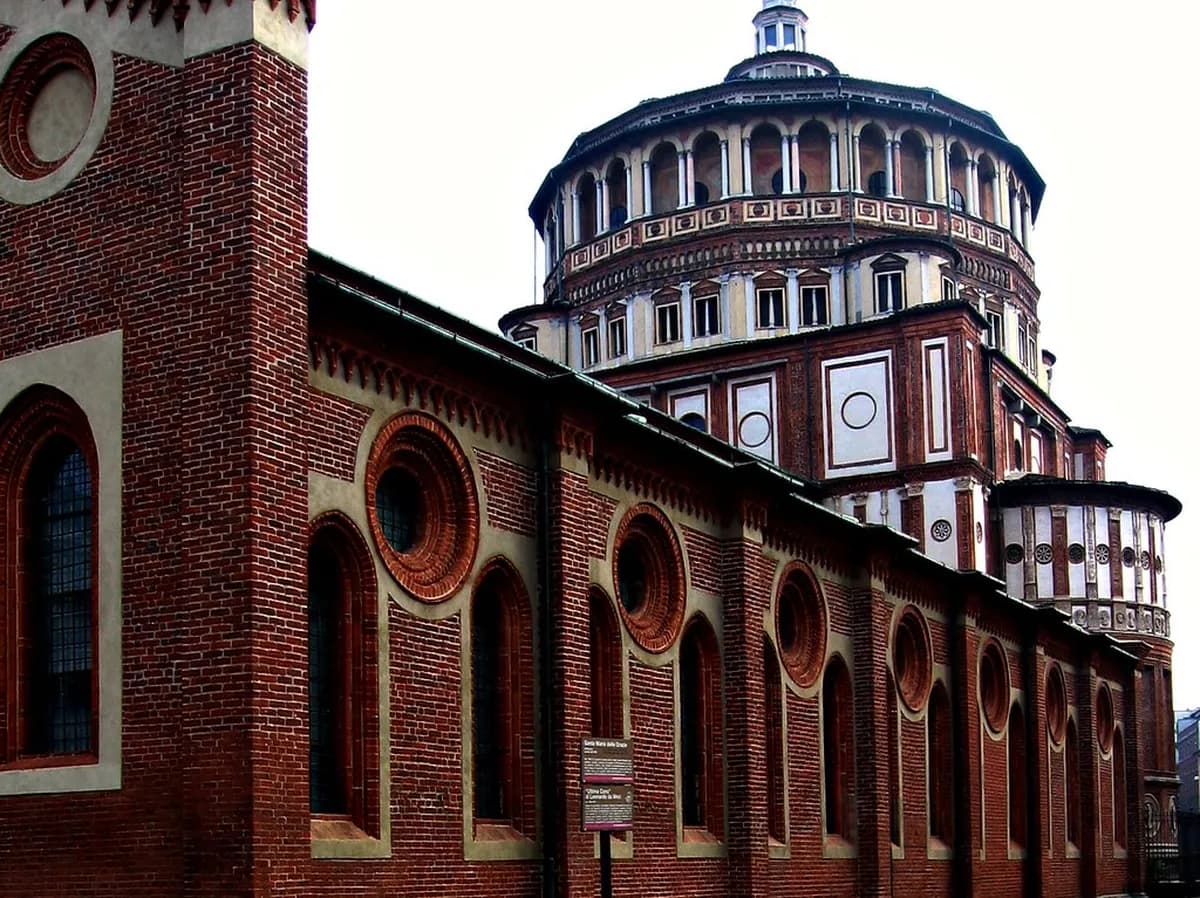
The Last Supper (Cenacolo Vinciano) is painted directly onto the refectory wall of Santa Maria delle Grazie in the Magenta district, about 1.5 km west of the Duomo. Da Vinci worked on it between 1495 and 1498 while living in Milan under the patronage of Ludovico Sforza. His apartment was in the building directly across the street — a fact that makes walking the neighborhood feel unusually specific.
Tickets cost €15 per person and viewing is strictly controlled: groups of up to 30 people get exactly 15 minutes inside the refectory. The official booking portal releases tickets in rolling 90-day windows — the moment a new block opens, it typically sells out within hours. The practical rule is to check the portal exactly 90 days before your planned visit and have your payment details ready.
If you miss the official release, tour operators pre-purchase blocks and sell them bundled with a guide. This route costs €45–€65 per person but has far better availability on short notice, sometimes even the day before. The church of Santa Maria delle Grazie is free to enter separately and houses excellent 15th-century frescoes that most visitors walk past without noticing. Budget 90 minutes for the full visit including the church interior.
- The museum is open Tuesday to Sunday, 08:15–19:00. It is closed on Mondays.
- Cancellations do occasionally appear on the official site 24–48 hours before a session — worth checking if you are already in the city without a ticket.
- Photography inside the refectory is not permitted. Leave the camera in the bag and take in the painting without a screen between you and it.
Pinacoteca di Brera: Renaissance Masterpieces
The Pinacoteca di Brera occupies the upper floors of Palazzo di Brera in the heart of the Brera art district and holds one of Italy's most important collections of Northern Italian Renaissance painting. The museum houses works by Mantegna, Raphael, Caravaggio, Tintoretto, and Bellini across 38 rooms. Standard adult admission is €15 and the gallery opens Tuesday to Sunday, 08:30–19:15.
The collection can overwhelm on a first visit. A focused one-hour route through the highlights serves most travelers better than trying to see everything. Start with Mantegna's "Dead Christ" (Room VI) for its radical foreshortening, move to Raphael's "Marriage of the Virgin" (Room XXIV), and finish with Caravaggio's "Supper at Emmaus" (Room XXIX). The central courtyard contains a working conservation lab behind glass walls — watching restorers work on centuries-old canvases is unexpectedly gripping and costs nothing extra.
The surrounding Brera neighborhood is the most pleasant in central Milan for an afternoon wander. Via Fiori Chiari and Via Fiori Oscuri are lined with independent galleries and boutiques. The Brera Botanical Garden, accessed through the Palazzo di Brera courtyard, is free and almost entirely unknown to tourists — a genuine pocket of quiet ten steps from one of the city's busiest art museums.
- The Braidense National Library on the same floor as the gallery is free to enter and takes about 10 minutes to walk through. Its 18th-century reading room is one of the most beautiful interiors in Milan.
- The gallery is one of the Milan's top museums for first-time visitors with limited time.
Navigli: The Historic Canals of Milan
The Navigli district in the southern part of the city is built along two medieval canals: the Naviglio Grande, which once carried marble from the Alps to build the Duomo, and the quieter Naviglio Pavese. The waterfront promenades are lined with low-rise 19th-century buildings housing a dense mix of bars, trattorie, vintage clothing stores, and small galleries. Walking the canal towpaths is free and takes about 20 minutes end to end.
The neighborhood has two distinct personalities. During the day it is calm and local, with market stalls and antique dealers setting up along the Naviglio Grande on the last Sunday of each month. After 18:00 it becomes the city's most animated aperitivo district, with every bar filling its pavement tables and the Alzaia Naviglio Grande promenade becoming essentially a slow-moving street party.
The Naviglio Pavese canal is notably less crowded than the Grande and connects to a canal lock system still in partial operation. For anyone wanting the visual without the evening crowds, the Pavese side delivers a more atmospheric experience. Most of the canal-side bars open their aperitivo service around 18:00; budget €12–€20 for a drink with a full food spread included — this is the mechanics of the Milanese aperitivo, explained in more detail below.
Visit Navigli after 18:00 for the best atmosphere when bars fill their patios and the promenade becomes a street party. The last Sunday of each month hosts antique dealers and market stalls along Naviglio Grande, perfect for off-the-beaten-path shopping and local finds.
Castello Sforzesco: Historical Secrets and Museums
Castello Sforzesco is a 15th-century fortified complex built by Francesco Sforza on the site of an earlier Visconti castle. It served successively as a ducal palace, a Napoleonic military base, and is now a cultural complex housing seven separate municipal museums. The outer grounds — including the moat terraces and the main piazza — are free to enter daily from 07:00 to 19:30, making it one of the most accessible large monuments in the city.
The combined museum ticket (€11 for adults) covers the Civic Museum of Ancient Art, an Egyptian collection, a musical instruments museum, and the Pietà Rondanini — Michelangelo's final and unfinished sculpture, which he was working on just days before his death in 1564. The Pietà alone justifies the entry fee for anyone interested in Renaissance art. It occupies its own room and is displayed at eye level with no barrier between the viewer and the marble.
After the castle, walk through the back gate into Parco Sempione — 47 hectares of English-style park that stretches to the Arco della Pace at the northwestern edge. The park houses the Triennale Design Museum (Italy's most prestigious design institution) and a panoramic tower (Torre Branca) that offers rooftop views for €6. Da Vinci's restored fresco inside the castle's Sala delle Asse was recently reopened after a long conservation project and is worth ten minutes of anyone's time.
Milan Tourist Spots for Fashion and Shopping Enthusiasts
Milan is the global capital of fashion but understanding how the city is divided for shopping will save you significant time and money. The Quadrilatero della Moda — bounded by Via Montenapoleone, Via della Spiga, Via Sant'Andrea, and Via Manzoni — is the luxury quarter. This is where Versace, Fendi, Armani, and Dolce & Gabbana maintain their flagship stores. Walking through it is free and the window displays are genuinely spectacular, especially in the weeks surrounding Fashion Week (February and September). The architecture on Via della Spiga, with its courtyard entrances and wrought-iron details, is worth the detour on its own.
Corso Buenos Aires is Milan's accessible shopping street, about 1.5 km northeast of the Duomo along the metro line. It is one of the longest shopping streets in Europe and hosts Zara, H&M, mid-range Italian shoe brands, and local chain stores. Prices here are standard European retail — no luxury markup. If you are buying anything practical for the trip, this is the neighborhood to do it. The surrounding Porta Venezia district has a relaxed, residential feel that contrasts sharply with the hushed formality of the Quadrilatero.
La Rinascente department store on Piazza del Duomo sits between these two worlds. The seventh-floor food hall and rooftop terrace face directly onto the Duomo's terraces and is the best free viewpoint in the city after the terraces themselves. The store carries both luxury and mid-range Italian brands and is open daily until 21:00.
Milan Tourist Spots for Food and Culinary Experiences
Milanese cuisine is richer and more butter-forward than southern Italian cooking and is anchored by two classic dishes: risotto alla Milanese (saffron risotto, often served with bone marrow) and cotoletta alla Milanese (breaded veal cutlet fried in butter). Both are common in traditional trattorie in the Brera, Navigli, and Isola neighborhoods. Most sit-down restaurants begin serving dinner at 19:30; arriving at 19:00 and eating immediately is the way to get a table without a reservation mid-week.
The Milanese aperitivo ritual deserves specific explanation because it is systematically misunderstood by visitors. It is not simply a happy hour with snacks. Between roughly 18:00 and 21:00, a large number of Milan bars offer a deal: pay for one drink (a Negroni, Spritz, Aperol Spritz, or Campari soda runs €8–€12) and you get unlimited access to a food buffet that can range from bruschetta and cold cuts to pasta, polenta, and hot dishes. The food is included in the drink price — you are not expected to order food separately. This is a legitimate and affordable dinner strategy for travelers on a budget, particularly in the Navigli and Isola neighborhoods. The unspoken rule is that you order at least one drink before approaching the buffet.
For a more structured food experience, Peck on Via Spadari (near the Duomo) is Milan's most historic delicatessen, open since 1883. The ground floor sells charcuterie, truffles, aged cheese, and prepared dishes. A sandwich from the counter costs around €8 and makes an excellent lunch. The Mercato Centrale at Milano Centrale train station is a newer but reliable option for a quick sit-down meal with regional Italian food before or after a train journey.
Secrets of Milan Tour: Hidden Gems and Local Finds
The areas immediately around the Duomo account for most of Milan's tourist footfall but a few short metro stops open up a very different city. The Isola neighborhood, north of Porta Garibaldi station, is a compact, low-rise district that was a working-class enclave until about a decade ago and is now one of Milan's most interesting eating and nightlife areas. Its streets are still walkable and human-scaled in a way that the centro storico is not. The weekly market on Via Borsieri on Saturday mornings sells produce, vintage clothing, and local crafts.
San Bernardino alle Ossa, a five-minute walk from the Duomo, is a small church that most visitors overlook entirely. The side chapel is decorated with the skulls and bones of plague victims from the adjacent hospital, arranged into geometric patterns on the walls. Entry is free. The chapel is open weekdays from 09:00 to 12:00 and 14:00 to 18:00. It is quiet, odd, and utterly unlike anything else in the city.
The Milan walking tour sector has grown considerably for 2026 and now covers routes that were not commercially available a few years ago: a Cinque Vie neighborhood tour (the medieval quarter southwest of the Duomo, rarely visited), a Leonardo trail connecting his Milan addresses, and an evening Navigli boat tour that uses the surviving canal lock at the Conca di Naviglio. These structured tours access courtyards and rooftops on private property that are otherwise closed. For travelers with limited time who want the hidden gems in Milan, a guided walk is more efficient than self-navigation.
Modern Milan: Porta Nuova and the Vertical Forest
The Porta Nuova district, a 10-minute metro ride from the Duomo to Garibaldi FS station, is Milan's most significant urban transformation of the 21st century. The area was a rail yard and industrial wasteland until 2012. It is now a coherent mixed-use neighbourhood of glass towers, ground-level retail, and a large public park called the BAM — Biblioteca degli Alberi (Library of Trees). The BAM is open daily and free; it hosts outdoor film screenings and markets throughout summer 2026.
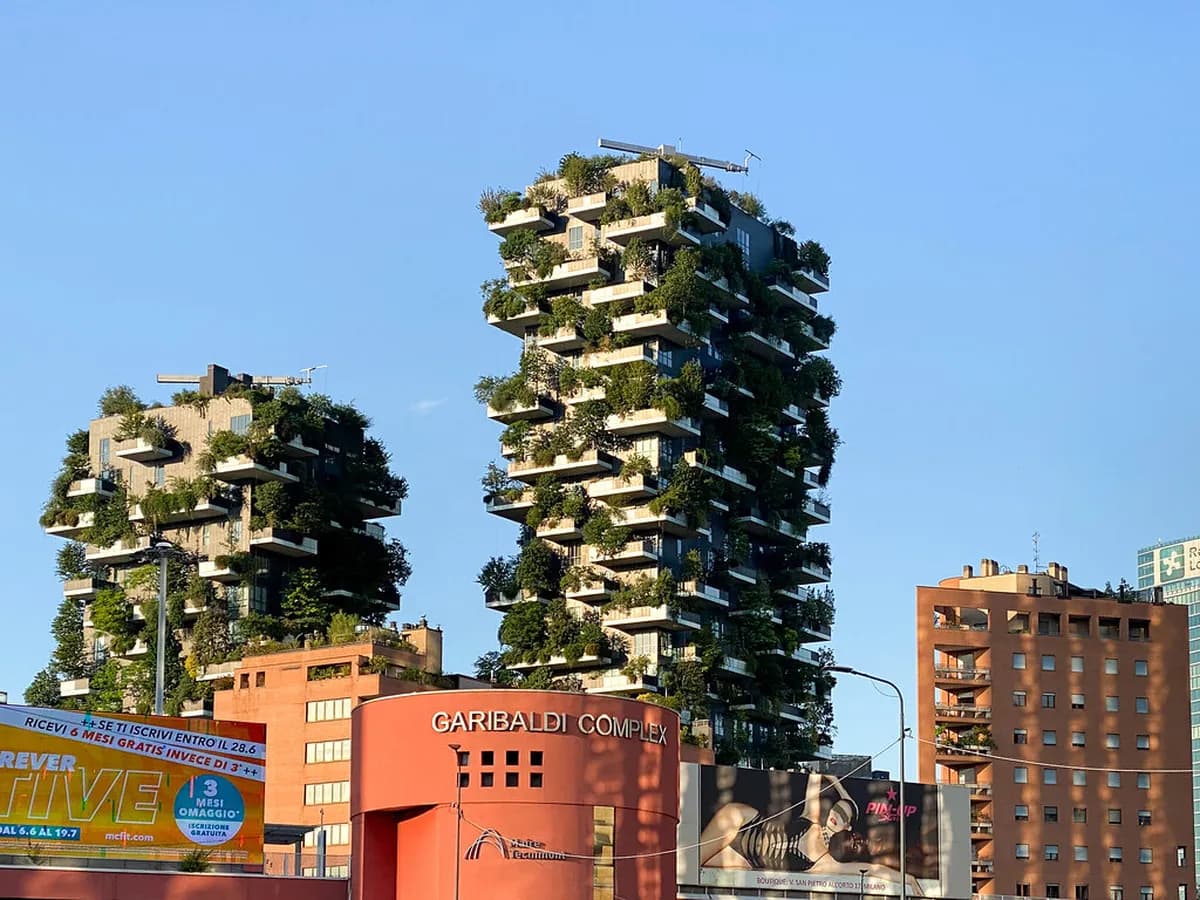
The most photographed element is Bosco Verticale (Vertical Forest) — two residential towers designed by Stefano Boeri and completed in 2014, covered in more than 900 trees and 20,000 plants held in purpose-built planters at each floor. The towers won the International Highrise Award in 2014. The buildings are private residences so entry is not possible, but the exterior is visible from street level and from the BAM park. The best angle for photography is from the eastern side of the park in the late afternoon when the sun hits the vegetation directly.
Piazza Gae Aulenti, at the centre of the district, is surrounded by the UniCredit Tower and several other glass towers designed by internationally recognized architects. It feels deliberately unlike the rest of Milan — closer in atmosphere to a contemporary Asian business district than to anything in the historic centre. This contrast is the point: Porta Nuova is the argument that Milan is not merely a preservation project. For those who want to see the the city-centre highlights versus the modern face of the city, an hour in Porta Nuova answers the question.
Planning Your Milan Sightseeing Itinerary
When deciding a three-day Milan plan, group the Duomo, Galleria, and La Scala on Day 1 — all three are within a five-minute walk of each other and together take a full morning. Afternoon Day 1 works well for the Sforza Castle and Brera. Day 2 should begin with the Last Supper (booked well in advance) and continue through the fashion district and Porta Nuova. Day 3 is best saved for Navigli and any museums you have not yet covered.
Booking the Last Supper is the single most time-sensitive task in Milan trip planning. The official portal (cenacolovinciano.org) releases tickets in 90-day rolling windows. Set a reminder for exactly 90 days before your visit date and check the site around 09:00 Italian time (UTC+2 in summer). Tickets at €15 disappear within minutes of release. Tour operator packages with bundled access cost more but are available on shorter notice.
Transportation within the city is simple. A 90-minute ATM ticket costs €2.40 and covers metro, tram, and bus. The historic centre is largely walkable: the Duomo to Sforza Castle is 1.2 km on foot. For the day trips from Milan to Lake Como or Bergamo, trains depart from Milano Centrale and Milano Nord stations with journey times of 30–50 minutes depending on the destination.
A note on the Malpensa Express: the train from Malpensa Airport to Milano Centrale takes approximately 50 minutes and costs €13. Trains run every 30 minutes from roughly 05:30 to 23:00. The bus alternative (Malpensa Shuttle, €10) takes 60–75 minutes and is subject to traffic delays on the A8 motorway. The train is almost always the better option unless you are staying near the western edge of the city.
What to Skip: Avoiding Milan's Tourist Traps
Restaurants facing Piazza del Duomo directly are uniformly overpriced and underperforming. A pasta dish that costs €9 in Brera costs €22 on the Piazza. Walk ten minutes toward Missori metro or into the Cinque Vie lanes southwest of the square for food that Milanese people actually eat. The coperto (cover charge) at tourist-facing restaurants can add €4–€6 per person before you have ordered anything.
The Leonardo3 Museum inside the Galleria can be skipped if you are already planning to visit the National Museum of Science and Technology on Via San Vittore. The science museum is far larger, has the original Last Supper preparatory drawings, and costs roughly the same. The Galleria museum is aimed primarily at families and adds little for adults who have already covered Da Vinci's major Milan connections.
Street vendors near the Duomo who place objects in your hand without asking, or who offer to photograph you without explicit pricing agreement, are operating familiar tourist traps. A clear "no thank you" delivered while still walking is the appropriate response. The city centre has improved on this front in recent years but the Piazza del Duomo's eastern side remains the most active area for these interactions.
Frequently Asked Questions
How do you get from Malpensa Airport to the city?
The Malpensa Express train is the fastest option, reaching Milano Cadorna or Centrale stations in about 50 minutes. Tickets cost approximately $14 each way. Buses are also available but can be delayed by heavy city traffic.
How much time should you plan for sightseeing in Milan?
Plan for two to three days to see the major landmarks without feeling rushed. This timeframe allows you to visit the Duomo, see The Last Supper, and explore the Navigli district. For more info, see hidden gems in Milan.
Is the Milan City Pass worth it for a short stay?
The pass is worth it if you plan to visit at least three major museums and use public transport frequently. It includes entry to the Duomo and the Scala Museum. Calculate your individual entry fees first to ensure it saves you money.
Milan is a city that rewards those who look past its industrial exterior to find its artistic soul. From the heights of the Duomo to the quiet canals of Navigli, there is a surprising amount of beauty to discover. By following this guide, you can avoid the common tourist traps and experience the city like a local.
Remember to book your high-demand tickets early and leave room in your schedule for a slow aperitivo. Whether you are here for a day or a week, Milan's blend of history and modernity will leave a lasting impression. Safe travels as you explore one of Italy's most vibrant and stylish urban centers.
Continue exploring
More guides you'll find useful