Piazza del Duomo, Ortigia: Guide to Syracuse's Baroque Square
Plan a slow visit to Piazza del Duomo in Ortigia, Syracuse: Baroque palaces, the Duomo built over the Temple of Athena, and practical tips for the square.
On this page
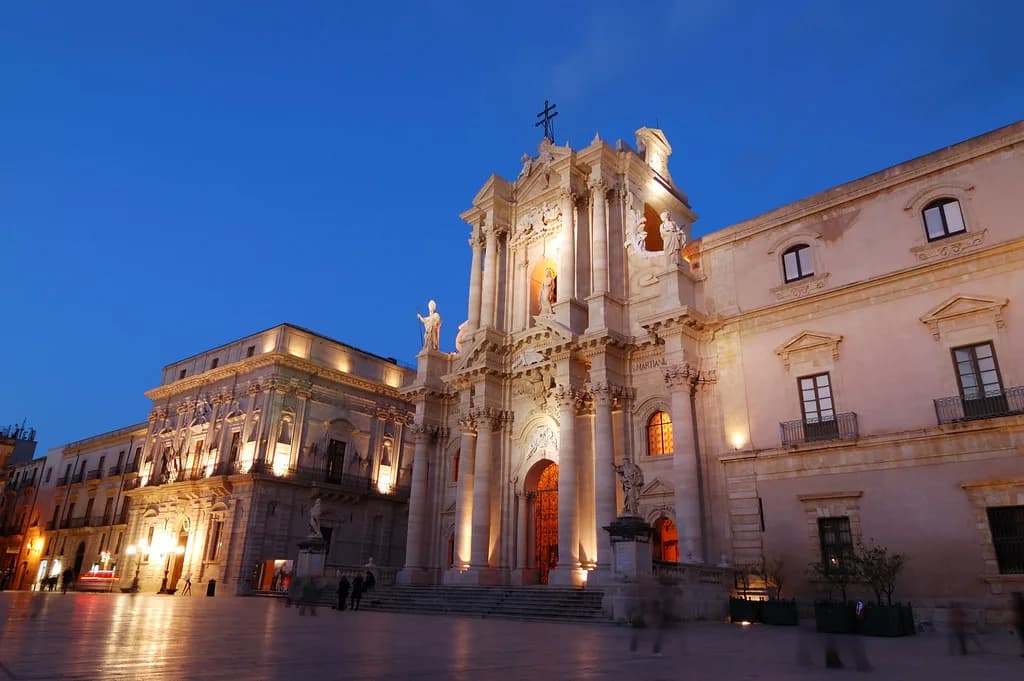
Piazza del Duomo is not a perfect square. Its irregular, slightly rounded shape on the side facing the cathedral gives it the feel of a stage, and it sits at the centre of Ortigia, the island district that forms Syracuse's old town.
The most striking detail is inside the cathedral, not outside it: on the left nave, Doric columns from the days when a Temple of Athena stood on the site are still part of the building. Look for them before you start photographing facades.
Walking the square itself costs nothing and needs no plan beyond getting there. What sits behind each door — the Duomo, the palaces, the church of Santa Lucia alla Badia — is a separate question, and the honest answer is that the city does not publish a single combined arrangement. Check with each site directly for admission and visiting times rather than assuming one ticket covers the piazza.
What You Are Actually Looking At
Think of the piazza as a shallow bowl. The curved side wraps toward the cathedral, while the opposite side is closed off by palazzi, so the Duomo reads as the focal point from almost anywhere on the pavement. The limestone facades catch low light exceptionally well, which is why the square photographs differently at every hour.
This is not a quiet corner of Sicily. Piazza Duomo functions as a crossroads for residents and visitors alike, lined with small bars and restaurants whose outdoor terraces spill across the stone. Expect company, especially at sunset when the light draws people out.
The Duomo: A Temple in a Cathedral's Clothing
The site began as a temple to Athena in the 5th century BCE. The Byzantines converted it to Christian worship in the 7th century and walled up the gaps between the peristyle's huge Doric columns, which is why those columns still stand inside the church today.
The building changed hands and faiths again: it served as a mosque during the Arab period before returning to Christian use. The Normans gave it an austere facade that collapsed in the earthquake of 1693, and the Baroque front you see now dates from 1713. Those are the two firm dates worth carrying with you — the rest is easier to read as layers than as a single era. Further visitor details appear in Piazza Duomo, a beauty by day or by night.
Whether you can step inside, and under what conditions, depends on the cathedral's own arrangements on the day. Ask at the entrance or check ahead; do not build an itinerary around an assumed free entry or a fixed opening window.
Reading the Palaces Around the Square
Most visitors photograph the facades without learning what they are, which is a shame because each has a distinct role. Opposite the cathedral stands Palazzo Beneventano del Bosco, an aristocratic residence rebuilt at the end of the 1700s. Next to the Duomo is Palazzo Senatorio, the Senators' Palace, now the city hall and built in the 1600s on the ruins of an Ionian temple, as described in the Duomo Square guide to the piazza.
To the right of the cathedral, the medieval Episcopal Palace completes the group, with restored structures from the 1600s, a terrace and a hanging garden. Knowing that one palace is civic, one aristocratic and one episcopal turns a row of anonymous Baroque fronts into a diagram of how the city organised itself.
None of these are simply open monuments. The city hall is a working office, and the others are not a single ticketed circuit; treat the exteriors as the freely readable part and verify separately if you hope to go further inside any of them.
Santa Lucia alla Badia and Its Baroque Facade
The church of Santa Lucia alla Badia sits on the square with a characteristic Sicilian Baroque facade, named for the convent to which it belonged. In evening light, when the stone warms, its front is worth a few unhurried minutes rather than a passing glance.
It is often folded into the Caravaggio story of Syracuse, but do not assume that means a painting is on view on any given day. Verify what is currently displayed and when the church is open before you set expectations for your group.
Day Versus Night: Two Different Squares
By day, the piazza is about architecture and shade. The semi-oval shape, the cathedral's 1713 facade, the Doric columns inside the left nave and the palace fronts are all easier to study in flat light, and the terraces are pleasant for a mid-morning coffee or a long lunch.
At sunset and after dark the square changes register. The stone takes on a honey tone, the facades are lit, and the space becomes a place to linger rather than inspect — which is exactly why the terraces fill up. If you only have one evening in Ortigia, this is a sensible place to spend it. Further visitor details appear in Piazza Duomo, a beauty by day or by night.
A practical compromise: walk the perimeter and read the facades in daylight, then return at dusk for the atmosphere. Two short visits beat one rushed one, and the square is compact enough that doubling back costs you very little.
Using the Cafes and Terraces Wisely
Outdoor seating rings the square, and sitting down is part of the experience rather than a compromise. Menus and prices vary from place to place and are not published in any central list, so look at the board before you sit and decide there rather than assuming a standard rate for the piazza.
Time your stop deliberately. A table at midday gives you shade and a view of the passing trade; an evening table gives you the lit facades but a busier room. If you want the architecture rather than the crowd, take the terrace earlier and walk the square later.
Routing Piazza Duomo Into an Ortigia Day
Piazza Duomo works best as the hinge of an Ortigia walk rather than a standalone stop. Approach through the island's lanes, spend time on the square, then continue toward the water and the Fountain of Arethusa, which sits in the same compact district and pairs naturally with a slow afternoon.
If you want to push further, Castello Maniace anchors the tip of the island and gives the day a second architectural full stop. Build the order around opening times rather than distance: the island is small, so the constraint is what is actually open when you arrive.
Beyond Ortigia, Syracuse's wider sights reward a second day. Use the city's attraction guides to decide what else justifies the trip before you commit a morning to it.
Suggested Duration: 45 Minutes or Half a Day
A 45-minute loop is a fair suggestion, not an official figure: walk the perimeter, read the palace fronts, look for the Doric columns if the cathedral is open, and take one coffee. That covers the architecture without pretending you have absorbed the history.
A half day suits the slower traveller. Give the cathedral real time, sit down for a proper meal, wander the surrounding lanes, and come back at dusk. The difference is not more sights — it is noticing the same square in two lights.
If you want quiet, look beyond the piazza between visits. The city's quieter corners are covered in the hidden gems in Syracuse guide, which is useful for filling the gap between daytime and evening.
Mistakes to Avoid
The biggest error is assuming one ticket or one schedule covers the buildings around the square. The Duomo, the civic palaces and Santa Lucia alla Badia are distinct entities; nothing in the city's published material suggests a combined arrangement, so verify each individually.
The second is treating Piazza Duomo as a photo stop. It is a working civic space with the city hall on it, and it rewards a slower look at roles and layers rather than a quick frame. The third is ignoring the heat: plan shaded spells and indoor pauses in the middle of the day, and save the open square for kinder hours.
Finally, do not rely on any listing for events in the piazza. Programme changes; check the cathedral's own notices and the city's channels for what is actually happening during your stay.
Plan Your Visit
Piazza del Duomo rewards attention more than checklist ambition. Learn the three palace roles, find the Doric columns inside the cathedral, note the 1713 facade and the 1693 earthquake that made it necessary, and the square stops being pretty scenery and becomes a readable document.
The practical rules are simple: walk it freely, verify interiors and opening times with each site, check terrace prices at the table, and come back at night. For details on the cathedral itself, use the dedicated Ortigia Cathedral Guide, and for the wider island, the Ortigia Neighbourhood Guide.
Frequently Asked Questions
Is Piazza del Duomo free to walk around?
Yes. The square is public space in the middle of Ortigia, and walking through it, reading the palace facades and sitting on the paving costs nothing. Going inside the cathedral, the palaces or Santa Lucia alla Badia is a separate matter, and arrangements differ by building, so check with each site directly before planning around entry.
Why are there Doric columns inside the cathedral?
The cathedral stands on the site of a temple to Athena built in the 5th century BCE. When the Byzantines converted the building to Christian worship in the 7th century, they walled up the gaps between the peristyle's columns instead of removing them, so the ancient Doric columns survive inside the church, visible on the left nave.
When was the cathedral's Baroque facade built?
The Norman facade collapsed in the earthquake of 1693, and the Baroque front you see today dates from 1713. Those two years are the firm anchors for the building's exterior history; the interior layers, from temple to church to mosque and back, span far longer.
When is the square at its best?
Daylight is better for reading the architecture: the 1713 facade, the palace fronts and the semicircular plan are all clearer in flat light. Sunset and the hours after dark are better for atmosphere, when the stone warms and the facades are lit. If you can, do both in separate short visits.
How does Piazza Duomo fit into an Ortigia day?
Treat it as the hinge. Approach through the island lanes, spend time on the square, then continue to the Fountain of Arethusa or out toward Castello Maniace. The island is compact, so the real constraint is which sites are open when, not travel time between them.
Can you walk to Ortigia from Siracusa?
Ortigia is the old town district of Syracuse rather than a separate destination, and Piazza del Duomo sits within it. Confirm current pedestrian routes and bridge access locally on arrival; published transport details change, and this guide does not list specific lines or timings.
Do I need one ticket for all the buildings on the square?
No single arrangement is documented. The cathedral, the civic palaces including the city hall, and Santa Lucia alla Badia are distinct buildings with their own access rules. Verify entry conditions and any admission charges with each site rather than assuming a shared ticket.
Sources
Continue exploring
More guides you'll find useful