Fountain of Arethusa, Ortigia: Myth, Papyrus and Visiting Tips
Plan a visit to the Fountain of Arethusa in Ortigia, Syracuse: the Arethusa and Alpheus myth, the wild papyrus in the basin and what to see nearby.
On this page
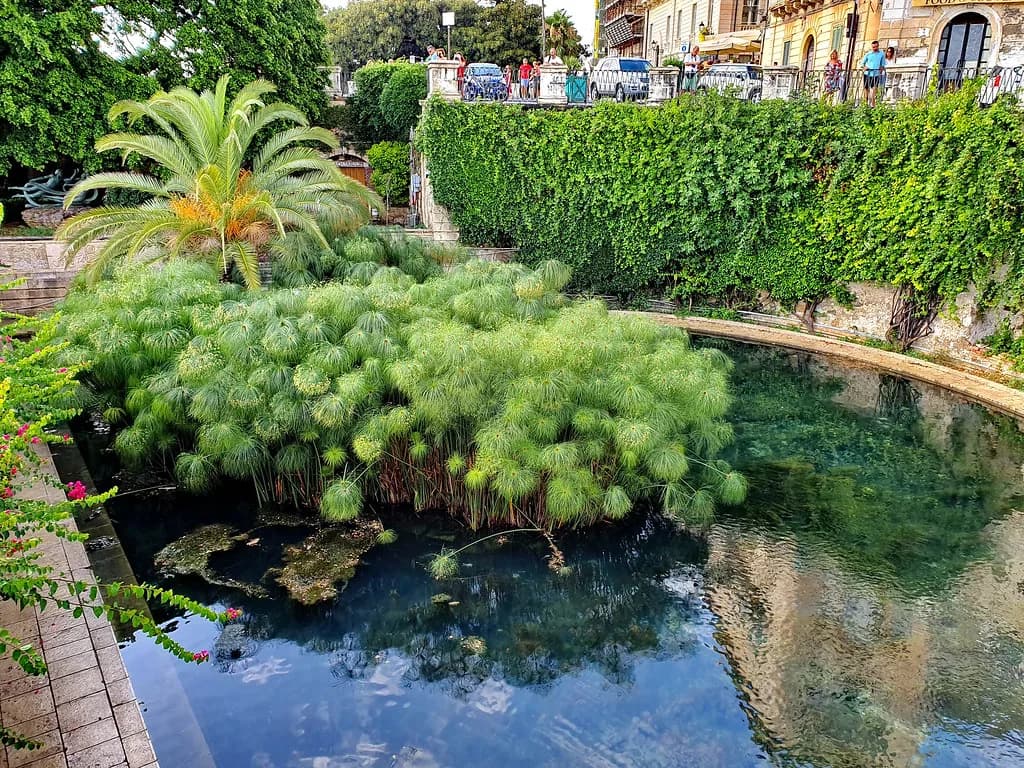
On the western rim of Ortigia, the oldest part of Syracuse, freshwater still rises a few steps from the Ionian Sea. The Fountain of Arethusa, or Fonte Aretusa, is a shallow spring basin bordered by stone and greenery, and it is the kind of place you can pass in minutes or sit with for as long as the story holds your attention. As a suggested planning allowance, set aside 20 to 30 minutes for the Belvedere view, the lower waterfront and a proper look at the plants. That is an editorial estimate, not an official duration.
What makes it unusual is the layering: a Greek myth about a hunted nymph, a botanical curiosity in the water itself, and a site whose present shape is the result of centuries of rebuilding. Treat it as an open-air public spot rather than a museum, and treat any app notification about its status with suspicion until you are standing in front of it.
A Freshwater Spring at the Edge of the Sea
The spring sits on the island of Ortigia, in the historic heart of Syracuse in south-eastern Sicily. It is a freshwater spring that gushes out at the seashore, forming a small lake inhabited by fish and plants, and local tradition nicknames it the papyrus fountain because of the vegetation growing around it. You do not need a ticket booth or a turnstile to reach it; it is part of the island's street fabric, close to the seafront promenade and the lanes leading back toward the cathedral square.
Because it is small and open to the sky, the spring rewards a short, attentive stop rather than a scheduled excursion. The water is described as shallow, with freshwater fish visible, and mallard ducks are said to inhabit the spring. Those sightings depend on the day, so plan around the setting and the plants rather than around wildlife.
The Myth of Arethusa and Alpheus
In the Greek legend, Arethusa is a nymph in the following of Artemis, known to Roman writers as Diana. While bathing in the river Alpheus she is surprised by the river god, who desires her; she flees and calls on the goddess for help. Artemis hides her in a cloud and transforms her into the freshwater spring that emerges on Ortigia.
Alpheus is not simply left behind. In the version told locally, Zeus takes pity on him and turns him into an underground stream that travels beneath the sea and mingles with Arethusa's waters in the spring. That second transformation is worth keeping separate from the first: the nymph becomes the fountain, the river god becomes the current that feeds it.
The story travelled widely and inspired poets, writers and at least one composer over the centuries, which is part of why a modest basin carries such weight in the city's imagination. Read it as legend rather than history, and the site becomes more interesting, not less.
Wild Papyrus and the Shape of the Basin
The botanical claim is the reason to slow down here rather than just photograph the water from the railing. The spring is described as one of only two wild, papyrus-bearing springs in Europe, with the plants growing directly in the basin rather than in a separate garden bed. Whether you find the stand lush or sparse will depend on the season and recent conditions.
The basin is not the large natural lake it once was. A hotel guide reports that the spring was remodelled several times over the centuries, and that in 1540 the Spanish reduced the lake by about 200 metres to build the ramparts around Ortigia. Those walls were demolished in 1847, and the present Belvedere was raised on the bases of the ramparts, which explains why today's spring reads as a contained pool rather than an open lagoon.
Treat those dates as reported history from a secondary source rather than an official record, and avoid expecting a single unchanged natural feature. What you see is a designed landscape with a spring at its centre.
Is the Fountain of Arethusa Free to Visit?
The spring is an outdoor, open-air site in a public part of Ortigia, so there is no gate, ticket window or timed entry to plan around. That is different from Syracuse's ticketed monuments, such as the interiors of the cathedral or the Neapolis archaeological area, which have their own admission arrangements. Do not assume the two work the same way.
One travel app listed the spring as temporarily closed on a date in late October, alongside a note that opening hours were to be determined. A public fountain does not really open or close in that sense, and a third-party toggle is not evidence of works or closure. Check the municipal website and simply look on arrival before altering a route around it. That approach also protects you if maintenance fencing goes up without notice.
No reliable current source confirms ticketed access, guided entry or any formal booking for the spring itself, so plan as you would for a city square. If someone offers a paid tour that includes it, you are paying for the guide's commentary, not entrance.
Where to Stand: Belvedere or Waterfront
There are effectively two ways to look at the spring, and the choice affects what you actually see. From the Belvedere above, the shape of the basin and the papyrus stand read clearly as a whole, which suits a first orientation. From the lower level closer to the water, you get the surface, the reflections and whatever birds are present. The source describes both viewing options, from the Belvedere above or from the Aquarium below.
Light matters more than any viewpoint. The spring, the open sea and the evening light are described as combining especially well at sunset, when the low sun softens the stone and the water. Arriving in the middle of the day gives flatter light; arriving late gives atmosphere but less clarity in the papyrus.
If you have time for only one stop, take the elevated view first, then walk down. Doing it in the reverse order tends to leave you looking back up at a railing you have already seen.
Piazza del Duomo and the Walk Through Ortigia
The spring sits naturally on a walking line across the island. From Piazza del Duomo, the baroque heart of Ortigia ringed by palaces and the cathedral facade, you can cross Ortigia on foot and reach the spring, then continue along the seafront. That sequence gives you the city's two extremes in one continuous walk: the enclosed square and the open water.
The cathedral itself is the building that best explains Syracuse's habit of building over its own past. Its Doric columns survive from the temple of Athena, incorporated into the Christian church, and the baroque facade you see today dates from after the 1693 earthquake. Step inside only if it is open for visitors at the time of your visit.
From the spring, the promenade toward the southern tip of Ortigia leads to Castello Maniace, the 13th-century fortress begun under Frederick II. It is partly used for military purposes and can only be visited in part, so treat it as a landmark and a view rather than a guaranteed interior tour.
Pairing the Spring With the Neapolis Archaeological Park
Most travellers combine Ortigia with the Neapolis Archaeological Park on the mainland side of Syracuse, and the pairing works well because the two halves of the city tell different stories. In the park you get the Greek theatre, the Roman amphitheatre and the quarry landscapes; on Ortigia you get the myth-soaked spring. A single day can hold both if you accept a lot of walking or a short transfer.
The park's most theatrical stop is the Ear of Dionysius, a tall S-shaped cave carved out of the quarry known as the Latomia del Paradiso. Legend attaches it to the tyrant Dionysius I, who was said to have used its acoustics to overhear prisoners, though the cave's shape is also explained by the line of an ancient aqueduct above it.
The name itself is credited to Caravaggio, who is said to have coined it in 1608 after seeing the cave; before that it was known as the talking cave. For the park's entrance fees, free-entry days and any exhibition surcharges, check the operator's site on the day, because the figures published by ticket resellers can carry dates that no longer apply.
A Suggested Half-Day on Foot
Allow roughly half a day for a slow circuit that starts at Piazza del Duomo, reaches the spring and follows the seafront south. That duration is a suggestion, not an official figure; the actual time depends on how long you linger at the cathedral, the spring and any cafe stops. Ortigia is compact, so the distances themselves are modest.
A sensible order is the square first, while it is quieter, then the spring from the Belvedere, then the lower waterfront, then the walk toward Castello Maniace. Retrace your steps through the lanes rather than looping around the island, and you will pass smaller churches and courtyards that rarely appear on a short list.
If you are staying more than a day, split the two halves of the city across separate mornings. The archaeological park involves uneven ground and considerable sun exposure, which is easier to manage before the heat builds.
Practical Cautions
Do not rely on a travel app for the status of a public spring. One listing marked the site as temporarily closed and left hours undetermined, which is not a meaningful category for an open outdoor basin and was not confirmed by the city. Confirm anything unusual through the municipal site, and trust your eyes on the ground.
The same caution applies to wildlife, water clarity and how full the papyrus looks. Descriptions of fish and ducks in the basin show what can be seen, not what will be seen during your visit, and nothing in the available information sets rules for swimming, accessibility or security. Ask locally if any of those matter to your plans.
Plan Your Visit
The Fountain of Arethusa is one of the few places in Syracuse where a myth, a rare plant and a waterfront view sit within a few steps of each other. It asks very little of you: no ticket, no queue, no schedule. The reward comes from knowing why the water is there and what the city did to its basin over the centuries.
Build it into a walk that includes the cathedral square and the seafront, and keep a second half-day for the archaeological park and the Ear of Dionysius. For the rest of the city, from the fortress to the hidden corners, start with the Syracuse Attractions hub, the hidden gems in Syracuse list and the Ortigia neighbourhood guide, then decide what earns your time.
Frequently Asked Questions
What is the myth of Arethusa and Alpheus?
Arethusa was a nymph in the following of Artemis, whom the Romans called Diana. The river god Alpheus pursued her, and Artemis hid her in a cloud and turned her into the freshwater spring on Ortigia. In the local version, Zeus transforms the grieving Alpheus into an underground stream that flows beneath the sea and joins her waters in the fountain.
Why does papyrus grow in the Fountain of Arethusa?
The spring is described as one of only two wild papyrus-bearing springs in Europe, and the plants grow in the basin itself rather than in a separate botanical garden. Local tradition calls the spot the papyrus fountain for that reason. The density of the papyrus varies, so judge it on the day rather than expecting a fixed display.
Is the Fountain of Arethusa free to visit?
The spring is an open-air feature in a public part of Ortigia, with no ticket booth or turnstile, unlike Syracuse's ticketed monuments such as the cathedral interior or the Neapolis park. A travel app once listed it as temporarily closed with undetermined hours, which is not a meaningful status for a public fountain. Check the municipal website and the site itself before altering plans.
How long do you need at the Fountain of Arethusa?
As a suggested duration, allow 20 to 30 minutes if you want the Belvedere view, the lower waterfront and a look at the papyrus. If you are folding it into a walk across Ortigia, a half-day is a comfortable allowance for the cathedral square, the spring and the seafront toward Castello Maniace. That is a planning estimate, not an official figure.
What is nearby the Fountain of Arethusa in Ortigia?
Piazza del Duomo and the cathedral are a short walk inland, and the seafront promenade runs south toward Castello Maniace at the tip of the island. The cathedral is worth seeing for its reused Doric columns from the temple of Athena. Castello Maniace is partly a military property, so its walls and views are more reliably accessible than its interior.
Who named the Ear of Dionysius, and how does it relate to Caravaggio?
The name is credited to Caravaggio, who is said to have coined it in 1608 after visiting the cave; before that it was called the talking cave. The cave lies in the Latomia del Paradiso quarry inside the Neapolis Archaeological Park. Its acoustics are tied to the legend of the tyrant Dionysius I, though an ancient aqueduct above the cavity also explains its shape.
Sources
- Comune di Siracusa
- The Fountain Arethusa of Syracuse: where legend and reality meet
- Syracuse Arethusa Fountain | Trip.com Siracusa
- The Ear of Dionysus, in Syracuse: between legends and nature
- Piazza Duomo, a beauty by day or by night
- Tickets for Neapolis Archeological Park with Audioguide | musement
Continue exploring
More guides you'll find useful