Temple of Apollo in Syracuse: Ortigia Visitor Guide
See the Temple of Apollo in Ortigia, Syracuse: what survives of the sixth-century BC Doric ruin, why access is exterior-only, and which nearby sights to pair.
On this page
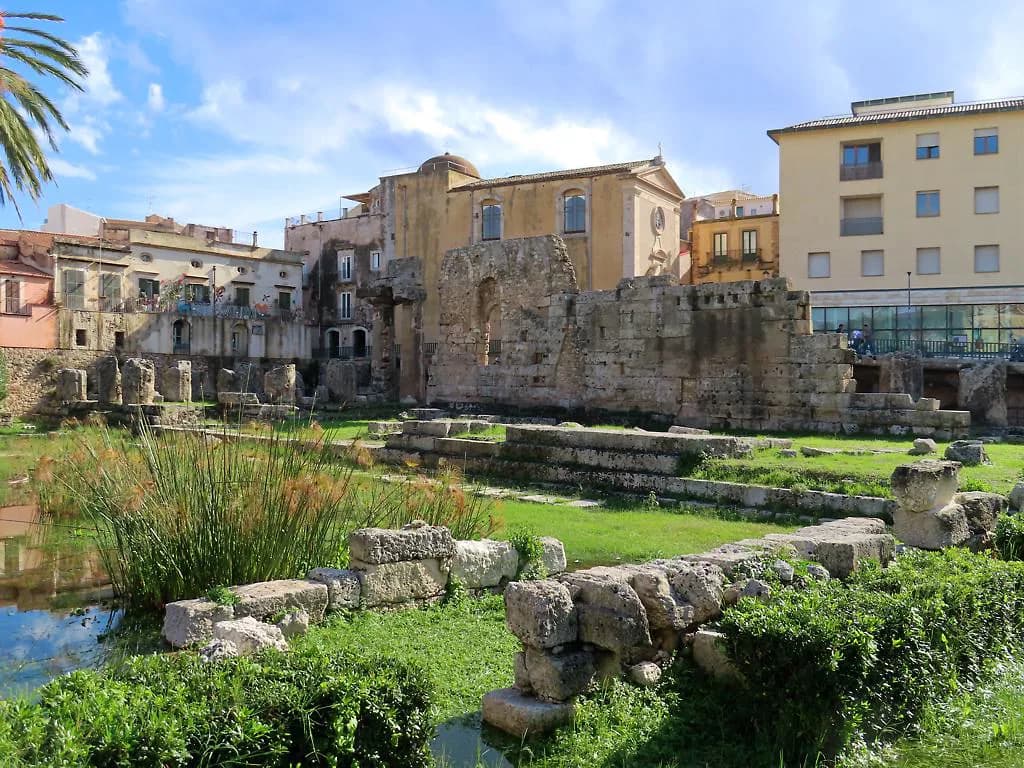
The Temple of Apollo, known locally as the Apollonion, sits where many travellers first set foot on Ortigia, the island that forms Syracuse's historic centre. It is a fragmentary Doric ruin beside Piazza Pancali, not a roofed monument, and that shapes the visit. One reference dates it to approximately 565 BC. Plan for a short stop and you will get more from it than if you arrive expecting a museum.
This guide covers what you actually see, how the site was dated and reused, why there is no interior access, and which nearby sights fit the same walk. It also separates the Ortigia-side stops from the Neapolis-side archaeology across the water, because the distance between them is easy to underestimate.
Why the Temple of Apollo Anchors the Entrance to Ortigia
The ruin occupies a low, open setting on Via dell'Apollonion just off Piazza Pancali, so you meet it on foot rather than through a gate. Because it sits at the island's threshold, it works best as the opening note of an Ortigia walk rather than a destination you cross town for. Arrive expecting a few minutes of looking and reading, then move on into the lanes.
That position makes it a hinge between the modern city and the historic island. Cross the bridge, pause at the columns, then continue toward Piazza Duomo or down to the sea. If you need to sequence the island without backtracking, a Syracuse in One Day: A Perfect 1-Day Itinerary helps you order the stops around this one.
What Survives Today: Columns, Fragments and the Temple Footprint
What you see is the bare skeleton of a temple: a platform, column stubs and scattered blocks, with the cella area reduced to its base. The remains are exposed to the sky, hemmed in by street furniture on one side and the square on the other. This is archaeology in a living street rather than in a landscaped park.
Photographs flatten the monument, so walk its perimeter and notice how the stone shifts in changing light. The local building stone, a pale limestone quarried in the Hyblaean hills, runs from white through beige to ochre, and the temple blocks carry those shifts. Angled, softer light makes the fluting and joints easier to read than harsh midday sun.
Dating and Origins: A Greek Temple of the Sixth Century BC
The temple dates to the sixth century BC, with one widely used reference giving approximately 565 BC, placing it among the earliest monumental Greek temples in the western Mediterranean. Treat that precision as scholarly convention rather than a fixed date carved in stone. What matters for a visitor is the ambition: a stone Doric temple raised within a few generations of the city's founding.
Sources describe the temple as one of the earliest Doric stone temples, so calling it Syracuse's oldest monument is a reasonable shorthand but not a settled fact. Syracuse was founded by Corinthian settlers in the eighth century BC and grew into one of the most powerful cities of the Greek world, which is the context for a temple of this size at the island's edge. Let the visible masonry make the argument rather than a superlative.
Later Lives of the Site: Sanctuary, Church and Mosque
The temple did not simply fall out of use and stay that way. Over the centuries it served different cults, later a church and at another stage a mosque, which is why the standing remains are so reduced. Reading the ruin as a palimpsest rather than a single-period building makes the scattered blocks more legible.
This layering is the norm in Syracuse, where the cathedral nearby reuses the columns of an earlier temple in much the same spirit. A short stop at the Apollonion therefore sets up a useful habit for the rest of the day: look for earlier fabric inside later buildings. It is one reason to see the ruin before, not after, the cathedral.
Viewing Details: Exterior-Only, Open to the Street
There is no gate, ticket window or interior to plan around. Visitors cannot enter the temple and instead admire it from the surrounding pavement and square, reading the placards along the perimeter for background. That is why the stop stays short and why there is nothing to book. Further visitor details appear in The 22 most historic buildings and sites in Syracuse.
One travel listing frames the site as open all day and suggests a viewing time of twenty to forty minutes; that is a planning figure, not an official duration. Because the ruin is unfenced, it works as a filler between meals or before an evening waterfront walk. The trade-off is that you share the space with traffic rather than an interpretation centre.
Positioning It on a Walking Route from Ortigia's Gateway
A sensible line runs from Piazza Pancali through the lanes to Piazza Duomo, then down to the Fountain of Arethusa and out to Castello Maniace at the island's tip. Each leg is short, and the sequence keeps you moving roughly north to south. Do the temple first while your attention is fresh, since later stops ask more of your time.
Allow the whole island walk to fill a morning rather than compressing it into an hour. Distances are modest but the streets are narrow and detours tempting. Keep the temple as a fixed anchor at the start so the rest of the day can drift. For wider planning, see Ortigia Neighbourhood Guide.
Pairing Options Nearby: Cathedral, Piazza Duomo and Arethusa Spring
The Cathedral of Syracuse stands on Piazza Duomo, which one source places about five hundred metres south of the temple, and it incorporates original Doric columns from an earlier temple into its fabric. Seeing both on one walk makes that reuse vivid. Church timetables shift with services, so check locally before relying on any published hours.
Beyond the square, the Fountain of Arethusa sits by the water with papyrus growing in its basin, and Castello Maniace guards the island's southern tip. The castle is a thirteenth-century Swabian fortress whose published hours and admission are best confirmed with the city rather than taken from a secondary page. Both make an unhurried continuation of the walk.
Pairing Options Across the Bridge: Neapolis Park and the Paolo Orsi Museum
The Neapolis Archaeological Park lies on the mainland and gathers the Greek theatre, the Roman amphitheatre and the quarries in one ticketed complex. Ticketing there is separate from the free temple, and published prices and free-entry days change, so confirm on the park's own pages before you go. Give it a half day if you want to see the theatre and the Ear of Dionysius properly.
The Regional Archaeological Museum Paolo Orsi is a short walk from the park and holds finds from digs across the region, including fragments from the city's Doric temples. It is the logical place to see such material in context after viewing the ruin in the street. Museum hours shift by season, so verify before building a day around it.
Best Time of Day and Coping with the Open, Sunny Square
The site is exposed, and Piazza Pancali collects heat through the middle of the day, so early morning or late afternoon is more comfortable than noon in summer. The stone reads better in low, angled light, and pavements are quieter before tour groups arrive. Carry water, since there is no shade within the ruin itself.
In high summer, treat the temple as a brief stop and save shaded lanes, church interiors or a long lunch for the hottest hours. Winter visits are gentler, though rain makes the surrounding stone slippery. Either way, this is a stop measured in minutes, not hours.
Practical Notes: What Is Unsettled and How to Confirm It
Because the temple is an open, unstaffed monument, there is no ticket and no closure schedule to check, which removes most of the usual uncertainties. What does change is everything around it: church hours, park ticketing, castle opening and museum timetables. Confirm those with the Comune di Siracusa or the individual sites rather than with resale pages.
Where a source quotes a price or opening time for a Syracuse attraction, treat it as a snapshot and re-check on the operator's own site before you build a day around it. If sources frame the temple's age a little differently, say so and lean on the broader sixth-century BC framing. A little verification protects the rest of your itinerary.
Plan Your Visit
The Temple of Apollo is a free, exterior-only ruin at the gateway to Ortigia, best seen in twenty to forty minutes before continuing to the cathedral, the spring and the castle. Arrive early or late, read the placards, and keep expectations calibrated to fragments rather than a reconstructed building.
From there, cross the bridge for the ticketed Neapolis park and the Paolo Orsi museum if you want the deeper archaeological story. Check current hours and admission on official pages, then let the walking day unfold at street level.
Frequently Asked Questions
Can you go inside the Temple of Apollo in Syracuse?
No. The temple is a ruin viewed from the surrounding pavement and square, and visitors cannot enter the remains themselves. Information placards along the perimeter explain the site's history, so it works best as a short stop on an Ortigia walk.
How old is the Temple of Apollo in Ortigia?
It dates to the sixth century BC, with one reference giving approximately 565 BC, which places it among the earliest Doric stone temples in the Greek west. Sources frame the dating slightly differently, so treat exact years as scholarly convention rather than a fixed record.
Is the Temple of Apollo free to visit?
Yes, because there is no gate, ticket office or bookable interior. You view the ruin from the street and square at no cost. Paid sites such as the Neapolis park across the bridge are ticketed separately and their prices should be checked with the operator.
How long does it take to see the Temple of Apollo?
Twenty to forty minutes is a sensible allowance for looking at the remains and reading the perimeter placards; that figure comes from a travel listing and is a planning aid, not an official duration. Most visitors pair it with other Ortigia sights, since the stop itself is brief.
Where exactly is the Temple of Apollo in Ortigia?
It stands on Via dell'Apollonion just off Piazza Pancali, near the point where you cross onto the island. That position makes it the natural first sight of an Ortigia walking route.
What else is worth seeing within walking distance of the temple?
The Cathedral of Syracuse and Piazza Duomo lie a short walk south, with the Fountain of Arethusa and Castello Maniace further along toward the island's tip. All sit within the compact streets of Ortigia.
Is the Temple of Apollo the oldest monument in Syracuse?
It is among the earliest surviving structures, but calling it the oldest outright is a simplification. Sources describe it as one of the earliest Doric stone temples, and the city's Greek and Roman layers elsewhere complicate any single ranking.
Sources
- The 22 most historic buildings and sites in Syracuse
- Temple of Apollo Map - Archaeological site - Syracuse, Sicily, Italy
- Syracuse ... The Archaeological Park
- #SmartEducationUnescoSicilia The senses tell of the Temple of Apollo |
- Comune di Siracusa
- Tickets for Neapolis Archeological Park with Audioguide | musement
- Temple of Apollo (Apollonion) Tickets [2026] - Promos, Prices, Reviews & Opening Hours | Trip.com
Continue exploring
More guides you'll find useful