Syracuse in One Day: A Balanced 1-Day Itinerary
Plan one day in Syracuse, Sicily, balancing Ortigia's piazzas and seafront with the Neapolis archaeological park, plus parking and food tips.
On this page
Syracuse rewards a single day better than most Sicilian cities, because its two halves sit close together: the historic island of Ortigia and the archaeological park inland. The island measures roughly one kilometre by 500 metres, according to The Thinking Traveller, so the old town is genuinely walkable rather than a taxi circuit. What one day cannot do is see everything at an unhurried pace, so this plan is a suggestion, not official guidance, and it tells you what to drop when time runs short.
The shape of the day is simple. Spend the morning on Ortigia, where public space is free and only interiors cost anything; eat around the morning market at midday; then give the afternoon to the Neapolis park, where the Greek theatre, Roman amphitheatre, Ear of Dionysius and the latomies sit together. Anything you add beyond that, from Castello Maniace to a beach, comes at the expense of something else.
Why Syracuse Suits a Single Day
Syracuse is a 2,700-year-old city whose ancient Greek and Roman layers are still visible in daily life, from the temple foundations beneath the cathedral to the quarries north of the centre. That density is the argument for a day trip: you are not travelling between dispersed sights but moving through a compact cross-section of Mediterranean history. The city is also UNESCO-listed together with the Necropolis of Pantalica, which gives the archaeology a wider context if you have time to read up beforehand.
First-time visitors often assume Ortigia is a separate excursion, but it is the historic centre itself, joined to the mainland and easy to reach on foot from the modern city. Once you accept that, the day organises itself: walk the island in the morning while energy is high, then take the short transfer to the park in the afternoon. Browsing our Syracuse Attractions hub before you go helps you decide which paid interiors actually matter to you.
Orientation: How Ortigia Relates to the Mainland and the Park
Ortigia sits at the southern edge of the modern city, and its lanes are better suited to walking than driving. If you arrive by car, Rudderless Travel explains the colour-coded parking system: white bays are free, blue bays are paid by the hour, and yellow bays are reserved for certain permit holders. Reading the markings before you park avoids a fine and tells you quickly whether you are circling a paid zone.
The Neapolis park lies in the opposite direction from the island, in the archaeological district north-west of the centre, so plan one transfer between the two rather than shuttling back and forth. Local buses run in Syracuse, but timetables and journey lengths are not published in the sources here, so check the operator's own information on arrival instead of trusting an old blog post. For a deeper look at that northern quarter, our Neapolis Neighbourhood Guide covers what surrounds the ruins.
Morning on Ortigia: Temple, Piazza and Cathedral
Start at the Temple of Apollo, which Rudderless Travel describes as the oldest known Doric temple in Western Europe, dating to as early as the sixth century BC. It later served as a Byzantine church, a mosque and then a church again, so the surviving columns carry several centuries of reuse in one small site. It sets the tone for the morning: layers rather than single monuments.
From there, walk inland to Piazza Duomo, a baroque square built over the site of the ancient Greek acropolis. The cathedral on its edge preserves the columns of the Temple of Athena inside its walls, a detail worth knowing before you step in, since the interior is not part of the free public square. Use the Ortigia Cathedral: Visitor Guide to Syracuse's Duomo to confirm current visiting arrangements rather than assuming the doors are open.
Between the two, detour to Piazza Archimede for the Fontana di Diana, created by Giulio Moschetti in 1907 with the goddess Diana at its centre. It is a public fountain in an open square, free to see and a natural pause between sights. If you are travelling with children or a reluctant walker, this stretch is short enough that the morning never feels like a forced march.
Ortigia's Edge: Arethusa, the Seafront and Castello Maniace
Head south-west to the Fountain of Arethusa, a freshwater spring fringed with papyrus right beside the sea, and the spot where Greek myth places the nymph Arethusa resurfacing after her flight from Alpheus. The combination of fresh water and salt within a few metres is the oddity that makes it memorable. Nearby Forte Vigliena offers a simple dock and staircase over the water, a good place to sit rather than sightsee.
At the island's tip stands Castello Maniace, built between 1232 and 1240 under Frederick II and named after the Byzantine general George Maniakes, who took Sicily from the Arabs in 1038. What you can see inside depends on current use and hours, which are not published in this material, so check at the entrance or with the Comune di Siracusa before planning your morning around it. The cathedral on Piazza Duomo, by contrast, is covered in detail in our Ortigia Cathedral Guide.
If the castle is closed and you still have time on the island, the Chiesa Monumento Pantheon dei Caduti, known locally as the Pantheon, commemorates Syracuse's fallen of the First World War and is cited by Rudderless Travel as a stop for history-minded visitors. Treat any small church you find as a bonus rather than a fixture: Sicilian churches keep their own hours, and a locked door is common outside service times.
Midday Food Stop: Build a Meal Around the Market
The morning street market on Ortigia runs Mondays to Saturdays and sells fruit, vegetables, fish and meat, according to The Thinking Traveller, which makes it the most efficient lunch briefing in the city. Arrive before vendors pack up, look at what is actually in season, and let that decide where you sit. The same source singles out a delicatessen at the end of the market, I Sapori dei Gusti Smarriti, for cheeses, cured meats, wines and sun-dried tomatoes made in its own laboratory, which makes a useful picnic or gift stop.
For a sit-down meal, Sicilia in Tavola is described by Rudderless Travel as one of Ortigia's longest-standing restaurants, known for homemade pasta and seafood, with reservations advisable because it fills. Menu prices change, so check the board or ask before ordering rather than budgeting from an old review. Wherever you eat, leave the coffee stop short: the afternoon park is the part of the day most easily squeezed.
If you prefer something quicker, the market sandwiches and cured meats do the job in half the time and free up an hour for the ruins. That trade-off is worth taking on a one-day visit, when the constraint is daylight rather than appetite. Our Syracuse local food guide goes further into what to order across the city.
Afternoon in the Neapolis Park: Theatre, Amphitheatre and Latomies
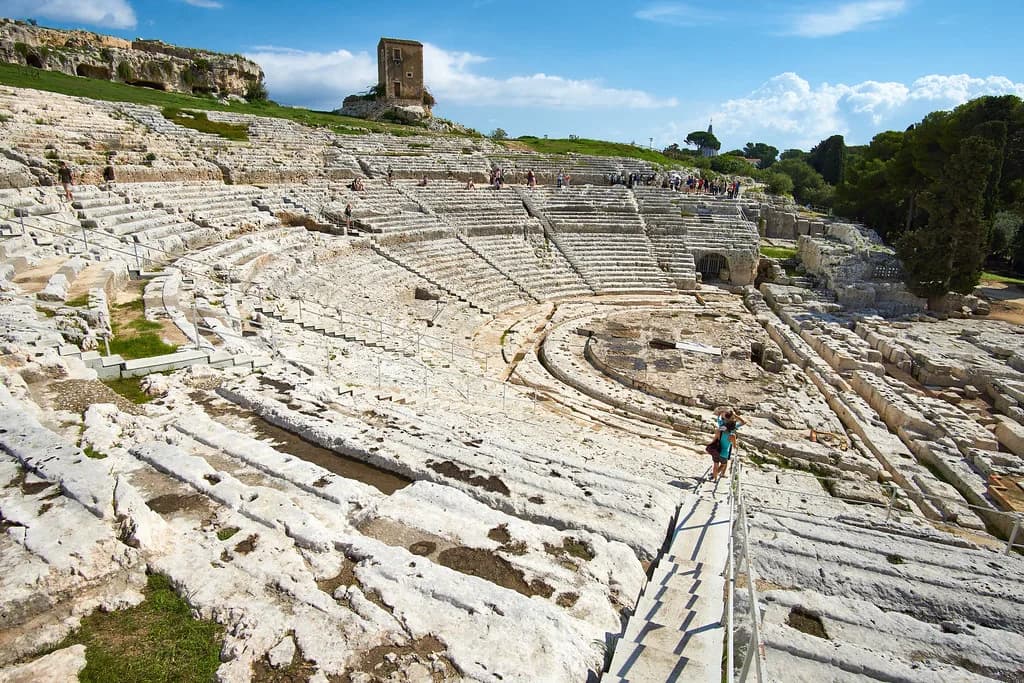
The archaeological park is the reason many people come to Syracuse at all. Its Greek theatre is described by The Thinking Traveller as built to accommodate 15,000 spectators, and Rudderless Travel dates the theatre to around the fifth century BC; the Roman amphitheatre within the park is also described as one of the largest anywhere. The Neapolis Archaeological Park Visitor Guide covers the individual monuments, so read it before you arrive rather than squinting at signage on site.
The Ear of Dionysius is the park's theatrical set piece: Rudderless Travel notes that its teardrop shape amplifies sound, audible from an opening some 72 feet above the floor. The name comes from Caravaggio, who invoked the legend of Dionysius I spying on prisoners held below. Whether or not you credit the story, the acoustics are the point, so stand still and listen rather than walking straight through.
The Latomie del Paradiso, the limestone quarries inside the park, were worked as mines and used as prisons, and the Grotta dei Cordari within them was named for rope-makers who used its humidity. Walking through takes longer than it looks, which is why the park deserves a solid block of afternoon rather than a rushed hour before closing. Ticket scope is not set out in these sources, so buy at the entrance and ask what your ticket actually covers.
Be aware that the theatre is used in ways that change how the park feels at certain times of year. Festival programming shifts from one year to the next, so confirm dates and performance schedules with the organiser before timing a visit around them. Outside those periods the theatre is simply an ancient monument, which suits a one-day trip better.
Deciding What to Cut When Time Runs Short
One day rarely covers both halves comfortably, and pretending otherwise produces a miserable sprint. If you have only a few hours, choose Ortigia: it needs no ticket, rewards wandering, and keeps food and transport within a few hundred metres. If you came for the ancient world, do the opposite and give the park your best hours, treating Ortigia's piazzas as a stop on the way in or out.
When you keep both, cut in this order: the Castello Maniace interior, the cathedral interior, then the far western seafront. That leaves the Temple of Apollo, Piazza Duomo seen from outside, Arethusa and the market in the morning, plus the theatre and Ear of Dionysius in the afternoon. Adding a beach or a nearby baroque town is a second-day project, best handled in our Syracuse in 2 Days: A Balanced Itinerary.
Getting There and Away: Catania Airport, Train, Bus and Car
Catania is the nearest airport to Syracuse, roughly 60 kilometres to the north according to Rudderless Travel, and it is where most arrivals begin. A car gives you flexibility for the wider Val di Noto and the beaches, but it brings the parking question in Ortigia with it. Trains and buses also connect Catania with Syracuse; check current timetables with the operator on the day, because frequencies and journey times change and are not reliable from older write-ups.
Buses in and around Syracuse are run by AST, covering the town and districts such as Belvedere, Cassibile and Fontane Bianche, while smaller shuttle buses serve tourists, as described by Rudderless Travel. Sailing frequencies from Malta are seasonal and changeable, so verify with the ferry company rather than booking around a remembered schedule.
Practical Cautions: Verify Prices, Hours and Ticket Scope
None of the sources behind this itinerary publish current ticket prices for the Neapolis park, the cathedral or the castle, and quoting figures from older accounts would mislead you. Check the Comune di Siracusa site and each site's own noticeboard for admission and opening times, and buy in person unless an official booking channel is advertised. Note too that a ticket for one monument does not automatically cover every corner of a complex; ask at the desk what is included.
Church interiors in Ortigia are separate from the public squares, the market keeps its own morning rhythm, and event programming shifts the park's availability. Build a short list of must-sees rather than a minute-by-minute schedule, and keep the order flexible. Orientation is the thing worth getting right in advance; almost everything else can be settled at the entrance.
Where to Stay if the Day Becomes a Weekend
Ortigia is the obvious base if you want evenings on the island and everything within walking distance. Rudderless Travel mentions Alla Giudecca, a restored fifteenth-century building on Ortigia near the sea, and Atrio Casa Vacanza B&B, as options weighed on location and price rather than facilities alone. Availability and rates shift with the season, so compare current listings rather than relying on a years-old recommendation.
Staying on the mainland, closer to the archaeological park, trades atmosphere for easier parking and quicker access to the ruins and to onward roads. For a single night before an early flight from Catania, that practical trade often wins. If you have two nights, split them and see Ortigia at dusk, when the day-trippers leave and the piazzas cool down.
Plan Your Visit
A good Syracuse day is unbalanced on purpose: a slow, on-foot morning on Ortigia and a committed afternoon among the ruins, with a market lunch in between. Get the parking markings right, treat interior visits as optional extras, and accept that one missed sight is the price of not racing. Our Syracuse Attractions hub lists the individual guides if you want to plan each stop in detail.
Before you go, confirm opening times and admission with the Comune di Siracusa and the individual sites, since those are the details that change fastest. Everything else, from the route between the two halves to the order of the morning, can be adjusted on the day. For related planning, see Hidden Gems in Syracuse, Sicily. For related planning, see Syracuse Rainy Day Guide: Indoor Museums and Covered Sights.
Frequently Asked Questions
Can you walk from Siracusa to Ortigia?
Yes. Ortigia is the historic centre of Syracuse, joined to the mainland rather than a separate island you need transport to reach, and it is compact enough to cover on foot once you are there. Wear comfortable shoes, since the lanes are uneven and the day adds up.
Is one day enough for Syracuse and Ortigia?
You can see the highlights of both in a day if you accept trade-offs: a morning on Ortigia and an afternoon in the Neapolis park, with the castle or cathedral interior skipped. Trying to add beaches, museums and a long lunch usually means rushing the archaeology.
Should you visit Ortigia or the Neapolis park first?
Ortigia works better in the morning, when the market is active and the light is softer, leaving the park for the afternoon. If ancient ruins are your priority, reverse the order and start at the park before the heat and crowds build.
Where do you eat during a one-day Syracuse itinerary?
The morning market on Ortigia is the most flexible option, with fruit, fish, cheese and cured meats for a quick meal, including a delicatessen noted for local produce. For a sit-down lunch, look for the long-standing trattorias around the island and check the menu before ordering.
How do you get to Syracuse from Catania?
Catania is the nearest airport, about 60 kilometres away, and trains and buses connect it with Syracuse, while a car adds flexibility for the wider region. Confirm current timetables with the operator, since schedules change and are not reliable from older accounts.
Is Syracuse worth visiting for a day?
Yes, if you want a concentrated dose of Greek and Roman history alongside a walkable baroque old town. The city layers a Greek theatre, Roman amphitheatre and quarried caves within reach of Ortigia's piazzas, which is more than most day stops offer.
Sources
Continue exploring
More guides you'll find useful