Syracuse Rainy Day Guide: Indoor Museums and Covered Sights
Plan a wet day in Syracuse, Sicily, with covered options in Ortigia and the Neapolis park, plus honest advice on what works and what doesn't in the rain.

On this page
Syracuse sits on Sicily's southeastern coast, and its rain pattern works in your favour in the shoulder months: the southeast around Syracuse and Ragusa is generally drier through autumn and winter than the Ionian coast near Taormina and Messina. That matters when you are choosing where to base a spring or late-autumn trip, because the odds of a washout are lower here than further north and east. Keep a wet-day plan in your pocket anyway, since a single grey day can still arrive.
The practical shape of a wet day here is simple: Ortigia, the island heart of the city, is compact and full of covered interiors, while the Neapolis archaeological zone on the mainland is largely open-air but contains one spectacular cave. One anchor per half-day, with a long lunch in between, beats trying to force a full outdoor itinerary under an umbrella. That rhythm also matches how the city is laid out, with the ancient Neapolis district on the mainland and the historic island of Ortigia linked to it by two bridges.
Ortigia or the Mainland? Your First Wet-Weather Decision
Start by deciding which side of the city you will spend the wettest hours on, because crossing between Ortigia and the archaeological zone costs time you may not want to spend soaked. Ortigia is the obvious base for a rainy morning: narrow lanes, churches, palaces and galleries sit close together, and the island is small enough to retreat indoors within minutes. The mainland Neapolis zone needs more of a weather window because much of it is exposed.
If you are driving, plan parking before you arrive rather than improvising in the rain. Most accommodation in Ortigia does not offer parking, and the usual fallback is the pay car parks at the entrance to the island, Marina and Talete. Ortigia itself is mainly pedestrian, so once the car is parked you will not need it during your stay, which makes a wet day easier to manage on foot.
Travellers arriving without a car have a straightforward approach from Catania, the nearest major airport, with regular trains and buses connecting to Syracuse. Allow more margin than you would on a dry day, since wet pavements and slower traffic stretch every transfer. If you are weighing car hire against public transport for the whole trip, pick up a car in Catania rather than Syracuse, where rental choice is thinner.
Duomo di Siracusa and Piazza Duomo: The Covered Core of Ortigia
Piazza Duomo is the most efficient rainy-day anchor in the city: a semi-oval square lined with aristocratic palaces and closed on one side by the cathedral, so you can move between shelter and open sky without leaving the block. The cathedral itself is a genuine curiosity, rebuilt in the Baroque style after the 1693 earthquake but visibly built over an ancient temple, with Doric columns still framing part of the interior. That layering of pagan temple and Christian church makes it worth more than a quick dash in from the rain.
Take your time inside rather than treating the church as a five-minute shelter. On the square itself, look for the church of Santa Lucia alla Badia and the Palazzo Senatorio, the city hall, which stands on the site of an ancient temple; the surrounding palaces reward a slow circuit under an umbrella between showers. Keep the visit to a single square as your morning anchor rather than adding three more churches in the wet. Many of Syracuse's churches and their piazzas are part of the everyday city rather than a single ticketed complex, so treat each interior separately when you plan.
Pair the cathedral with the Fountain of Arethusa a short walk away, where a natural freshwater spring sits at the island's edge surrounded by papyrus. It is outdoors, so slot it into a break in the rain rather than a downpour, and use it as the turning point between the square and the sea-facing lanes.
Palazzo Bellomo and the Covered Lanes of Ortigia
For a proper indoor hour, head to the regional art gallery housed in a thirteenth-century Catalan-Gothic palace, where the collection's highlight is Antonello da Messina's Annunciation. It gives a wet afternoon a clear purpose beyond shopping and coffee, and the building itself is part of the appeal. Before you go, confirm current opening days and any separate admission directly, since the gallery is its own ticketed site rather than part of a city-wide pass; our visitor guide to Palazzo Bellomo sets out what to expect inside.
Ortigia's lanes themselves are a reasonable wet-weather walk if you accept short dashes between doorways rather than a long loop. The route from the Temple of Apollo near the bridge, past Piazza Archimede and on toward the cathedral, strings together several sheltered pauses and keeps you oriented without a map. The Temple of Apollo is the oldest Doric temple in Sicily and was reused over the centuries as a church, mosque and barracks, so even a glance from under an awning has substance.
If the rain settles in for the afternoon, the Papyrus Museum in Syracuse is a compact, specialised alternative that keeps you indoors without repeating archaeological ground; check its published hours before setting out, as they are limited. Our Papyrus Museum in Syracuse guide explains what the collection covers. For a wider list of quieter corners to fold into a wet day, see our hidden gems in Syracuse.
The Neapolis Park in the Rain: Theatre, Amphitheatre and the Ear of Dionysius
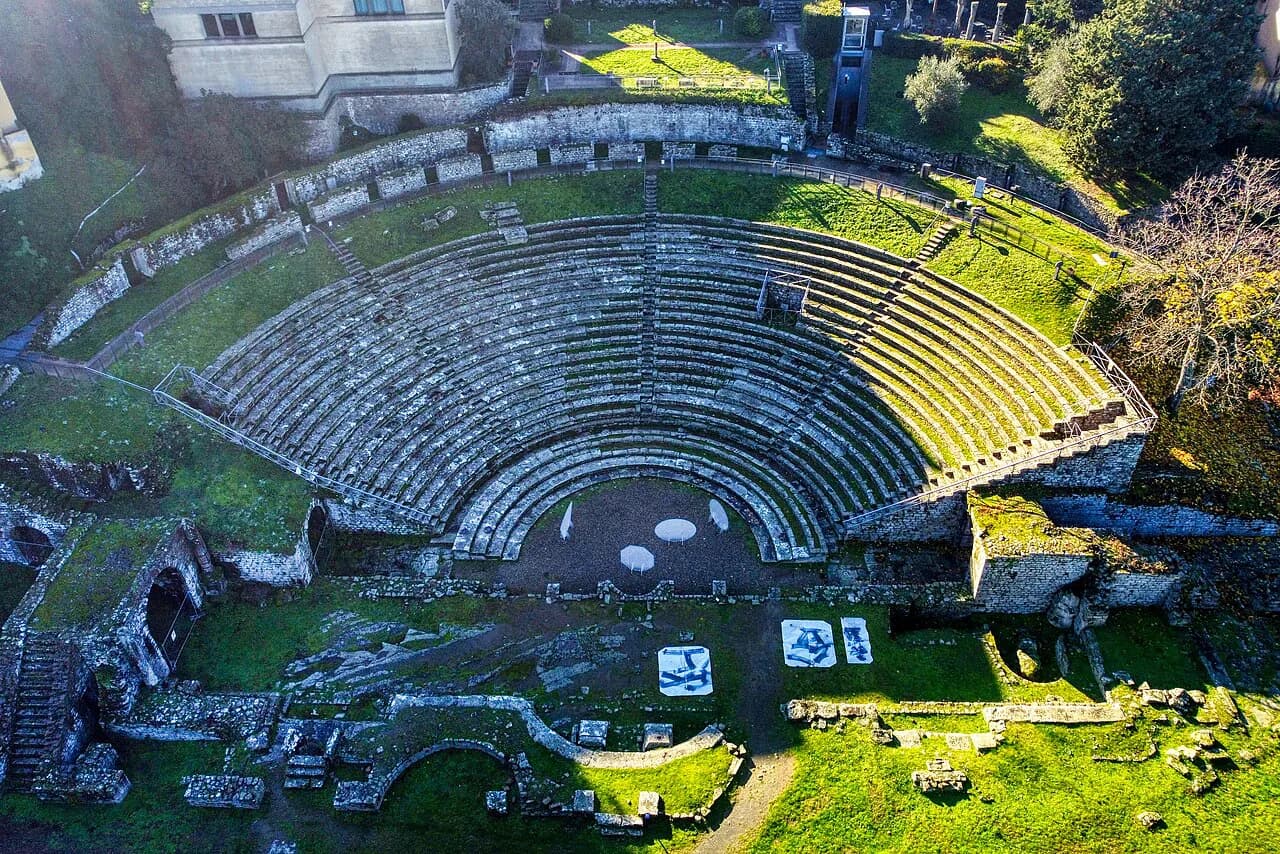
The Neapolis Archaeological Park is the city's headline ancient site, bringing together the Greek Theatre, the Roman amphitheatre and the Altar of Hieron II in one open-air setting, and it is a single ticketed complex. In rain, treat it as a calculated gamble rather than a default: the paths and stone seating are exposed, but the site's scale means a short shower does not ruin a visit. Aim for a morning slot before heat or crowds build, which also gives you a dry afternoon fallback if the weather turns.
The Greek Theatre is the reason most people come, carved into limestone in the fifth century BC and still used for open-air performances in the warmer months. Its scale is best appreciated in dry conditions, so if the forecast is genuinely poor, swap it for a museum morning and return another day rather than paying for a rushed visit. Admission is not free, and the official ticket and any seasonal inclusions should be checked on the operator's own site before you commit; a reseller page notes that the park opens in the morning but that hours can change.
The Ear of Dionysius is the one part of the park that feels almost indoor, and it is worth understanding what you are walking into. It is an artificial cave in the Latomia del Paradiso quarry, roughly 23 metres high, with an S-shaped plan that amplifies sound, and it takes its name from Caravaggio, who likened its form to an ear in 1608. Legend ties it to the tyrant Dionysius eavesdropping on prisoners, though the shape most likely reflects how the rock was cut beneath an ancient aqueduct.
Treat the cave as shelter from a shower, not as a fully weatherproof attraction: you still cross open quarry ground to reach it, and the rock floor can be slick. The wider park, including the Roman amphitheatre and the Altar of Hieron II, is exposed, so prioritise the theatre and the cave if time is short. For the surrounding district and how it fits into the city, our Neapolis Neighbourhood Guide: Syracuse's Archaeological District is a useful companion.
Paolo Orsi: The Sheltered Counterpart to the Open-Air Park
When the sky refuses to cooperate, the Paolo Orsi Archaeological Museum is the obvious indoor substitute for the park, and it sits close to the Neapolis site. Its collections draw on excavations in and around Syracuse, including material from the city's Greek temples, which makes it a sensible pairing with a later dry visit to the ruins rather than a replacement you regret. The Paolo Orsi Archaeological Museum: Visitor Guide to Syracuse's Top Collection covers the highlights if you want to plan a route through the rooms.
Budget a proper block of time here rather than squeezing it between showers, because a large archaeological collection rewards slower reading than a dash through the cases. Confirm the museum's current opening days and ticket arrangements directly, since these are not fixed indefinitely and reseller pages are not a reliable guide. Our broader Syracuse Attractions hub lets you compare it with the city's other sights before you commit a wet morning.
Maniace Castle: A Fortress Interior at the Tip of Ortigia
At the southern tip of Ortigia, the thirteenth-century Maniace Castle was built for Frederick II of Swabia as part of a coastal defence system, and over the centuries it served as a royal residence, a prison and a military base. Its quadrangular plan, limestone walls and cylindrical corner towers make it a substantial interior stop when the weather closes in, and the walk there along the seafront is short enough to attempt between showers. The castle is its own ticketed monument with its own hours, which vary and should be confirmed before you walk out; do not assume it shares admission with any other Syracuse site.
The walk itself is part of the experience: from the Fountain of Arethusa, the seafront route skirts the water to the castle entrance, so a break in the rain is enough to get you there. If the downpour is heavy, save the castle for another day and stay in the Piazza Duomo area instead, where shelter is continuous.
The Ortigia Market When the Weather Turns
The morning market is one of Ortigia's liveliest rituals, with stalls selling fish, seafood, seasonal produce and cheese, but it is largely an outdoor experience and loses much of its appeal in sustained rain. If you still want a taste of it, go early, keep the visit short, and pair it with a covered café or an indoor lunch nearby rather than building a whole morning around the stalls.
Think of the market as a fair-weather bonus that can be swapped, not a fixed appointment. On a wet day, the better use of that hour is a long Sicilian lunch, which is often the most enjoyable part of a rainy itinerary and costs you no wasted travel time.
Wet-Day Practicalities: Getting Around and What to Skip
A few habits make a rainy day in Syracuse much easier. Waterproof jackets with hoods work better than umbrellas in narrow old-town lanes, a spare pair of socks earns its place in the day bag, and booking any indoor attraction with limited capacity ahead of time is sensible when everyone else has the same idea. Keep the plan to one or two anchors and let the rest of the day stay loose.
Drivers should remember that restricted-traffic rules in the historic centre apply whatever the weather, so park at the edge of Ortigia and walk in rather than hoping enforcement relaxes in the rain. The city publishes its ZTL rules and access arrangements for the historic centre, which is the place to check current restrictions before you drive into Ortigia.
What should you skip? Long museum visits with no hands-on element hold attention poorly, and ambitious multi-town drives on wet, winding roads cost more time than they look like they will on a map. Outdoor markets and street-food walks are better saved for a dry day, and a full outdoor itinerary rebuilt under an umbrella rarely works.
Pairing a Rainy Day With a Longer Trip
Syracuse can be seen in a day, but it deserves at least two, which gives you room to absorb one wet day without losing the trip's shape. A sensible split is a museum-and-cathedral day when the weather is poor and a park-and-seafront day when it clears, so a single grey morning does not derail the itinerary.
The city is also a good base for the Val di Noto, with Noto a short drive southwest and Ragusa further out, both part of the UNESCO-listed Baroque towns of the region. On a wet day, those drives are less appealing than staying put, so keep them for clearer weather and use Syracuse's compact centre instead.
Spring and early autumn are the sweet spot for a visit, with warm but manageable weather and fewer crowds than midsummer. If you are travelling in the shoulder season and want more ideas beyond the obvious sights, browse our hidden gems in Syracuse for quiet corners that work in changeable weather.
A Wet Day in Syracuse, Planned Well
Rain does not empty Syracuse of things to do; it just changes the order. Lead with the covered core of Ortigia, hold the Neapolis park and the castle for a dry window, and keep a museum in reserve for the worst of it. That way a single wet day costs you atmosphere rather than an entire sight.
Check current hours and admission directly with each site before you set out, since these are the details that change and the ones worth verifying on the day. And if you are still choosing where to base a shoulder-season trip in southeast Sicily, remember that Syracuse's corner of the island is generally drier than the Ionian coast, which makes it a forgiving choice when the forecast is uncertain.
Frequently Asked Questions
What is there to do in Syracuse when it rains?
Head for Ortigia, where the cathedral on Piazza Duomo, the Palazzo Bellomo art gallery and the lanes around them give you short hops between shelter. The Paolo Orsi Archaeological Museum is the strongest indoor substitute for the open-air Neapolis park, and the Papyrus Museum offers a compact alternative. The Ear of Dionysius cave in the Neapolis park is a partial shelter, but you still cross open quarry ground to reach it.
Is the Neapolis Archaeological Park worth visiting in wet weather?
It can be, if you accept that most of the site is exposed. The Greek Theatre and the Roman amphitheatre sit in the open, while the Ear of Dionysius is an artificial cave that shields you from a shower. If the forecast is genuinely poor, visit the Paolo Orsi museum instead and return to the park on a drier day rather than rushing a paid visit in the rain.
How many days do you need in Syracuse?
Two days is a reasonable minimum, and it gives you room to absorb one wet day without losing the trip. Use one day for Ortigia's covered core and the seafront, and another for the Neapolis park and the Paolo Orsi museum. If you have a third day, add a nearby Baroque town such as Noto once the weather clears.
Is Syracuse worth visiting outside the summer?
Yes. Spring and early autumn bring warm but manageable weather with fewer crowds than midsummer, and the southeast coast around Syracuse and Ragusa is generally drier in autumn and winter than the Ionian coast near Taormina. Rain is still possible outside summer, so build a flexible indoor day into the plan rather than assuming sunshine.
How do you get to Syracuse from Catania?
Catania's Fontanarossa airport is the nearest major airport, and regular trains and buses connect it to Syracuse. Trains run every couple of hours and the journey is under an hour and a half, while buses take a little longer; check current timetables and fares directly with the operators before you travel, since these change.
Where can you park when staying in Ortigia?
Most accommodation in Ortigia does not offer parking, so the usual solution is one of the pay car parks at the entrance to the island, Marina and Talete. Ortigia is mainly pedestrian, so once you have parked you will not need the car. Confirm current rates and availability with the car park operator, and check the city's restricted-traffic rules before driving into the historic centre.
Sources
- Visit Syracuse Italy ⭐️ Discover What to Do and See in 2026
- A Local’s Guide to Syracuse & Ortigia, Sicily — Go Ask A Local
- What to Do in Sicily When It Rains: Family Options
- Comune di Siracusa
- Tickets for Neapolis Archeological Park with Audioguide | musement
- Maniace Castle in Syracuse: Discover the Majestic Bastion on the Sea
- The Ear of Dionysus, in Syracuse: between legends and nature
- Duomo Square - Syracuse (Siracusa), Sicily - Italy - ItalyGuides.it
Continue exploring
More guides you'll find useful