Neapolis Archaeological Park Guide: Greek Theatre & Tickets
Plan a visit to Syracuse's Neapolis Archaeological Park: what the Greek Theatre, Roman Amphitheatre and Ear of Dionysius involve, plus ticket scopes and free days.
On this page
The Neapolis Archaeological Park sits in the ancient Neapolis quarter of Syracuse, a short walk from the modern centre and a natural anchor for a day in the city. It gathers the Greek Theatre, the Roman Amphitheatre, the Ear of Dionysius cave and the Latomia del Paradiso quarry into roughly twenty-four hectares, so it rewards planning rather than a rushed pass-through. Treat it as the fixed point of your Syracuse itinerary and build the rest of the day around it.
Where the park sits and why it anchors a Syracuse visit
Syracuse began as a Corinthian colony and grew into one of the most powerful cities of the ancient Mediterranean, with the Neapolis zone lying outside the original island settlement of Ortigia. The park preserves the monumental core of that zone, which is why it works as a first stop before you move on to the baroque streets of Ortigia. Starting here in the morning also means you see the quarries and theatre before the heat builds, a sequencing recommended by a long-running Sicily travel blog.
Because the site is large and the monuments are spread across rising ground, a little orientation saves backtracking. Arriving early in the day leaves room for a slow circuit and then a late-morning transfer to Ortigia, where you can shift from Greek and Roman stone to medieval and baroque streets. If you want quieter corners between the headline monuments, the wider selection of hidden gems in Syracuse gives you options for the same afternoon.
What's inside: Greek Theatre, Roman Amphitheatre, Ear of Dionysius and Latomia del Paradiso
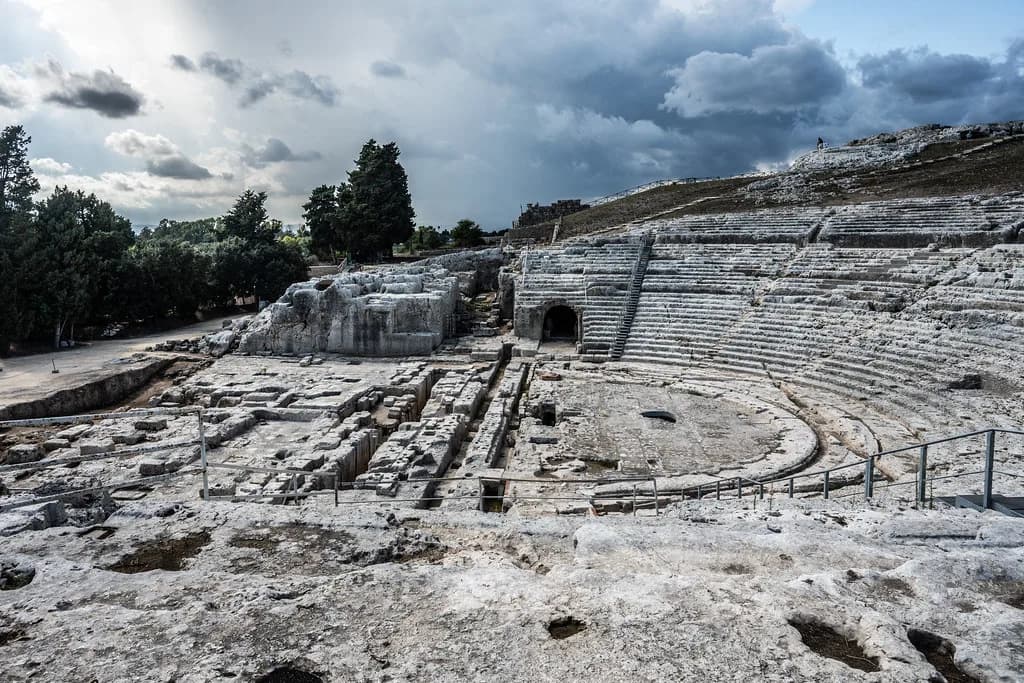
The Greek Theatre is the park's centrepiece, cut into the rock of Temenite Hill and once among the largest theatres in Sicily, with the Romans later adapting it for their own spectacles. The visitor account records a general May-to-June season for Greek drama performances in this extraordinary natural setting, though no specific performance dates should be assumed. For a monument-by-monument walkthrough, the Greek Theatre of Syracuse visitor guide covers the seating, acoustics and Roman alterations in more depth.
Near the entrance stands the Roman Amphitheatre, built in the third century BC and among the largest arenas of its kind, where gladiatorial and animal spectacles were staged. A rectangular channel at its centre is thought to have served as drainage for the arena, a detail that makes the structure easier to read than a bare oval of stone. Walking on, you pass the Altar of Hieron II, of which only the base survives, and the Via dei Sepolcri, an ancient road lined with burial niches.
The Latomia del Paradiso is a former quarry whose stone built much of ancient Syracuse and which is now planted with citrus, oleander and bay trees. Inside it lies the Ear of Dionysius, a cave roughly twenty-three metres high whose pointed profile resembles an ear and whose acoustics carry whispers across the chamber. The name is attributed to Caravaggio, and the legend of the tyrant Dionysius using the cave as a prison is exactly that, a legend worth enjoying without treating it as fact. For practical detail on the cave itself, see the guide to the Ear of Dionysius in Syracuse.
Ticket scopes explained: plain entrance versus audioguide bundles
The park sells a standard entrance ticket and, through resellers, a separate audioguide-inclusive product that bundles admission with a downloadable or on-site audio commentary. If you mainly want to walk the site and read the panels, the plain ticket is the simpler and cheaper route; the bundle makes sense if you prefer commentary as you move between monuments. Check which scope you are buying before you pay, because the audioguide version is a different product rather than an upgrade applied at the gate.
Pricing published by resellers belongs to the period in which it was written, and the figures commonly quoted, including a higher price covering an exhibition, applied to a window that ended on 31 October 2025. Do not budget from those numbers for a 2026 visit; instead confirm the current adult rate, any EU youth concession and whether an exhibition is included on the official park operator's page before you go. Treat any third-party listing as a description of what was offered, not as a current price list.
Guided options are sold separately by tour platforms, and their inclusions vary, so read whether park admission is bundled or must be bought on top. A guided tour into the Neapolis Archaeological Park typically describes the Greek Theatre and the Latomie del Paradiso, but the exact scope differs between products and operators.
Concessions and free entry: who pays less and when entry is free
The reseller listing describes a two-tier pricing system rather than a single rate: a full adult price and a reduced price for EU citizens aged 18 to 25, who should carry proof of age and citizenship. Children from 0 to 17 and visitors with a disability plus one accompanying carer are listed as free, with those tickets issued at the on-site ticket office. Because concession rules are administrative rather than fixed for all time, confirm eligibility on the operator's site before relying on it.
Free entry is not open-ended. The listed conditions were the first Sunday of each month, plus 10 March, 25 April, 2 June and 4 November, with free tickets issued only at the ticket offices on the day rather than booked in advance. If your trip coincides with one of those dates, plan to arrive early and expect queues, since free admission tends to concentrate demand. Verify the current free-day calendar with the operator before building a trip around it.
Opening hours, timing and a suggested visit shape
The venue opens at 08:30, but the same listing warns that hours can change and directs visitors to the official website for current opening and closing times. Do not assume a fixed closing time from any third-party page, and check the day before you go, especially outside the main season. A morning arrival remains the most practical choice, both for cooler temperatures and for quieter early photography of the theatre.
As a suggestion rather than an official figure, allow around two to three hours to cover the Greek Theatre, Roman Amphitheatre, Ear of Dionysius and the quarry paths without rushing, and add time if you use an audioguide or a guided tour. Visitors with limited mobility should note that paths run over uneven ground, so a slower pace is realistic. Build in a rest in the shade of the Latomia del Paradiso before heading on.
Pairing the park with Ortigia works well because the two halves of Syracuse tell different stories in a single day. After the morning circuit, cross to the island for lunch, harbour views and the baroque streets around the duomo, then finish at the water's edge. If you want a fortress stop on Ortigia, the Castello Maniace visitor guide explains what the seafront castle involves.
Common mistakes: one ticket for everything, old prices and skipped quarries
The most common error is assuming a single ticket covers every ancient site in Syracuse. The Museo Archeologico, usually called the Paolo Orsi Archaeological Museum, is a separate collection a short distance from the park and is not part of the park entrance; the Paolo Orsi Archaeological Museum visitor guide explains what it holds. Budget for it as a distinct stop on another morning if you want to see the finds from the excavations.
The second mistake is treating online prices as permanent. Sourced figures from the 2024 to 2025 window no longer describe the current rate, and resellers do not always update their fine print. Before booking, compare the operator's page with any reseller listing and check what the ticket actually includes, then decide whether the audioguide bundle or a plain entrance suits you.
The third mistake is racing straight to the theatre and leaving. The Latomia del Paradiso, the Via dei Sepolcri and the Altar of Hieron II explain how the site worked as a whole, and skipping them leaves you with a single monument rather than a city quarter. The theatre is the highlight, but the quarries are what make the site feel like a landscape rather than a ruin.
Plan Your Visit
Book with the scope you actually need, arrive near opening, and check the operator's site for the current adult price, youth concession, free days and hours before you commit. Treat every online price as dated information and every bundle as a distinct product, then you can enjoy the theatre, amphitheatre and quarries without surprises at the gate. Use the Syracuse Attractions hub to match the park with the rest of the city's sights. For related planning, see Castello Eurialo: Planning a Visit to Syracuse's Greek Fortress.
Frequently Asked Questions
Is the Neapolis Archaeological Park worth visiting?
Yes, if you care about Greek and Roman Sicily. The park brings together the Greek Theatre, the Roman Amphitheatre, the Ear of Dionysius and the Latomia del Paradiso in one large, walkable site that anchors a Syracuse itinerary and pairs naturally with a later wander around Ortigia.
When is entry to the Neapolis Archaeological Park free?
The conditions published by resellers list the first Sunday of each month plus 10 March, 25 April, 2 June and 4 November, with free tickets issued only at the on-site ticket offices. Confirm the current free-day calendar with the official operator before planning a trip around it, since these arrangements can change.
What is included in the Neapolis Archaeological Park ticket?
The standard ticket covers park admission, while a separate reseller product bundles admission with an audioguide. A bundled exhibition was included during a window that ended on 31 October 2025, so check the operator's page for what the current ticket includes rather than assuming the exhibition is still part of it.
Are audioguides available at the park and in which languages?
Where an audioguide is included, it is provided by Aditus Culture and collected at the ticket office on site. The fine print names English, Italian, Spanish and French, while German appears only in one listing heading, so treat German as unconfirmed until the operator says otherwise.
How long does it take to see the Greek Theatre and the rest of the park?
As a suggested plan rather than an official figure, allow around two to three hours for the theatre, amphitheatre, cave and quarry paths, and add time for an audioguide or guided tour. Paths cross uneven ground, so a slower pace is realistic for many visitors.
Do children and disabled visitors pay to enter?
The reseller listing says children aged 0 to 17 and visitors with a disability plus one accompanying carer enter free, with those tickets requested at the on-site ticket office. Eligibility rules can be updated, so confirm them with the operator before you travel.
Is the archaeological museum included in the park ticket?
No. The Museo Archeologico, known as the Paolo Orsi Archaeological Museum, is a separate site near the park with its own collection and its own admission, so plan it as a distinct stop rather than part of the park circuit.
Where does the Ear of Dionysius get its name?
The cave's tall, pointed profile resembles a human ear, and the name is attributed to the painter Caravaggio after his visit to Syracuse. The story that the tyrant Dionysius used it as a prison to overhear captives is a legend rather than documented fact.
Sources
Continue exploring
More guides you'll find useful