Latomia dei Cappuccini: Guide to Syracuse's Ancient Quarry
Plan a visit to the Latomia dei Cappuccini in Syracuse: its history as the city's largest quarry, its carved walls and gardens, and what to check before you go.
On this page
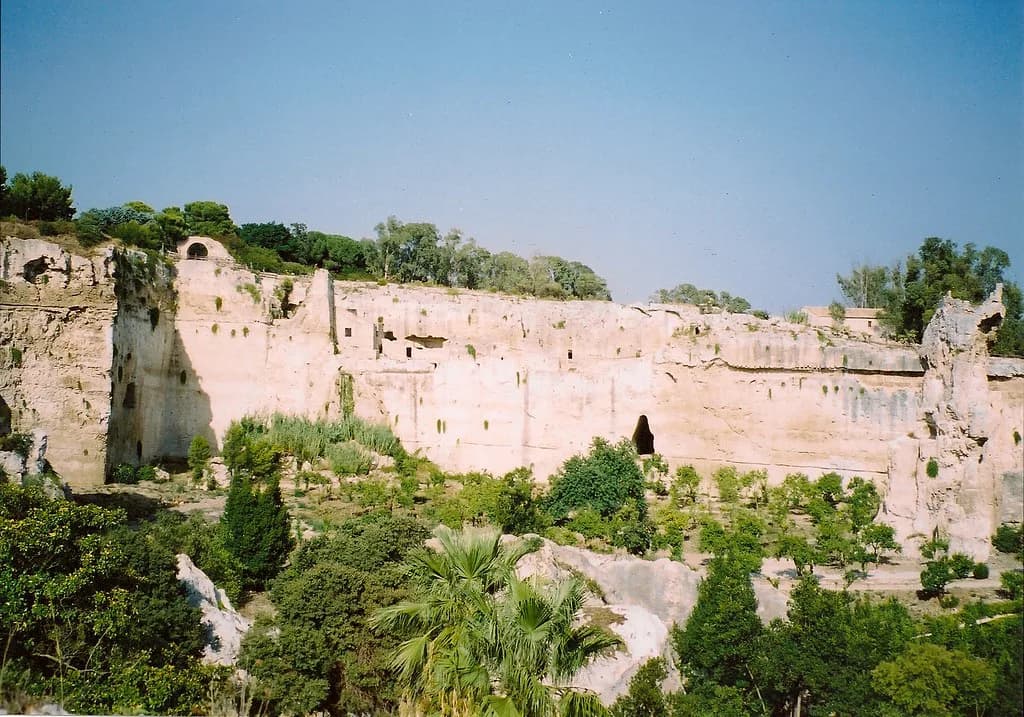
The Latomia dei Cappuccini is described as the largest of the quarries that Syracuse hollowed out of its own bedrock, a deep excavation whose walls still show how the city mined stone for its monuments. Over the centuries the same space served as a place of pagan worship, a pagan and Christian necropolis, and finally the garden of a Capuchin convent built above it. This guide treats it as a working quarry first and a monument second, because that order explains almost everything you see.
A word on planning: access, opening hours and whether any given day welcomes visitors are not fixed facts you can rely on from a guidebook. Check with the Comune di Siracusa before you build a day around this site, and treat any online listing as a prompt to verify rather than a confirmation. The historical material below is what you can count on; the logistics are yours to confirm locally.
What the Latomia dei Cappuccini Actually Is
The name comes from the Greek words for stone and cutting, and that is the plainest description of the place: a quarry where blocks were sawn and levered free, leaving sheer faces and stepped ledges behind. Syracuse's quarries sit in the northern part of the Neapolis zone, below the level of the modern streets, so you look down into them rather than up at them. The Cappuccini quarry is the biggest of the group, which is why its scale reads as a landscape rather than a hole.
Because the stone was taken away rather than built up, there is no facade, no inscription and no grand entrance to orient you. What remains is negative architecture: the shape of the void, the tool marks on the walls and the vegetation that has colonised the floor. Understanding that inversion is the key to enjoying the site, since first-time visitors often expect ruins and find a hollow instead.
The quarry's address is given as Via Puglia in Syracuse, which is useful for orientation even if you cannot rely on any single listing for current conditions. Use it to place the site on a map relative to the Neapolis monuments, then confirm the approach on the ground. Do not assume a separate ticket office or a staffed entrance exists, because nothing in the historical record guarantees one.
Where It Fits in the Story of Syracuse
Syracuse was one of the great cities of the Greek west, and its monuments were built from the rock it stood on. Quarrying began here as early as the sixth century BC, when the quarries were used to enrich the city with its monuments and public works. That long extraction is the foundation of everything else the site became.
The quarrying did not happen in a void, so to speak: it happened just outside the ancient centre, in the district the Greeks called Neapolis, where the theatre, the altar and the sanctuaries were later laid out. That proximity is why the quarries and the monuments are usually discussed together, even though they represent different phases of the city's life. If you want the wider picture of how the pieces fit, the Syracuse Attractions hub maps the sights across the city.
After the quarry stopped producing stone, the space did not stop being used. The record shows it passing through pagan worship, then a pagan and Christian necropolis, and only much later the convent that gave it its present name. That layering is the real subject of the site: not one antiquity but a stack of them, each leaving its own small traces.
How the Stone Was Worked and What It Built
The quarrying was a slow subtraction: blocks were cut free from the living rock along joints and levered out, leaving the vertical faces and right-angled corners you can still see. The floor of the quarry is not natural ground but the level at which the last blocks were removed, which is why it can feel strangely flat and enclosed. Reading the cut faces is the closest thing to watching the work happen.
The stone went into the city's public architecture, which is why a quarry visit pairs so naturally with a walk around the ancient monuments. The scale of the operation is hard to grasp until you stand in the hollow and realise how much material had to leave it. That quantity, more than any single ruin, is the quarry's real monument.
The Athenian Prisoners and the Quarry's Grim Reputation
After the failed Athenian expedition against Syracuse in 413 BC, thousands of captured soldiers were held in the city's quarries, and the Cappuccini quarry is among the places associated with that captivity. The conditions described in the ancient accounts are brutal: exposure, crowding and little shelter, with the quarries likened to a slow death sentence for those held there. Whether or not every detail can be pinned to this specific hollow, the association is central to how the site has been understood ever since. Further visitor details appear in Syracuse, Latomia dei Cappuccini - Livius.
Traces on the rock have been interpreted as evidence of how prisoners were secured, though such readings require caution. Treat these marks as layers of interpretation rather than certainties, and let the sheer walls do the arguing. The story lands best when you stand at the bottom and look up at the rim.
From Necropolis to Capuchin Convent
At the end of the sixteenth century a Capuchin convent was built above the quarry, and the friars put the hollow to work: they laid out a garden and an irrigation system, turning a sterile excavation into productive ground. The quarry thus acquired its name not from its ancient use but from the community that settled on its edge. That is a useful reminder that the site's most recent layer is also its namesake.
Before the convent, the quarry had already been reused as a place of worship and as a necropolis with pagan and Christian burials. Each phase left small marks rather than grand structures, so the evidence is subtle and easy to walk past. Knowing that the tombs and cult traces exist makes you look at the walls differently; the greenery is not simply overgrowth but the continuation of a managed garden.
What to Look For on Site
Start with the sheer cut walls, because they preserve the quarry's working logic more clearly than anything else on the floor. Look for the vertical faces, the corners where blocks were freed, and the change in rock where later cuts meet older ones. Then raise your eyes to the rim, which shows how much rock was removed and how far the ground level has been altered.
The vegetation is the second text: the subtropical growth that fills these hollows is part of what makes them memorable, and at Cappuccini it also carries the memory of the convent garden. Cypresses, palms and dense scrub soften the rock and create the enclosed, slightly theatrical atmosphere the site is known for. This is a place to look slowly rather than to photograph and leave.
Allow roughly an hour if you are inclined to sit and read the walls, and considerably less if you only want a quick look. That is a suggestion for pacing, not an official figure, so adjust it to whatever access arrangements you find on the day. If the site is closed when you arrive, the visit is simply not possible, which is why confirming first matters.
Why Grand Tour Travellers Came
In the eighteenth and nineteenth centuries, travellers on the Grand Tour came to Syracuse to see the quarries, and several recorded their reactions in letters and journals. The painter Vivant Denon visited in 1778 and is among those whose accounts survive. The site's mixture of scale, vegetation and dark history made it a set piece of the Sicilian itinerary.
The ancient and modern reputations reinforce each other: Cicero's description of the quarries as a work of kings and tyrants is quoted again and again, and later writers added their own wonder. You do not need the quotations to feel the effect, but knowing they exist explains why the place has a literary aura out of proportion to its size.
Cappuccini Versus the Latomia del Paradiso
Most visitors meet a Syracuse quarry without realising it, because the Latomia del Paradiso sits inside the Neapolis area beside the Greek theatre and the Ear of Dionysius. That quarry is famous for its cave and its connection to the theatre complex, and it is the one people usually mean when they say they have seen the latomie. Cappuccini is a different, larger hollow, with a convent garden and a burial history rather than a show cave.
The practical point is that familiarity with one quarry tells you nothing about access to another. Do not assume the Cappuccini quarry shares the ticket, opening arrangements or guided routes of the Neapolis complex. Check each site separately, and read the Neapolis Archaeological Park Visitor Guide to understand what that ticketed area does and does not include.
Practical Planning: What to Confirm Before You Travel
The Comune di Siracusa publishes city services and notices, and its tourism pages are the sensible starting point for current information about monuments under municipal care. Look there, and consider contacting the tourist office directly, before you commit a morning to this site. The municipality does not, in what it currently publishes, set out a distinct visitor schedule for the Cappuccini quarry.
Three questions are worth asking in advance: whether the site is open to the public at the moment, whether any organised programme is running, and how you are meant to reach it on foot. The quarry is associated in the past with occasional cultural events, but no current dates or programme are published for those, so do not plan around them. Guided visits and bookings cannot be assumed either; ask rather than expect.
Treat any price, entry condition or closure you find online as unverified until the municipality or an on-site source confirms it. That caution is not pedantry: quarry sites in Syracuse have different management arrangements, and the Cappuccini quarry should not be assumed to share the ticketing of the paid Neapolis park. If you need certainty, plan your day around monuments with published arrangements and treat this one as a bonus.
Nearby Syracuse Context to Pair With the Quarry
The Neapolis zone is the natural companion, since the Greek theatre, the altar and the other quarries sit in the same northern district. Build a half-day around that cluster and slot the Cappuccini quarry in if access allows. A slower second half-day can go to Ortigia, where the cathedral, the fountain and the sea walls give a completely different view of the city.
For the finds that came out of this landscape, the Paolo Orsi Archaeological Museum is the obvious complement, with collections covering the Greek city and its hinterland. If your interest is underground Syracuse more broadly, the Catacombs of San Giovanni in Syracuse are a separate ticketed site with its own arrangements. For quieter corners of the city, our guide to hidden gems in Syracuse is a reasonable place to start.
Plan Your Visit
The Latomia dei Cappuccini rewards a specific kind of visitor: someone willing to look at a hollow in the rock and see the quarrying, the burials, the convent garden and the Grand Tour enthusiasm as one story. It does not offer a polished, signposted experience, and the sources do not promise one. Go for the scale and the silence rather than for a checklist of sights.
Before you go, check the municipal website for current visitor information and ask directly if anything is unclear. Keep the quarry as an optional stop within a Neapolis day rather than the anchor, and you will never be disappointed by a closed gate. If access is not possible, the other quarries, the theatre and the museum still tell most of the same story.
Frequently Asked Questions
What is the Latomia dei Cappuccini and why is it significant?
It is the largest of Syracuse's ancient quarries, a deep hollow cut into the rock north of the city centre. It is significant because it preserves the marks of stone extraction from the sixth century BC, then later use as a pagan and Christian burial ground, and finally a Capuchin convent garden built on its rim.
How old is the quarry and when was it used?
Quarrying is recorded from the sixth century BC, when the stone was taken for the city's monuments. After extraction ended, the space was reused as a place of worship and as a necropolis, and at the end of the sixteenth century a Capuchin convent was built above it and a garden laid out inside.
Is the Latomia dei Cappuccini the largest quarry in Syracuse?
Sources describe it as the largest of Syracuse's quarries, which is part of why it feels like a landscape rather than a pit. The more famous Latomia del Paradiso, next to the Greek theatre, contains the Ear of Dionysius but is a different, smaller hollow with a different history.
What happened to the Athenian prisoners held in the quarries?
After the Athenian expedition failed in 413 BC, thousands of captured soldiers were held in Syracuse's quarries under conditions the ancient accounts describe as brutal. The Cappuccini quarry is among those associated with that captivity, and marks on the rock have been interpreted as traces of how prisoners were held.
Can you visit the Latomia dei Cappuccini, and do you need to book?
Access is not something a guide can guarantee. Check with the Comune di Siracusa and ask the local tourist office whether the site is open at the time of your visit and whether any booking is needed. Guided visits cannot be assumed.
Is the Latomia dei Cappuccini included in the Neapolis Archaeological Park ticket?
Do not assume it is. The Cappuccini quarry lies in the same northern district as the Neapolis monuments, but ticket scope is not guaranteed for it, so verify separately with the municipality rather than buying a park ticket expecting entry.
How does it compare with the Latomia del Paradiso and the Ear of Dionysius?
The Latomia del Paradiso is the quarry most visitors see, because it sits beside the Greek theatre and contains the Ear of Dionysius. The Cappuccini quarry is larger, less visited in practice as part of a monument circuit, and shaped by its convent garden and burial history rather than by a show cave.
How long should you spend at the Latomia dei Cappuccini?
As a suggested pace rather than an official figure, allow around an hour if you like reading the cut walls and sitting in the greenery, and less for a quick look. Since access is uncertain, keep it as an optional stop within a half-day at the Neapolis monuments.
Sources
Continue exploring
More guides you'll find useful