Syracuse in 2 Days: A Balanced Ortigia & Neapolis Itinerary
Plan two balanced days in Syracuse: Ortigia's Piazza Duomo and cathedral, then the Neapolis park with the Greek Theatre and Ear of Dionysius.
On this page
Two days is a workable allowance for Syracuse, because the city's highlights fall into two distinct zones. Ortigia, the island old town, holds the cathedral, the baroque piazzas and the waterfront. The mainland Neapolis district holds the Greek Theatre, the Roman amphitheatre and the quarries. Splitting the days by geography rather than mixing them saves a lot of walking back and forth.
A concrete anchor for planning: the Ear of Dionysius, the S-shaped cave inside the Neapolis park, is described by one hotel travel blog as roughly 23 metres high with a depth of about 65 metres. Treat those figures as approximate description rather than official survey data. What matters for your itinerary is that the cave sits inside a large quarry complex, so you should budget real time for the park rather than treating it as a quick photo stop.
This plan assumes you sleep in Syracuse at least one night and start fresh both mornings. It deliberately leaves room for heat, slow lunches and unplanned wandering, since Ortigia rewards exactly that. Everything about hours, tickets and closures must be checked with the site or the city before you travel.
Before You Go: Choosing the Order of Your Two Days
The conventional order, Ortigia first and the archaeological park second, works well because the island is compact and easy to explore on arrival while you find your bearings. Doing the park first also has merit if you want the physically bigger day out of the way early. Either way, keep each day in one zone.
Decide whether to base yourself on Ortigia or on the mainland near the Neapolis park. Ortigia puts dinner, evening walks and the cathedral on your doorstep; the mainland side shortens the morning commute to the ruins. Neither choice is wrong, and both are within walking reach of the other side of the city for most visitors.
Before booking anything, check the Comune di Siracusa site for city notices and the individual site operators for opening arrangements, since these can change seasonally. Third-party listing sites often recycle outdated hours, so treat them as background only. If you are weighing a shorter trip, the one-day version concentrates on Ortigia alone.
Day 1, Morning: Piazza Duomo and the Cathedral
Start on Ortigia at Piazza Duomo, a semi-oval square framed by baroque palaces including Palazzo del Senato, now the city hall, and Palazzo Beneventano del Bosco opposite. The cathedral is the centrepiece, and its history is the reason to linger rather than photograph and move on.
The cathedral occupies the site of an ancient temple to Athena. The Byzantines converted the temple into a church and walled up the gaps between the Doric columns, and those columns are still visible inside along the left nave. The baroque facade you see from the square dates from the early eighteenth century, after the 1693 earthquake.
Plan your morning around the square itself, which is public space and free to walk through. Whether you can or should enter the cathedral interior, and on what terms, is something to confirm locally on the day. Do not assume free access to interiors anywhere in the city on the basis of an aggregator listing.
Allow time for the church of Santa Lucia alla Badia on the square, whose Sicilian baroque facade is worth a look, and for a coffee at one of the cafe terraces lining the piazza. This is the moment to slow down rather than tick off sights.
Day 1, Midday: Fonte Aretusa and the Southern Tip
From Piazza Duomo, walk south through Ortigia toward Fonte Aretusa, the spring-fed pool near the sea, then follow the Lungomare Alfeo along the water to the island's southern tip. The walk is short and level, and it strings together the old town's most photogenic edges.
At the tip stands Castello Maniace, built from 1232 under Frederick II of Swabia and later reshaped over centuries. It is worth knowing in advance that the castle can only be visited in part because it remains a military property, so plan for the approach, the outer walls and the sea views rather than an unrestricted interior tour.
Eating near the water at midday is tempting, but the stretch around Piazza Duomo usually gives you more choice and a shorter wait outside peak hours. Wherever you eat, sit down properly: this is the day for a long lunch, not a sandwich on the move.
Day 1, Afternoon: Palazzo Bellomo or a Slow Waterfront
The afternoon presents a genuine fork. One option is Palazzo Bellomo, the Swabian-era palace on Ortigia that now holds the regional museum, with medieval and modern art including Caravaggio's Burial of Saint Lucia. The other is to skip museums entirely and drift along the waterfront.
If art and church interiors appeal, Palazzo Bellomo is the more focused choice on the island. If you have already had a heavy travel day, the waterfront afternoon will leave you fresher for the archaeological park tomorrow. Choosing one over the other is better than rushing both.
Note the split between free public space and ticketed collections: the piazzas and the lungomare cost nothing, while museum interiors are separate paid visits with their own arrangements. Confirm current opening days and admission directly with each museum before you go, because published third-party hours vary.
Day 1, Evening: Dinner and a Lit-Up Piazza
Return to Piazza Duomo in the evening, when the palaces and cathedral are lit and the terraces fill up. The square is one of the finest in Italy and rewards a slow circuit on foot after dinner rather than a hurried look.
Resist overplanning the evening. Book one table near the piazza, eat unhurriedly, then walk the lanes of Ortigia without a route. If you want more unusual corners for the walk, keep a short list ready from our guide to hidden gems in Syracuse so you are not scrolling at the table.
Day 2, Morning: The Neapolis Archaeological Park
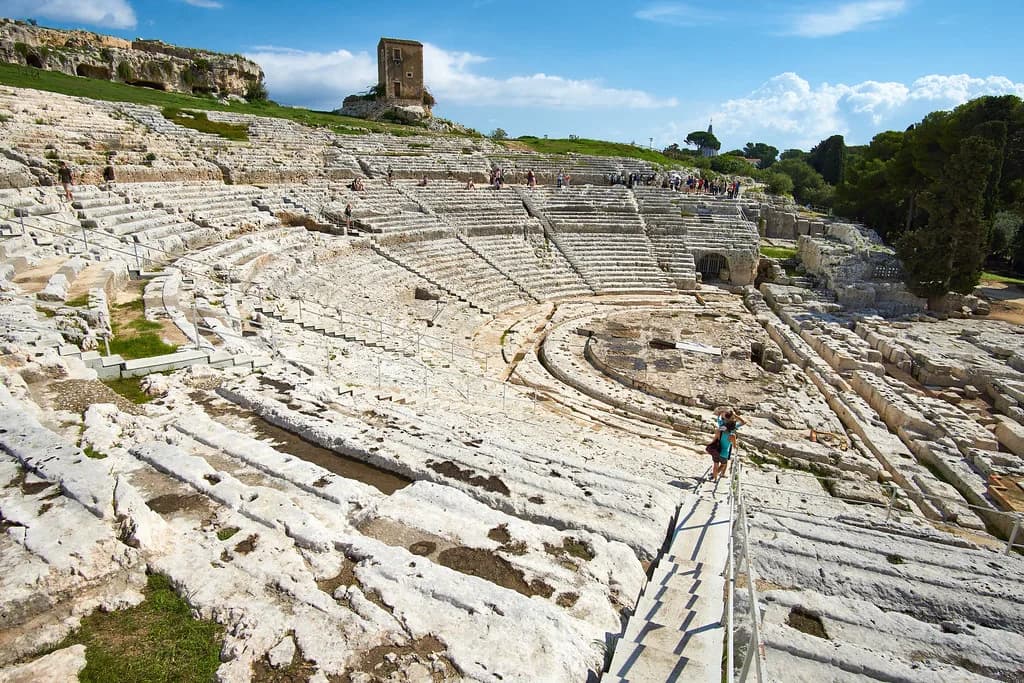
Cross to the mainland and give the Neapolis Archaeological Park a full morning. The complex spreads across a large area of the ancient city and holds the Greek Theatre, the Roman amphitheatre, the Altar of Hieron II and the quarries, so a leisurely circuit rather than a checklist is the realistic approach.
A sensible route starts with the Roman amphitheatre near the entrance, continues past the altar to the Greek Theatre, and finishes in the Latomia del Paradiso quarry with the Ear of Dionysius. That sequence minimizes backtracking across the site and keeps the cave as a finale rather than a detour.
The Greek Theatre was originally cut in the sixth century BC and later adapted by the Romans for other spectacles. It remains the park's headline monument, so arrive early to see it before tour groups gather and the Sicilian sun intensifies. Shade inside the park is limited in the open areas.
Do not rely on memory or aggregator pages for opening hours or ticket prices. These change and the listings in circulation are often undated. Check the official park operator and the city's tourism pages the week you travel, and note that some dates carry free or reduced entry schemes that must be confirmed rather than assumed.
Day 2, Midday: The Ear of Dionysius, Legend and Geology
The Ear of Dionysius is the park's most theatrical moment, an S-shaped cave carved out of the quarry rock. Its distinctive shape amplifies sound, and the acoustics are genuinely striking, whatever explanation you prefer.
The popular story is that the tyrant Dionysius I used the cave as a prison and eavesdropped on his captives from above. A more sober reading is geological: an ancient aqueduct above the cavity guided the way the rock was cut, which explains the unusual S-curve without any surveillance scheme. Both versions are worth knowing, and neither is settled.
The name itself is traditionally credited to Caravaggio, said to have likened the cave to an ear during his time in Sicily in the early seventeenth century. Treat the attribution as tradition rather than documented fact. Inside the cave, try the acoustics for yourself and let the guide or signage frame the rest.
Day 2, Afternoon: Museums for Context
After the park, the Regional Archaeological Museum Paolo Orsi is the natural follow-up, holding finds from prehistoric through Roman times that give context to what you have just walked through. The museum sits in the Villa Landolina area, separate from the park and separately ticketed.
If your energy is fading, the Papyrus Museum is the lighter alternative, a small museum devoted to the plant that grows naturally in the Syracuse area. Treat it as a distinct museum with its own location and admission, and verify the address before you set out, since published addresses conflict between sources.
A suggested two to three hours is a reasonable allowance for the Paolo Orsi collection if you read the labels; half that if you move briskly. That is a planning estimate, not official guidance. If the park ran long, pick one museum and do it properly rather than squeezing in both.
Both museums sit on the mainland side of the city, so group them with your Neapolis morning rather than returning to Ortigia in between. The combined walk keeps your day coherent.
Day 2, Late Afternoon: The Catacombs Alternative
If Roman ruins leave you cold, swap the museums for the Basilica and Catacombe di San Giovanni, an early Christian complex with underground galleries that offers a different kind of history from the Greek and Roman sites. It makes a strong second act after a shorter park visit.
The trade-off is real: the catacombs reward those interested in early Christianity more than those chasing classical monuments. Read a short description before committing, and check visiting arrangements directly with the site. If you have a third day, you can fit both without a compromise.
Practical Trade-offs: Heat, Walking and Splitting the Group
Syracuse gets hot, and the Neapolis park offers little shade in its open sections, so plan the archaeological morning early and keep the afternoon for interiors or the waterfront. Bring water and a hat. The quarry gardens are greener and cooler, which is another reason to end the park circuit there.
Ortigia is compact enough to walk end to end comfortably, which is why the island day needs no transport planning. The mainland side requires a bit more effort to reach on foot, and you should build in the crossing time rather than assuming it is instant. Confirm local routes and any limited-traffic rules in the old town through the city's own pages.
If one traveller wants ruins and the other wants churches, split for an afternoon rather than compromising both days. The two zones are separate enough that you can meet back on Ortigia for dinner. Our neighbourhood guide to the Neapolis district helps if you want to explore the area around the park more slowly.
Where to Eat and Sleep on a Two-Day Route
Match your bed to your route. Staying on Ortigia puts Piazza Duomo, the lungomare and the evening passeggiata within a few minutes of your door, at the cost of a longer morning walk or crossing to the park. Staying near the Neapolis district reverses the trade-off.
For food, treat the terraces around Piazza Duomo as your evening base and the streets near the park as a lunch stop on day two. Neither needs to be booked far ahead outside peak season, but reserving one dinner table removes the pressure of hunting for a seat after a long day of walking.
Travel writers who cover Syracuse repeatedly describe the city as easy to combine with the rest of southeastern Sicily, which is why two days here often sits inside a longer island route. If that is your plan, keep the schedule loose so a delayed morning does not unravel the next stop.
Plan Your Visit
Two days in Syracuse work best when you resist the urge to cram. Give Ortigia a full day of squares, cathedral history, waterfront and a slow evening, then give the Neapolis park a full morning followed by one museum. The itinerary is deliberately not maximalist, because the city rewards lingering more than ticking boxes.
Before you travel, verify hours, tickets and any closures with the official sites and the city, since third-party listings in circulation are often undated. Book only what you must, and leave room for the unexpected, which is where the best parts of a Syracuse trip usually come from. For a wider spread of things to see, browse our Syracuse attractions hub.
Frequently Asked Questions
How many days do you need in Siracusa?
Two full days cover the essentials: one day on Ortigia and one for the Neapolis archaeological zone plus a museum. Add a third day if you want the catacombs, a slower waterfront afternoon, or more time in the museums without rushing.
Can you walk to Ortigia from Siracusa?
Ortigia is connected to the mainland by short bridges, and the island itself is compact enough to cross on foot. Plan extra time for the crossing on your park day rather than assuming it is instant, and check any limited-traffic rules in the old town with the city.
Is the Neapolis Archaeological Park worth a full day?
A full morning is a realistic allowance for most visitors, given the Greek Theatre, the Roman amphitheatre, the altar and the quarries. Pair it with one museum in the afternoon rather than stretching the park across a whole day.
Should you visit Ortigia or the archaeological park first?
Ortigia first is the calmer start, letting you settle in around the piazza and the waterfront. Doing the park first also works if you prefer to tackle the largest site while you are freshest. Keep each day in one zone either way.
Do you need tickets for Syracuse Cathedral?
Check the cathedral's own visitor information and confirm interior access terms locally on the day. Do not rely on aggregator listings for admission arrangements, and treat the surrounding piazza as free public space regardless.
What is the Ear of Dionysius and is the legend true?
It is an S-shaped cave in the Latomia del Paradiso quarry. The story that the tyrant Dionysius used it to eavesdrop on prisoners is legend; a competing explanation credits an ancient aqueduct above the cavity for the shape. Neither is conclusively settled.
Is the Papyrus Museum inside the Paolo Orsi museum?
They are separate museums with separate arrangements, and published addresses for the Papyrus Museum differ between sources. Verify the current location before setting out rather than assuming they share a site.
What can you do in Syracuse in two days if it rains?
Shift weight to interiors: the cathedral, Palazzo Bellomo, the Paolo Orsi museum or the Papyrus Museum, and a long lunch. Leave the open-air park for a dry morning, and check each site's opening days before rearranging your plans.
Sources
- Comune di Siracusa
- Syracuse itineraries and travel guides – Wanderlog
- Papyrus Museum "Corrado Basile" Biletleri [2026] - Promosyonlar, Fiyatlar, Yorumlar ve Çalışma Saatleri | Trip.com
- The Ear of Dionysus, in Syracuse: between legends and nature
- Catania & surrounding area
- Maniace Castle in Syracuse: Discover the Majestic Bastion on the Sea
- Duomo Square - Syracuse (Siracusa), Sicily - Italy - ItalyGuides.it
- Piazza Duomo, a beauty by day or by night
- Syracuse ... The Archaeological Park
- Basilica & Catacombe di San Giovanni | Syracuse, Italy | Attractions - Lonely Planet
- Siracusa's Museums - Love Sicily
Continue exploring
More guides you'll find useful