Pisa Churches Guide: Romanesque and Gothic Highlights
Choose which Pisa churches to visit beyond the cathedral, from Pisan Gothic Santa Maria della Spina to Romanesque San Paolo a Ripa d'Arno and its chapel.
On this page
Almost every visitor to Pisa walks across Piazza dei Miracoli, photographs the Tower, and moves on without stepping into the churches a few metres away. That is a shame, because the square holds four separate monuments built in the same white Carrara marble, and the city itself keeps smaller Romanesque and Gothic churches along the Arno that many day-trippers never reach. This guide helps you decide which ones fit your time.
One concrete detail worth knowing before you plan: the Opera della Primaziale Pisana states that the Tower visit takes about 30 minutes on foot up 251 steps, and that children who will not have turned eight by the end of the year are not admitted. Those official terms shape how much time and energy you will have left for churches, so treat the climb as a scheduled commitment rather than a spontaneous stop.
The through-line for the rest of the day is sculpture. Two pulpits carved roughly forty years apart, one by Nicola Pisano in the Baptistery and one by his son Giovanni in the Cathedral, sit within a short stroll of each other and show how Italian sculpture moved from weighty classical modelling toward restless Gothic drama.
How to Read Pisan Romanesque and Gothic
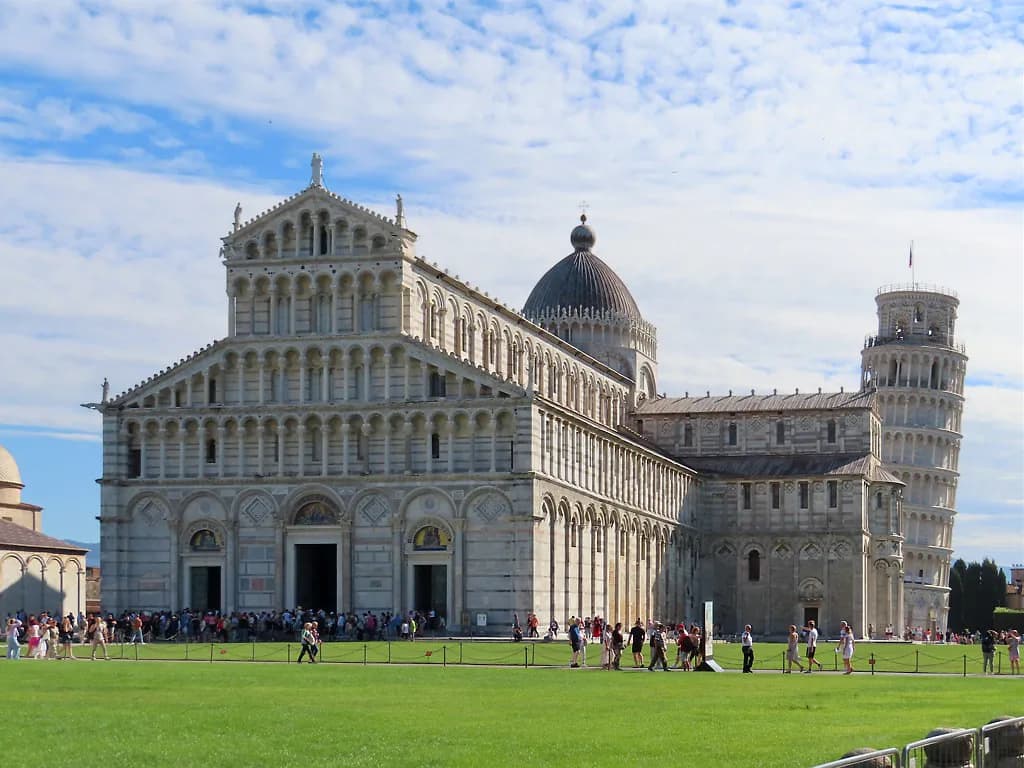
Pisan Romanesque is recognisable before you read a single label. Look for striped marble bands, blind arcading and stacked open galleries across facades, a style that borrowed from Byzantine, Arab and Norman sources because Pisa was a maritime republic trading across the Mediterranean. The Cathedral, begun in the 11th century, is the model; the smaller churches repeat its grammar at a domestic scale.
Pisan Gothic arrives later and lighter. Santa Maria della Spina is the clearest small-scale example, with a west front of gables and rose windows and a riverside flank of arches and niches holding figures of Christ and the Apostles. Once you have noticed the contrast between the heavy arcaded Romanesque facades and this slender, pinnacled Gothic box, the rest of the city becomes readable.
The pulpits tie the two styles together. Nicola Pisano's pulpit in the Baptistery, completed in 1260, models its figures on Roman sarcophagi, while Giovanni Pisano's Cathedral pulpit of 1302 to 1311 pushes the same stories into compressed drama. Seeing both in one morning is the single most instructive exercise available on the square.
Piazza dei Miracoli: Four Monuments, Not One Ticket
The square officially called Piazza del Duomo holds four distinct monuments: the Cathedral, the Baptistery, the Leaning Tower that serves as the Cathedral's bell tower, and the Camposanto Monumentale. They share a building tradition and a marble source, but they do not share a single admission arrangement, so decide which interiors you actually want before you arrive.
The Cathedral is a working place of worship, and the Opera della Primaziale Pisana asks visitors to dress and behave accordingly; the operator notes that shawls are sold in the bookshops inside its two museums for anyone caught out. Admission arrangements are published on the operator's own pages rather than fixed here, because pass systems and booking rules are exactly the kind of detail that changes. Read the operator's ticket-advice page before you rely on any blog, including this one.
For the Tower, the operator publishes the terms that matter. Under-18s must be accompanied by an adult, ID may be requested to certify age, bags and luggage go to the cloakroom before the visit, and the operator advises against the climb for people with cardiovascular or muscular problems. Late arrivals are refused without refund, so treat your slot time as firm.
The Baptistery, Camposanto, Sinopie Museum and Opera del Duomo Museum form the ticketed group, and the operator describes a ticket in that group as valid from the chosen date for a year, so you can spread those interiors across a longer stay. The Cathedral sits outside that logic with its own pass arrangement. Do not assume one purchase covers everything on the square.
The Baptistery is the largest in Italy, 34 metres across with a dome rising to 55 metres, and its circular interior produces the echo that guides often demonstrate with a sung note. At its centre stands the original octagonal font, carved for full-immersion adult baptism, which explains its size. Budget real time here rather than treating it as a photo stop on the way to the Tower.
The Camposanto is the fourth monument, a monumental cemetery begun in the late 13th century around a courtyard traditionally said to contain soil brought from Golgotha. Its frescoes were badly damaged in 1944 when a fire destroyed the lead roof, and the preparatory drawings beneath them, the sinopie, now form their own museum collection. The operator's Sinopie Museum page explains that those drawings were revealed only because the surviving frescoes had to be detached after the wartime fire.
Santa Maria della Spina: Gothic on the Arno
Santa Maria della Spina sits on the left bank of the Arno and is small enough to walk past by mistake, which is part of its appeal. It began around 1230 as an oratory known as Santa Maria di Pontenovo, named for a nearby bridge that collapsed in the 15th century and was never rebuilt, and was enlarged in 1325. The result is a compact Gothic jewel box rather than a barn-like cathedral.
The name is a relic story, not an architectural label. The church acquired a relic believed to be a thorn from Christ's crown of thorns in 1333, which made it a pilgrimage site and gave it the name della Spina, of the Thorn. Look for the two doorways and three gables with small rose windows on the west front, and the arcaded south side facing the river.
The statue of the Virgin and Child on the highest spire is a copy; the original is kept in the National Museum of San Matteo, so sculpture-hunters should add that museum to the list rather than squint at the roofline. This remains a consecrated space, so modest dress is appropriate. Opening arrangements for small city churches are volatile; confirm them locally rather than fixing a schedule around this one building.
San Paolo a Ripa d'Arno and the St Agatha Chapel
San Paolo a Ripa d'Arno stands in a tree-lined square on Lungarno Sonnino, south along the river from Santa Maria della Spina, and is known locally as the Duomo Vecchio, or old cathedral. It is one of Pisa's oldest buildings, founded according to tradition in the early ninth century, and its facade reuses Roman stones in bichrome marble bands with blind arches and loggias above.
Inside, the plan is a Latin cross with a nave and two aisles on Elban granite columns, and the church holds a second-century Roman sarcophagus reused as a medieval tomb. Its reliefs were studied as models by Nicola Pisano and his pupil Arnolfo di Cambio, which makes this riverside church a useful missing link if you have already seen the pulpits on Piazza dei Miracoli.
Behind the church stands the small octagonal Chapel of St Agatha, built in the 11th century to mark a Pisan victory over the Palermitans. Buildings that once linked it to the church were demolished after the Second World War, which is why the chapel now reads as a free-standing structure in its own right. Treat church and chapel as one stop, a short walk from the Spina.
This is first and foremost an active parish church rather than a monument with a turnstile, so visits fit around services. One long-standing description notes that the church is open to the public during mass, a reminder to check local notices rather than assume all-day access. Confirm the current situation before planning the walk south from Ponte Solferino.
City-Centre Churches for a Short Detour
San Michele in Borgo, a church built toward the end of the 10th century, packs several architectural phases into one facade and sits on the busy street of the same name between the river and the cathedral quarter. Because it lies on a natural walking route through the centre, it costs you little to step inside on the way through rather than making a special trip.
Santo Stefano dei Cavalieri on Piazza dei Cavalieri began construction in April 1565 under the Knights of St Stephen, and its position on Pisa's second great square makes it an easy add-on if you are following the Medici thread through the city. San Michele degli Scalzi, in the eastern part of Pisa, is further out and better suited to a longer wander than a rushed half day.
The city tourism portal is the sensible first check for what is currently open or running, since it lists exhibitions, markets and events alongside its itineraries for the historic centre and the riverside. Its themed walking routes, including one on medieval Pisa, are a reasonable way to string several churches together without inventing your own circuit.
Practical Constraints Before You Set Out
Separate worship from sightseeing in your planning. The Cathedral and the riverside churches are active religious spaces where dress and behaviour matter, while the Baptistery, Camposanto and the two museums are ticketed collections with published conditions. Mixing the two in one itinerary is fine; assuming identical rules is not.
The Opera della Primaziale Pisana applies security measures across its monuments: large luggage and suitcases are not allowed, and only small bags or backpacks within 20 by 30 by 38 centimetres are accepted. Animals are excluded except certified guide dogs. These rules are scoped to the Piazza del Duomo monuments, so if you carry a daypack, plan a cloakroom stop before any Tower climb.
Prices, time slots and opening hours are all volatile and should come from the operator rather than from any secondary guide. The Opera della Primaziale Pisana states plainly that it is responsible only for the prices published on its own site and at its on-site ticket offices, which is a good reason to ignore figures quoted elsewhere. Check the official pages in the week before you travel.
The city portal is useful for the wider picture, including seasonal events and temporary exhibitions that might change your dates. Use it to check whether anything unusual overlaps your stay, and to confirm that the smaller churches you want are reachable on foot from your route rather than depending on a specific bus.
Fitting Churches Into a Short Stay
For a half day centred on the Tower, give the square itself the bulk of your time: the Cathedral, the Baptistery and, if you have the appetite, the Camposanto and one museum. A suggested pattern is to book your Tower slot first, then fill the hours around it with interiors, since the climb has a fixed time and a refusal policy for lateness. This is a planning suggestion, not an official schedule.
If you have a full day, add the river walk. Start at Santa Maria della Spina on the Arno, continue south along Lungarno Sonnino to San Paolo a Ripa d'Arno and the St Agatha chapel, then cut back through the centre past San Michele in Borgo. That route is compact on foot and gives you Gothic and Romanesque in one loop rather than as separate excursions.
Travellers based in Pisa for longer, or using it as a base, can spread the ticketed interiors across different days because the museum ticket remains valid from the chosen date for a year. That makes it sensible to pair the square with a day trip rather than force everything into one visit. Options such as Lucca suit a slower second day.
If your tastes run to the overlooked, the city rewards wandering beyond the postcard circuit, from medieval lanes to riverbank corners that rarely appear on a half-day tour. Build in unstructured time and let the churches be stops rather than destinations. The wider collection of hidden gems in Pisa is a good place to start shaping that day.
Plan Your Visit
The simplest way to choose is by style and by time. Short on hours: stay on Piazza dei Miracoli and prioritise the Cathedral and Baptistery interiors around your Tower slot. A full day: add the Arno walk to Santa Maria della Spina and San Paolo a Ripa d'Arno. Either way, confirm current arrangements with the operator and the city tourism portal before you go.
Two habits will save you trouble: carry only a small bag if you plan to climb the Tower, and treat published opening hours and admission details as provisional until checked on official pages. The churches themselves reward a slower pace, so leave room to sit in a pew or stand in front of a pulpit panel for longer than your itinerary suggests.
Frequently Asked Questions
Which Pisa churches are worth visiting beyond the cathedral?
Santa Maria della Spina is the most distinctive for its riverside Pisan Gothic facade and its thorn relic history. San Paolo a Ripa d'Arno, known as the old cathedral, pairs a Romanesque interior and a reused Roman sarcophagus with the small octagonal St Agatha chapel behind it. San Michele in Borgo is a convenient city-centre stop on a walking route.
What is Santa Maria della Spina known for?
It is known for its compact Pisan Gothic architecture on the left bank of the Arno and for the relic of a thorn from Christ's crown of thorns, acquired in 1333, which gave the church its name. It began around 1230 as an oratory and was enlarged in 1325.
Why is San Paolo a Ripa d'Arno called the old cathedral?
The nickname Duomo Vecchio reflects its former role before the Cathedral on Piazza dei Miracoli took over that function. It is one of Pisa's oldest buildings, traditionally founded in the early ninth century, and its interior holds a second-century Roman sarcophagus that influenced Nicola Pisano and Arnolfo di Cambio.
Do you need a ticket to enter Pisa's churches?
It depends on the building. The Baptistery, Camposanto, Sinopie Museum and Opera del Duomo Museum are ticketed collections managed by the Opera della Primaziale Pisana, while the city churches are active places of worship with their own arrangements. The Cathedral has a separate pass system published by the operator, so check its pages rather than assuming one ticket covers the square.
How should I dress when visiting churches in Pisa?
Cover shoulders and knees and behave as you would in any working church. The Opera della Primaziale Pisana asks visitors to dress and behave appropriately in the Cathedral and notes that shawls are sold in the bookshops inside its two museums if you are caught out. The riverside churches are consecrated spaces too, so the same courtesy applies.
How long do the Piazza dei Miracoli monuments take?
The Tower climb itself is scheduled for about 30 minutes, and the operator states 251 steps on foot. Most visitors spend longer on the square overall once the Cathedral, Baptistery and any museum are added, so allow a half day if you want interiors rather than just photographs. Confirm current opening times with the operator before fixing a schedule.
Sources
- Home | Comune di Pisa - Turismo
- Santa Maria Della Spina: Audio Guide
- Must Visit Catholic Churches in Pisa
- Exhibition "Pisa and its territory. A look from the sky" | Comune di Pisa - Turismo
- The Complete Guide to Tuscany | Pisa | Chiesa di San Paolo a Ripa d'Arno | Podere Santa Pia, Holiday house in the south of Tuscany
- Opera della Primaziale Pisana: sito ufficiale – A few words of advice before you buy your ticket
- Opera della Primaziale Pisana: sito ufficiale – Sinopie Museum
Continue exploring
More guides you'll find useful