San Paolo a Ripa d'Arno: Pisa's Duomo Vecchio Church Guide
A visitor guide to San Paolo a Ripa d'Arno in Pisa: its Romanesque facade, three-nave interior, Roman sarcophagus and the Chapel of Sant'Agata behind it.
On this page
Most Pisa itineraries are built around one square, but the city's Romanesque churches are scattered across both banks of the Arno, and the south bank holds one of the most rewarding. San Paolo a Ripa d'Arno stands on Lungarno Sonnino, in a tree-lined square a short way downstream from the river's central bends. It is a working church rather than a museum set piece, and the published guidance is simple: it is open to the public during mass.
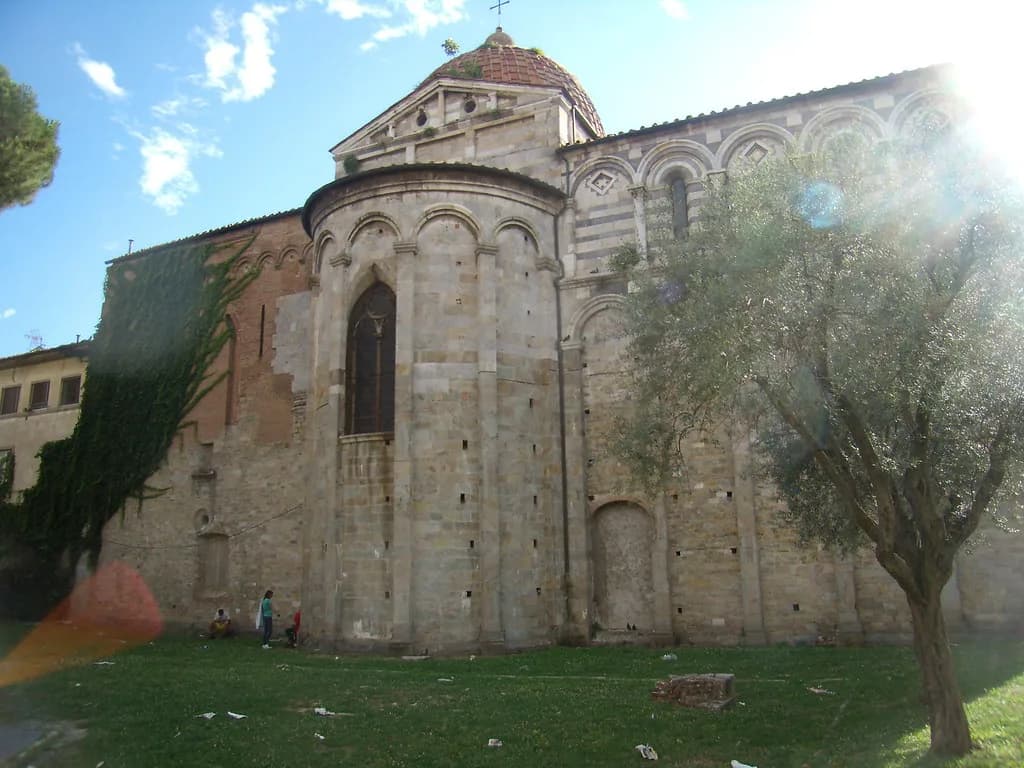
The building rewards anyone willing to look slowly. Bichrome marble banding, blind arches and tiers of loggias run across the facade, while the interior opens into a plain Latin-cross plan of granite columns, apse and dome. The small octagonal Chapel of Sant'Agata sits just behind it, a separate structure with its own story.
Why San Paolo a Ripa d'Arno Is Called the Duomo Vecchio
The nickname Duomo Vecchio, or Old Cathedral, is the key to the church's standing. Before Santa Maria Assunta was completed on Piazza dei Miracoli, San Paolo a Ripa d'Arno served a cathedral function, which is why local tradition and guide sources still call it the old cathedral. That earlier role explains why a church this far from the tourist core carries such architectural weight.
Founding dates are less settled than the nickname suggests. One guide states the church was founded in 803, another traces the reports to around 925 and describes a church structure existing by 1032, and a third places the foundation between the 9th and 10th centuries. Treat these as competing traditions rather than a single verified date, and read any plaque or leaflet you find on site as one version of the story.
The later record is easier to follow. The complex passed through Benedictine and Vallombrosian hands and later the Order of the Knights of St. Stephen, became a parish after the order's suppression in 1798, and was substantially reworked in the 19th century to recover its Romanesque character. War damage in the 1940s led to restoration work in 1949 to 1952.
Reading the Facade
Start outside, because the exterior carries the church's most legible messages. Bands of bichrome marble, some of it reusing Roman stone, divide the facade, and pilaster strips frame blind arches across the lower registers. Higher up, three orders of loggias lighten the composition, a hallmark of the Pisan Romanesque language shared with the city's better-known monuments.
Attribution of the upper facade is cautious in the sources: it was designed in the 12th century but completed later, possibly in the 14th century and possibly by Giovanni Pisano. Walk to the river side and then around the apse to see how the banding continues; the effect is subtler than the marble screens at the Camposanto, which is part of why the church reads as a neighbourhood building rather than a showcase.
Inside: Granite Columns, Apse and Dome
The interior is a Latin cross with a nave and two aisles divided by columns of Elban granite, ending in an apse, with a dome over the crossing. After the density of the facade, the effect is deliberately spare: plain surfaces, a clear structural rhythm, and light falling from the upper windows. It is a good place to slow down rather than tick off highlights.
That restraint is the contrast worth noticing. Piazza dei Miracoli concentrates multi-coloured marble surfaces and crowds; here the architectural ideas are the same family, but the experience is quieter structurally and visually. If you have already walked the monumental square, this is where you can read a Pisan church's bones without the overlay of a ticketed visitor circuit.
What to Look For: Sarcophagus, Crucifix and Frescoes
Inside, the object most often singled out is a 2nd-century Roman sarcophagus reused as a medieval tomb, with reliefs that later served as a model for Nicola Pisano and his pupil Arnolfo di Cambio. A related tradition holds that the sarcophagus above the left-hand door contains the body of Burgundio, the 13th-century philologist. Look for the carving before reading the labels; the reuse is the story.
Other works cited include a 13th-century painted Crucifix, frescoes by Buonamico Buffalmacco and a Madonna with Saints by Turino Vanni from the 14th century. Condition, placement and whether a given piece is on view can change with restoration, so ask at the parish if a specific work is your reason for coming. Several comparable Pisan panels are held in the city's museums.
The Chapel of Sant'Agata Behind the Church
Behind San Paolo a Ripa d'Arno stands a small octagonal brick chapel, built around 1063 by the monks according to one source, which ties its origin to a Pisan victory over the Palermitans. It has pilasters, arches with mullioned windows, an unusual pyramidal cusp and traces of 12th-century wall decoration inside. Treat it as a separate stop, not an annex you glance at on the way out.
The chapel once connected to the church through surrounding buildings. Those structures were demolished during the post-war restoration of 1949 to 1952, which left Sant'Agata standing free in its original isolated form. Whether you can step inside on a given day is not something published schedules settle, so ask at the church rather than assuming the chapel is open.
Practical Visiting: Mass Times and What Is Not Published
The most reliable practical fact is that the church is open to the public during mass, so a visit should be planned around liturgy rather than around a fixed monument timetable. The city's tourism portal lists events and city-wide visitor information, but it does not publish a standalone visiting schedule for this church. Check the parish's own notices or the notice board at the entrance before making a special trip.
Several things travellers often ask about are simply not confirmed by available sources: current opening hours beyond mass, any entry fee, garden or green-space access, step-free entry, parking and bus routes. Do not build an itinerary on assumptions about these. The municipality's institutional site is the place to check for civic notices and disruption alerts that might affect the surrounding streets.
Atmosphere is equally unverifiable. The church sits away from the main visitor axis, but no source establishes that it is empty, quiet or unknown to locals, so arrive expecting a functioning place of worship with whatever activity that entails. If you want to see the interior without disturbing a service, wait outside until it ends.
Pairing It With a Lungarno Walk
San Paolo a Ripa d'Arno fits naturally into a south-bank river walk. Heading toward the city centre along Lungarno Sonnino brings you past the former Benedictine monastery and its small church of Saint Benedict, then on to the white marble church of Santa Maria della Spina near Ponte Solferino. The route is compact and easy to follow on foot.
Beyond Santa Maria della Spina, the Porta a Mare gate marks the old city limit toward the sea and the point where the Florentines entered Pisa in the early 14th century. Reading the two banks in sequence, from gate to bridge to church, gives the architecture a context that a single stop cannot. Allow an unhurried half day if you want to add interior visits.
If marble churches on the river appeal, extend the walk with a detailed look at the riverside itself, which explains the Lungarno layout and the bridges in order. That page and the church guide here work best read together, one for urban context and one for what happens inside a single building.
A Working Church, Not a Ticketed Museum
Plan the visit as you would any active parish church. Dress respectfully, keep voices low, do not walk through the nave during a service, and leave liturgical areas to those taking part. Photography rules and any cordoned-off zones are set locally, so follow what is posted rather than what a previous visitor reported.
It also helps to keep ticketing scopes separate in your head. San Paolo a Ripa d'Arno is not described as part of a combined ticket with the monuments on Piazza dei Miracoli, and it should not be assumed to share their arrangements. For the cathedral complex and its monuments, check the official city tourism pages for how entry currently works.
Is San Paolo a Ripa d'Arno Worth Your Time?
Yes, if you want to understand Pisan Romanesque beyond one famous square. The church offers a full architectural vocabulary, a documented interior with a reused Roman sarcophagus, and a small chapel behind it with a separate history, all on a riverside stretch that connects easily to Santa Maria della Spina and the Porta a Mare.
Build the day around mass rather than a fixed timetable, confirm access locally, and treat the Duomo Vecchio name as a prompt to look closer at what came before the monumental square. Arriving without assumptions about fees, garden access or crowds is the most useful preparation you can make.
Frequently Asked Questions
Why is San Paolo a Ripa d'Arno called the Old Cathedral?
The nickname Duomo Vecchio refers to the church's former cathedral role before Santa Maria Assunta on Piazza dei Miracoli was completed. It is a traditional name rather than an official title, and it explains why a church away from the main visitor square carries such substantial Romanesque architecture.
When can you visit San Paolo a Ripa d'Arno?
The church is described as open to the public during mass, so visits depend on the liturgy schedule. No separate visitor timetable for the building is published on the city tourism portal, so check the parish notices or the entrance board on the day you plan to go rather than relying on an old listing.
Is there an entry fee for San Paolo a Ripa d'Arno?
No entry fee is stated in the available sources, and the church is a working place of worship rather than a ticketed monument. Any donation box, guided arrangement or chapel access would be organised locally, so confirm on site instead of budgeting a specific amount.
What is the octagonal chapel behind the church?
That is the Chapel of Sant'Agata, a small octagonal brick building dating to the 11th century, when it was built by the monks and linked in tradition to a Pisan victory over the Palermitans. Post-war restoration demolished the structures around it, leaving it freestanding behind the church.
How long should you spend at San Paolo a Ripa d'Arno?
Allow roughly half an hour to read the facade, interior and chapel, and longer if you combine it with the Lungarno walk past Santa Maria della Spina and the Porta a Mare. This is a suggested allowance, not an official figure, and a service in progress will change what you can see.
Can you combine it with the Leaning Tower area?
Yes, but plan for a walk between the two banks of the Arno rather than expecting one continuous site. The church is not described as sharing a ticket with the Piazza dei Miracoli monuments, so check the official tourism portal for how entry to that complex currently works.
Sources
Continue exploring
More guides you'll find useful