Santa Maria della Spina: A Guide to Pisa's Church on the Arno
A practical guide to Santa Maria della Spina in Pisa: 1230 origins, the thorn relic, marble sculpture on the Arno, the 1870s rebuild and where the originals are now.
On this page
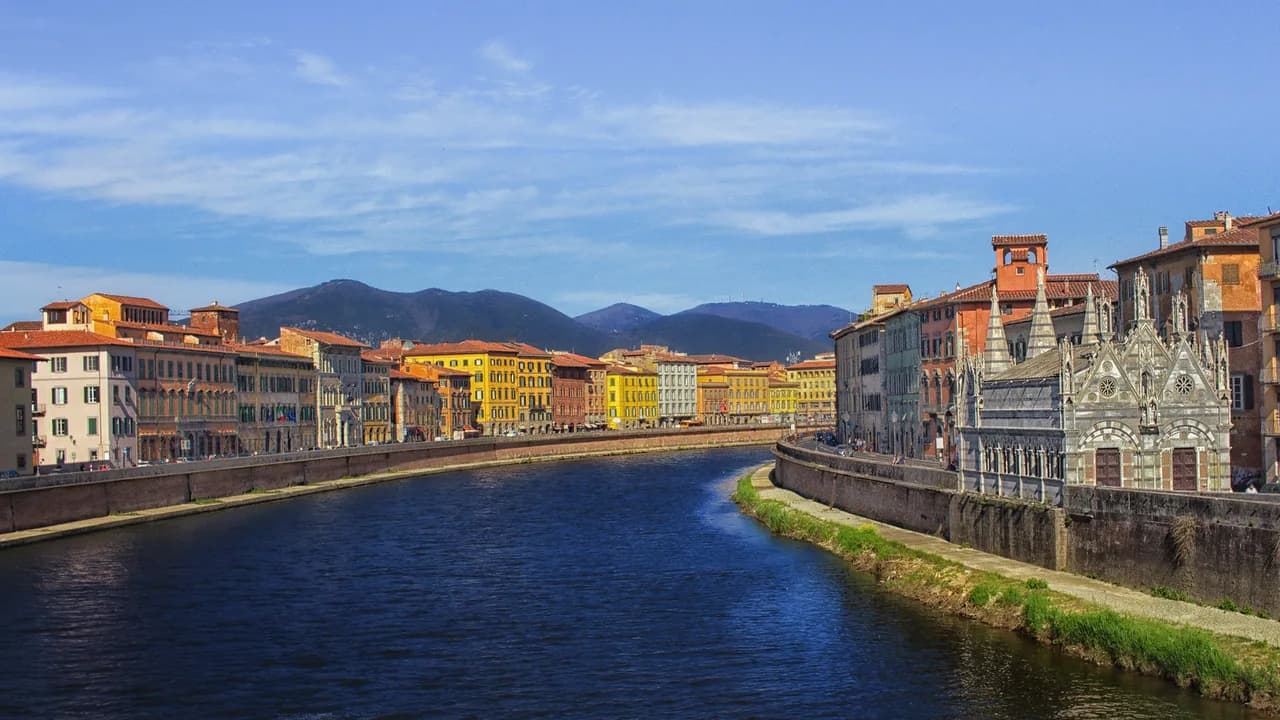
Santa Maria della Spina sits on the left bank of the Arno along Lungarno Gambacorti, a compact Gothic church bristling with spires, tabernacles and statues in polychrome marble. It is small enough to see in passing and detailed enough to reward a slow quarter of an hour on the riverbank, especially for travellers walking between Pisa's centre and the quieter riverfront. Treat the exterior as the main event: the interior is a single hall used for exhibitions, and current access should be checked locally rather than assumed.
The church's story is stranger than most visitors expect. It was founded in 1230 at the foot of a bridge that later collapsed, was enlarged by the Commune from 1323, and in the 1870s was taken apart and rebuilt a few metres east and a metre higher because the riverbank kept giving way. The name comes from a thorn from Christ's crown that tradition says arrived in 1333, but the relic has not been kept here since the 19th century; it is now in the church of Santa Chiara.
Where Santa Maria della Spina Sits on the Arno
The church stands on Lungarno Gambacorti, the left-bank riverside road, near Ponte Solferino. That position makes it a natural stop on a walk along the Arno rather than a separate outing: you pass it on the way from the city centre toward the Lungarno Sonnino stretch, where San Paolo a Ripa d'Arno and its Sant'Agata chapel sit in a tree-lined square. Pisa's Arno Lungarnos are a chain of viewpoints, and this church is one of the links.
Because the church is pinched between the road and the water, there is no grand piazza to step back into. You see it in fragments first: a spire above a wall, a pale facade reflected in the river, the south side opening as you approach. That compression is part of its character, and it also means the best views come from across the water or from a few metres along the bank rather than from directly in front.
Origins and Names: Pontenovo, the Gualandi and the Commune
The church was built in 1230 at the wish of the Gualandi family, at the foot of a bridge over the Arno. It was first called Santa Maria di Pontenovo, a name tied to that bridge, which collapsed in the 15th century. Like other bridge oratories, it belonged to the Commune of Pisa rather than to a single parish, which helps explain why the city took charge of its later enlargement.
From 1323 the Commune enlarged the church and covered it with the spires, tabernacles and statues that define it today, work associated with the workshop of Lupo di Francesco and later with Andrea and Nino Pisano. The building you see is therefore a 14th-century remodelling of a 13th-century oratory, not a single-period design. Keep that layering in mind when reading the sculpture, because the exterior mixes original medieval work, later replacements and modern copies.
The Thorn Relic and Why It Is No Longer Here
The name della Spina refers to a thorn from Christ's crown, which tradition says reached this church in 1333. The relic made the small riverside oratory a pilgrimage stop, and the church's richer decoration is often linked to that status. Whether or not the tradition is historically exact, the thorn is the reason the church has the name most visitors ask about.
The thorn is no longer kept in Santa Maria della Spina. Since the 19th century it has been held in the church of Santa Chiara, so anyone hoping to see the relic should plan around that church instead. Inside Santa Maria della Spina, the object that once anchored the pilgrimage is absent, which changes how the building reads: it is a monument to a relic's memory rather than a working reliquary.
Reading the Exterior: South Side, Facade and Apse
Start with the south side facing the river, where a gallery of pinnacled tabernacles holds statues of the twelve Apostles, with prophets above them. This is the richest face of the church and the one most easily seen from the bank. The facade carries a Madonna and Child attributed to Giovanni Pisano, with angels at the sides, while the apse has marble inlays and a doorway topped by a reused Greek-Syrian lintel from the 3rd century.
On the east side, statues of saints from the workshop of Nino Pisano stand below a Madonna and Child attributed to Nino himself, between two angels. Inside, the presbytery holds the Madonna of the Rose by Andrea and Nino Pisano, flanked by St Peter and St John the Baptist, and the Medici period added a marble choir by Andrea Guardi from 1453 and a tabernacle by Stagio Stagi from 1534. These are the details most people walk past, yet they are what makes the church worth more than a snapshot.
The exterior freestanding statues you see today are copies. Since 1996 the originals have been kept in the Museo Nazionale di San Matteo, where they can be studied at close range. That matters for how you look: the riverbank figures give the overall effect, while the museum collection holds the medieval carving itself. The Madonna of the Milk on the inner facade is likewise a plaster copy, with the original in the same museum.
The 1870s Move: Dismantling, Raising and Ruskin's Objection
By the 19th century the church's position beside the Arno had become a liability, with ground that kept giving way. After Italian unification the decision was taken to dismantle the church and rebuild it elsewhere; between 1871 and 1875 it was moved a few metres to the east and raised by about a metre. The operation was costly in more than money: marbles were destroyed, statues were badly restored or replaced, and the sacristy that hung over the river was never rebuilt.
John Ruskin, passing through Pisa, was outraged by the reconstruction, and his reaction is a useful corrective to the church's picture-postcard reputation. What stands on the Lungarno today is a 19th-century reassembly of medieval parts, not an untouched medieval building on its original foundations. Knowing this does not diminish the church, but it explains why some sculpture looks crisper, or more replaced, than you might expect from a 14th-century facade.
Outside Versus Inside
The interior is much simpler than the exterior suggests: a single hall with a wooden ceiling decorated in the 19th century, used for exhibitions. That is a very different experience from the sculpted facade, and it means the church works best when you approach it as an exterior first. The official tourism portal does not publish current opening hours or days for the interior, so treat access as something to confirm on the day.
Check access locally before building a day around the interior. The city's tourism portal lists current events and places, and it is the sensible place to confirm whether anything is scheduled at the church during your dates. Pisa's attractions are spread across religious and civic sites with separate arrangements, so do not assume one ticket or one timetable covers the church and the museums. If the interior is closed, the exterior alone still justifies the stop.
What Is Original and Where the Originals Are Now
The clearest way to plan a visit is to separate three things: the church as a riverside monument, the original sculpture held in the Museo Nazionale di San Matteo, and the relic held at Santa Chiara. Each sits in a different place, and each answers a different question. If you want the medieval carving, go to the museum; if you want the pilgrimage object, go to Santa Chiara; if you want the setting that made the church famous, stay on the Lungarno.
The Museo Nazionale di San Matteo is also where the original Madonna of the Milk is kept, with a plaster copy left in the church. Pisa's museum landscape includes several separate collections, and the city's own site is the place to confirm which are open and how they are ticketed, since arrangements change. Do not rely on a single ticket covering the church and the museum; they are distinct sites with distinct administrations.
Photographing Santa Maria della Spina from the Riverbank
The classic view is from across the Arno or from a short distance along the left bank, where the full south side with its tabernacles and spires reads clearly. From the road side you get the facade and the apse in sequence as you walk, which suits a slow pass rather than a single stop. The church is small, so a wide view that includes the river and the opposite bank often tells the story better than a tight crop of the marble.
Because the church sits directly on the Lungarno, traffic and pedestrians share the space, and there is no landscaped forecourt to compose around. Early morning and late afternoon are commonly recommended for Pisa's monuments in general, but no source establishes crowd patterns at this specific church, so treat timing as a preference rather than a rule. The reflections and the low angle from the water's edge are the practical advantages of the riverbank position.
Pair the church with the river walk rather than treating it as a standalone photo stop. Walking from the centre along Lungarno Gambacorti toward Ponte Solferino and on to Lungarno Sonnino gives you changing angles and a natural end at San Paolo a Ripa d'Arno. That route also puts the church in the context of Pisa's overlooked corners, which are often quieter than the Piazza dei Miracoli and easier to enjoy without a crowd.
Pairing Nearby: San Paolo a Ripa d'Arno and the Sant'Agata Chapel
A few steps past Santa Maria della Spina, Ponte Solferino marks the beginning of Lungarno Sonnino, and along that stretch stands San Paolo a Ripa d'Arno, known locally as the Duomo Vecchio or Old Cathedral. It is one of Pisa's oldest buildings, with a simple three-nave interior and a Roman sarcophagus holding the 13th-century philologist Burgundio. The church is open to the public during mass, so treat it as a possible stop rather than a guaranteed one.
Behind San Paolo stands the small octagonal Sant'Agata chapel, built in the 11th century and freed from later buildings after the Second World War. Together with the riverfront setting, it makes the Lungarno Sonnino stretch a compact sequence of Romanesque architecture after the Gothic showpiece of Santa Maria della Spina. This is the kind of pairing that turns a single church visit into a half-day walk without adding transport.
Practical Planning for a Short Stop
Plan Santa Maria della Spina as a short stop of roughly fifteen to thirty minutes if you are focusing on the exterior, longer if the interior happens to be open and you want to look at the Guardi choir and the Stagi tabernacle. The church is not a ticketed complex in the way Pisa's cathedral square is, and the official sources do not publish entry prices or booking rules for it. Confirm locally whether the hall is accessible on your dates.
If your trip also includes the Piazza dei Miracoli, keep the two experiences separate. The cathedral square is a ticketed, timed monument complex with its own rules, while Santa Maria della Spina is a riverside church seen mainly from outside. Pisa's less-visited sights, from the riverfront to the city's smaller churches, reward a slower pace than a rushed circuit of the famous square.
Plan Your Visit
Santa Maria della Spina rewards a traveller who knows what they are looking at: a 13th-century oratory enlarged in the 14th century, dismantled and rebuilt in the 1870s, and now a riverside monument whose most famous carvings are copies. Approach it as part of a walk along the Arno, with San Paolo a Ripa d'Arno and the Sant'Agata chapel as the natural next stop. Check current access to the interior through the city's tourism portal rather than assuming it is open.
For the fuller picture, continue into Pisa's other collections, including temporary exhibitions at Palazzo Blu, and use the city's attraction guides to decide which sites deserve your time. The church itself needs little planning beyond a riverbank walk; what needs planning is the rest of your Pisa day around it. Build the route around what is confirmed open on your dates, not around a fixed list.
Frequently Asked Questions
Is the thorn of the Crown of Thorns still in Santa Maria della Spina?
No. Tradition says the thorn arrived at the church in 1333, but since the 19th century it has been kept in the church of Santa Chiara in Pisa. If the relic is your reason for visiting, plan around Santa Chiara instead.
Can you go inside Santa Maria della Spina?
The interior is a single hall with a 19th-century wooden ceiling, used for exhibitions, but the official tourism portal does not publish current opening hours or days. Check with Pisa's tourism office before your visit, and treat the interior as a possible bonus rather than a guarantee.
Was the church moved from its original position?
Yes. Between 1871 and 1875 the church was dismantled and rebuilt a few metres to the east and raised by about a metre because the riverbank ground kept giving way. The sacristy that once hung over the river was never rebuilt, and the art critic John Ruskin objected to the reconstruction.
Are the statues on the church original?
The freestanding exterior statues are copies. Since 1996 the originals have been kept in the Museo Nazionale di San Matteo. The Madonna of the Milk on the inner facade is also a plaster copy, with the original in the same museum.
What is worth looking at on the exterior?
The south side facing the river has a gallery of tabernacles with the twelve Apostles and prophets above. The facade carries a Madonna and Child attributed to Giovanni Pisano, and the apse has marble inlays with a reused Greek-Syrian lintel from the 3rd century.
How long does a visit take, and what should I combine it with?
Allow roughly fifteen to thirty minutes for the exterior, longer if the interior is open. Combine it with a river walk toward Ponte Solferino and Lungarno Sonnino, where San Paolo a Ripa d'Arno and the Sant'Agata chapel are a natural next stop.
Sources
Continue exploring
More guides you'll find useful