Hidden Gems in Siena: Lesser-Known Places Worth Seeking Out
A practical guide to lesser-known places in Siena, from confraternity chapels and medieval fountains to quiet churches, with notes on what is free and paid.
On this page
Most Siena itineraries begin and end at the Duomo and the shell-shaped Piazza del Campo, and both deserve their time. But a short walk away are fountains built to sort drinking water from washing water, a chapel holding the relics of Catherine of Siena, and a synagogue tucked behind an ordinary facade. This guide organises those lesser-known stops into churches, fountains and streets, museums and interiors, and the edges of the city.
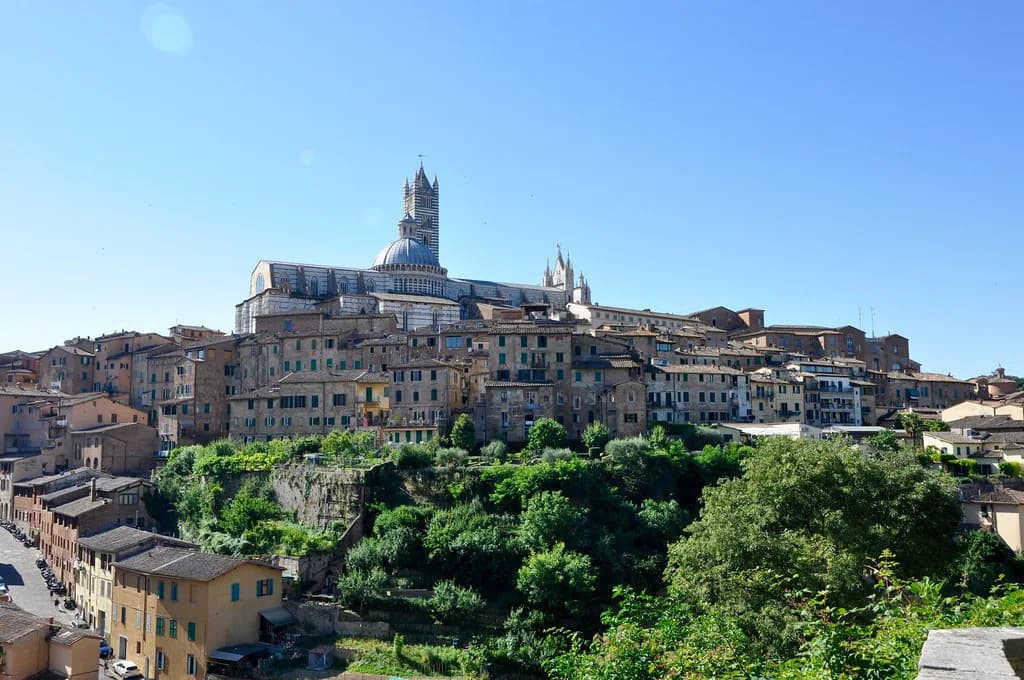
One early practical detail shapes the whole day: Siena's historic centre is compact and walkable but stacked across three hills, so a list of five nearby stops can still mean repeated climbs and descents. A source describing the city's layout notes that the centre is dense and pedestrian, with the main sights close together on foot. Build in slack for slopes rather than treating the map as flat.
How to Use This Guide: Free Churches Versus Paid Collections
Siena mixes free-to-enter churches with separately ticketed museums, and the two should not be confused. A source states that the Basilica of San Domenico is free to visit, while Santa Maria della Scala is a museum with its own admissions arrangement. Do not assume that a Duomo complex ticket covers everything you plan to see.
Prices, opening hours and temporary closures change, and several published details age quickly. Before you commit a morning to a ticketed interior, check the site's own page or the city's tourist office for the current schedule. Where this guide mentions paid entry, treat it as a prompt to verify, not as a fixed figure.
A second rule is etiquette. San Domenico and the Synagogue of Siena are active places of worship, not attractions that pause for visitors. Dress modestly, keep voices low, and step aside when services or private prayer are underway.
Start With the Layout: Three Hills, One Compact Centre
Siena was built where three hills meet, and the streets climb and twist between them. That topography explains why the Duomo sits on a raised piazza and why so many viewpoints open suddenly between rooftops. Plan your stops in a loop rather than zigzagging, and accept that the return leg will usually be uphill.
The train station sits outside and below the historic centre, so arrival involves a climb or a short ride up before any sightseeing begins. If you are coming for the day, decide in advance whether you want to spend energy on the transfer or save it for the streets. A self-guided route that follows the natural slope of the contrade works better than a list ordered by fame.
Basilica of San Domenico and the Relics of Catherine
The large Cistercian Gothic basilica dominates the western side of the city, and many visitors pass it on the way in from the stadium or fortress parking areas. Its interior is plainer than the Duomo's, reshaped over centuries by fire and earthquake, so it can feel austere at first. The reason to come is the Chapel of Saint Catherine and its relics.
According to a source on the relics, Catherine died in 1380 at the age of 33, and her head was brought to Siena the following year, where it was placed in this chapel. Frescoes by Il Sodoma illustrating scenes from her life surround the reliquary, and a second reliquary elsewhere in the church holds her thumb and the cords she used for penance. Entry to the church is free, which makes it an easy addition to a walk.
Fontebranda: A Medieval Fountain With Tiered Bays
At one of the lowest points of the city stands a large medieval fountain that looks like a miniature castle, complete with a crenellated top and three Gothic arched bays. Dante and Boccaccio both mention it, which gives a sense of how central it once was to daily life. The three bays held water of decreasing purity: drinking water, then washing water, then water for animals.
The fountain still works, making its arches a shady pause on a hot afternoon. Because it sits below street level near the city's western edge, it fits naturally into a route that ends with a downhill stretch rather than a climb.
Collegiata di Provenzano and the July Palio
The late sixteenth-century church of Provenzano grew around a terracotta bust of the Madonna that reportedly began working miracles after being struck by a soldier's stray shot. The image became central to Siena's Marian devotion, and the church now enshrines it in an ornate silver and gold altarpiece. The July Palio is run in honour of the Madonna di Provenzano.
On the night before that race, the drappellone, the painted cloth awarded to the winning contrada, is hung beneath the church dome. The Palio itself has long been held on 2 July and 16 August, per one source, a tradition rather than a confirmed future schedule. Check the official Palio calendar before planning a trip around race days.
Outside race season the church is a calm, short stop, and its position away from the Duomo crowds makes it a sensible link between the northern streets and the centre.
The Synagogue of Siena: A Hidden Rococo Worship Space
Siena's Jewish community is among the oldest in Tuscany, with documents attesting a presence from 1229. Because the synagogue occupied a ghetto building, it has no grand entrance; the worship space sits upstairs behind an ordinary house facade, decorated in light-filled Rococo style. A women's gallery looks into the main room through latticework.
Inside are historic Torah scrolls, silverware and ritual vestments, along with the Elijah seat, a liturgical piece inscribed with biblical text. Two plaques beside the door commemorate Sienese Jews: one placed in 1948 for the fourteen deported and killed in the Nazi camps, and one added in 1999 for the bicentenary of the 1799 burning of thirteen Jews during the destruction of the ghetto.
The synagogue is still used for services, so visiting hours and access can vary. Confirm arrangements with the community before turning up, and treat the interior as a place of prayer first and a sight second.
Fountains and Street Curiosities: Casato and Vicolo degli Orbachi
The Fonte del Casato is not one of Siena's grand fountains, but it has an unusually dark history. Built between 1352 and 1360 to supply water to nearby homes, it was repeatedly blessed because of suicides there, and it carries a vague legend about a fight between a wolf and a man. The basin sits well below the street above and is reached by a long run of stairs, which explains its gloomy setting.
In the Bruco contrada, the Vicolo degli Orbachi holds a contrada fountain beneath a small bridge, marked by a modern sculpture. The curiosity that draws people here is a naked female figure in a window, a work by Pier Luigi Olla from 1995. It is a quick look rather than a destination, and worth folding into a wander rather than a special trip.
Santa Maria della Scala: Pilgrims' Hall and the Chapels Below
Santa Maria della Scala faces the Duomo and was, until relatively recently, the city's main hospital. Its ground-floor Pilgrims' Hall carries a fresco cycle from the 1440s by Domenico di Bartolo, il Vecchietta and Priamo della Quercia, showing the charitable work done here for travellers on the via Francigena. There is little wall text beyond scene titles, so give yourself time to read the images.
Two lower levels lead to various collections, including a large archaeological holding, but the most distinctive spaces are three confraternal chapels. The Oratory of the Confraternità di Santa Caterina della Notte, on the first basement level, preserves sixteenth-century stucco work and a thirteenth-century marble Madonna, along with the names and instruments of its members.
The museum is a separate ticketed entity from the Duomo complex, so treat admission as its own decision rather than an add-on. It is also a sprawling, sometimes chilly building; a rainy day is a reasonable moment to give it a couple of hours. For wider planning, see A Rainy Day in Siena.
Palazzo Salimbeni and the City's Banking Streets
Palazzo Salimbeni, in Sienese Gothic style, is the headquarters of Monte dei Paschi, founded in 1472 as a charitable monte di pietà and turned into a commercial bank in 1624. The palace was home to one of Siena's wealthiest families before the bank bought it in 1866. A wide bench on the facade is where supplicants once waited their turn, a common feature of medieval banks.
The surrounding street names, Via Banchi di Sopra and Via Banchi di Sotto, recall the city's moneychangers, whose trade gave us the word bank and, less obviously, a lot of benches. Treat the palace as an exterior stop on a walk; it is the story, not an interior visit, that rewards the detour.
Museo delle Biccherne: Painted Register Covers
The Museo delle Biccherne belongs to the state archive and displays over a hundred painted covers of registers kept by Sienese magistrates from the Middle Ages to the early eighteenth century, often commissioned from significant artists. The result is a room of thick vellum bindings that feels unlike any conventional gallery in the city.
Access has been reported as limited and organized by reservation rather than as a walk-in visit. Because such arrangements change, confirm current access with the archive before building a day around it, and keep a backup stop nearby in case the timing does not work.
The Tiniest Window at Palazzo della Rovere
On the facade of Palazzo della Rovere, in the small central piazza Postierla, sits what Sienese tradition calls the tiniest window in Siena: a real opening dwarfed by a normal window beside it, complete with matching grey shutters. No documented story explains it, so it is best described honestly as a curiosity rather than a monument. Pause for a minute, then move on.
Beyond the Walls: the Ex-Psychiatric Hospital of San Niccolò
Outside the city walls, the former psychiatric hospital of San Niccolò was a monastery from 1300 to 1810 and a hospital from 1818 to 1999, with a large iron sign at the entrance still reading Ospedale Psichiatrico. The building was designed to look like a grand villa with extensive gardens, reflecting period beliefs that space itself formed part of a cure. It now houses University of Siena departments.
This is a walk for readers interested in institutional history rather than art, and it takes you well beyond the usual circuit. Since it is a working university site, view the exterior and the grounds rather than expecting museum-style access.
Contrast Stops: Facciatone and Torre del Mangia
The Torre del Mangia rises from Piazza del Campo and has long been a symbol of the city, built in the fourteenth century under civic rather than family patronage. Per one source, climbing it involves a long run of steps and group entry at set times, with tickets sold in person at the Palazzo Pubblico ticket office. If stairs or queues are a concern, the Facciatone viewpoint offers an alternative panorama.
Neither is a hidden gem in any honest sense, but both make a useful contrast: they show why the quieter churches and fountains feel calmer by comparison. Slot them into the start or end of a day rather than the middle of a walking route.
Half-Day and Full-Day Routes Through the Quieter Siena
For a half day, work west and downhill: start at San Domenico for the Catherine chapel, continue to Fontebranda, then loop back through the centre to Provenzano. This keeps the climbing at the beginning and gives you a natural finish near the northern streets.
For a full day, add Santa Maria della Scala in the morning when you are fresh, then take the synagogue and the Postierla window in the afternoon, finishing with the Orbachi sculpture in the Bruco contrada. If you have energy left, the walk out to San Niccolò rewards the effort with a very different side of the city.
A longer stay is what makes these places work, because the pleasure lies in returning to a square at a different hour rather than ticking off stops. Build in a slow lunch and leave room for the unplanned detour. If you want to sample the city's food traditions more deliberately, a dedicated look at the local cuisine can be worked in. For wider planning, see Siena Local Food Guide.
Practical Notes Before You Go
Dress for churches, allow for stairs and slopes, and check current hours and closures for any ticketed interior before you set out. The free churches reward a short visit; the paid museums deserve a decision rather than an assumption.
If you enjoy this slower approach in Siena, the same logic applies elsewhere in Italy, from the cloisters of Florence to the quieter corners of Montepulciano. Our guides to hidden gems in Florence and Montepulciano follow the same principle. For wider planning, see Hidden gems in montepulciano.
More Siena guides
- A Rainy Day in Siena
- An Evening in Siena
- Best Time to Visit Siena
- Day Trips from Siena
- Free Things to Do in Siena
- Siena Contrade and the Palio
- Siena Local Food Guide
- Siena Neighbourhoods Guide
- Siena One Day Itinerary
- Siena Self-Guided Walk Through the Old Town
- Siena Three Days Itinerary
- Siena Two Days Itinerary
- Siena With Kids
- Basilica di San Domenico in Siena
- Battistero di San Giovanni Siena
- Climbing the Torre del Mangia in Siena
- Fonte Gaia in Siena
- Fontebranda in Siena
- Loggia della Mercanzia in Siena
- Palazzo Chigi-Saracini in Siena
- Palazzo Pubblico Siena Museum Guide
- Piazza del Campo Visitor Guide
- Porta Romana Siena
- Sanctuary of Saint Catherine in Siena
- Santa Maria della Scala in Siena
Frequently Asked Questions
What are the best hidden gems in Siena?
The strongest lesser-known stops are the chapel and relics of Catherine in the Basilica of San Domenico, the tiered medieval Fontebranda, the Rococo interior of the Synagogue of Siena, and the confraternal chapels below Santa Maria della Scala. Smaller curiosities include the Fonte del Casato and the sculpture in Vicolo degli Orbachi's window.
Is Siena worth visiting beyond the Duomo and Piazza del Campo?
Yes, if you have more than a few hours. The quieter churches, fountains and museum interiors explain how the city actually worked, from water supply to charitable care to banking. They also tend to be less crowded than the main sights.
Which lesser-known Siena churches are free to enter?
The Basilica of San Domenico is free to enter, including the Catherine chapel, and the Collegiata di Provenzano is a church visit rather than a ticketed museum. Santa Maria della Scala, by contrast, is a museum with its own admission. Confirm current arrangements before you go.
How long do you need to see Siena's quieter sights?
A half day covers San Domenico, Fontebranda and Provenzano comfortably on foot. A full day allows Santa Maria della Scala, the synagogue and a wander through the contrade. Staying overnight makes the hills far less tiring.
Is 4 hours in Siena enough to see anything beyond the main sights?
Four hours is enough for one cluster, not the whole list. Choose either the western churches and fountains or the museum interiors, and leave the rest of the city for a return visit. Trying to cover everything in four hours mostly produces stair-climbing, not discovery.
Do I need to book Siena's smaller museums in advance?
Not generally, but access to the Museo delle Biccherne has been reported as limited and reservation-based, so confirm with the state archive. For any ticketed interior, check the official page for current hours before planning your day around it.
Are the fountains and street curiosities accessible?
Several sit below street level and are reached by stairs, including the Fonte del Casato. Treat these as short stops rather than essential sights, and check access details for specific sites before relying on them.
Sources
Continue exploring
More guides you'll find useful