Fontebranda Siena Visitor Guide: Medieval Fountain & Contrada
Plan a short stop at Fontebranda in Siena: how its three basins worked, what the Gothic facade shows and why Catherine of Siena is tied to this fountain.
On this page
Fontebranda rewards a few minutes of looking rather than a quick photograph. It is a built fountain complex rather than a single spout, and its interest lies in how water was rationed across three basins and in what the carved facade still shows. This guide treats the site as a short structural stop and keeps current access details out of the plan, because they belong on official channels rather than in a guide that cannot verify them.
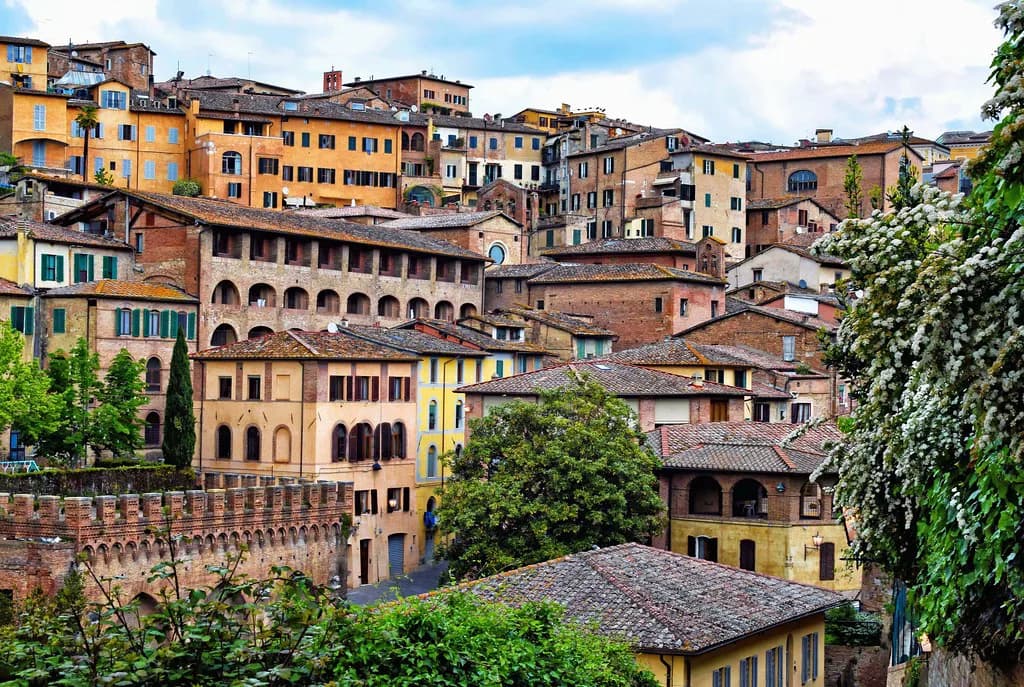
Siena grew on dry hills away from rivers, so its fountains were civic infrastructure rather than decoration. Understanding that constraint changes what you see at Fontebranda: not a pretty monument, but part of a system that moved water through tunnels and channels to reach fountains, wells and cisterns. The pages in our Siena Attractions collection give the same treatment to the city's other named sights, so you can build a route that matches your interests.
What Fontebranda Is
Fontebranda is one of Siena's surviving medieval fountains, an imposing Gothic structure rather than a single jet of water. Its footprint is unusual for a fountain: a broad facade with pointed arches opening onto a series of tanks that step down and back. Treat it as architecture first — a piece of public works that happens to be beautiful — and the visit makes more sense.
One hotel guidebook confidently calls Fontebranda the largest and most important of Siena's fountains; that is a strong claim from a secondary source, so hold it loosely. What is not in dispute is its scale: the facade spans three ogival arches and encloses substantial basins. For a fountain, that is a building-sized commitment, and it tells you how seriously medieval Siena treated its water supply.
Reading the Three Basins
The three tanks were not parallel pools filled independently. Water entered the first basin, used for drinking, then overflowed into the second, which served as a trough for animals, and finally ran into the third, a wash-house. Clean water was used once at the top of the chain and then reused down the line, which is a sensible design in a city without a river.
The Santa Caterina site, maintained in connection with Siena's Catherine heritage, describes this sequence plainly, and it is worth carrying in your head when you look at the structure. The lower basins sat below the drinking level for a reason: gravity did the sorting. When you stand in front of the fountain, look for the different levels rather than assuming they are decorative terraces.
From the third basin the water continued into a channel described as a "fogna bianca" and was then drawn on by the dye houses, tanneries and mills clustered in this part of the city. That final stage is what ties the fountain to working life rather than only to households. It also explains why Fontebranda was valuable beyond its drinking water.
What the Gothic Facade Shows
The facade's three pointed arches frame the basins in a way that reads as civic display. In the 13th century the fountain received cross-vaulting over the water and four stone lions at the front, from whose mouths water spouted. The lions are original water outlets, not ornamental guardians, which is easy to miss if you look at them as sculpture.
Between the lions sits the Balzana, the black-and-white emblem of Siena. The hotel guide identifies the emblem at the centre of the facade, while the Santa Caterina account concentrates on the lions and the vaulting; together they give you a checklist for the frontage. Look for the shield, the lion heads and the arched openings as separate elements rather than one carved surface.
Water in a Dry City: The Bottini
Siena sits on arid hills, far from rivers and mountain runoff, so its inhabitants dug an extraordinary network of underground aqueducts through the rock. These conduits are called bottini because they are covered by barrel vaults, and they fed the city's fountains, wells and cisterns. Fontebranda was served by one of the two principal master conduits, which is why its supply was among the most copious.
That detail matters for visitors because it reframes the fountain as the visible end of an invisible system. The water arrived from tunnels you cannot see from the street, and the basins were the point where it became public and usable. If the engineering angle appeals, the city's water heritage rewards further reading before or after your walk.
Practical verification still matters. This guide cannot confirm whether water currently flows at Fontebranda, whether any part of the structure is closed for work, or whether there are set visiting times. Check the Comune di Siena's site and tourism channels shortly before you go rather than relying on older descriptions, including this one.
Catherine of Siena and the Dyers
Catherine is remembered as the saint of Fontebranda, and the connection is concrete rather than purely devotional. Her family lived in this neighbourhood, and her father drew water from the fountain for his cloth-dyeing trade. The fountain was therefore part of the household economy, not just a backdrop to her biography.
The wider district supported dye works, tanneries and mills that depended on the same water, so Catherine's family was one small part of a busy manufacturing quarter. Keep that in mind when you walk the surrounding streets: the houses and workshops you pass belonged to a working neighbourhood organized around water. The Sanctuary of Saint Catherine in Siena, uphill from the fountain, is the natural companion stop for the devotional side of the story.
Note that the sanctuary and the fountain are separate places with separate arrangements. Do not assume a ticket or opening time for one applies to the other, and confirm any details for the sanctuary through its own official channels. The Sanctuary of Saint Catherine Siena visitor guide covers that site on its own terms.
The Contrada dell'Oca Setting
Fontebranda stands in the Contrada dell'Oca, within the Terzo di Camollia, close to the Porta di Fontebranda. Those names are the navigational frame for the visit: the gate, the contrada and the fountain belong to the same corner of the city. Use them to orient yourself on a map rather than hunting for an address.
Siena's contrade are more than neighbourhood labels; they organize the city's social life and its Palio loyalty. The fountain's identity is bound up with the Oca, and even a brief look at how the contrade work will make the streets around Fontebranda read differently. Our Siena contrade and Palio guide explains the system without turning it into spectacle.
If you want more of the quarter than the fountain alone, the surrounding lanes reward slow wandering. Our hidden gems in Siena guide points to overlooked corners across the city, including the Basilica of San Domenico, which sits on the ridge above this part of town and belongs naturally to a Catherine-themed circuit.
What Survives and What Changed
A fountain at this spot is documented as early as 1081, and in 1193 it was rebuilt and enlarged by a builder named Bellamino, whose inscription is still preserved inside. The 1246 works added the cross-vaulted covering and the four stone lions. These dates are historical context for reading the structure, not information about current visiting conditions.
What you see today is therefore the product of several campaigns rather than a single medieval design. That layering is part of the pleasure: the facade records additions and reworkings the way a palimpsest does. Approach it as a document of changing civic priorities around water, and the visit gains a second layer beyond the obvious photographs.
Fitting Fontebranda Into a Siena Walk
Fontebranda works best as a deliberate detour on a route that already heads toward the Catherine sites on this slope. Pair it with the Sanctuary of Saint Catherine and the Basilica of San Domenico above, and you have a coherent half-day theme built around water, work and devotion. The Siena Self-Guided Walk Through the Old Town gives a broader framework if you want the fountain to sit inside a longer itinerary.
Allow a short stop rather than a scheduled visit. The fountain is a structure to read and photograph from the outside, and the surrounding contrada streets are part of the experience. If you want the Basilica of San Domenico Siena visitor guide for the uphill leg, it will help you plan that portion separately from the fountain.
Siena's medieval sites often mix freely visible exteriors with separately ticketed interiors, so do not assume anything about Fontebranda's access from the look of the place. Confirm on official channels before building a day around it. The city's own tourism pages are the right starting point for that check.
Is Fontebranda Worth the Detour?
Yes, if you care about water engineering, medieval civic life or Catherine's Siena. The fountain condenses all three into one compact structure, and the three-basin logic gives you something specific to look for when you arrive. It is not a long visit, but it is a meaningful one.
Go with loose expectations about access and verify current arrangements through the Comune di Siena and the Santa Caterina site before you set out. Then let the contrada streets do the rest of the work: the fountain is the anchor, but the neighbourhood around it carries the story.
Frequently Asked Questions
What is Fontebranda in Siena and why is it significant?
Fontebranda is a medieval fountain complex in Siena's Contrada dell'Oca, built around three descending basins and a Gothic facade with pointed arches. It matters because it shows how a dry hill city managed water: the fountain was the visible end of an underground conduit system, and its basins served drinking, livestock and laundry in sequence. It is a piece of civic infrastructure as much as a monument.
Why did Fontebranda have three separate basins?
The three tanks worked as a chain rather than independently. Water entered the first basin for drinking, overflowed into the second for animals, and then ran into the third as a wash-house. That arrangement got several uses out of the same water before it passed on to dye works, tanneries and mills downstream. It is a rationing design suited to a city without a river.
What does the facade of Fontebranda show?
The frontage opens through three pointed Gothic arches onto the basins. Four stone lions once spouted water from their mouths, so they are functional outlets rather than decoration, and the vaulted covering over the water dates from the 13th century. Siena's black-and-white emblem, the Balzana, is also identified at the centre of the facade. Look for these as separate features.
How is Fontebranda connected to Catherine of Siena?
Catherine is remembered as the saint of Fontebranda because her family lived in this neighbourhood and her father drew water from the fountain for his cloth-dyeing work. The fountain was part of the household economy, and the surrounding district supported dye houses, tanneries and mills. That makes the Catherine link a matter of daily work as well as devotion.
Which contrada is Fontebranda in?
Fontebranda lies in the Contrada dell'Oca, within the Terzo di Camollia, near the Porta di Fontebranda. Those names give you the navigational frame for finding it and for understanding the surrounding streets. Siena's contrade are social and ceremonial organizations as well as geographic ones, so the setting is part of the site's identity.
Is Fontebranda free to visit and are there opening hours?
No reliable access, hours or ticketing information is available for the fountain itself, so this guide does not state any. Medieval sites in Siena often combine visible exteriors with separately managed interiors, and you should not infer arrangements from appearances. Check the Comune di Siena and the Santa Caterina site shortly before your visit to confirm the current situation.
How long should you spend at Fontebranda?
Treat it as a short structural stop rather than a scheduled attraction. A few minutes is enough to read the facade, find the three basins and look for the lions and the Balzana, and the surrounding contrada lanes are worth a slow wander afterward. Any suggested duration is our own guidance, not an official figure.
Where is Fontebranda located in Siena?
It sits in the Contrada dell'Oca in the Terzo di Camollia, near the Porta di Fontebranda, in the lower part of the city associated with Catherine of Siena. Use those names on a map rather than a street address. We do not give walking times or step-by-step directions because those depend on your starting point.
Sources
Continue exploring
More guides you'll find useful