Fonte Gaia Siena: What to See at Piazza del Campo
Fonte Gaia in Siena is a 19th-century copy of Jacopo della Quercia's marble fountain. Learn what the reliefs show and where the original sculptures are kept.
On this page
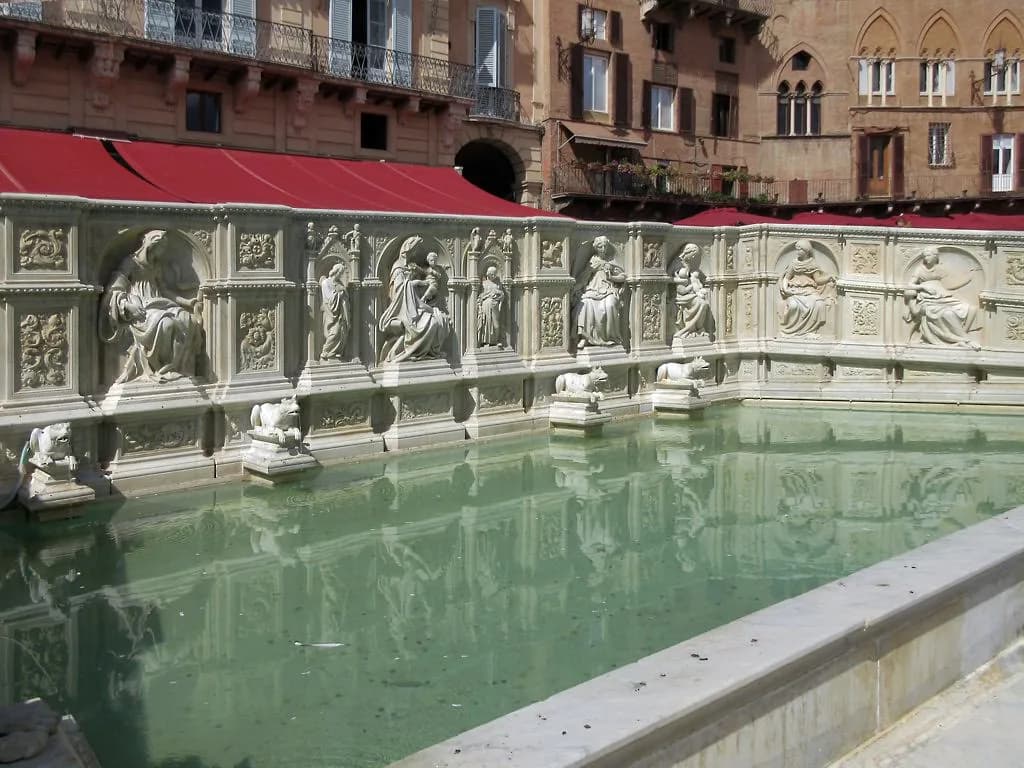
Fonte Gaia stands at the northern end of Piazza del Campo, directly in front of the Palazzo Pubblico, so it is almost impossible to miss on a walk through Siena's shell-shaped square. The marble basin that greets visitors is not the fountain Jacopo della Quercia finished in 1419, but a nineteenth-century replacement carved by Tito Sarrocchi in 1858. Knowing that single fact changes what you look for, and this guide covers the location, the sculpture, the original marbles indoors and the practical question of how to view the fountain politely.
Where Fonte Gaia Sits on Piazza del Campo
The fountain occupies the upper, flat end of the sloping square, close to the Palazzo Pubblico, which makes it the natural first or last stop on any circuit of the Campo. Because the piazza is ringed by cafés and used as an open-air living room, the fountain is rarely alone, so treat it as a busy public landmark rather than a quiet corner. If you want a fuller orientation to the square's shape and landmarks, read our Piazza del Campo visitor guide before you arrive.
Position matters for understanding the monument: della Quercia's fountain was designed for the civic heart of the city, facing the seat of government, not tucked down a side lane. Wherever you enter the Campo from, aim for the flat end nearest the palace tower, and you will reach the marble panels within a couple of minutes. Broader context on Siena's other sights is collected in our Siena Attractions hub.
Why the Fountain You See Is a Nineteenth-Century Copy
The original Fonte Gaia was commissioned to replace an earlier fountain and completed by Jacopo della Quercia in 1419, as the tourist guide Michele Busillo describes in his account of the fountain's iconography. It was a major civic undertaking that brought spring water into the centre of Siena, and the name Gaia is popularly tied to the rejoicing that greeted it. Two centuries of exposure eventually made a replacement necessary, and Tito Sarrocchi produced the copy now in place.
Sarrocchi's version is a faithful reconstruction in spirit, retaining the Madonna and the personifications of virtues that made the fountain a piece of public messaging, but it is a nineteenth-century sculpture and reads differently from the Renaissance carving. The Happy Traveler's description of the fountain makes the same distinction between the open-air replica and the earlier marbles, and notes that it anchors social life in the square today. Treat the fountain as both an artwork and a meeting point, and the copy-versus-original question becomes part of the visit rather than a footnote.
Reading the Marble: Madonna, Virtues and Civic Meaning
The panels centre on the Virgin and Child, flanked by figures representing virtues that a republican government wanted to associate with its own rule. Busillo points out that this iconography echoes Ambrogio Lorenzetti's painted allegories inside the Palazzo Pubblico, a few steps away, so the fountain forms part of a wider programme about good government and the common good. Seeing the fountain after the palace frescoes makes the connection much clearer; our Palazzo Pubblico Siena museum guide explains what to look for inside.
You do not need an art-history background to read these figures. Look for the seated Madonna, the accompanying virtues and the overall symmetry of the basin, which was designed to be viewed from the square as a piece of civic furniture. A few minutes of close looking at the reliefs repays more than a quick photograph from the crowd.
The She-Wolf, Romulus and Remus, and Siena's Roman Myth
The fountain also carries Siena's origin story in stone: reliefs of the she-wolf suckling Romulus and Remus, the twins whose descendants were said to have founded Siena according to local legend. The Happy Traveler's account explains how this Roman imagery was adopted as a badge of civic identity, appearing on flags and frescoes across the city as well as on the fountain. Once you notice the wolf, you start seeing it all over Siena.
The civic and mythical layers sit side by side, which is why the fountain rewards a slower look than its photogenic setting suggests. If you are building a walking route through the old town, the Siena self-guided walk old town covers the sequence of squares and streets that brings you naturally to the Campo.
Where the Original Della Quercia Marbles Are Kept
The original sculptural elements were moved indoors for protection and are associated with the Santa Maria della Scala museum complex, as the Happy Traveler's practical notes on the fountain indicate. Seeing them requires a museum visit rather than a stroll through the square, and the museum sets its own admission arrangements, which you should confirm on its official pages before planning a visit. The city's tourism portal, Visit Siena, linked from the Comune di Siena homepage, is a sensible place to start checking current visiting information.
Do not assume that a single ticket covers every museum or monument in the city, and do not rely on a blog post for current prices. Check the Santa Maria della Scala site or the Comune's tourism pages for the latest arrangements. If your time is short, the outdoor copy still conveys the fountain's scale and setting, which the indoor fragments cannot.
Details Lost in the Copy: Rea Silvia and Acca Larenzia
Busillo's close reading of the surviving fragments identifies two female figures, Rea Silvia and Acca Larenzia, connected to the Roman myth of the twins' birth, which were not reproduced in the nineteenth-century version. Their absence is one of the clearest reasons to seek out the originals: the copy preserves the general composition but not every iconographic subtlety. He also notes scholarly debate over the fountain's name, including a humanist reading linking Gaia to Roman antiquity rather than simple rejoicing.
For visitors, the takeaway is modest but useful: what you see in the square is an interpretation, and the original marbles reward anyone willing to visit the museum where they are held. Keep the two experiences distinct in your plans rather than expecting the outdoor fountain to tell the whole story.
How to View Fonte Gaia Without Blocking the Square
The Campo is a working public space used for events, markets and everyday crossing, so the courteous approach is to step to the side of the fountain rather than gathering on its rim. Quiet mornings and the hour before sunset are commonly suggested as calmer windows for photographs, though treat this as a suggestion rather than a rule, since the square's rhythm shifts with the season. For other, less crowded corners of the city, our guide to hidden gems in Siena offers alternatives away from the main set pieces.
For photographs, position yourself at the fountain's edge and use a longer lens or a slight crop to isolate the panels instead of standing in the middle of the traffic flow. Do not climb into the basin, and do not assume the water is for drinking; whether ornamental fountain water is potable is not something to guess at, so carry your own bottle. If you want a wider sense of the piazza's etiquette and layout, the Piazza del Campo visitor guide is the relevant reference.
Suggested Duration and Combining the Fountain With the Palazzo Pubblico
Fifteen to thirty minutes is a reasonable suggested allowance for the fountain itself, including a slow look at the panels and a few photographs; this is our estimate, not an official figure. Pair it with the Palazzo Pubblico and its civic frescoes, since the two sites interpret each other, and reserve the museum for whichever of the two collections interests you more if time is limited. The Palazzo Pubblico Siena museum guide sets out what is inside.
If you are following a day route through Siena, place the fountain early or late rather than at midday, when the square fills. The Basilica of San Domenico is a further stop that pairs well with a Campo visit, and it is covered in our hidden gems page.
What to Be Cautious About
Some popular traditions attached to the fountain, such as tossing a coin into the basin, appear in travel writing but should not be treated as permission or as an established local custom. Likewise, claims about the water's drinkability circulate online without an official source; the safe choice is to admire and photograph the fountain and leave the water alone. For anything that changes season to season, check the Comune di Siena's pages rather than an older article.
Finally, resist labelling the fountain a hidden spot. It is one of the most photographed corners of Siena, and expecting solitude there will only lead to disappointment. Plan around the crowds instead of hoping to avoid them. The Siena Attractions hub lists the city's main sights so you can balance busy and quieter stops across a day.
Plan Your Visit
Fonte Gaia is best understood as two monuments in one: the marble fountain in the square, a nineteenth-century recreation of a Renaissance civic statement, and the original fragments kept indoors, where the details the copy omits can still be studied. Give the outdoor fountain a short, unhurried look, then decide whether the museum merits a longer stop.
Before travelling, confirm current opening arrangements and admission for any museum you plan to enter through official sources, and use the city's tourism pages for events in the square. With that checked, the fountain needs no booking and no special preparation beyond a willingness to step aside for the next visitor.
Frequently Asked Questions
Is the Fonte Gaia in Siena the original fountain?
No. The marble fountain in Piazza del Campo is a nineteenth-century replacement carved by Tito Sarrocchi in 1858, based on Jacopo della Quercia's original completed in 1419. The original sculptural elements were moved indoors for preservation and are associated with the Santa Maria della Scala museum complex.
What do the marble reliefs on Fonte Gaia depict?
The panels centre on the Madonna and Child with personifications of virtues, alongside imagery of the she-wolf and the twins Romulus and Remus, which ties the fountain to Siena's claimed Roman origins. The programme echoes the allegories of good government painted inside the Palazzo Pubblico nearby.
Where is the original Fonte Gaia sculpture kept?
The original marbles by Jacopo della Quercia were removed from the square and are associated with the Santa Maria della Scala museum complex in Siena. Check that museum's official information for current visiting arrangements and admission before planning a stop.
Why is Siena's fountain called Fonte Gaia?
One popular explanation links the name to the joy that greeted water arriving in the city centre. Another reading, discussed in scholarship on the fountain, places Gaia in a humanist frame connected to Roman antiquity. Both explanations circulate, so treat the etymology as debated rather than settled.
When is the quietest time to see Fonte Gaia?
Early morning and the hour before sunset are commonly suggested as calmer times for the square, but this is a suggestion rather than an official rule, and the piazza's rhythm changes with events and season. Expect company either way, since the fountain is one of the most photographed spots in Siena.
How long do you need at Fonte Gaia?
A suggested fifteen to thirty minutes is enough to look closely at the reliefs and take photographs, though that is our estimate rather than an official figure. Add time separately if you plan to see the original marbles in the museum or visit the Palazzo Pubblico.
Sources
Continue exploring
More guides you'll find useful