Piazza del Campo Visitor Guide: Siena's Shell-Shaped Square
Plan a visit to Piazza del Campo in Siena: how the shell-shaped square works, what its nine brick sectors mean, when the Palio takes over, and how long to linger.
On this page
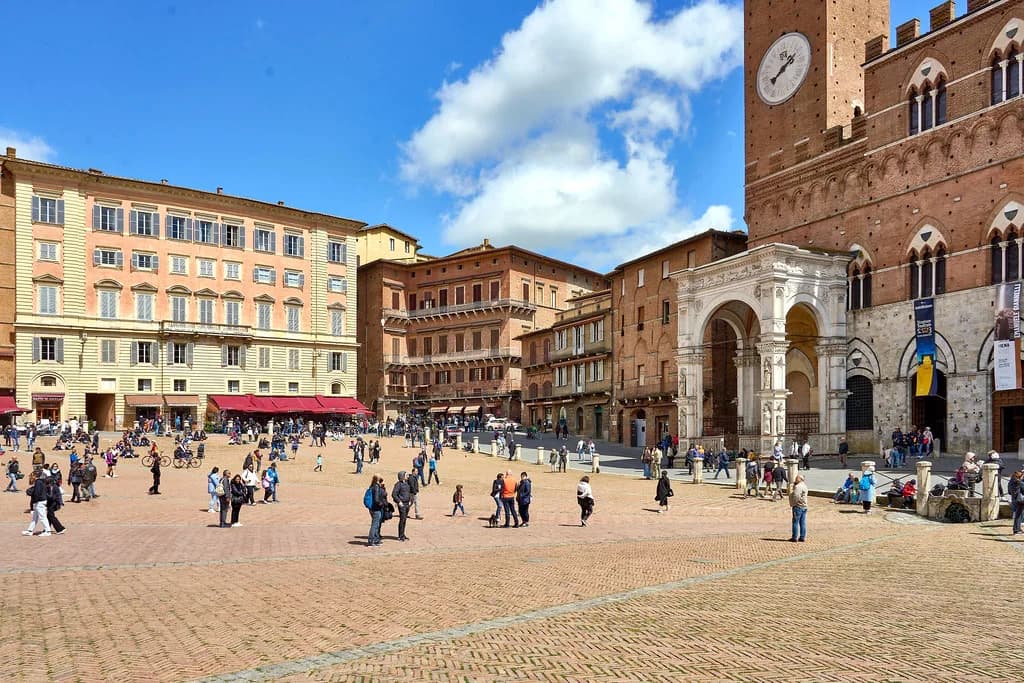
You rarely see Piazza del Campo before you are in it. The historic centre funnels you down narrow brick alleys, and then the space opens at once into a wide, tilted bowl of red paving with the Palazzo Pubblico sitting low at the far end. Locals simply call it il Campo, and it works less like a museum exhibit than as the city's shared front room.
The one fact worth carrying in your pocket is that walking the square itself is a free public act: it is open ground, not a ticketed monument. Tickets enter the picture only for interiors such as the Museo Civico inside the Palazzo Pubblico and the Torre del Mangia climb, which are sold separately from the open square. Budget roughly 30 to 45 minutes for a first pass and an hour or more if you plan to sit, circle the perimeter and look closely at the fountain, as an editorial suggestion rather than any official figure.
Quick Orientation: A Sloping Public Square
The Campo is a single designed space rather than a cluster of separate sights, and its shape is the reason. The paving is semicircular and slopes southwards toward the Palazzo Pubblico, following the natural dip of the valley, so the town hall reads almost like a stage backdrop from every entrance. That geometry is why the square works for crowds: sightlines converge, and the slope acts as a natural grandstand.
In practice you arrive on foot through one of the alley mouths, and the reveal is deliberate. The historic centre is pedestrian and tightly built, so walking in is part of the experience, and arriving by vehicle only drops you at the edge of the old town. If you want a structured route, a Siena self-guided walk old town itinerary can fold the Campo in as its natural midpoint. Related guide: Siena Attractions: Visitor Guides to 15 Sights.
The Shell Decoded: Nine Sectors and Herringbone Brick
Look down rather than up. The brick surface is divided into nine wedge-shaped sectors by pale travertine strips that fan out across the shell, an explicit homage to the Government of the Nine who ruled Siena in the late medieval republic. The inner paving is laid in herringbone brick, while an outer band in stone frames the whole fan. Once you notice the nine-part division, the square stops looking decorative and starts looking political.
The slope had a practical job before it had a scenic one. Because the ground falls toward the centre, rainwater could be channelled and drained, keeping what was originally a market field usable. The concave shape also meant the space could hold ceremonies and crowds with decent visibility from every point, which is why it is often described as an open-air theatre with brick palaces as its wings.
How the Campo Became a Civic Square
Before it was a drawing room, the Campo was a drained valley used for markets. The transformation came under the Government of the Nine, who built the Palazzo Pubblico on the lower side from around the end of the thirteenth century and used the square to project civic authority. Treat the precise early dates you read elsewhere with light caution; the broad sequence, from market ground to monumental civic centre, is the useful takeaway.
What makes the perimeter feel so unified is regulation, not accident. Building rules required owners of houses facing the square to follow a Gothic aesthetic, with two- or three-light windows and brick facades, and an irregular church that intruded into the space was removed. The result is a ring of palaces that differ in age and function yet share a coherent look. That is why the square photographs as one composition.
Free to Walk, Ticketed to Enter
The most common planning error is assuming one ticket covers everything here. Walking the open square costs nothing, but the Palazzo Pubblico houses the Museo Civico, whose rooms hold frescoes such as Lorenzetti's allegories of good and bad government, and the Torre del Mangia is climbed on a separate ticket. A Palazzo Pubblico Siena museum guide is the place to decide whether the interiors justify your time, while Torre del Mangia tickets and climb notes cover the tower as its own decision.
Do not assume every palace on the perimeter welcomes visitors. Palazzo Sansedoni, the long brick facade on the curved side, is described as not open to visitors, so admire it from the paving. For current ticket prices and opening hours of the interiors, check the city and museum operators directly rather than relying on older guides, since those figures change with the season.
Fonte Gaia Up Close: A Copy in the Square
At the upper edge of the shell stands Fonte Gaia, the city's first public fountain. What you see today is not the original sculpture: Jacopo della Quercia's marble panels were replaced in the nineteenth century by copies carved by Tito Sarrocchi, and the originals are preserved indoors. Look at the reliefs, then go see the real thing.
The original panels are held at Santa Maria della Scala, the former hospital complex facing the cathedral square. Pairing the two is a sensible half-day: study the copy in the open air, then walk the short distance through the old town to see the sculptures in controlled conditions. It also makes the square's role clearer, as a stage for civic symbols whose finest artwork now lives in a museum.
The Palio Reality Check
Twice a year the square stops being a place to linger and becomes a racecourse. The city states plainly that the traditional Palio races take place in the Campo on 2 July and 16 August each year, so plan around those dates rather than through them if you want open paving. On race days expect dense crowds, temporary structures and restricted movement across the square; treat it as heavy disruption and possible access limits rather than a documented closure of the whole site. Further visitor details appear in Homepage | Comune di Siena.
Events are not confined to the Palio season. The city's own programme notes Christmas events and a New Year's Eve concert in Piazza del Campo, with the square lit and busy on those evenings. If your trip falls in late December or around a festival, check the Comune's events listing before you build an itinerary, because the square can be partly occupied by staging while the surrounding streets stay walkable.
When to Linger: Shadows, Space and Crowds
The square's character changes with the light. Early mornings and late afternoons bring long shadows across the brick and far more open paving, which suits sketching, photography and simply sitting on the slope. Midday in high season brings tour groups and heat, and the brick reflects both. The trade-off is simple: quieter hours give you space but less bustle, while event days give you atmosphere at the cost of room to move.
Sitting on the ground is part of how the square is used; students, schoolchildren and picnickers settle on the paving as shadows shift across it. Bring something to sit on if the brick is hot, and treat the fountain and the palace edges as vantage points rather than picnic spots. The square rewards patience over a quick photo stop.
Pairing the Campo With Nearby Sights
Behind the Palazzo Pubblico sits Piazza del Mercato, the old market square, where a deli is described as a good place to buy a sandwich loaded with Tuscan produce and carry it back up to the Campo. That is a practical lunch strategy rather than a dining recommendation, and you should confirm current opening before relying on any single shop.
The Duomo complex is a short walk away but belongs to a different ticket system entirely. The Opera della Metropolitana sells a single pass covering its museum sites, with separate pricing and seasonal hours published on its own site, so do not assume your Campo plans include cathedral entry. Check the cathedral operator's published hours for your dates, since they vary across the year and around religious celebrations.
If you want to push beyond the headline sights, the hidden gems in Siena guide covers quieter corners of the old town, and the Basilica of San Domenico in Siena sits within walking distance for a calmer counterpoint to the crowded square. Build these as optional add-ons rather than a fixed circuit, since the pleasure of the Campo is partly in not rushing away from it.
Plan Your Visit
Treat Piazza del Campo as the free, open heart of Siena and plan your paid visits around it: the Museo Civico and the Torre del Mangia are separate tickets, and the cathedral operates its own pass and hours. Walking the square costs nothing, so the real budget is time, and the square repays an unhurried hour more than a hurried ten minutes.
Before you go, confirm the Palio dates and any event programming through the city, and check the museum and cathedral operators for current prices and seasonal hours, since those figures shift. Then arrive on foot through the alleys, look down at the nine sectors, and let the shell shape do the rest.
Frequently Asked Questions
Is Piazza del Campo free to visit?
Yes. The square is open public ground, and walking it, sitting on the slope or circling the perimeter costs nothing. Paid entry applies only to interiors such as the Museo Civico inside the Palazzo Pubblico and the Torre del Mangia climb, which are sold on separate tickets. Check current prices with the operators before you go.
Why is Piazza del Campo shaped like a shell?
The semicircular, sloping form follows the natural dip of the valley, with the ground falling toward the Palazzo Pubblico. That shape drained the original market field and created a natural amphitheatre with good sightlines from every point. The nine wedge-shaped sectors marked by pale stone strips are a deliberate homage to the Government of the Nine.
When is the Palio held in Piazza del Campo?
The city states that the traditional Palio races take place in the Campo on 2 July and 16 August each year. Those are recurring race days rather than a guarantee about any specific year's schedule or start times. Expect heavy crowds and restricted movement on those dates, and confirm details through official city channels.
Is the Fonte Gaia in the square the original?
No. The fountain you see in the square is a nineteenth-century reproduction by Tito Sarrocchi, installed to protect the earlier marble panels from the weather. Jacopo della Quercia's original sculptures are preserved at Santa Maria della Scala, the former hospital complex near the cathedral square, so pair the two for the full story.
Can you climb the Torre del Mangia?
The tower is climbed on a separate ticket from the open square and from the Museo Civico, so plan it as its own decision rather than part of general admission. Current prices, hours and any capacity limits should be checked with the operator before you travel. The climb is not described here as easy or accessible.
How long should you spend at Piazza del Campo?
As an editorial suggestion rather than an official figure, allow 30 to 45 minutes for a first pass and an hour or more if you plan to sit, circle the perimeter and study the fountain. Add separate time for the Museo Civico or the tower if you intend to go inside. Mornings and late afternoons are calmer than midday.
What is the best time of day to visit?
Early mornings and late afternoons bring longer shadows and more open paving, which suits photography and sitting without the midday crush. Midday in high season is busier and hotter, and the brick reflects the sun. Event days, including the Palio and the New Year's Eve concert, offer atmosphere but far less room to move.
How do you reach Piazza del Campo on foot?
The square sits in Siena's pedestrian historic centre and is reached through narrow brick alleys that open suddenly onto the paving. Arriving on foot is part of the experience, and vehicles only bring you to the edge of the old town. Use the alley mouths as entry points and expect a deliberate scenic reveal as you step out.
Sources
Continue exploring
More guides you'll find useful