Hidden Gems in Livorno: Canals, Ex-Voto and Quiet Corners
Discover Livorno's lesser-known corners, from the Venezia Nuova canals and Fortezza Nuova to Montenero's ex-voto collection and a fresco-covered dome.
On this page
Many cruise passengers docking in Livorno step straight onto a coach for Pisa or Florence, and the city they pass through rarely gets a proper look. That is a reasonable trade-off on a short port call, but it also explains why Livorno's canal quarter, hillside sanctuary and seafront terrace stay calm even on busy days. This guide treats those places as a wandering route rather than a ranking, with honest notes on upkeep, crowds and what still needs confirming before you set out.
One planning point decided most of the structure here: the canal district, the seafront and the Montenero hill sit in different parts of the city, so pairing them all in one rushed loop makes for more walking than seeing. Building two short outings instead, one around the canals and one along the coast or up the hill, keeps the pace slow enough to actually look at things.
Why Livorno Is Worth Staying For
Livorno was not built to look like a postcard. The Medici reshaped it as a port and a social experiment, offering settlers from many backgrounds protection and a fresh start, and the city's character still reflects that mix. Reading it as a working harbour town with a cosmopolitan past is a better approach than hunting for the classic Tuscan hill-town look, and it explains why so much here is warehouses, canals and civic façades rather than picture-perfect piazzas.
The Medici connection is not just background colour. One traveller's account of Livorno's canals describes pastel buildings reflected in quiet waterways, with hardly anyone strolling along them even when the rest of the city is busy. That combination, real history with a fraction of the attention, is the reason these corners deserve a place in a day here rather than a hurried glance from a shuttle window.
If you are staying overnight rather than passing through, the layout of the city matters more than any single sight. The Livorno neighbourhoods guide: where to stay and what each quarter is like is useful for choosing between the canal district and the seafront before you book, since each puts a different group of these places on foot.
Venezia Nuova: Canals Without the Venice Crowds
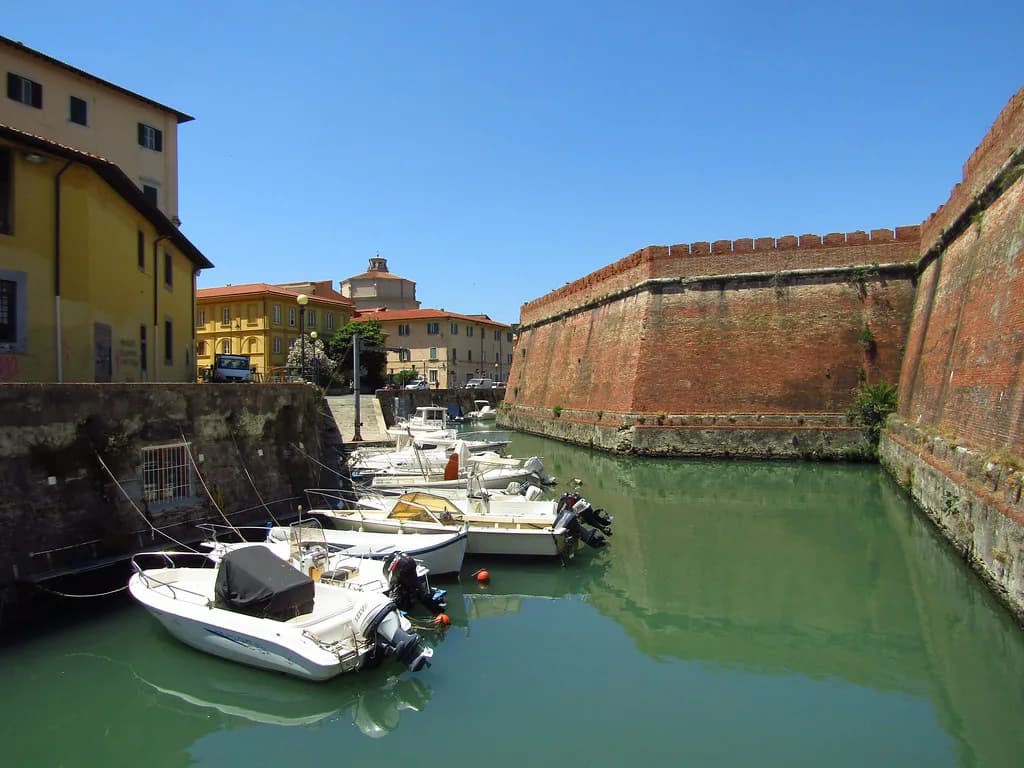
The quarter known as Venezia Nuova was added from the 17th century to give the merchants drawn to Livorno's port room to trade, and its canal system was built with techniques and labour brought from the Venetian lagoon. Reports describe tall buildings with faded façades, old warehouses, and streetlights reflected in the brackish water after dark, which is why an evening stroll here reads very differently from a daytime checklist stop.
Look for the Ponte di Marmo bridge, where inscriptions carved into the stone by dockworkers and boatmen commemorate comrades lost at sea. Many are barely legible now, so treat this as a detail to find rather than a monument to inspect, and give the canal edges a slow lap rather than a quick photo. The payoff is atmosphere: quiet water, worn stone and no queue.
The same canal quarter holds the Fortezza Nuova and the church of Santa Caterina, so pairing them saves a walk. Readers who want a structured route through these waterways, fortresses and the old harbour can follow the Livorno self-guided walk: canals, fortresses and the old harbour, which covers the same ground with proper pacing.
Fortezza Nuova: A Fort Turned Public Park
Sitting among the canals is La Fortezza Nuova, a 15th-century pentagonal fort with guard towers and surviving gun parts. The city has turned it into a public park, so it functions as open ground rather than a ticketed monument. One traveller's impression is that it is not well kept, looking greener in summer and threadbare in winter, which is worth knowing before you walk in expecting manicured lawns.
What the fort does offer is elevation over the canal ring and the colourful houses lining the water, making it a natural viewpoint rather than a sight with an entrance gate. Music festivals and events have been held inside from time to time, according to one account, and a small bar inside the walls has been reported as a calm spot for a drink. Check what is happening on the day rather than planning around a specific event, because the programme changes.
Santa Caterina's Frescoed Dome
In the Venezia district, the church of Santa Caterina hides its best feature behind a rough, almost minimalist façade. Step inside and the interior opens into an octagonal plan with side chapels, marble columns and Baroque decoration, crowned by a dome that one visitor describes as one of the largest frescoed surfaces in Tuscany. The altarpiece is a painting by Giorgio Vasari, The Coronation of the Virgin, whose sketch is held at the Louvre.
Churches in Italy are generally free to enter, but they are places of worship first, with dress expectations and occasional closures for services. Budget a short visit rather than a full stop, look up before you leave, and treat any notices at the door as the rule for that day. If you want context beyond the building itself, the Livorno Attractions hub sets this church alongside the city's other sights in one place.
Montenero: Ex-Voto on the Hill
On the hill looking over the city and its port, the Montenero monastery holds a collection of more than 700 ex-voto paintings offered in thanks for escapes from shipwrecks, fires and illness. They were mostly painted by people who were not professional artists, and that is precisely what makes them worth the climb: small, direct pictures that record how people dressed, worked and lived. One of the objects on display is a bodice and a pair of slippers belonging to a Livornese girl kidnapped by pirates in the 1800s, according to the same account.
The caveat here is arrangement. Parts of the sanctuary complex and its collections are not simply left open for anyone who walks in, so confirm what is accessible on your visit before climbing the hill. Plan the climb as one half of an outing rather than tacking it onto a canal walk, and keep a backup plan along the seafront if access turns out to be limited.
Art Without the Crowds at Villa Mimbelli
Away from the centre, Villa Mimbelli is a 19th-century property once owned by a family in the grain trade, now home to the Giovanni Fattori Civic Museum. Inside, the Macchiaioli painters are the draw: a group of Tuscan artists who worked outdoors in quick, bold strokes and are sometimes described as doing a decade earlier what the French Impressionists later became famous for. The villa itself, with frescoed walls and ceramic cherubs along a balustrade, gives the paintings a setting that most gallery visits lack.
This is a paid interior, so treat it separately from the free public spaces in this guide rather than assuming one ticket covers the city's art. Fares and opening days change, and organisers' pages are the place to check before you go, since a museum of this size can keep shorter hours than a public park. If the Fattori is closed, Modigliani's childhood home in Livorno is a separate stop that many visitors overlook entirely.
For a boxier view of what is available to visit and which interiors need tickets, the Livorno Attractions hub is a sensible first stop, followed by the Livorno self-guided walk: canals, fortresses and the old harbour, which keeps the walking route separate from the indoor stops.
Market Food: The Vettovaglie Interlude
The Vettovaglie market is the food stop rather than a sight, with bread, schiacciata, fresh pasta, meat, fish and eggs under a Neoclassical and Art Nouveau roof. Livornese residents still shop there for daily needs, which is why it reads as a working market with a lively murmur rather than an exhibit. One traveller warns that lunchtime is the busiest hour, so going earlier or later makes for a calmer walk through the aisles.
Outside, look for the local speciality known as 5e5, which pairs a chickpea pancake with bread and, if you like, a slice of garlicky aubergine, washed down with a sweet fizzy soft drink. For a proper sit-down meal, the classic Livornese dish is cacciucco, a hearty fish stew traditionally made from leftover unsold fish at the end of the market day, and one account of eating in the city also names a gelateria and a pizzeria near Piazza della Repubblica as favourites. Prices are not listed here because they change; check the stalls or menus on the day. Related guide: Livorno Food Guide: What to Eat and Where to Find It.
Terrazza Mascagni and the San Jacopo Seafront
The seafront walk from Piazza San Jacopo in Acquaviva leads to Terrazza Mascagni, a black-and-white tiled terrace that stretches out toward the sea. The piazza in the church's shadow is where locals sunbathe and dive from a small pier, according to one account, and it marks the end of a long walking route that begins in Florence. The terrace itself, named after the Livorno-born composer Pietro Mascagni, was once the site of a fortress and then a carnival park before becoming the public square it is today.
This is one of the free, open spaces that make a low-cost afternoon possible: no ticket, no queue, just a long seafront and a view that shifts with the weather. Sunset is the obvious timing, but the walk between San Jacopo and the terrace is the real point, so set out with enough daylight to enjoy both ends of it.
Planning the Walks Around the Weather and Crowds
A practical question decides how much of this you see: when to go. Summer gives you the terrace and pier at their best but also the hottest walking between clusters, while winter can leave the fortress park looking scruffy and the market livelier. Best time to visit Livorno and how to avoid the crowds lays out the trade-offs without pretending any month has the city to itself.
Arriving by ship means you also have to plan around free shuttle transport from the port, which is not always clearly signposted. One traveller's advice is to skip the ship's paid excursion, take the free shuttle toward the centre, and walk or use local transport from there rather than paying for a taxi transfer into town.
A Half Day Versus a Full Day
If you have only a few hours, pick one cluster and stay in it. The canal district suits a shorter visit best: Venezia Nuova, the Fortezza Nuova viewpoint and the interior of Santa Caterina are close enough to link on foot, and the market makes a natural end point before lunch. Trying to add Montenero or Villa Mimbelli to the same window means time in transit rather than time looking. If you want a structured version of that plan, the Livorno one-day itinerary: a realistic plan for a single day sets out how much fits without rushing.
With a full day, keep the two clusters separate. Morning in Venezia Nuova, an early lunch at the Vettovaglie market, then an afternoon along the seafront from San Jacopo to Terrazza Mascagni works well, and the hill can be moved to a second day rather than squeezed in. That structure is a suggestion, not an official timetable; adjust it to how much walking you actually want.
If your port call is short, the honest advice is to defer Montenero and the Fattori museum, both of which need travel time and either booking checks or a ticket purchase. The canals, the fortress park, the church and the terrace are all better adapted to a tight schedule because they sit in the centre or along the coast and do not depend on opening hours in the same way.
Wander Livorno Slowly
Livorno rewards the traveller who does not rush to the next famous city. The canal quarter, the fort above it, the frescoed dome of Santa Caterina, the ex-voto on the hill and the tiled terrace by the sea each take a modest amount of time, and they add up to a day that feels unhurried rather than unambitious. Treat access details, museum fares and sanctuary arrangements as things to verify before you go, and let the rest of the day stay loose.
If you want to keep going through Tuscany, the Livorno Attractions hub is the natural next stop, and the Best Time to Visit Livorno is worth reading before you set a date. Further afield, our guides to hidden gems in Florence cover the same approach: fewer sights, more attention, and a willingness to check what is actually open.
More Livorno guides
- A Self-Guided Livorno Walk Through the Canal District, Fortresses and Old Harbour
- Best Time to Visit Livorno
- Free Things to Do in Livorno
- Getting Around and Arriving in Livorno
- Livorno Evening Guide
- Livorno Neighbourhoods Guide
- Livorno Rainy Day Guide
- Livorno Viewpoints
- Livorno with Kids
- One Day in Livorno
- Chiesa di Santa Caterina in Livorno
- Duomo di Livorno
- Fortezza Nuova Livorno
- Fortezza Vecchia Livorno Guide
- Mercato Centrale di Livorno
- Piazza della Repubblica in Livorno
- Terrazza Mascagni in Livorno
- Visiting the Santuario di Montenero Above Livorno
Frequently Asked Questions
Is Livorno worth exploring instead of a day trip to Pisa or Florence?
Only you can weigh that, but it helps to know what each choice involves. A day trip means a longer journey and less time on the ground; staying in Livorno gives you a canal quarter, a fortress park with views, a frescoed church, a market and a seafront terrace, all in one city. If you have already seen Pisa and Florence, or you simply want a slower day, staying put is a strong option.
Can you walk from the cruise port into central Livorno?
Many cruise lines run free shuttle buses from the port toward the centre, and local transport is an alternative. Check the arrangements on the day of arrival, because operators change them and signage can be unclear. Walking the whole route from the ship is possible for some passengers but adds distance before you have seen anything.
Are there free things to do in Livorno?
Several of the places in this guide are free public spaces, including the canal streets of Venezia Nuova, the Fortezza Nuova park and the Terrazza Mascagni seafront. Churches are generally free to enter but may close for services, and any collection with a ticket, such as a museum interior, should be checked for current opening days and fares before you travel.
How long does a slow wander through the canal district take?
There is no official duration, but a relaxed half day covers Venezia Nuova, the Fortezza Nuova viewpoint and the interior of Santa Caterina without hurrying. Add the market for lunch and you have filled a morning comfortably. Trying to include Montenero or a gallery in the same window is where the day starts to feel rushed.
Do I need to book the Montenero ex-voto collection in advance?
Some parts of the sanctuary complex and its collections are not simply open to anyone who turns up, so it is worth asking before you climb the hill. The monastery is an active religious site, and arrangements can vary. Have a seafront alternative ready in case access is limited on the day you visit.
Sources
Continue exploring
More guides you'll find useful