Fortezza Vecchia Livorno Guide: The Old Port Fortress
Plan a short visit to Fortezza Vecchia, Livorno's Medici-era fortress by the old dock. Learn its history, canal-side approach and what to verify first.
On this page
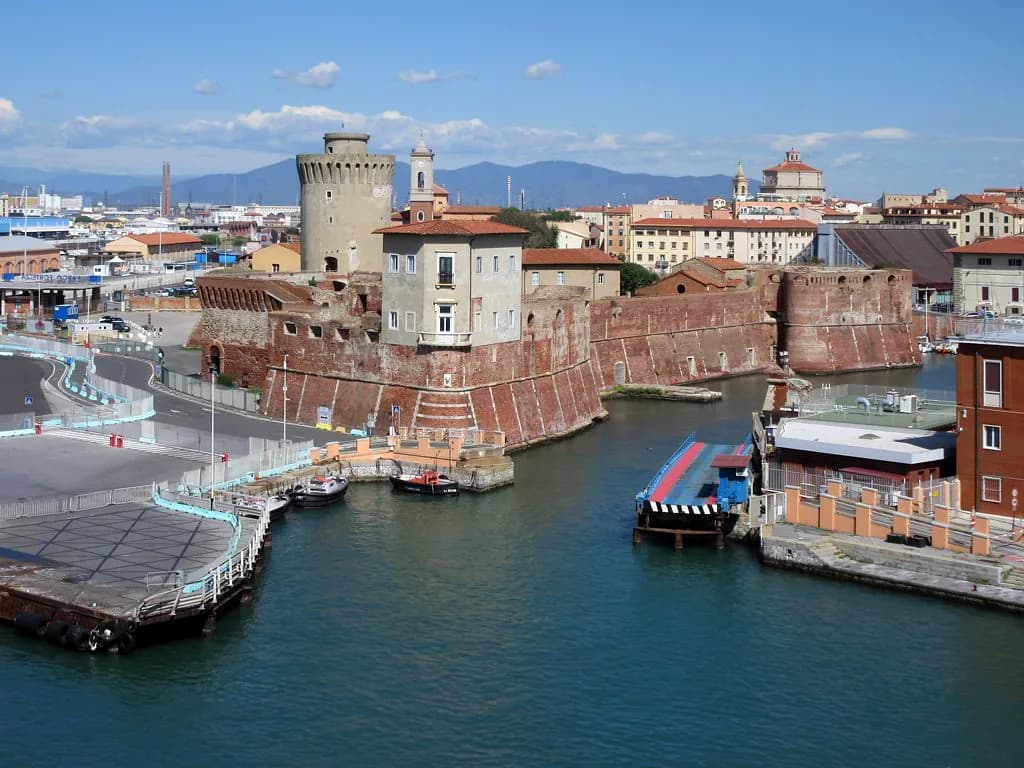
Fortezza Vecchia is the harbour-end anchor of Livorno, a fortified complex beside the old dock rather than a single museum hall. Visitor listings describe it as a venue for cultural events and festivals, which makes it worth reading the city's own calendar before you plan a walk there. Approach it on foot through the canal streets and the fortress becomes an orientation point for the whole port.
Where Fortezza Vecchia Sits
The fortress stands at Piazzale dei Marmi, beside the Medicean Darsena, the historic dock that shaped Livorno's maritime identity. Its position at the water's edge means the walk toward it is as useful as the site itself, since the harbour and canal geometry explain why a fort was built here. Treat the address as your planning anchor rather than a clue to a fixed route.
From the canal district the fortress is reached along the scali, the canal-side streets that give this part of Livorno its navigable logic. Those streets climb past small bridges and low facades before opening toward the port, so the approach works best as a short preliminary walk rather than a dash. Wear shoes with grip, because canal edges and bridge surfaces can be smooth underfoot.
A Short History of the Fortress
The site's layers go back further than the stone you see above ground. A keep associated with Countess Matilda of Tuscany in the eleventh century stood here before the Pisans built a fort, and that earlier tower was folded into the Pisan structure. Reading the fortress as a succession of building campaigns helps make sense of why its walls feel thicker and more irregular than a single-era castle.
The Medici gave the complex its defining shape and its association with the city's rise. The castle has been called a symbol of Medicean Livorno, and the ceremony proclaiming Livorno a city took place inside the fortress on 19 March 1606. That date is the strongest single fact to carry with you: the fort is not just defensive architecture but a civic stage where Livorno's status was announced.
The fortress is also linked in overviews to Fortezza Nuova, the later pentagonal work on the other side of the historic centre. Seeing the two in sequence clarifies how Livorno's defences shifted as the port grew beyond its earliest walls. If your interest leans toward green-edged ramparts and open views, the Fortezza Nuova Livorno: visiting the pentagonal fortress and its park guide covers that site separately.
What You Actually See
Expect a layered monument rather than a curated exhibition. The value lies in the mass of the walls, the sense of a fortress once surrounded by water, and the way the complex opens toward the modern port. Walking the exterior gives you the clearest reading of how the fort once controlled the harbour approach.
Views back over the port are the reason to linger rather than pass through. For a wider comparison of elevated and waterfront prospects across the city, the Livorno viewpoints: where to look over the city, port and coast guide sets harbour edges alongside terrace and hilltop options. Pair a harbour look with one inland vantage and you get a fuller picture of how the city meets the sea.
Open Areas and Ticketed Spaces
Do not assume one entry rule covers the whole complex. Fortress grounds, event spaces and any temporary exhibition areas are often managed separately, and the available listings do not establish which interiors are currently open. One travel listing notes free admission as a visitor impression, but that is not a confirmed operator rule and should not be relied on for planning. For a separate free public green, the Fortezza Nuova Livorno page explains that fortress and its park as distinct ground.
The practical approach is to treat exterior walls and the surrounding harbour edge as your baseline and to confirm anything beyond that directly with the city before you travel. That framing protects you from arriving expecting a paid museum circuit that may not be running. It also keeps expectations realistic if an event has closed part of the site.
Events and Festivals
The fortress functions as a cultural venue, and events have included evening concerts and discos according to visitor listings. Because programming shifts with the season, a festival mentioned in one account is no guarantee of anything on your dates. Check the city's own events calendar before you build an evening around the fortress.
The Comune di Livorno publishes a dated events listing that names venues, so it is the place to confirm whether anything is scheduled at the fortress during your stay. A recent snapshot of that calendar showed exhibitions at Villa Fabbricotti and the Museo della Città, plus theatre at the Teatro Goldoni, rather than fortress programming. Absence there is information too: it tells you to plan a daytime exterior visit instead.
Canal-Side Approach and Pacing
A suggested duration, not official guidance, is to allow about an hour for the fortress exterior and its harbour views, then add the walk to and from the canal district. That keeps the visit proportionate: this is a place to read the port through stone, not to work through galleries. Build in time to pause at bridges for photographs and to notice how the water lines frame the fort.
If you want a longer half-day, extend south to the seafront after the fortress. The Terrazza Mascagni Livorno: visiting the checkerboard seafront terrace offers a deliberate contrast between harbour fortification and open-sea promenade. Doing both in one outing keeps transport simple and gives you two very different readings of Livorno's relationship with water.
Walkers who prefer quieter corners should give the canal streets their own time rather than treating them as a corridor. The hidden gems in Livorno guide covers overlooked corners of the city that reward a slower pace. The Designer Journeys port-city guide, meanwhile, describes the Nuova Venezia district as offering a canal-side mood without crowds, so a loop through those streets before or after the fortress can turn a single sight into a fuller neighbourhood walk; judge the quiet for yourself once you are there.
Practical Checks Before You Go
Confirm three things with the Comune di Livorno before relying on them: whether any part of the complex is open beyond the exterior, whether an event is scheduled during your dates, and whether any area is closed for works or a private booking. The city site is the authoritative starting point for all three, and it costs one short check to avoid a wasted trip.
Ignore any listing that promises a specific ticket price or skip-the-line entry, because none of the available sources establishes current pricing or booking arrangements. A visitor-reported note that a bridge opens hourly for pedestrians is likewise an anecdote, not a rule, so do not plan your timing around it. Arrive with a flexible plan and let what you find on the ground set the pace.
Accessibility and security rules inside the fortress are not documented in the available sources, so anyone with mobility needs should ask the city directly rather than assume step-free routes through historic walls. The same caution applies to evening visits, where lighting and staffing may differ from daytime. A short message to the city's contact channels before travelling resolves both questions. If you are travelling with children, the Livorno with kids guide,
If you are travelling with children, the Livorno with kids guide sets family-oriented stops alongside a harbour visit; the fortress itself has no documented child-specific offer in these sources, so treat it as a short exterior stop rather than a programmed activity. On the fortress's place in a broader city itinerary, see the
For the fortress's place in a broader city itinerary, see the Livorno Attractions hub.
Plan Your Visit
Fortezza Vecchia works best as a harbour-edge orientation point: a short, atmospheric stop that explains how Medici Livorno protected and presented itself to the sea. Approach it on foot through the canal streets, allow roughly an hour for the exterior and views, and treat any interior access or event as something to confirm with the city.
Keep the rest of your Livorno itinerary flexible enough to absorb a change of plan. If the fortress turns out to be closed for an event, the canals, the seafront terrace and the city's exhibition spaces are all within reach. That is the sensible way to plan around a monument whose public access is not fully documented.
Frequently Asked Questions
Is Fortezza Vecchia free to visit?
Some visitor listings give the impression that admission is free, but this is not a confirmed operator rule and no reliable source establishes current pricing. Check with the Comune di Livorno before you travel, and assume only that you can walk the surrounding harbour area without a ticket.
Why is Fortezza Vecchia important to Livorno?
The fortress is tied to the city's Medici era and is described as a symbol of Medicean Livorno. The ceremony proclaiming Livorno a city took place inside it on 19 March 1606, which makes it a civic as well as a military landmark.
Can you walk to Fortezza Vecchia from Livorno's cruise port?
The fortress sits beside the Medicean Darsena and harbour edge, and the canal district leads toward it on foot along the scali. Exact walking times from the cruise terminal are not documented in the available sources, so allow more time than a map suggests and wear shoes with grip for smooth canal-side surfaces.
How long should you spend at Fortezza Vecchia?
A suggested duration, not official guidance, is about an hour for the exterior and the views back over the port, plus the walk to and from the canal district. Add time if you plan to extend the outing to the seafront or the city's exhibition venues.
Does Fortezza Vecchia host events and festivals?
Visitor listings describe the fortress as a venue for cultural events and festivals, including evening entertainment at times. Programming changes, and no current calendar is documented here, so check the Comune di Livorno events listing before building a visit around a specific evening.
Can you visit inside the fortress?
The available sources do not establish which interiors are currently open to the public, and parts of a fortress complex may not share one entry rule. Treat the exterior and harbour views as the dependable part of a visit and confirm interior access with the city beforehand.
What else should I see nearby?
Fortezza Nuova, the canal streets and the Terrazza Mascagni seafront all work well alongside a fortress visit. Together they show three different faces of Livorno's relationship with water, from defensive walls to residential canals to an open promenade.
Sources
Continue exploring
More guides you'll find useful