Terrazza Mascagni Livorno: Visit the Checkerboard Seafront
Plan a visit to Livorno's Terrazza Mascagni: black-and-white mosaic pavement, the liberty-style gazebo, sea views and links to the Ardenza waterfront.
On this page
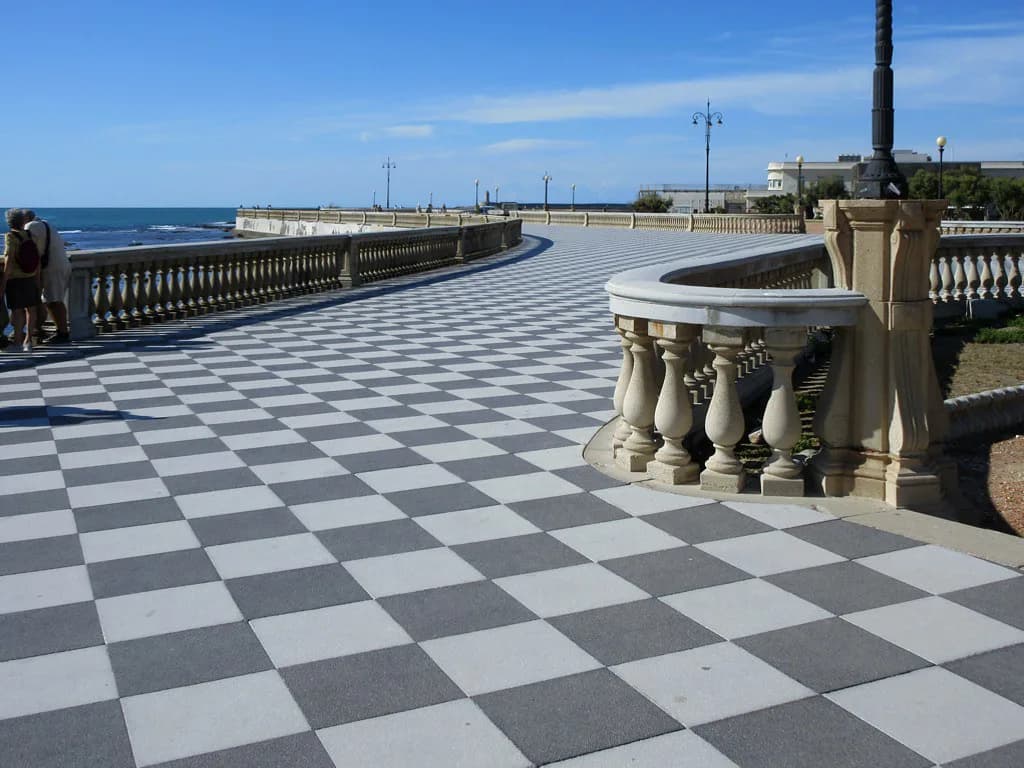
The Terrazza Mascagni is Livorno's signature seafront balcony: a vast open platform paved in black and white squares, bounded by a balustrade of small marble columns and facing straight out to the Tyrrhenian Sea. The city's tourism board treats it as the first thing a visitor should see, describing it as a Liberty-style checkered square that works as an extension of the city toward the water.
It is also free, outdoors and does not require a reservation, according to the Visit Livorno listing, which makes it an easy anchor for a day that mixes paid museums with open-air wandering. Before you build an itinerary around it, it helps to know what the terrace actually is: civic space, not a ticketed monument, with no published opening or closing hours.
What the Terrazza Mascagni Is and Where It Sits
The terrace occupies the point where Livorno's historic centre gives way to the coastal boulevard, Viale Italia, which runs south along the sea. Several sources note that it is one of the most photographed places in the city, so expect company at the balustrade rather than solitude. Its principal draw is the view: the Tuscan Archipelago and the Meloria shoals on clear days, with the light and wind constantly rearranging the panorama. Further visitor details appear in Mascagni Terrace: Livorno’s Iconic Seaside Promenade - Miramare Village.
Because the platform is open to the sky and the sea, it belongs to the same family of experiences as the city's other elevated and waterside lookouts, which reward timing more than ticking off. If you enjoy comparing vantage points across Livorno, the wider set of Livorno viewpoints: where to look over the city, port and coast is worth reading before you decide where to spend a sunset.
Practically, the terrace is reachable by public transport and sits on the coastal road, so it fits naturally between the centre and the southern suburbs. Exact bus routes and timetables are not published on the terrace's own listing, so check the local operator's site or the tourist information offices before relying on a specific line.
Pavement, Balustrade and the Liberty-Style Gazebo
The terrace's identity comes from its floor: a checkerboard of white and black marble tiles, roughly 9,000 square metres of it, laid out in a geometry that shifts as the sun moves. Around the edge runs the balustrade, made of more than 4,000 small columns that from a distance read as a marble wave parallel to the sea. The effect is deliberately theatrical, and it explains why photographers gravitate to the diagonal lines rather than the wide flat view.
At the centre stands an octagonal gazebo in Liberty style, which the sources describe as the focal point of the composition and a venue that has hosted concerts and public gatherings. Do not read that as a promise of a current programme: nothing reliable is published here about what is scheduled this season, so treat any performance as a bonus and check local listings if music is a priority.
For photographs, the strongest angles use the balustrade as a leading line toward the horizon, or place a single figure on the checkerboard to give the tiles scale. Morning and evening light flatten the pavement's contrast less than midday does, which is why dawn and dusk are the moments most often suggested. These are photographic suggestions, not official visiting hours.
History in Brief: From Fortress Site to Civic Icon
The terrace was built in the 1920s on the site of the Forte dei Cavalleggeri, a seventeenth-century coastal defence demolished to make room for a representative seaside setting, and the design is attributed to the Livorno engineer Enrico Salvais. It was originally named Terrazza Ciano, after a figure of the Fascist regime, and only after the Second World War took the name of the Livorno-born composer Pietro Mascagni, author of Cavalleria Rusticana. Both names are history now; today's signage and maps use Mascagni.
Storm damage is part of the structure's story rather than a footnote. Visit Livorno records that the terrace was repeatedly hit by violent weather and was fully restored at the end of the 1990s, with green areas reinstated and the music gazebo faithfully rebuilt. That restoration is why the pavement reads as crisp geometry today rather than worn stone.
Knowing this changes how you look at the place: it is a twentieth-century urban design project over an older defensive site, not an ancient monument. The city's own administration publishes news and notices about Livorno's public spaces and services, which is where to look for any official communication affecting the seafront.
When to Go: Light, Weather and the Changing View
The panorama depends on the hour, the day, the weather and the wind, so the terrace is less a fixed sight than a shifting one. Clear, breezy days give the longest views toward the archipelago; haze softens the horizon but also produces the layered light photographers chase. Check a marine forecast before committing to a sunset visit, because an exposed platform is uncomfortable in strong wind and rain.
Seasonally, the terrace behaves like the rest of the seafront: lively on warm evenings when Livorno takes its passeggiata, brisker and emptier in winter. Daytime averages in Livorno run around 20°C in October and drop to roughly 11°C in December, which is a useful reminder that the coastal wind can make a sunny afternoon feel colder than the number suggests.
Sunset is the popular slot, and rightly so, but dawn gives you the same geometry with far fewer people and a quieter sea. Neither is an official recommendation; both are simply ways to use the light that the sources describe as the terrace's main variable.
Free Access and Practical Expectations
Visit Livorno lists the terrace as free, outdoors, reachable by public transport and available without reservation, which is the clearest published statement about access. There are no official opening hours for the space, because it functions as open civic ground rather than a gated attraction. Plan around daylight and weather instead of around a timetable.
As a suggested duration rather than an official figure, allow about half an hour for the pavement, the balustrade and a turn around the gazebo, and considerably longer if you continue along the waterfront. The trade-off is real: a quick stop fits a cruise day, while a slow visit rewards anyone willing to sit with the view. Our guide to free things to do in Livorno: what costs nothing and what doesn't helps you balance the free stops against paid sights. For wider planning, see Free Things to Do in Livorno.
One general point on access: a source describes the area as accessible to people with reduced mobility, but specific facilities such as adapted toilets or dedicated parking bays are not documented here. If you need particular assistance, confirm details with Livorno's tourist information service before travelling.
Around the Terrace: Pancaldi, San Jacopo and the Baracchina Bianca
The immediate surroundings are part of the experience. Visit Livorno places the Bagni Pancaldi, one of Europe's oldest seaside resorts, the Grand Hotel Palazzo, and the church of San Jacopo in Acquaviva with its legend-wrapped crypt within the beauty that frames the terrace. Treat these as neighbouring context rather than stops on a measured route.
Near the Naval Academy, the Baracchina Bianca provides refreshment with a sea view, according to the same tourism source, and it is the obvious pause if you want a drink without leaving the waterfront. Refreshment points along this stretch come and go with the season, so check on arrival rather than planning around a particular venue.
For the city's less obvious corners, including the canal quarter, our guide to the hidden gems in Livorno pairs well with a seafront morning, and its Venezia Nuova coverage explains why the canal district repays a slow walk after the open sky of the terrace.
Extending the Walk Along Viale Italia and Ardenza
Viale Italia is the seafront boulevard that carries the city south past the terrace, and it is described as ideal for walking, jogging, cycling or pausing at cafés with a view. From there the coast runs through Ardenza and on toward Antignano and the Romito cliffs, which the sources mention as glimpses from the terrace itself.
Humbo describes the checkered pavement as running some 500 metres along the coast, with locals gathering in the evening and the space coming alive at sunset. That makes the terrace a natural starting point rather than a destination to reach and leave.
No source gives walking times or distances between the terrace, Ardenza and the station, so judge the extension by your own pace and the weather rather than by a quoted number. A one-way walk with a bus or taxi back is more flexible than committing to a loop on a windy day.
Paid Sights to Pair with a Free Terrace Visit
Because the terrace costs nothing, it balances well against the city's ticketed attractions. The Livorno Aquarium and the Giovanni Fattori Civic Museum in Villa Mimbelli, with its Macchiaioli works, are both listed among the things to see near the terrace; check each venue directly for current opening arrangements and entry conditions, since neither is covered by the terrace's free access.
Inland, the Venezia Nuova district is Livorno's most atmospheric quarter, a seventeenth-century network of canals, bridges and historic palazzi best appreciated on foot or by boat. A separate Fortezza Nuova Livorno guide covers the pentagonal fortress and its park if you want another free outdoor stop in the same day.
For a companion piece in the historic centre, the Chiesa di Santa Caterina in Livorno is a distinct visit from the seafront and worth checking for its own opening times rather than assuming access.
Eating After the Sea Air
Livorno's coastal position shapes its food, and cacciucco, the fish stew that traditionally combines at least five types of fish, is the dish to try. Riso nero made with cuttlefish ink and triglie alla livornese, red mullet in tomato sauce, are the other local staples named in the same overview.
The Mercato Centrale, a nineteenth-century covered market, is the practical place to see and taste local produce, and it fits naturally into a city-centre wander after the seafront. For market days and hours, check current information locally, as these change through the week.
If your day is short, the smart sequencing is terrace first, market and canals second, with a seafood lunch between them. That keeps the waterfront in the best light and leaves the covered streets for the heat of the afternoon.
Why Linger on the Terrace
The Terrazza Mascagni rewards patience more than efficiency: the light changes, the wind shifts, and the view toward the archipelago opens or closes by the hour. Arriving without a schedule and staying a little longer than planned is closer to how the space is actually used than racing through a checklist.
Build the day around the free platform, add one paid sight such as the aquarium or the Fattori museum, and finish with a walk along Viale Italia or a bowl of cacciucco in the centre. Check official city and tourism channels for anything time-sensitive, since the terrace publishes no fixed hours and nearby venues set their own.
Frequently Asked Questions
Is the Terrazza Mascagni free to visit?
Yes. Livorno's tourism board lists the terrace as free, outdoors and available without reservation, which fits its character as open civic space rather than a ticketed monument. There are no published opening hours because the platform is not gated. Nearby museums and the aquarium set their own entry arrangements, so check those separately before you go.
What is the best time of day to visit the Terrazza Mascagni?
Dawn and dusk are the moments most often suggested for photography, because low light plays up the contrast of the black and white pavement and softens the view toward the sea. These are suggestions rather than official hours. Midday is brightest but flatter, and strong wind or rain can make the exposed platform uncomfortable at any hour, so check the marine forecast first.
How long should I spend at the Terrazza Mascagni?
As a suggested duration, not an official figure, allow around half an hour for the pavement, balustrade and gazebo, and longer if you continue along Viale Italia toward Ardenza. A short stop suits a cruise day, while a slow visit gives you time to watch the light change. No source gives measured walking times along the waterfront, so pace it yourself.
Why is the Terrazza Mascagni paved in black and white?
The checkerboard is a deliberate design decision from the 1920s project: roughly 9,000 square metres of white and black marble tiles, surrounded by a balustrade of more than 4,000 small columns that reads as a marble wave from a distance. The geometry was intended to give the waterfront a monumental, representative character, and it remains the terrace's defining visual feature.
What is there to see near the Terrazza Mascagni?
Within the immediate seafront setting are the Bagni Pancaldi, the Grand Hotel Palazzo, the church of San Jacopo in Acquaviva and the Baracchina Bianca near the Naval Academy. Further along Viale Italia the coast runs through Ardenza toward Antignano and the Romito cliffs. The Livorno Aquarium and the Fattori Civic Museum in Villa Mimbelli are the main paid options to pair with a free terrace visit.
Is the terrace accessible for visitors with reduced mobility?
A tourism source describes the area as accessible to people with reduced mobility, but it does not document specific facilities such as adapted toilets, dedicated parking or ramps. If you rely on particular assistance, confirm the details with Livorno's tourist information service before travelling rather than assuming the general statement covers your needs.
Can I walk from the Terrazza Mascagni along the Ardenza seafront?
Yes, the seafront boulevard Viale Italia continues south past the terrace toward Ardenza and beyond, and it is described as suited to walking and cycling. No source gives distances or walking times, so treat the extension as an open-ended stroll. A one-way walk with a bus or taxi back keeps the plan flexible if the wind picks up.
What food should I try after visiting the terrace?
Look for cacciucco, Livorno's fish stew, traditionally made with at least five kinds of fish. Riso nero with cuttlefish ink and triglie alla livornese are the other local specialities worth seeking out, and the Mercato Centrale is the practical place to see local produce. Check market days and venue hours locally, as these vary through the week.
Sources
Continue exploring
More guides you'll find useful