Piazza della Repubblica Livorno: Bridge-Square Guide
A practical guide to Piazza della Repubblica in Livorno, the covered bridge-square over the Fosso Reale, its grand-ducal statues, and how to see it from below.
On this page
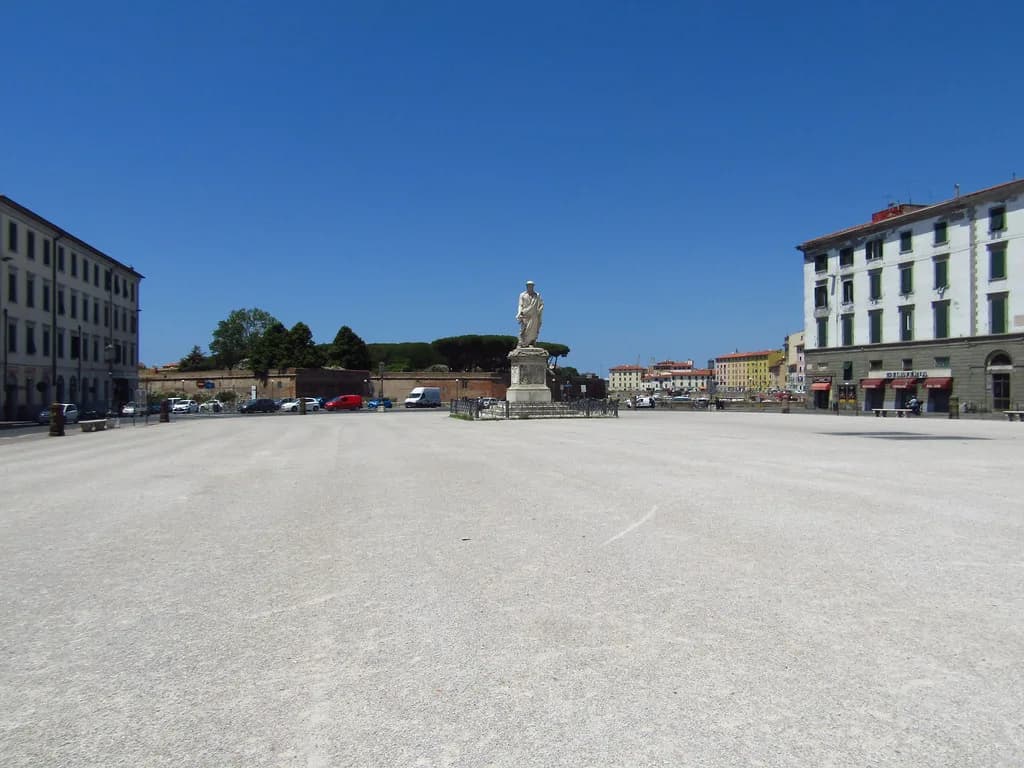
Piazza della Repubblica is the kind of landmark that rewards a second look. It reads as a city square, but it is really an elliptical covered bridge laid over the Fosso Reale, carrying traffic and pedestrians across the canal that once separated Livorno's historic centre from its newer suburbs. That double identity makes it a natural hinge for a walk: arrive from the centre, cross the span, and choose between Via Grande, Fortezza Nuova or Venezia Nuova on the other side.
Visit Livorno describes it as the widest bridge in Europe, a claim attributed to the city's own promotional material rather than a verified measurement. What is certain is its shape: a broad, vaulted deck rather than a narrow crossing, with two grand-ducal statues looking down on the traffic. For orientation, the local name Voltone is more useful than the official name, because it points to the vault below.
What the Square Actually Is
Most visitors expect an open piazza and instead find a covered bridge. The Fosso Reale runs beneath the pavement, and the elliptical span was designed to connect the historic centre with the suburbs beyond the canal without interrupting the waterway. The perpendicular axis to the old Via Ferdinanda, now Via Grande, is what makes the crossing feel like a street rather than a monument.
Visit Livorno lists the square among the city's water buildings and fortresses, which is the right category: it is infrastructure with civic ambition. It is free to visit, outdoors and reachable by public transport, and the tourism board notes that no reservation is required. That makes it a low-commitment stop to slot into a wider day rather than a ticketed attraction with a timed entry.
How the Square Came to Be
The project dates to the 19th century, when Livorno's rulers wanted a link between the historic centre and the new districts beyond the Fosso Reale. Architects Luigi Bettarini and Mario Chietti produced two competing solutions, and after adjustments Bettarini's design prevailed. The result was the elliptical covered bridge that survives today, oriented perpendicular to the axis of Via Ferdinanda.
Originally named Piazza dei Granduchi as a tribute to the Florentine dynasty, the space has been renamed several times, including a period under Carlo Alberto di Savoia, before taking its current name after the 1946 referendum. Those changes are more than trivia: they explain why the square carries a dynastic, then royal, then republican identity in the space of a single span. Reading the statues and the name together gives you a quick lesson in how Livorno's civic allegiances shifted. Further visitor details appear in Piazza della Repubblica | Visit Livorno.
Why It Is Called the Voltone
For people who live in Livorno, the square is simply the Voltone, a reference to the large vault that covers the Fosso Reale. The nickname is an orientation tool: if someone tells you to meet at the Voltone, they mean the covered passage, not an open piazza. It also explains why the space feels enclosed even on a bright day, with the canal running beneath rather than around it.
The vaulting shapes how you experience the square. Looking up, you see the structure that carries the deck; looking down, you sense that the pavement conceals old shops and underground premises. Visit Livorno notes that the pavement still hides these spaces today, which is a reminder that the surface you walk on is a lid over another layer of the city.
The Two Grand-Ducal Monuments
Two imposing statues dominate the square: Ferdinando III and Leopoldo II, carved by Francesco Pozzi and Emilio Santarelli. They honour the Medici grand dukes, and their scale is part of the point: they were made to be seen from below, from the deck, and from the water. The tourism board's account places them on the square without specifying which end each occupies, so treat the pair as a group rather than assuming a fixed left-right arrangement.
To look at them properly, step to the side of the traffic flow and find a spot where you can see the statue against the vault rather than against the sky. The composition rewards that angle, because the figures were designed for a covered setting where the light is filtered. If you are crossing quickly, at least pause on the approach so the pair registers as a deliberate pair rather than two isolated monuments.
A Square With Many Names
The sequence of names from Piazza dei Granduchi through Carlo Alberto di Savoia to today's Piazza della Repubblica tracks the city's political history. The dynastic name honoured the Florentine grand dukes; the Savoy name marked the Italian monarchy; the post-referendum name marked the republic. For a visitor, that progression is a compact way to date the square's layers without reading a history book.
It also matters for practical reading: guidebooks and older maps may use different names for the same place. If you are navigating by an old map, the Voltone nickname is the most reliable anchor, because it refers to the physical structure rather than the political fashion of the moment. Use the statues and the covered span as your visual confirmation that you have found the right spot.
Walking It and Choosing an Exit
Once you have crossed, the square opens onto a set of distinct routes. Via Grande leads into the lively heart of the centre; Via De Larderel runs historic and narrower; the Fortezza Nuova offers a green, fortified counterpoint; and Venezia Nuova presents the dome of Santa Caterina as its skyline. Choosing an exit is really choosing the next chapter of your walk, so decide before you step off the span.
The pavement itself is part of the experience: Visit Livorno notes that it hides ancient shops and underground premises, so the surface underfoot is a lid over older commercial life. That detail is a good reason to walk slowly and look at the edges of the span rather than treating it as a quick crossing. A self-guided loop that links the square with the canal district works well, because the bridge is the natural hinge between centre and water.
Seeing It From the Water
The most distinctive view of the square is from below, through the tunnel that carries the Fosso Reale under the Voltone. A boat excursion navigates the water beneath the square, passing reflections and the silhouette of the Fortezza Nuova before revealing corners of the older neighbourhoods. Excursion operators publish their own schedules and prices, so check those directly rather than relying on a guidebook.
The view from the water also reframes the statues, because you see them from a different level than the deck allows. If a boat trip is not part of your plan, the same perspective can be approximated by walking the canal banks where the Fosso Reale emerges on either side of the span. Either way, the square is best understood as a piece of infrastructure seen from two levels at once.
Practical Visiting Notes
Visit Livorno describes the square as free, outdoors, reachable by public transport and usable without a reservation. There are no published opening hours because it is an open public space, not a ticketed site, and that makes it easy to include on a flexible day. Check the city's official pages for any temporary works or events that might affect access, since those change without long notice.
Pairing the square with a seafront stop gives a balanced half-day. Terrazza Mascagni Livorno, the checkerboard seafront terrace, is a different kind of public space, and moving between the two shows how Livorno uses its water edges. Keep the square as a start or end point rather than a destination in itself, and the day will flow better.
Plan Your Visit
Piazza della Repubblica works best as a hinge, not a headline. Cross it slowly, look up at Ferdinando III and Leopoldo II, note the vaulted lid over the Fosso Reale, and let the Voltone nickname do the orientation work for you. Then pick an exit that suits the rest of your day: Via Grande for the centre, Fortezza Nuova for green space, or Venezia Nuova for the canal-side streets.
If the water level and your timing allow, take the view from below as well, but verify excursion details with the operator before you build a day around it. The rest of the visit needs no booking: the square is free, outdoors and open to anyone passing through. Bring a little patience for the traffic, and treat the crossing as a short architectural lesson rather than a five-minute shortcut. For related planning, see Hidden Gems in Livorno.
Frequently Asked Questions
Is Piazza della Repubblica in Livorno a square or a bridge?
It is both in appearance and a bridge in function. The space is an elliptical covered bridge over the Fosso Reale, perpendicular to Via Grande, so it reads as a square while carrying people and traffic across the canal.
Why do locals call Piazza della Repubblica the Voltone?
The nickname refers to the large vault that covers the Fosso Reale beneath the square. If someone suggests meeting at the Voltone, they mean the covered crossing rather than an open piazza.
Which grand dukes are commemorated by the statues on Piazza della Repubblica?
The two statues represent Ferdinando III and Leopoldo II, carved by Francesco Pozzi and Emilio Santarelli. The tourism board places them on the square without specifying which end each occupies, so look at them as a pair.
Is Piazza della Repubblica free to visit?
Yes. Visit Livorno lists the square as free, outdoors, reachable by public transport and usable without a reservation. There are no published opening hours because it is an open public space, though temporary works can affect access.
How do you see the square from below?
A boat excursion can take you through the tunnel under the Voltone, with views of the Fortezza Nuova and the canal-side neighbourhoods. Operators publish their own schedules and prices, so confirm details with them before planning around a trip.
What is nearby after crossing Piazza della Repubblica?
The main exits lead toward Via Grande, Via De Larderel, the Fortezza Nuova and the Venezia Nuova district with the dome of Santa Caterina. Each offers a different next chapter for a walk, so choose before you step off the span.
Sources
Continue exploring
More guides you'll find useful