Piazza Paolo VI Brescia Guide: Two Cathedrals, One Square
See how Brescia's round Romanesque Duomo Vecchio and Baroque Duomo Nuovo share Piazza Paolo VI, with the Broletto and a practical short visit plan.
On this page
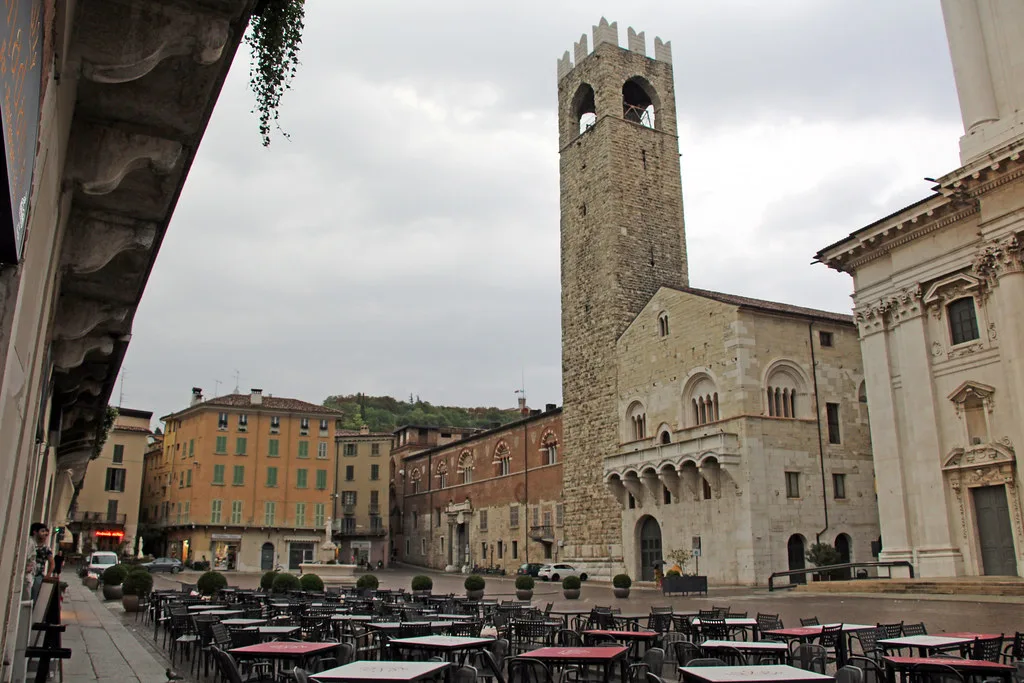
Piazza Paolo VI holds two cathedrals at once: the round, shadowed Duomo Vecchio and the marble-fronted Duomo Nuovo stand metres apart, with the medieval Palazzo del Broletto closing one side. The square is also called Piazza del Duomo, so searches for either name lead to the same paving stones.
Treat the square as a 20-minute stop you can stretch, not a half-day destination. It works best as the anchor of a walk that continues to Piazza della Loggia and then to the Roman remains; the timing below is our suggestion, not something the city publishes.
Where the Square Sits and Why It Works as a Walking Anchor
Piazza Paolo VI lies in the historic centre, a short walk from Piazza della Loggia and the Roman archaeological area around the Capitolium. That cluster is compact enough to cover on foot, which is why the square works better as one link in a route than as a standalone outing.
Piazza della Loggia is worth lingering in: its Renaissance loggia faces a clock tower whose astronomical dial dates from 1546, and three of Brescia's talking statues stand there, where citizens historically posted complaints about city government. Pairing the two squares gives you civic and religious Brescia in one loop.
Allow more time only if you plan to enter the Santa Giulia Museum, which occupies a former monastery and is a separate, ticketed visit rather than part of the square. Check the museum's own site for current admission and hours before building it into your day, and browse our Brescia Attractions hub for the city's other sights.
Duomo Vecchio: The Round Romanesque Church
The Duomo Vecchio, nicknamed La Rotonda, is described by the city's tourism board as the most prominent surviving circular Romanesque church, begun around 1100. Its circular plan gives the interior an unusual, enveloping feel, with heavy stone and dim light rather than the bright decoration of later Italian churches.
Just inside the entrance you meet the red marble sarcophagus of Berardo Maggi, made Bishop of Brescia in 1275 and a fine example of Romanesque sculpture. Further in, the church layers eras: fragments of a sixth-century predecessor basilica and a Roman bath suite can be seen beneath floor level in the transept, and the crypt of San Filastrio is open to visitors.
Look for the chapels holding works by Romanino, Moretto and Palma the Younger, and for the Treasure of the Holy Crosses in its namesake chapel. Some reliquaries are shown only on limited occasions, so do not plan a trip around seeing them without confirming with the diocese.
Duomo Nuovo: Marble, Dome and a Long Building History
The Duomo Nuovo, dedicated to Santa Maria Assunta, was designed by Giovanbattista Lantana and begun in 1604 on the site of the old basilica of San Pietro de Dom. Money problems stalled the work for generations, and the cathedral was only completed in 1825, which explains why its facade and upper storeys read slightly differently.
The facade uses pale Botticino marble, and the interior follows a Greek cross plan under a large dome. Inside, pause at the fifteenth-century wooden crucifix on the first altar to the right, the Moretto lunette of Isaac's Sacrifice above it, and the Trinity Chapel altarpiece by Giuseppe Nuvolone, painted as a thanks-offering after the plague of 1630.
A monument to Pope Paul VI, a Brescia native created by sculptor Raffaele Scorzelli in 1984, stands along the left side of the nave beneath organ paintings by Romanino. The tourism board states the New Cathedral is accessible to people with disabilities; confirm current arrangements directly if you rely on step-free access.
Reading the Two Cathedrals Together
Standing between the two buildings is the real point of the square. On one side you have rough medieval stone and a circular footprint; on the other, a classical facade in local marble topped by a dome. Walking from one to the other compresses centuries of Brescian building history into a few dozen steps.
Sequence the interiors rather than choosing one: start in the darker Duomo Vecchio so its underground layers and sarcophagi make sense as the older stratum, then cross to the Duomo Nuovo for the brighter, later space. If you only have time for one, the Rotonda is the more distinctive experience.
Both are active places of worship, so dress modestly, keep voices low, and accept that doors may close for services or special events. The cathedrals are generally open to visitors without charge, but that is not a published operator rule, so treat free entry as likely rather than guaranteed.
Palazzo del Broletto: Civic Power Beside the Churches
The Broletto, on the north side of the square, was the seat of city government in the medieval period and its oldest public building. Its courtyard, towers and mixed Romanesque, Gothic and later elements show how the complex grew in stages rather than being built to one plan.
Treat the Broletto as an architectural frame, not a museum stop, and do not hunt for a ticket office. It houses civic functions, so access to interior spaces varies; if a particular courtyard or hall matters to you, ask at the city's tourist information rather than assuming public entry.
Seen from the square, the Broletto's bulk makes the two cathedrals read as a single ensemble and gives the space its enclosed, outdoor-room feeling. Photograph it from the cathedral side in the afternoon, when the sun rakes the stone and the marble opposite.
A Suggested 20-Minute Loop
Begin at the centre of the square and turn a full circle once, naming each facade: Broletto, Duomo Vecchio, Duomo Nuovo. This orientation takes two minutes and prevents the common mistake of entering the first church you reach and leaving without seeing the second.
Spend about five minutes inside the Duomo Vecchio: the Maggi sarcophagus at the entrance, a walk around the circular nave, and a look down toward the crypt stairs. Cross to the Duomo Nuovo for another five to seven minutes, standing under the dome and finding the Moretto lunette and the Paul VI monument.
Finish with the Broletto courtyard and a slow look back across the paving. If time is short, cut the interiors to a doorway glance at each and spend the remaining minutes outside, where the contrast is the whole attraction. The 20-minute figure is a suggestion for pacing, not an official visit duration.
Extending the Walk: Loggia, Clock Tower and Roman Brescia
From the square, walk to Piazza della Loggia for the Venetian-style loggia begun in 1489 under Filippo Grassi and the Torre dell'Orologio that links it back toward the cathedrals. The clock tower's astronomical dial and its two bell-striking figures reward a close look rather than a passing snapshot.
Continue to the Capitolium, the temple built in AD 73 under Vespasian and dedicated to Jupiter, Juno and Minerva, with the Roman theatre close by. These are ticketed archaeological and museum sites with their own admission arrangements, so do not assume a single ticket covers the whole UNESCO area; check each site's current terms before you go.
The Winged Victory, found during excavations of the Capitolium in 1826 and now displayed in the associated museum, is a highlight of the Roman route. Build in extra time if you want the full archaeological circuit rather than the square alone, and verify opening days and ticket scope with the city's museum foundation.
Etiquette and Practical Constraints
Both cathedrals are working churches, so cover shoulders, remove hats, and keep phone conversations outside. Photography without flash is usually tolerated, but step aside from anyone praying and respect any cordoned area; these are courtesies rather than posted rules.
Do not extrapolate opening hours from a tourism description. Schedules change with the liturgical calendar and special events, so check the Diocese of Brescia or the parish before travelling, especially for weekday visits or public holidays.
The wider city centre is largely pedestrian, and driving into the historic core brings restricted-traffic complications. Confirm current access rules and parking with the city before bringing a car, and plan on walking between the squares once you are in the centre.
Plan Your Visit
Piazza Paolo VI earns its place in a Brescia itinerary because it packs a Romanesque rotunda, a Baroque cathedral and a medieval civic palace into one small space. Give it 20 minutes and it is a highlight; give it an hour and it becomes a short course in how the city layered its history.
Build the rest of the day around it: Piazza della Loggia and its clock tower next, then the Roman sites if you want ticketed depth. For quieter corners nearby, see our hidden gems in Brescia.
Frequently Asked Questions
Is Piazza Paolo VI the same as Piazza del Duomo in Brescia?
Yes. The square in front of the old and new cathedrals is known both as Piazza Paolo VI, after the Brescian pope, and as Piazza del Duomo. Signage and maps may use either name, and they refer to the same open space surrounded by the two cathedrals and the Palazzo del Broletto.
Are the Duomo Vecchio and Duomo Nuovo free to enter?
In practice the two cathedrals are generally open to visitors without an admission charge, but this is not a formal operator rule and entry can be suspended during services or special events. Check with the Diocese of Brescia or the parish before you travel if entry is essential to your plans.
How long does it take to visit Piazza Paolo VI?
A suggested 20-minute loop covers the exterior of both cathedrals, brief interior stops and the Broletto courtyard. That figure is our pacing suggestion rather than an official visit duration, and art-focused visitors often spend closer to an hour.
Why are there two cathedrals on the same square?
The Duomo Vecchio, a circular Romanesque church begun around 1100, served the city first. The Duomo Nuovo was started in 1604 on the site of an older basilica and only finished in 1825, so for long periods the two buildings coexisted as Brescia's religious centre evolved.
What should I see inside the Duomo Vecchio?
Look for the red marble sarcophagus of Bishop Berardo Maggi just inside the door, the circular nave, the fragments of the earlier basilica and Roman baths visible below floor level, and the chapels with works by Romanino and Moretto. The crypt of San Filastrio is open to visitors.
Can I combine Piazza Paolo VI with Piazza della Loggia and the Roman ruins?
Yes, all three sit within a walkable stretch of the historic centre. The cathedrals are generally free to enter in practice, while the Capitolium and Santa Giulia Museum are separately ticketed, so check each site's current admission and hours before setting out.
Do I need to dress a certain way to enter the cathedrals?
Both are active places of worship, so modest dress with covered shoulders and quiet behaviour inside are appropriate. There is no published dress code for tourists, but following church etiquette avoids causing offence and mirrors what is expected in Italian churches generally.
Is the Broletto open to visitors?
The Palazzo del Broletto is a civic building with a historic courtyard rather than a museum with an entrance fee, and access to interior spaces varies. Ask at Brescia's tourist information if a specific courtyard or hall matters to your visit.
Sources
- Comune di Brescia
- Audioguide für Piazza von Paolo VI., Brescia | SmartGuide
- Piazza Paolo VI and Piazza della Loggia from Brescia, Italy – intothesquare
- Visit Capitolium of Brixia, Brescia in Brescia | Live the World
- Brescia: visit Santa Giulia and Unesco heritage site
- Brescia’s Duomo Nuovo and Duomo Vecchio – Jubilee Church | Visit Brescia
- Santa Giulia Museum | Visit Brescia
Continue exploring
More guides you'll find useful