Brescia Hidden Gems: Overlooked Places Worth a Detour
A slow guide to Brescia's overlooked corners, from the Carmine quarter and Roman remains to hilltop views, San Cristo's murals and Franciacorta wine country nearby.
On this page
Brescia sits about halfway between Milan and Venice, near enough to the lakes that most visitors treat it as a blur from the train window. That positioning is why the city stays calm: travelers bound for Lake Garda, Como or Verona seldom break the journey. Treat Brescia as a destination rather than a transfer point and a compact historic center opens quickly.
This guide covers the places most worth the detour, from Piazza della Loggia's clock tower to the partly underground Capitolium and the castle on Cidneo hill. Each entry includes what you need to decide, with deeper detail in the individual sight guides. A reasonable pace is one full day for the center and a second for the castle or a lake-and-wine excursion; these are suggestions, not official visiting times.
Why Brescia Gets Skipped, and What Changes When You Slow Down
First impressions of Brescia can be industrial, with grey residential blocks and vacant lots along the approach, as one visitor describes. Push past that edge and the centro storico turns out to be well preserved, with good dining and shops around the main squares. The contrast is part of the city's character: this is a working Italian city, not a restored stage set.
A 2026 Guardian feature makes the case from a local angle, quoting a Brescian guide who argues the city packs in everything people come to Italy for. Proud residents are actively trying to raise its profile, which means you get substantial sights without the pressure of Verona or Milan. If you have enjoyed quieter stops such as the hidden gems in Florence, Brescia operates on a similar scale, with far fewer visitors.
The trade-off is that Brescia does not organize itself for tourists. Signage is modest, sights are split between the flat center and the hill, and you will walk more than you would on a curated itinerary elsewhere. Build in a long lunch or an aperitivo break instead of sprinting between stops, and the slower rhythm becomes the point.
Piazza della Loggia and the Torre dell'Orologio: Start at the Clock
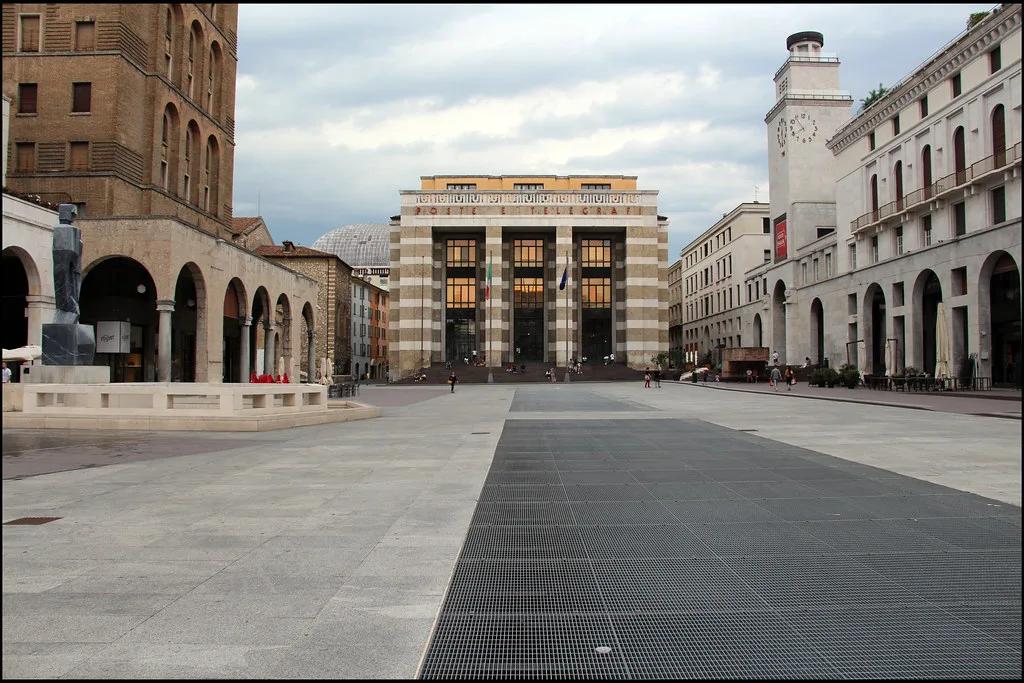
Piazza della Loggia is the natural first stop, a medieval square lined with bars, restaurants and cafes. Its Renaissance clock tower, the Torre dell'Orologio, carries a dial that goes beyond the hour, showing the date, the moon phase and the sun's position in the zodiac, according to one traveler account. Two mechanized figures strike the bell and are known as the madmen of the hours.
The automatons are the detail most travelers miss, so time your arrival near the top of an hour and watch the square rather than your phone. The Guardian describes the figures as having struck the hours on a large bell since 1581, though four centuries of restoration mean the current mechanism is best treated as a living tradition rather than untouched original machinery.
The square also carries heavier history: a small pillar marks the spot where a 1974 bombing killed eight people. It is a reminder that Brescia is not a pretty backdrop but a place with a difficult twentieth century. Read the plaque, then let the aperitivo hour pull you back into the present.
Roman Brescia: The Capitolium, the Forum and the Winged Victory
The Roman site on Via Musei is central to Brescia's UNESCO World Heritage status. The Capitolium, a temple built in the first century AD and dedicated to Jupiter, Juno and Minerva, was rediscovered under later construction in 1823, and its partly subterranean setting makes it feel unlike a standard ruin. Preserved frescoes, marble floors and stone altars remain in place.
Among the finds is the Winged Victory, a bronze statue dated to the first century BC, now displayed in the nearby Santa Giulia Museum, according to the Guardian. The Roman forum behind the temple includes a seating area that suggests public events were held there. Check current opening days and ticket scope with the city's official pages before you go, since the archaeological area and the museum are separate sites with their own arrangements.
The underground component matters for planning: portions of the site sit below street level, so allow more time than you would for an open-air forum. If hours are short, the temple complex is the stronger pick over a rushed museum sweep, and the individual sight guides in the Brescia Attractions hub break down each one.
Brescia Castle: The Climb and the Panorama on Cidneo Hill
Castello di Brescia crowns Cidneo hill above the center and ranks among the largest fortresses in Europe, with massive bastions, the Prisoners Tower and the Mirabella Tower. It is reachable on foot or by car, making it the obvious half-day for anyone who wants a view over the city.
Go underground while you are up there: the fortifications include oil and water storage facilities and tunnels once used as escape routes. The walk up is the real filter, since casual day-trippers rarely make the climb, so the grounds feel calmer than the squares below. Many travelers treat the climb as the walk rather than a box to tick.
A path of pavement plaques leads up toward the castle, each marking a victim of Italy's years of lead, the political violence of the 1970s and 1980s, according to the Guardian. It turns a scenic climb into something more reflective. Check the castle's own pages for current access and interior openings rather than assuming towers are open.
The Carmine Quarter: A District That Changed Its Reputation
Carmine, a tangle of alleys west of the center, was a district locals were warned to avoid a generation ago, as one guide explains. Today it is a labyrinth of colorful streets filled with bars and restaurants, some just opening for the day, with graffiti and a bohemian mood. The honest story is one of change, not of a place that was always charming.
Walk it in the late afternoon, when the bars start to fill and the light hits the yellow walls, rather than treating it as a sightseeing route. A bar manager quoted in the Guardian describes the area twenty years ago as one of prostitutes and thieves, now safer but still vibrant and growing. Take that as context for the graffiti and grittier edges, not a reason to skip it.
If you enjoy districts that have changed character, the hidden gems in Venice offer a comparable exercise in reading a neighborhood honestly. In Brescia, the practical move is to pair Carmine with an evening aperitivo rather than a daytime detour.
Piazza Paolo VI and Its Two Cathedrals
Piazza Paolo VI compresses centuries into one stop: the round Duomo Vecchio, a Romanesque rotunda dating to around 1100, sits beside the Baroque Duomo Nuovo. Having co-cathedrals side by side is rare, which makes the square a compact lesson in how Italian cities layer styles. The older church holds thirteenth-century frescoes, a crypt and the Chapel of the Holy Crosses.
The newer cathedral contains paintings by Moretto and Romanino and a monument to Pope Paul VI, the square's namesake. Churches in Italy usually welcome visitors to the main nave, but opening windows, entry charges for special chapels and dress expectations vary, so check the notice at each door rather than assuming.
The square doubles as a cafe stop, with restaurants and bars around the duomos. It is the easiest place to break a walking day without leaving the historic center.
Santa Giulia Museum and the San Cristo Murals: A Slow Afternoon
Museo di Santa Giulia occupies a former Benedictine monastery covering more than 150,000 square feet, with over 11,000 works spanning prehistory to the eighteenth century. It includes the Basilica of San Salvatore, the Oratory of Santa Maria in Solario and a preserved Roman villa. The scale makes it the best wet-weather option in the city, and one visit shows why Brescia held Italy's Capital of Culture title in 2023, a past honor rather than a current label.
For something smaller, the sixteenth-century Chiesa di San Cristo is known as the Sistine Chapel of Brescia for murals covering nearly every surface. It is a short walk from the Roman site and pairs well with a museum visit, giving you one big collection and one intimate interior in the same afternoon.
Keep the two separate in your planning: the museum is a ticketed institution with its own opening days, while the church is a place of worship. Verify each on the day, and leave enough slack that a closed door does not sink the afternoon.
Aperitivo and Brescian Food: Pirlo, Casoncelli and What to Order
Brescia's aperitivo hour offers real value: the price of a drink commonly includes a plate of stuzzichini, the small appetizers that come with it, according to one traveler's account. The local drink to try is pirlo, a wine-based aperitivo the Guardian describes as the city's favorite, built on Franciacorta bubbles from the nearby wine district.
At the table, casoncelli is the signature stuffed pasta, typically filled with breadcrumbs, butter and cheese and served simply. Manzo all'olio, beef cooked in oil with anchovies, and coniglio alla Bresciana, rabbit braised in butter, lard and wine, are hearty secondi worth trying if you are hungry. Finish with persicata, a firm peach-jam confection with a story attached. Related guide: What to Eat in Brescia: Casoncelli, Fillings and Local Wines.
Restaurant and bar recommendations date quickly, so treat any named venue in a travel article as an example rather than a current pick. Check recent reviews or ask at your hotel, and note that aperitivo pricing varies by venue and is not something to plan around.
Franciacorta and Lake Iseo: Turning Brescia Into a Two-Day Base
The Franciacorta wine district lies south of Lake Iseo, and its DOCG sparkling wines are so well regarded locally that much of the production stays in the region. If you enjoy wine, this is the strongest reason to add a night to a Brescia stop rather than passing through.
On Lake Iseo, Monte Isola offers a slower day of net-makers, a boatyard and local salami, per the Guardian's account. It is a popular outing for Bresciani themselves, which says something about the scenery. Check ferry timetables with the lake operator before committing, since published schedules change by season.
Accommodation prices in the region shift with season and demand, so compare current rates yourself rather than relying on figures quoted in older articles. Staying in Brescia and day-tripping to the lake keeps the city as your base and avoids moving luggage twice.
Practical Decisions: How to Pace a Day and What to Skip
For one day, start at Piazza della Loggia, walk to the Capitolium on Via Musei, cross to Piazza Paolo VI, then finish with an aperitivo in Carmine. That covers the clock tower, the Roman core and the two cathedrals without rushing. Save the castle for a morning when you have legs and weather for the climb.
If you have two days, add Santa Giulia and San Cristo on the second morning, then choose between the castle tunnels and a lake excursion in the afternoon. Trying to do both the museum and the lake in one day leaves you in transit rather than in Brescia.
What to skip depends on your interests: the museum is enormous, so a rushed visit wastes the entry, and the castle's interiors are not guaranteed open. The hidden gem attractions listings for Brescia include underground and motoring collections as alternatives if the weather turns, though verify details before relying on them.
Plan Your Visit
Brescia rewards travelers who break the journey between Milan, Verona and the lakes, and it asks for little more than a day and a willingness to walk. The combination of a working clock tower, a buried Roman temple and a changing neighborhood like Carmine makes it feel lived in rather than staged.
Before you go, confirm opening days and ticket scope for the Capitolium and Santa Giulia directly with the city, and check church and castle notices on arrival. Those few checks prevent the common disappointment of arriving at a closed interior, and they keep the rest of the day flexible. For related planning, see Brescia in One Day: Roman Brixia, Santa Giulia & Castle.
Frequently Asked Questions
Is Brescia worth visiting on the way between Milan and Venice?
Yes, if you give it real time rather than a quick stop. The historic center holds a Renaissance clock tower, a Roman temple complex and two cathedrals within walking distance, and the castle adds a hilltop view. A single day covers the core comfortably; two days allow the museum and a lake or wine excursion.
What can you see in Brescia in one day?
Start at Piazza della Loggia, continue to the Capitolium and Roman forum on Via Musei, then cross to Piazza Paolo VI for the two cathedrals. Finish with an aperitivo in the Carmine quarter. The castle is best saved for a separate morning unless you start early and enjoy steep walks.
What food is Brescia famous for?
Casoncelli, a stuffed pasta usually made with breadcrumbs, butter and cheese, is the signature dish. Also look for manzo all'olio, beef cooked with anchovies, and coniglio alla Bresciana. With drinks, try pirlo, the local aperitivo based on Franciacorta sparkling wine.
Do you need tickets for the Capitolium or Santa Giulia museum?
The Capitolium archaeological area and Santa Giulia are separate sites, and ticket arrangements are not something to assume. Check current opening days and admission details with the city's official museum pages or at the site before visiting, since a single ticket does not necessarily cover both.
Is the Carmine quarter worth walking through?
Yes, for bars, restaurants and a sense of how the city has changed. It was a district locals were once warned to avoid and is now lively and safer, with graffiti and a bohemian mood. Go in the late afternoon or evening rather than treating it as a daytime sightseeing route.
Can you visit Franciacorta and Lake Iseo from Brescia?
Both work as day trips, with Brescia as your base. Franciacorta produces DOCG sparkling wine south of Lake Iseo, and Monte Isola on the lake is a popular outing with locals. Check ferry schedules and winery visits directly, as services vary by season.
Sources
Continue exploring
More guides you'll find useful