Duomo Nuovo Brescia Visitor Guide: The New Cathedral
A practical visitor guide to Brescia's Duomo Nuovo, covering its Baroque facade, vast dome, what to see inside and how to pair it with the Duomo Vecchio.
On this page
Piazza Paolo VI holds a pairing you rarely find in Italy: a Baroque cathedral and a Romanesque round church set side by side. The Duomo Nuovo, dedicated to Santa Maria Assunta, is the newer of the two and the one whose dome dominates the square. Treat the visit as a single square rather than two separate sights, and the stop makes far more sense.
One concrete planning detail is architectural scale: the dome rises about 80 metres, and the national tourism site describes it as the third largest in Italy behind St Peter's in Rome and Florence's cathedral. That claim is worth attributing rather than repeating as fact. Whatever the ranking, the dome is the reason to step out of the Brescia sun and look up.
What the Duomo Nuovo Is and Where It Sits
The Duomo Nuovo stands on Piazza Paolo VI in the historic centre, a short walk from the city's main squares and museum cluster. Italy's national tourism portal places it next to the Duomo Vecchio and describes the pair as the city's summer and winter co-cathedrals. That label is a useful mental map: one church is Baroque and luminous, the other medieval and shadowed.
Construction began in 1604 on the site of the early Christian Basilica of San Pietro de Dom and was not finished until 1825, when the dome was completed. Two centuries of work explain the mix of Counter-Reformation monumentality and later classical polish. Knowing the timeline helps you read the facade as a long negotiation rather than a single design.
Why This Square Has Two Cathedrals: Nuovo Versus Vecchio
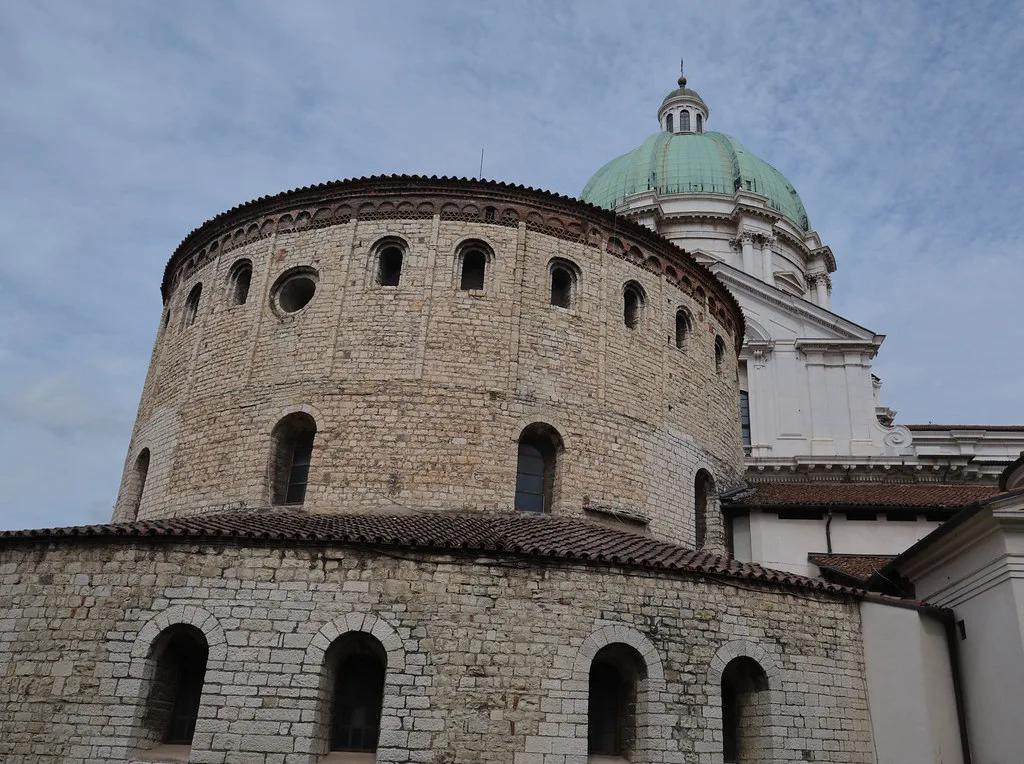
The Duomo Vecchio, known as La Rotonda, is the most prominent surviving Romanesque circular church in the city and predates its neighbour by centuries. Inside it holds sarcophagi, frescoes and the Treasure of the Holy Crosses, while the Duomo Nuovo offers a Greek-cross plan flooded with white marble and stucco light. Seeing them back to back compresses several architectural eras into one circuit.
Plan the order deliberately: start with the Duomo Vecchio's low, dark rotunda, then cross to the Duomo Nuovo and let the height and brightness reset your sense of scale. That is an editorial suggestion, not an official route, but it uses the square's layout well. No source consulted here publishes official visiting hours for either interior, so confirm them before setting out.
The Facade Explained: Botticino Marble and Corinthian Columns
The facade is clad in Botticino marble, a local stone that reads warmer and softer than the pale Carrara surfaces of many Italian cathedrals. Corinthian columns support a curved tympanum, and above the main entrance sits a bust of Cardinal Angelo Maria Querini. Look up rather than straight ahead: the upper storey covers only the centre front of the building, which is why the composition feels top-heavy from close range.
The facade rewards a few minutes of slow looking before you go in, because the interior gives you almost none of the same colour. Statues crown the composition above the triangular tympanum, and the marble's pale tone photographs differently in morning and afternoon light. There is no need to build a schedule around that; just notice it if you pass the square more than once.
Inside the Greek-Cross Plan: Dome, Evangelist Busts and Marble Light
Inside, the church follows a Greek-cross layout with a monumental central space under the dome. White marble and stucco cover nearly every surface, producing the blue-white light that the national tourism portal highlights. Stand under the centre to read the proportions, then walk the perimeter so the side chapels are not reduced to blur.
Marble busts of the four Evangelists decorate the pendentives beneath the dome, each one a small sculpture in its own right. A common mistake is to photograph the dome once and leave; the pendentives and cornices are where the craft shows. Give the crossing several minutes before moving to the chapels.
Art and Chapels Not to Rush Past
Several works inside deserve a deliberate stop. A 15th-century wooden crucifix stands on the first altar on the right, beneath a lunette by Moretto depicting Isaac's Sacrifice, and the third altar holds the sarcophagus of St Apollonius, Bishop of Brescia in the 3rd century. The Trinity Chapel has an altarpiece by Giuseppe Nuvolone painted as an ex voto for the end of the 1630 plague.
Along the left side of the nave, a monument to Brescia's Pope Paul VI, sculpted by Raffaele Scorzelli in 1984, sits below organ paintings by Romanino showing scenes from the life of the Virgin. Further along, the presbytery altarpiece of the Assumption is by Iacopo Zoboli, dated 1773. These are the details that turn a quick photo stop into a proper visit.
About the 80-Metre Dome and Its Ranking
The dome rises roughly 80 metres and was the final element completed in 1825. Italy's national tourism portal ranks it third in Italy after St Peter's Basilica and Florence's cathedral, a claim best read as the tourism authority's description rather than an engineering measurement. Quote it carefully if you repeat it.
Dome rankings shift with how height is measured, so treat the superlative as context rather than a reason to visit. The interior experience matters more: the crossing, the pendentives and the light are what you actually see. If the ranking is your main interest, verify it against the tourism portal's current wording before repeating it in print.
Practical Orientation: Restricted Centre, Transit and Parking
The historic centre around the cathedrals is restricted to car traffic, so arriving by public transport or on foot is the simpler approach. Visit Brescia lists bus lines 2, 10, 11, 17 and 18 and the Vittoria metro stop, with paid parking at Piazza Vittoria for drivers. Treat those details as the tourism board's published context and re-check them before travelling, since routes and arrangements change.
Opening times are the one thing you should never assume. The tourism board directs readers to the Diocese of Brescia's dedicated page for information and opening hours, which is the sensible place to confirm before setting out. No reliable schedule is published in the sources used here, so check on the day rather than trusting an old listing.
Pairing Plan: A Short Sequence Through Both Cathedrals
Allow roughly an hour for the square if you want both interiors without hurrying; that is an editorial estimate, not an official duration. Begin outside with the facade of the Duomo Nuovo, then enter the Duomo Vecchio first to see the rotunda and its sarcophagi. Cross to the Duomo Nuovo afterwards so the dome lands as a contrast rather than a warm-up.
Inside the Duomo Vecchio, look for the red marble sarcophagus of Berardo Maggi and the fragments of an earlier basilica and Roman bath visible under the transept floor. A Latin Mass is celebrated there on Sunday mornings at 11, according to the tourism board, so time a sightseeing entry around it. Confirm current arrangements locally before relying on that detail.
Etiquette and Pacing: A Working Place of Worship
Both cathedrals remain active places of worship, so keep voices low, dress modestly and avoid wandering into reserved areas during services. The Duomo Nuovo is also described by the tourism board as accessible to people with disabilities, but that statement covers the cathedral generally, not every chapel or level. Ask on site if you have specific needs.
The cathedral rewards patience more than speed. A rushed circuit of the nave takes minutes; a slow one that includes the chapels, the Paul VI monument and the dome takes considerably longer. Build in slack rather than treating the square as a box to tick before lunch.
What Nearby Brescia Sights Fit the Same Half-Day
Piazza Paolo VI sits inside a compact historic centre that suits a walking half-day rather than a checklist. Beyond the obvious monuments, the city has quieter corners worth seeking out, and a guide to the hidden gems in Brescia can help you choose them without straying far from the centre. If you want to compare the cathedral with the city's other headline sights first, the Brescia Attractions hub gathers them in one place.
The city's event calendar is also worth a glance before you fix dates, since exhibitions and temporary shows rotate through the centre. The Comune di Brescia publishes news and a dated events listing, which is more reliable than secondary roundups. Check it close to your travel date rather than months ahead.
Plan Your Visit
The Duomo Nuovo is best understood as half of a square, not a standalone monument. Arrive on foot, see the Romanesque rotunda first, then let the Baroque interior and its 80-metre dome provide the contrast. Confirm opening times with the Diocese of Brescia before you go, and treat any ranking claim as attributed context.
If you are building a wider itinerary, pair the cathedrals with a slow walk toward the city's other central squares. Our guide to hidden gems covers the quieter alternatives when the main sights feel busy. For related planning, see Duomo Vecchio Brescia: A Visitor Guide to La Rotonda.
Frequently Asked Questions
How long does it take to visit the Duomo Nuovo in Brescia?
There is no official recommended duration. A rough editorial allowance is 20 to 30 minutes for the Duomo Nuovo alone, and about an hour for both cathedrals on Piazza Paolo VI if you include the chapels. Add time if a service is under way, since visitors should not move around freely then.
Is the Duomo Nuovo dome really the third largest in Italy?
Italy's national tourism portal describes it as the third largest in Italy, after St Peter's Basilica in Rome and Florence's cathedral, with a height of about 80 metres. That is the tourism authority's description rather than an independent ranking, so cite it as such.
Can you visit the Duomo Nuovo and Duomo Vecchio together?
Yes. They stand side by side on Piazza Paolo VI, which makes a single walking circuit practical. Enter the Romanesque Duomo Vecchio first, then cross to the Duomo Nuovo so the Baroque interior and dome land as a contrast.
How do you reach Piazza Paolo VI in Brescia?
The historic centre is restricted to car traffic. Visit Brescia lists several bus lines and the Vittoria metro stop, with paid parking at Piazza Vittoria for drivers. Re-check routes and parking arrangements before travelling, since these change.
What should you see inside the Duomo Nuovo besides the dome?
Look for the marble busts of the four Evangelists in the pendentives, the Moretto lunette at the first altar on the right, the sarcophagus of St Apollonius, the Paul VI monument and the Romanino organ paintings. The Trinity Chapel altarpiece commemorating the end of the 1630 plague is also worth a stop.
Are opening hours and entry details published?
The tourism board directs visitors to the Diocese of Brescia's dedicated page for information and opening times. No reliable schedule appears in the sources used here, so confirm locally on the day rather than relying on older listings.
Sources
Continue exploring
More guides you'll find useful