Duomo Vecchio Brescia: A Visitor Guide to La Rotonda
Our Duomo Vecchio guide covers Brescia's circular Romanesque Old Cathedral: its layered interior, older remains beneath the floor, and the Duomo Nuovo beside it.
On this page
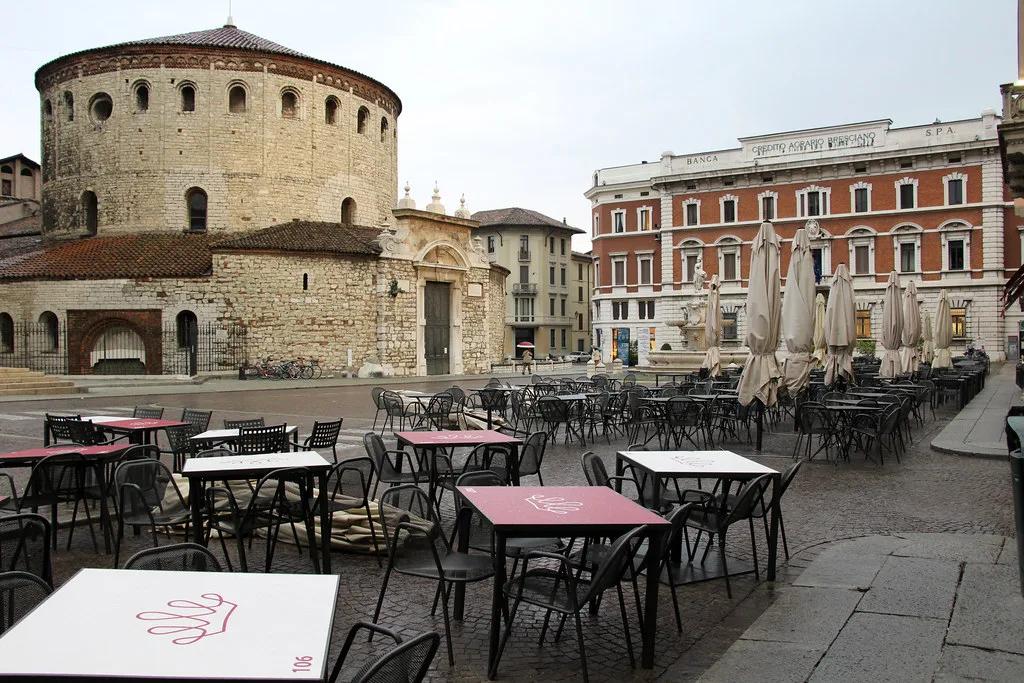
Brescia's Duomo Vecchio is the reason to slow down on Piazza Paolo VI. The circular Romanesque church, known as La Rotonda, stands shoulder to shoulder with the much later Baroque Duomo Nuovo, and stepping from one to the other takes you across roughly seven centuries of church building without leaving the square.
Orientation: Two Cathedrals, One Square
The Duomo Vecchio occupies Piazza Paolo VI in the heart of the historic centre, directly beside the Duomo Nuovo. The pairing is unusual enough to be the square's defining feature: a medieval rotunda anchoring one of Italy's later, domed cathedrals. Start here rather than treating the Old Cathedral as a five-minute photo stop.
Construction of the Old Cathedral began around 1100 under a corporation of specialised masons, according to Visit Brescia, which describes it as the most prominent Romanesque circular church still in existence. It serves as co-cathedral of Brescia alongside the Duomo Nuovo. Read that claim as the tourism board's framing rather than a neutral survey, but it sets expectations for what makes this building distinct.
For orientation around the wider city, picture Brescia as a compact historic core of squares and Roman traces rather than a single monument. The Duomo Vecchio is one stop in that sequence, not a day in itself, and the surrounding streets of the centro storico are worth wandering between stops.
The Circular Plan and What It Changes
La Rotonda's round footprint shapes the visit literally. Instead of a long nave leading to a high altar, you enter a central circular space where massive stone walls, arches and pillars create depth in every direction. Visitors often describe being surprised by a comparatively plain exterior that opens into a dim, moody interior.
Practical consequence: expect to move in a loop and to look down as well as up. The floor is punctured by openings and levels that reveal earlier buildings beneath, so the church reads as a layered site rather than one architectural era. Allow yourself to walk around the centre twice before moving on.
Light is part of the experience. With fewer large windows than a later cathedral, the interior stays subdued, and details such as the red marble sarcophagus near the entrance emerge gradually. If you are photographing, keep it brief and low-key; this is an active place of worship, not a gallery.
What to See Inside
The first major work most visitors meet is the sarcophagus of Berardo Maggi, made of red marble and described by Visit Brescia as a typical example of Romanesque sculpture. Nearby, the sarcophagus of Bishop Balduino Lambertini, made in 1349 by Bonino da Campione, adds a fourteenth-century layer.
In the chapels, look for paintings by Romanino, Moretto, Palma the Younger, Grazio Cossali and Antonio Gandino, plus a large altarpiece by Pietro Marone. Mid-thirteenth-century frescoes sit in the central part of the church, and the right side carries a large canvas by Francesco Maffei depicting the bell tower, which collapsed. These names reward even a short look at the labels.
The choir and organ by Giangiacomo Antegnati, built in the mid-sixteenth century, are another reason to look beyond the central floor. Visit Brescia also notes that a Mass in Latin is celebrated in the Old Cathedral on Sunday mornings at 11, but that schedule is exactly the kind of detail to confirm locally before planning around it.
Beneath the Floor: Earlier Basilica and Roman Baths
The transept under the floor exposes fragments of the prior basilica from the sixth century and remains of a Roman bath. This is the part of the visit that most changes how you understand the building: the church sits on top of, and partly reuses, a much older sequence of structures.
A crypt dedicated to San Filastrio also lies under the church, linked to an earlier eighth-century building. None of the available sources confirm current access or opening times for the crypt, so treat any descent as a bonus rather than a guaranteed element of the visit. Ask at the cathedral before you count on it.
The Treasure of the Holy Crosses in its chapel holds reliquaries including fragments of the True Cross. Visit Brescia states these can be viewed only on the last Friday of March and on 14 September; that is the source's description, not a promise about any particular year, so verify with the diocese if this is your main reason to come.
Old and New Together
The Duomo Nuovo was designed by Giovanbattista Lantana and begun in 1604 on the remains of the old basilica of San Pietro de Dom. Financial difficulties delayed work, and the cathedral was completed only in 1825, with a dome that Visit Brescia ranks as the third tallest in Italy. The contrast with the rough Romanesque stone next door is immediate.
Inside the New Cathedral, the one-nave Greek-cross plan is monumental rather than intimate. Worth locating: a fifteenth-century wooden crucifix on the first altar on the right, Moretto's Sacrifice of Isaac in the same altar's lunette, and the 1510 sarcophagus of Saint Apollonius. The chapel altarpiece by Giuseppe Nuvolone commemorates the end of the 1630 plague.
Visit both in one sitting if time is short, because the comparison does the interpretive work for you. Moving from heavy medieval stonework to Baroque marble and a towering dome in a few dozen metres makes Brescia's architectural timeline legible in a way that separate visits do not.
A Short Walking Route Through the Centre
A sensible sequence runs from Piazza Paolo VI through Piazza della Loggia to the Roman forum area, with the two cathedrals first. Piazza della Loggia is a Renaissance square with a clock tower and astronomical clock carrying two bell ringers on top, and money-lending houses with Roman tombstones set into their facades.
From there, the Roman remains around Piazza del Foro include a theatre, a temple dated to AD 73 and a Republican sanctuary from the first century BC with mosaic floors and wall frescoes inside. That trio of stops fills a comfortable half day at an unhurried pace, and you can add or drop elements without breaking the route.
If you want quieter corners between the headline sights, build in time for the smaller churches and lanes that surround these squares rather than rushing between them. The city rewards detours on foot more than it rewards a checklist, and the hidden gems in Brescia are mostly found this way.
Practical Points Before You Go
The Duomo Vecchio is an active place of worship, so dress modestly and keep your voice down; visitors consistently describe a contemplative atmosphere inside. Cover shoulders and knees, and avoid touring during services. Treat the crypt and any relic displays as separate, occasional access rather than part of a single ticket.
Neither the city portal nor the tourism sources give current opening hours or admission arrangements for the Old Cathedral. Visit Brescia directs visitors to the Diocese of Brescia's dedicated page for opening times, so check there, or ask at the cathedral, shortly before your trip. Do not plan the day around a time you found in an old post.
Accessibility information for the interior is not published in these sources either. If step-free access or specific assistance matters to you, contact the parish directly before travelling rather than assuming the layout of a historic rotunda will be easy to negotiate.
Where to Go Next
The Santa Giulia City Museum, housed in an eighth-century convent, is the strongest follow-on for anyone interested in the layers you saw under the cathedral floor. It holds more than 11,000 artefacts and artworks, including excavated Roman houses viewed from a walkway, the Lombard Basilica of San Salvatore and the Brescia casket. For wider planning, see Brescia Attractions: Visitor Guides to 10 Sights.
For a second day, regional trains head north from Brescia towards Lake Iseo and the Valcamonica, where prehistoric petroglyphs at Naquane near Capo di Ponte form part of a UNESCO-listed landscape. These are day trips by rail, not afternoon add-ons, so give either one a full day if you go.
Closer to the centre, Brescia's castle sits on a hill and offers wide views over the city and beyond, with museums inside. It is a useful late-afternoon stop when the cathedrals and squares have drained your attention.
Fitting La Rotonda Into Your Brescia Visit
The Duomo Vecchio earns more than a passing glance. Its circular plan, layered floor and older remains beneath it make it the most distinctive church in the centre of Brescia, and pairing it with the Duomo Nuovo next door turns a single stop into a compact lesson in how the city built across centuries.
Before you travel, confirm current opening arrangements through the Diocese of Brescia and keep your expectations flexible about the crypt and the Treasure of the Holy Crosses. Everything else you can plan around: a modest, quiet interior, a short walking route through the squares, and a museum or hilltop finish if the day allows.
Frequently Asked Questions
Is the Duomo Vecchio in Brescia free to enter?
The sources used here do not confirm current admission arrangements for the Duomo Vecchio, so it is best not to assume either way. Check the Diocese of Brescia's page for the cathedral, or ask at the entrance, shortly before your visit.
Why is the Duomo Vecchio called La Rotonda?
The nickname comes from its shape. The church was built from around 1100 on a circular plan, and Visit Brescia describes it as the most prominent Romanesque circular church still standing.
What can you see inside the Duomo Vecchio?
Highlights include the red marble sarcophagus of Bishop Berardo Maggi, the 1349 Lambertini sarcophagus, frescoed chapels with works by Romanino, Moretto and Palma the Younger, mid-thirteenth-century frescoes, and a sixteenth-century choir and organ by Antegnati.
Is the crypt of San Filastrio always open to visitors?
The crypt is linked to an earlier eighth-century church, but the available sources do not confirm access or times. Treat a descent as a bonus and ask at the cathedral on the day rather than planning around it.
Should you visit the Duomo Vecchio and Duomo Nuovo together?
Yes. They face each other on Piazza Paolo VI, and the contrast between Romanesque stonework and the Baroque cathedral, completed in 1825, is the point. Seeing both back to back takes little extra time and explains the city's architectural history more clearly.
How long should you spend at the Duomo Vecchio?
No official duration is published. The building is compact, but the crypt and earlier remains invite slower looking, so budget a portion of a half day that also covers Piazza della Loggia and the Roman forum area nearby.
Sources
Continue exploring
More guides you'll find useful