Corso Umberto I Taormina: Walking Guide to the Old Town
Walk Taormina's Corso Umberto I from Porta Messina to Porta Catania: piazzas, palazzi, shops, free street access, suggested timing and cable-car access from Mazzarò.
On this page
Corso Umberto I is the street most Taormina visits begin on, whether travellers realise it or not. It threads the historic centre from one old arched gateway to the other, and almost everything in the centro storico sits on it or a few steps off it. Walking it costs nothing: it is a public pedestrian street, and the piazzas, gates and exterior facades are all part of that free experience. This guide treats it as a walking route rather than a list of shops: where to start, what to pause for, and how to pace the stroll.
One practical warning before you set out: sources disagree on the street's length, with some describing a few hundred metres and others roughly a kilometre between the gates. Plan by landmarks and time rather than by distance, and let the walk take as long as the detours deserve.
What Corso Umberto I Is and Where It Runs
The corso is Taormina's main pedestrian street, a continuous promenade of palazzi, churches, boutiques and cafés. It begins at Porta Messina at the northern end of the old town and finishes at Porta Catania at the southern end, two weathered stone gates that once marked the town's boundaries. Both arches are the natural places to start or end a walk, and each is easy to find on foot from the centre, with the Porto Catania multi-storey car park roughly a five-minute walk from the pedestrianised historic centre.
Because the street is the spine of the centro storico, it doubles as the town's social space rather than a museum corridor. Side alleys climb and descend steeply from it, so a short detour can lead to a viewpoint, a quieter square or a staircase down the hillside. Treat the corso as your baseline and wander off it deliberately.
Route Orientation: Which Gate to Start From
Starting at Porta Messina suits travellers arriving by cable car from Mazzarò, because the upper station drops you close to the northern entrance. Walking south from there, you pass through the busiest stretch first and finish at Porta Catania, where the Porto Catania multi-storey car park sits a short walk away for anyone arriving by car; it is well signposted from that edge of the centre.
Reversing the route works equally well if you are staying near Porta Catania or arriving by bus into the terminal on Piazza Luigi Pirandello. Either direction gives you the same sequence of piazzas and palazzi, just in mirror image, so choose the gate that matches your transport rather than worrying about which is the proper start.
Piazza IX Aprile, the Clock Tower and San Giuseppe
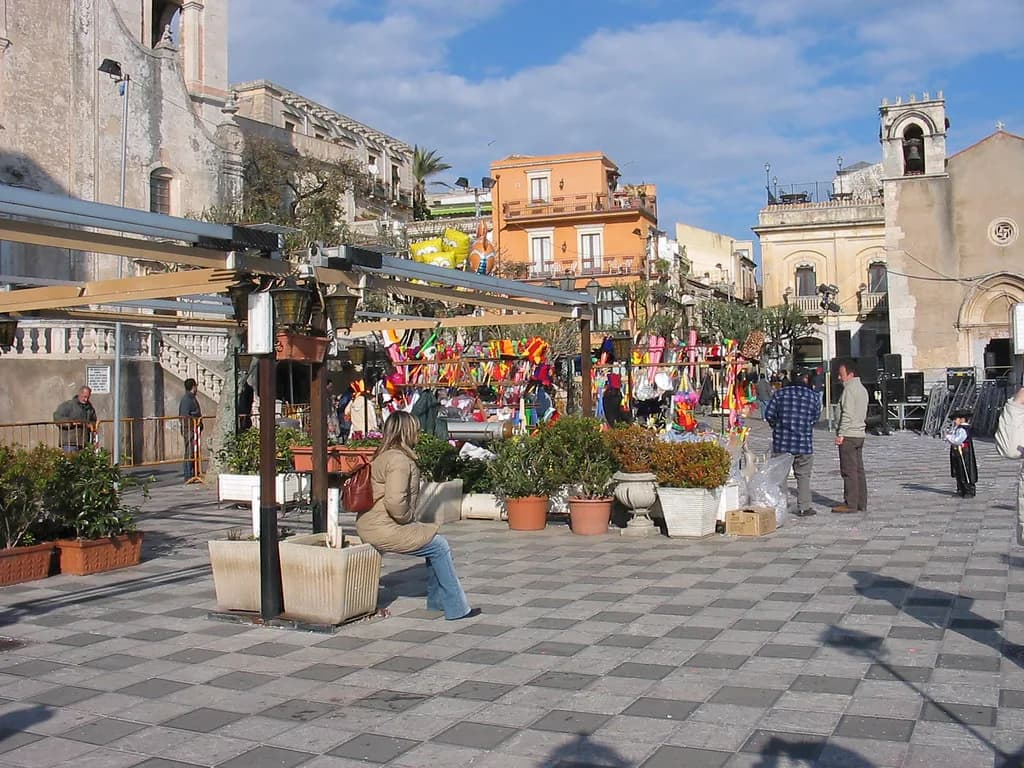
Piazza IX Aprile is the corso's grandest pause, a terrace square with patterned paving and sweeping views over the Ionian Sea towards Mount Etna. The Clock Tower stands over it, and the small baroque Chiesa di San Giuseppe faces the open side, its pale facade picked out in pink and yellow. Cafés occupy the edge of the square, making it the obvious spot for a coffee or a beer while you watch the town go by.
This is also the most photographed corner of Taormina, so expect company at the railing. If you want the view with fewer people around it, come back later in the day rather than trying to rush the square on your first pass.
Piazza del Duomo and the Cattedrale di San Nicola
At the southern end of the walk, Piazza del Duomo opens around the Cattedrale di San Nicola, a small medieval church that reads more fortified than opulent compared with later Italian baroque churches. A fountain sits outside in the square, and the surrounding cafés make another natural resting point. The cathedral is an active place of worship, so dress and behave accordingly if you step inside; travel writers visiting Taormina regularly underline that Italian churches are places of active worship rather than sights.
Note the distinction between the square and the building: the piazza is free to cross at any hour as part of your walk, while the cathedral interior follows its own opening arrangements. Check the notice on the door on the day rather than assuming a fixed schedule from a guidebook.
Palazzi and Roman Remains Worth Pausing For
Palazzo Corvaja is the standout secular building on the route, a medieval palace where Arab, Norman and Gothic elements sit together in its stonework and decoration. It currently houses the tourist information office, which makes it a useful first stop for maps and current local notices as well as an architectural pause. Nearby, Palazzo Ciampoli presents a softer baroque face with ornate balconies.
The Naumachie is easy to miss and worth hunting for: a long surviving brick wall from a Roman gymnasium, and one of the most photographed fragments in town. Chiesa di Santa Caterina, a seventeenth-century church, was built over the ruins of an ancient theatre, layering the street's history in a single facade. None of these require a ticket to admire from the street, though access inside individual buildings varies.
Quieter Corners Just Off the Main Axis
A few steps off the corso, Piazza Vittorio Emanuele II offers a calmer pause, ringed by historic buildings and greenery rather than shopfronts. It is the kind of square you reach by turning down a side street without a plan, and it rewards that aimlessness with benches and shade. If you would like a curated list of similar small, understated places a minute from the crowds, see the guide to hidden gems in Taormina.
Backstreets beyond the main axis hold more of the same: stairways, small churches and viewpoints that never appear on a shopfront map. Allow time to leave the corso entirely for twenty minutes; it is usually the part of the day people remember.
Shopping Realistically Along the Corso
The shopping mix runs from luxury labels to genuine Sicilian craft, which means the street rewards selective browsing rather than a sweep. Ceramics from Caltagirone, hand-painted tiles and Teste di Moro heads appear in artisan workshops, alongside Etna DOC wines, Bronte pistachio cream, capers and small-batch limoncello. Coral jewellery and filigree work continue a local tradition, and side streets hold antiques and vintage prints. Further visitor details appear in Corso Umberto Taormina 2026 Guide | Shops, Food, Tips.
Shop hours are not uniform, and many smaller businesses keep their own rhythm through the middle of the day. Read the hours posted on each door rather than planning around a single town-wide schedule, and carry cash for small workshops that may not take cards.
Eating Along the Corso: Granita, Arancini and Aperitivo
Sicilian breakfast on the corso means granita con brioche, almond or pistachio, eaten standing or at a pavement table. Later in the day, arancini make the easiest walking snack, and cannoli are best bought where they are filled to order so the shell stays crisp. Terrace restaurants along the street and at Piazza IX Aprile serve dinner with sea views, and those tables are worth reserving ahead in high summer.
Free to Walk: Street Access Versus Paid Sites
Walking Corso Umberto costs nothing: it is a public street, open to anyone at any hour, and the piazzas, gates and exterior facades are all part of that free experience. The confusion arises when visitors assume the street's attractions share one ticket. They do not, and several nearby sites are separately ticketed or have their own access rules.
The Teatro Antico di Taormina sits a short walk off the corso and is the most obvious paid stop in the area; check its current ticket scope and hours before you go rather than assuming a single combined ticket covers everything. Churches along the street are generally free to enter for worship, but treat any request for a contribution or a modest dress code as normal. For the theatre's own arrangements, use the Teatro Antico di Taormina visitor guide and confirm details with the site on arrival.
A Suggested Walk Duration, With Detours
As an editorial suggestion rather than an official figure, allow around ninety minutes to two hours for the full gate-to-gate walk with a handful of detours. That covers a stop at Piazza IX Aprile, a look into the Duomo square, a pause at Palazzo Corvaja and one side street. If you add a sit-down meal, a shopping browse in earnest or a museum visit, budget half a day.
The pace matters more than the clock. Cobblestones slow you down, side streets pull you uphill, and the best moments tend to be unplanned, so leave slack in the schedule rather than treating the walk as a checklist.
Timing the Walk: Morning, Afternoon and Passeggiata
Mornings are generally calmer on the corso, before day-trippers and tour groups build through the middle of the day. Afternoons bring the heaviest foot traffic in peak season, and the narrowest stretches can feel congested when a cruise excursion arrives. Neither pattern is a guarantee, so watch the street and adjust your pace accordingly. For a wider view of how the town's headline sights fit together, see Taormina Attractions.
The evening passeggiata is the street's own ritual: bars and cafés spill onto the pavements, terraces light candles, and locals and visitors walk the corso in the cooler air. It is the liveliest time to be there and the least suited to unhurried photography. Choose morning for space, evening for atmosphere, and accept that you cannot have both on the same day.
For a sense of what the town publishes about events and civic notices, the Comune di Taormina website is the page to check, since local festivals and closures can change how the street works on a given day. Confirm anything time-sensitive there rather than relying on old blog posts.
Getting There from Mazzarò by Cable Car
If you are staying down by the sea in Mazzarò, the cable car is the simplest way up. The funivia runs from the station on Via Luigi Pirandello in town down to the coast at Mazzarò and back, departs every 15 minutes, and drops you at the northern end of the corso close to Porta Messina. Advance warning for anyone planning a beach day: the same line is how you descend to Isola Bella, though the beach itself is a short walk from the lower station. Check the current timetable at the station on the day rather than relying on seasonal times.
From the lower station it is a short walk to the beach and the path towards Isola Bella Taormina, which makes the cable car useful in both directions: town above, coast below. Travellers coming from Catania by train should note that Taormina-Giardini Naxos station sits down the hill in Giardini Naxos, requiring a shuttle or taxi up to the centre; the wide practical detail, from station transfers to parking, is collected in the guide to getting to and around Taormina.
Practical Mistakes to Avoid
Cobblestones are unforgiving, so wear shoes you can walk in for a couple of hours rather than sandals you are still breaking in. Churches along the route are active places of worship, which means covering shoulders and speaking quietly inside, and some may ask you to wait during services. Finally, do not assume one ticket covers the street's sights: the corso is free, while individual museums and monuments nearby set their own entry arrangements.
Where to Go Next from Corso Umberto
From the corso, the obvious next moves are downhill or uphill rather than further along the street. The belvedere viewpoints near Via Pirandello give you the classic postcard view over Isola Bella, and the cable car takes you down to the beach and nature reserve if you want to swim. Uphill, the trail to Chiesa Madonna della Rocca is a steeper walk with wide views back over the town.
For anyone staying longer, a Castelmola day trip from Taormina makes a natural half-day extension above the town, while the Greek theatre and the gardens fill another. The easy, unhurried shape of such a stay is set out in the two-day Taormina itinerary, with a tighter version in the one-day Taormina itinerary. If you only have an afternoon left, the Villa Comunale Taormina gardens guide shows how to use it well.
Plan Your Visit
Corso Umberto I works best as an unhurried first walk through Taormina rather than a tick-box attraction. Start at the gate that matches your transport, keep an hour or two free, and let the side streets and squares pull you away from the main axis.
Before you go, confirm current opening arrangements for any paid site you plan to enter, and check local notices for events that might affect the street. Everything else, from the gates to the passeggiata, is simply there for the walking.
Frequently Asked Questions
Where does Corso Umberto I start and end in Taormina?
The street runs between Porta Messina at the northern end of the historic centre and Porta Catania at the southern end. Both are old stone gateways and easy landmarks to navigate by. You can walk it in either direction, so pick the gate closest to your arrival point.
How long does it take to walk Corso Umberto with detours?
Allow roughly ninety minutes to two hours for a relaxed gate-to-gate walk with a few pauses; this is a suggestion, not an official figure. Add more time for a sit-down meal, serious shopping or a museum visit. Cobblestones and side streets naturally slow the pace.
Is Corso Umberto free to visit?
Yes. It is a public pedestrian street, so walking it, crossing its piazzas and admiring the facades costs nothing. Individual churches, museums and monuments nearby have their own access arrangements, and some are separately ticketed.
What are the main sights along Corso Umberto?
Look for Piazza IX Aprile with its Clock Tower and Chiesa di San Giuseppe, Piazza del Duomo with the Cattedrale di San Nicola, Palazzo Corvaja, Palazzo Ciampoli and the Roman Naumachie wall. Chiesa di Santa Caterina and the quieter Piazza Vittorio Emanuele II sit just off the main axis.
What should I buy and eat on Corso Umberto?
Shops sell Caltagirone ceramics, coral jewellery, Sicilian linen, Etna wines, Bronte pistachio products and local delicacies. For food, start with granita con brioche, snack on arancini, and buy cannoli where they are filled to order. Reserve terrace tables ahead in high summer.
When is the best time to walk Corso Umberto to avoid the busiest periods?
Mornings tend to be calmer and evenings bring the passeggiata atmosphere, while midday often draws the heaviest foot traffic in peak season. No timing rule guarantees quiet, so watch the street and adjust. Choose morning for space and evening for atmosphere.
How do I reach Corso Umberto from Mazzarò or Isola Bella?
Take the cable car from Mazzarò up to the station near Porta Messina, then walk into the corso. The service runs at regular intervals; check the current timetable at the station. From Taormina-Giardini Naxos station in Giardini Naxos below, you need a shuttle or taxi up to the centre.
What is the evening passeggiata on Corso Umberto?
It is the Italian evening stroll, when bars and cafés spill onto the pavements and terraces light candles. Locals and visitors walk the street in the cooler air, making it the liveliest time to be there and the least suited to quiet photography.
Sources
Continue exploring
More guides you'll find useful