Isola Bella Taormina Guide: Beach, Reserve and Access
Isola Bella below Taormina: the free pebble beach, the ticketed islet reserve and its museum, and how to reach the bay by cable car, on foot or by car.
On this page
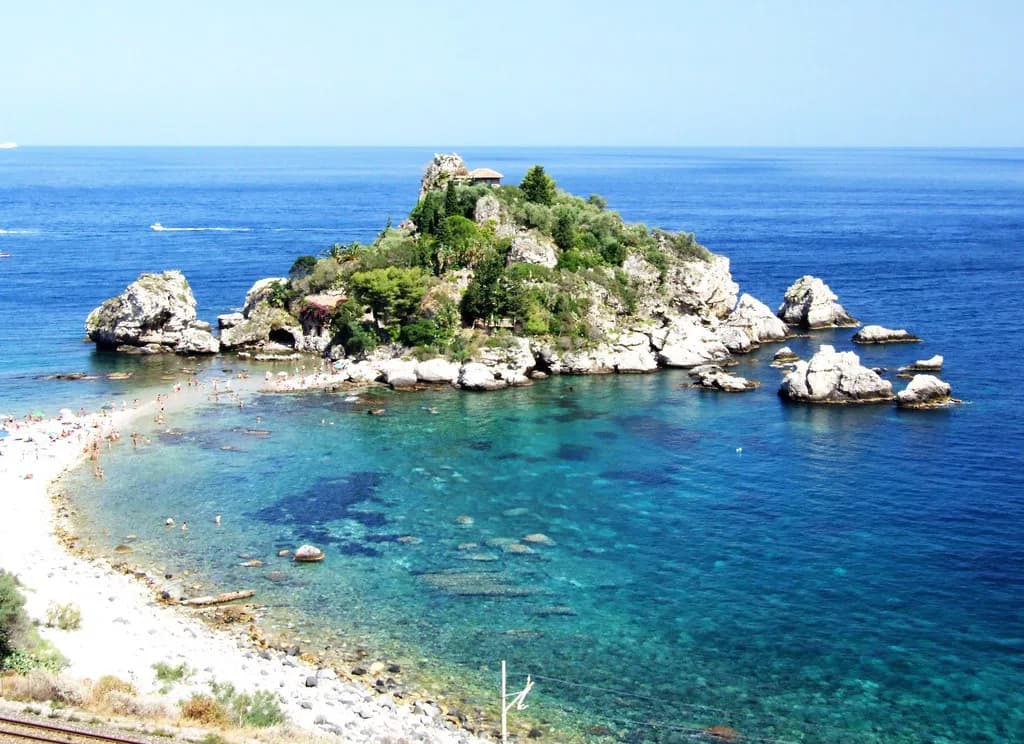
From Taormina, Isola Bella looks like a postcard: a green islet on a thin ribbon of shore, with the Ionian Sea shifting from turquoise to deep blue around it. Down at sea level the picture becomes practical, because the bay holds a free pebble beach, a separate ticketed islet with a reserve and a small museum, and serviced beach-club sections. A useful way to budget time is a half day here: a swim, a walk across the isthmus and a short look inside the reserve add up to a morning or an afternoon rather than a quick photo stop.
This guide covers getting down from town, what is free and what is not, the history behind the reserve and the timing choices that matter most. Where published details conflict or come only from older visitor guides, it says so and points you to the authority to check instead of repeating a figure as fact.
Where Isola Bella Is and How the Bay Is Laid Out
Isola Bella sits on the Ionian coast directly below Taormina, in the area of the Bay of Mazzarò. The Sicilian tourism board describes it as a small island stretching in front of the Taormina beach, covered in lush vegetation and joined to the mainland by a thin strip of sand. That strip is the hinge of the visit: it is what you cross to reach the islet, and it shifts with the sea.
Think of the bay as layers. Closest to the water is the public pebble beach, open to anyone. Beside and behind it are private beach-club sections with their own service arrangements. Out in the middle is the islet itself, which is a protected area rather than an extension of the beach.
The surface catches people out. This is a beach of pebbles and stones with a rocky seabed, not a long sandy strand, and the entry into the water is uneven. If you picture sunbeds and fine sand you will spend the first hour adjusting; with water shoes and the right expectations, the bay delivers more than a conventional beach.
Free Beach Versus Ticketed Islet
Access to the beach around Isola Bella is free; the paid element is stepping onto the islet itself. Since 2011 the islet's historic villa has housed the Regional Naturalistic Museum, so the common question of whether you have to pay has a two-part answer: no for the shore, yes for the islet.
Published prices do not agree. One long-running visitor guide lists a full ticket at six euros and a reduced ticket at three, while a boat operator's 2026 guide puts the full rate at around four euros and the reduced rate at two, including the museum. Treat the islet as ticketed, expect a small cash sum, and confirm the current rate and any reductions with the managing park before you travel.
Beach clubs are a third, separate arrangement. A lido can give you a serviced spot on the shore, but it does not grant access to the reserve, and a reserve ticket does not buy a sunbed. Decide which of the two you want before descending, because the serviced sections fill first on busy days.
Inside the Nature Reserve and Its Small Museum
The islet has been a nature reserve since 1998, managed with WWF involvement, and it packs nesting habitats, natural pools and dense Mediterranean flora into a very small space. Visit Sicily records that its management and protection were assigned to WWF and Ctgana and that it was declared a Regional Naturalistic Museum.
The museum is easy to overlook. It occupies the villa on the island, so one visit combines a short botanical walk with a look at the building and its collections. The islet is small, so this is a brief layer on top of beach time rather than a half-day museum.
Opening arrangements are the weakest part of the public record. Older guides describe a schedule from 9am until an hour before sunset, closed Mondays, with staggered entry in groups of fifteen, but no current official page in these sources confirms it. Visit Sicily directs readers to the Naxos Taormina Archaeological Park portal for visiting hours and procedures, which is the page to check in the days before you go.
A Short History: Bourbons, Florence Trevelyan and the Reserve
In 1806 Ferdinand I of Bourbon gave the islet to the town of Taormina. In 1890 it passed to Florence Trevelyan, an English noblewoman exiled to Sicily, who planted tropical species alongside the existing Mediterranean scrub and built a cottage among the rocks; much of today's greenery traces back to her. You can read the same story in Taormina itself, where her garden legacy survives in the Villa Comunale.
The twentieth century was rougher on the island. It changed hands repeatedly, was abandoned for long stretches and suffered vandalism before public institutions acquired it in 1990 and assigned its protection to conservation bodies. Read that sequence on site and the reserve feels less like scenery and more like a recovery story.
Getting There: Cable Car Plus the Final Walk
The simplest route from central Taormina is the cable car from Via Pirandello down to Mazzarò, whose valley station sits a few hundred metres from the beach entrance. Departures are frequent and the ride is short, which makes it the default choice for families, older visitors and anyone carrying beach gear. Hours and fares can change and the line can close for maintenance, so check the operator's own information first. For wider planning, see Taormina Funivia and Mazzarò Beach.
From the valley station it is a short walk to the shore and then a staircase down to the beach: around 134 steps, a figure both independent guides give. They are manageable going down and noticeable coming back up at the end of a hot afternoon, so leave the oversized bag behind.
There is also a pedestrian route from town, passing the Isola Bella viewpoint and continuing down a path to the shore. It is scenic and demanding, best done in cool hours and proper shoes, and it is not the option to choose with a cool bag and two children in tow.
Arriving by Car or by Boat
Driving down is possible but should be a deliberate decision. The seafront at Mazzarò gets congested in summer, and one operator's advice is to use the Mazzarò car park near the cable-car station and arrive outside peak hours. Rates and availability vary by season and operator, so check signage on the day rather than budgeting from an old figure.
The sea gives the most complete view, and boats along this coast can reach bays and caves that are not accessible on foot. Departures also run from the port of Giardini Naxos, a few minutes away, which suits travellers staying on that side of the coast. Tours range from a half day with snorkelling to private sunset cruises, and booking ahead matters most in July and August.
Best Time of Day and Season
Early morning, roughly eight to ten, is the strongest window: the sea is calmer, the light is cleaner and the beach is emptier. It is also the best time for snorkelling, because with little wind the rocky seabed is easier to read. Midday brings the most intense colour and the least comfort, with heat and crowds peaking between about eleven and half past three.
Late afternoon from about four is the alternative worth considering: the bay empties, the light softens and the landscape warms up. Across the year, the most balanced months are May, June, September and October; July and August are superb for swimming but busiest, and September into early October often combines warm water with a slower pace. If you are shaping a whole trip around crowd levels, our notes on the best time to visit Taormina avoiding crowds go wider than this one bay.
All of that advice is secondary to the day's conditions. Wind, current and swell change the bay more than any calendar suggestion, so look at the water before committing to a swim or a long snorkel, and stay close to shore when it is stirred up.
What to Bring and How to Handle the Pebbles
Water shoes are close to essential rather than a nice extra: barefoot walking on the pebbles turns every step into a small negotiation. Add water, sun protection, a hat and a snorkelling mask, and keep the bag light because you may be carrying it up those steps.
Snorkelling around the islet's rocky edges is rewarding, with fish and shifting light over submerged rocks. It is still a real marine environment rather than a pool, so a mask used within your comfort zone beats any ambitious plan.
Visiting with Children
Children can enjoy Isola Bella, but the pebble beach, uneven water entry and busy paths make it a planning-heavy day out. Arrive early, avoid the hottest hours, bring shoes that stay on and pick a spot away from the densest crowd.
A skippered boat trip is often the more relaxed family option, since it removes the steps, the bags and the scramble for space on the shore. When comparing boats, ask about shade, duration and safety arrangements rather than only the route.
Respecting a Fragile Reserve
The islet is a protected area with nesting habitats and natural pools, so its basic rules are not decorative. Do not take stones or shells, do not leave litter and do not disturb the marine environment; the reserve depends on that balance holding.
Back up the hill, Taormina rewards a slower look after a beach morning. The town's lanes and terraces are worth an unhurried hour, and our hidden gems in Taormina guide picks up where the coast leaves off.
How to Combine Isola Bella With the Rest of Your Day
A realistic plan is beach first, islet second: arrive early for a swim, cross to the reserve while the light is still flat, then retreat before the midday press. That sequence keeps the most physical part of the day in the coolest hours.
If you are in Taormina for a couple of nights, pair Isola Bella with a hill village on another morning rather than fitting both into one day. Our Castelmola day trip from Taormina notes cover the upland alternative when the coast is crowded, though on a short stay the Taormina one day itinerary will show how the coast slot fits round the town.
Plan Your Visit
Isola Bella works best when you treat it as three decisions: free beach or paid islet, cable car or car, morning or late afternoon. Get those right and the pebbles, the steps and the crowds stop being obstacles and become part of a very specific coastal day.
Before travelling, confirm the islet's current ticket price, opening days and any group limits with the managing park rather than relying on older guides, and check the cable car operator's page for maintenance. Then pack water shoes and go early.
Frequently Asked Questions
Do you have to pay to go to Isola Bella in Taormina?
The beach around the islet is free to access. Stepping onto the islet itself, which holds the nature reserve and the Regional Naturalistic Museum, requires a ticket. Published figures conflict between sources, so confirm the current rate and any reductions with the managing park before you travel.
Is the beach at Isola Bella free?
Yes. The pebble beach in the Bay of Mazzarò is open to everyone at no charge. Beach clubs operate separate serviced sections on the shore, and those are a different arrangement from both the free beach and the islet ticket.
How do you get from Taormina to Isola Bella?
Most visitors take the cable car from central Taormina down to Mazzarò, then walk a few hundred metres to the beach entrance. Alternatives are the pedestrian path from town, driving to Mazzarò, or arriving by boat from the coast.
How many steps are there down to Isola Bella?
Independent visitor guides put the staircase at around 134 steps. It is straightforward on the way down and more noticeable on the climb back, especially in afternoon heat, so travel light and allow time.
Can you walk from Taormina to Isola Bella?
Yes, there is a pedestrian route that passes the Isola Bella viewpoint and descends to the shore. It is scenic but demanding, so it suits cool hours, proper shoes and travellers without heavy beach gear.
What is the best time to visit Isola Bella?
Early morning gives calmer water, clearer light and fewer people, and it is the best window for snorkelling. Late afternoon is the other good option, with softer light and a quieter bay. Midday is hot and crowded.
How long should you spend at Isola Bella?
A half day is a sensible suggestion: a swim and some beach time, a walk across the strip, and a short look around the islet and its museum. The islet is small, so the museum adds a brief layer rather than a separate excursion.
Is Isola Bella worth visiting?
It is worth it if you accept the trade-off: pebbles and uneven water entry in exchange for clear water, rocky snorkelling and a small, historically layered reserve. Travellers wanting fine sand and full serviced comfort should plan around the beach clubs instead.
Sources
Continue exploring
More guides you'll find useful