Villa Comunale Taormina: A Guide to Trevelyan's Garden
Plan a visit to Taormina's Villa Comunale, the free garden Lady Florence Trevelyan created, with brick follies, exotic planting and wide sea views.
On this page
Most Taormina itineraries run along Corso Umberto and then straight down to the beach, which leaves the Villa Comunale as an afterthought. That is a mistake: the public garden on Via Bagnoli Croci, known locally as Parco Trevelyan, is one of the few places in town where you can sit in shade, look out over the Bay of Naxos and Mount Etna, and pay nothing to do it. Its 2026 listing gives free admission and daily opening, from 8am to midnight in the summer period and 8am to 8pm in winter. As a planning benchmark rather than an official recommendation, an hour here suits most first-time visitors, and two hours suits anyone who photographs plants or simply wants to slow down.
Where the Garden Sits and Why It Fits a Taormina Day
The garden occupies a slope on Via Bagnoli Croci, a short walk from the busy historic centre and just above the point where the town drops toward the sea. That position makes it a natural pause between a morning on the main street and an afternoon descent to the water, rather than a separate excursion. Arrive on foot from the centre, wander the terraces, and continue downhill toward the viewpoints and the cable car station instead of retracing your steps uphill.
Because the garden sits above the coast road, it works well as a rest stop with purpose: you get the panorama without committing to a hike. Taormina itself is built on terraces, so any day here involves steps, and the garden is where a slow half-hour genuinely improves the rest of the itinerary. Treat it as a buffer in your schedule, not a checkbox.
Lady Florence Trevelyan and the Making of Parco Trevelyan
The garden's identity comes from one person: Lady Florence Trevelyan, a Scottish noblewoman who settled in Taormina in the later 19th century and used the grounds for botanical experiment and quiet contemplation. The garden's history describes her filling it with rare plants gathered from around the world and with the eclectic built structures that still give the place its character. After her death the park passed to the Municipality of Taormina, which opened it to the public.
Her wider legacy in the area is visible elsewhere along the coast, including at Isola Bella, which travel writers credit her with buying in the late 19th century. Seeing both in one trip gives a fuller picture than either site alone, and it explains why the garden feels like a private collection opened to everyone. If you plan the beach day as well, the Taormina funivia and Mazzarò beach guide covers the logistics of getting down to sea level.
Admission and Seasonal Hours
Entry to the garden is free, and the garden's 2026 listing gives daily opening including holidays: 8am to midnight in the summer period and 8am to 8pm in winter. Those figures come from a promotional garden listing rather than a municipal notice, so confirm before a late-evening visit, especially around public holidays or after maintenance work. The Municipality of Taormina is the authority to check if the listing and your plans disagree.
Free admission applies to the garden grounds as described by that listing; do not assume it includes any separate ticketed collection or paid attraction nearby. Taormina's main paid sights, including the ancient theatre, are ticketed separately and should be planned and budgeted on their own terms. Check the Teatro Antico di Taormina visitor guide before you go if you want to combine both in one day.
The Beehive Follies
The structures that visitors remember are the alveari, or beehives, built on the remains of old farmhouses and arranged across open, stacked terraces. The listing describes them as eclectic with Oriental influences, decorated with arches, small towers, and floors and railings so delicate they resemble lace. Lady Trevelyan is said to have painted or taken tea in them with guests, which is a useful way to read them: they are garden buildings made for use, not ruins to walk past quickly.
Look at the details rather than the silhouette: brickwork, small towers and ironwork reward a slower lap, and the half-Gothic, half-exotic blend is what gives the garden its slightly theatrical mood. These are the photographs most people take home, so if the terraces are busy, wait a few minutes rather than shooting into a crowd. The follies sit inside a free garden, so there is no pressure to rush through them.
Plants, Fishpond and Shaded Paths
The planting is the other half of the story: palms, tropical species, flowering terraces and mature trees share the slope, giving the garden an international range that still reads as Mediterranean. The listed features include a romantic fishpond and shaded paths, which matter most in the middle of a Sicilian summer afternoon. Use them deliberately: pick the shaded route up or down the slope instead of the sunniest one.
If you like gardens generally, Taormina's geography keeps offering them: the public garden here and the planted slopes around town are part of the same appeal. The wider list of hidden gems in Taormina is a sensible place to look for the quieter corners that fit around a garden visit.
The Views: Etna, the Bay and the Light
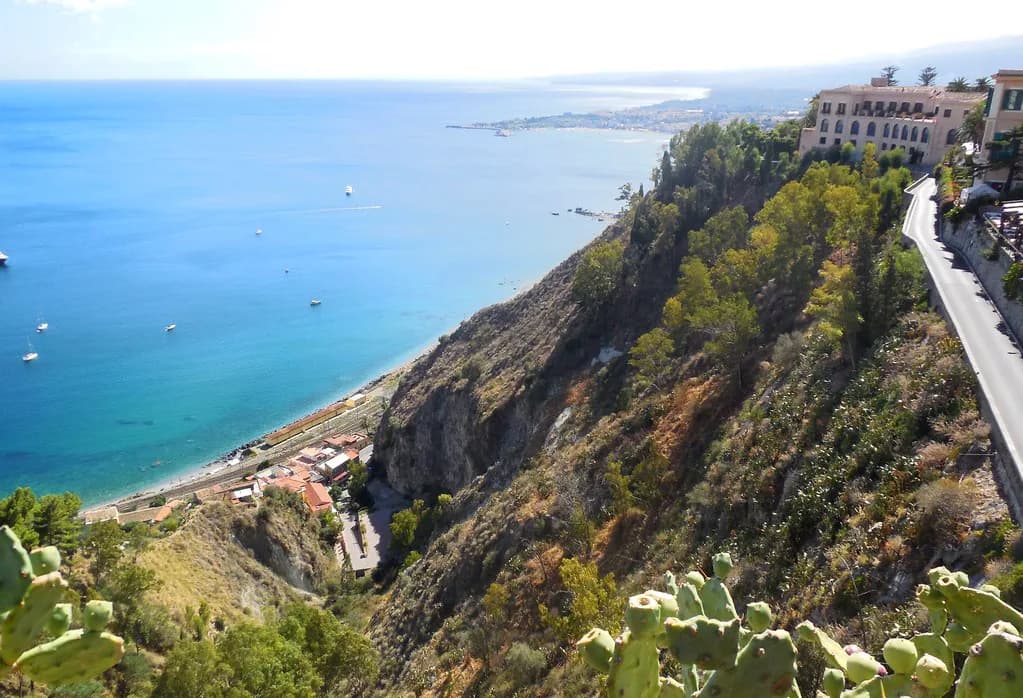
From the garden's terraces the view stretches from a smoking Mount Etna across to the Bay of Naxos, and the listing treats that panorama as part of the design rather than a bonus. Morning light tends to suit the sea, while later in the day the volcano side can soften; plan your lap around whichever you want to photograph first. A garden that faces both cannot be rushed in five minutes.
Photographers should bring something wider than a phone if they can, because the terraces are shallow and the view is broad. If the summit is clouded, the garden still works: the planted terraces and follies carry the visit on their own. That reliability is why the garden is a low-risk stop on an otherwise weather-dependent day.
Practical Notes on Dogs, Families and Access
Dogs are allowed but must be kept on a lead at all times, according to the garden's listing. Inside the grounds there is a large fitness area and a children's playground, which makes it a more practical stop for families than a pure ornamental garden would be. Those facilities are part of the free public space, not a paid attraction.
Access is the important caveat: the listing states the complex is difficult to reach for people with reduced mobility or in wheelchairs and that there is no lift. Taormina's stepped terrain compounds this, so anyone with mobility concerns should plan the approach and expect assistance rather than step-free access throughout. Verify the current situation locally before relying on a particular entrance.
Suggested Pacing and the Way Down to the Cable Car
As editorial advice rather than official guidance, give the garden about an hour, longer if you sketch, photograph or have children who want the playground. That timing lets you see the follies, the fishpond and the main belvederes without turning the visit into a march. If you are short on time, choose either the follies or the viewpoints and leave the other for a return.
From the lower end of the garden, the natural continuation is downhill toward the Belvedere di Via Pirandello and then the funivia to Mazzarò. Fares on the cable car are best treated as indicative and time-limited: the municipal operator ASM Taormina publishes the official tariff, and those figures change by season and by operator decision. Check the current price there before you travel rather than trusting a third-party figure. For wider planning, see Taormina Funivia and Mazzarò Beach.
Combining the Garden With Isola Bella, the Corso and Castelmola
A sensible full day pairs the garden with one further outing, not three. Garden plus Isola Bella works well: walk down, take the cable car or the stairway, swim in the reserve, and return for the evening passeggiata. Garden plus the main street is easier still, with the garden as a mid-afternoon break from the crowds. If you are building a structured day, the Taormina two-day itinerary shows where such a stop fits.
Castelmola, the hill village above Taormina, is a separate half-day at altitude rather than a quick add-on, since the journey takes time and the payoff is the panorama. If it appeals, plan it for a clear morning and read the Castelmola day trip from Taormina notes first. Do not attempt the garden, the beach and Castelmola on the same day unless you move fast and accept you will do each briefly.
Plan Your Visit
The Villa Comunale is the rare Taormina sight that costs nothing, requires no booking, and still delivers the town's two signature views. Check the published hours against the season before a late visit, treat the accessibility limits seriously, and set aside a slow hour rather than a quick look. Then walk downhill to the funivia, confirm the current fare with the operator, and continue your day at sea level.
Frequently Asked Questions
Is Villa Comunale in Taormina free to enter?
Yes. The garden's tourist listing describes admission to the grounds as free, and the space works as a public park with paths, terraces, a fitness area and a playground. Paid attractions elsewhere in Taormina, such as separate ticketed sites, are not covered by that, so budget them independently.
What are the opening hours of Taormina's Villa Comunale?
The garden's listing gives daily opening including holidays, with longer summer hours and a shorter winter closing time. Treat those hours as published guidance rather than a guarantee, since holidays and maintenance can change things, and confirm with the Municipality of Taormina before an evening visit.
Who created the Villa Comunale gardens?
Lady Florence Trevelyan, a Scottish noblewoman who settled in Taormina in the later 19th century, created the garden as a place of botanical experiment and contemplation. It later passed to the Municipality of Taormina, which opened it to the public, and it is still often called Parco Trevelyan.
What are the beehive structures in Parco Trevelyan?
The alveari, or beehives, are eclectic brick garden buildings raised on old farmhouse remains across stacked terraces. They mix arches, small towers and fine ironwork with Gothic and Oriental touches, and Lady Trevelyan reportedly used them for painting and tea with guests.
How long should I spend at Villa Comunale?
There is no official recommended duration. As a practical suggestion, an hour covers the follies, the fishpond and the main terraces at an unhurried pace, and two hours suits photographers or families using the playground. If you are short on time, pick either the viewpoints or the follies.
Is the garden suitable for wheelchairs or strollers?
The garden's listing states that the complex is difficult to access for people with reduced mobility or in wheelchairs and that there is no lift. Taormina's stepped streets add to the challenge, so plan the approach in advance and ask locally about the most workable entrance rather than assuming step-free routes.
Are dogs allowed in the Villa Comunale?
Dogs are permitted but must be kept on a lead at all times, according to the garden's listing. The grounds also include a children's playground and a fitness area, so keep leads short in busy parts of the park.
How do I get from Villa Comunale to the Mazzarò cable car?
Walk downhill from the garden toward the Belvedere di Via Pirandello and the upper cable-car station, then ride down to Mazzarò. Check fares and operating hours with the operator ASM Taormina, since published figures vary between sources and change with the season.
Sources
Continue exploring
More guides you'll find useful