Piazza IX Aprile & Via del Teatro Greco: Taormina Walk Guide
Walk Taormina from the free terrace of Piazza IX Aprile to the lane climbing toward the Ancient Theatre, with timing tips and honest access advice.
On this page
Taormina rewards walkers, and two stops sum up why: a public square with a panorama that costs nothing, and a lane climbing to the town's best-known ancient monument. Piazza IX Aprile and Via del Teatro Greco sit close together on the map, but they offer different kinds of visit, so it helps to know which is free open space and which is a separately listed archaeological site.
One detailed guide to Piazza IX Aprile advises setting aside about 15 to 30 minutes on the square, longer if you stop at a bar, and treats that window as a suggestion rather than any official duration. That is a workable rhythm for a walk: linger on the terrace, look up at the clock tower, then follow the Corso and turn toward the theatre lane before the light or your energy runs out.
Where Piazza IX Aprile Sits on the Corso
The square occupies the middle stretch of Corso Umberto, the pedestrian spine that links Porta Messina at one end with Porta Catania at the other. Arriving from Porta Messina, you reach it after roughly five minutes of strolling; from Porta Catania it takes rather longer in the opposite direction. Because it is a through-point rather than a detour, you can fold it into any walk along the Corso without planning a separate trip.
The square is a public outdoor space and, as the guide describes it, always accessible and free of charge. That distinction matters when you plan a day: the terrace, the paving and the view over the bay need no ticket and no booking. Treat the surrounding churches and the medieval gate-tower as architecture to admire from outside unless you have separately confirmed what is open.
What Makes the Square Distinctive
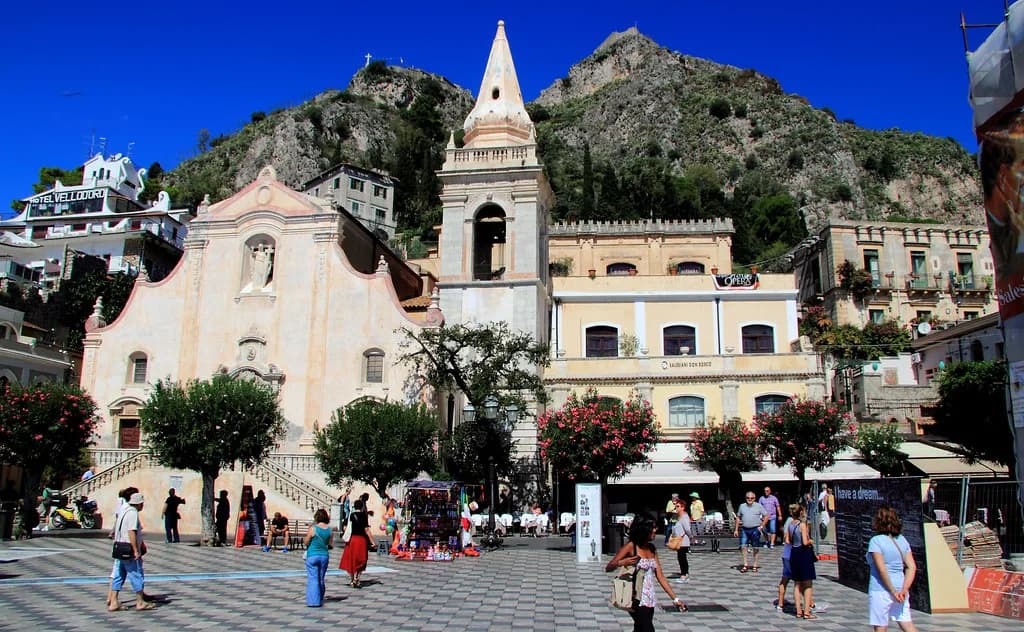
The floor is the first thing people photograph: a black-and-white chequerboard pavement that has become one of the town's signature images. At the far end, a balustrade opens onto a wide view of Mount Etna and the Bay of Naxos, with Castelmola visible on the ridge above. In the other direction, the square folds back into the Corso and its shopfronts.
The balustrade is about 110 centimetres high, which is comfortable for adults but means lifting small children to see over it. The surface itself is completely level, with no steps, so wheelchairs and pushchairs move easily across the square. These small practicalities make it a sensible pause mid-walk rather than a rushed photo stop.
The Buildings That Frame the Square
Three structures define the edges of the square. The Chiesa di San Giuseppe, a seventeenth-century baroque church, rises behind a side staircase; the former church of Sant'Agostino now houses the municipal library and keeps its bell tower; and the Torre dell'Orologio, also called Porta di Mezzo, is a medieval gate-tower that separates the upper and lower stretches of the Corso.
Walking through the clock tower takes seconds, and it works as a natural hinge for a route: the square and its churches on one side, the lane toward the theatre on the other. Whether the tower or the church interiors admit visitors is something the organisers publish separately, so check locally before you build a plan around going inside.
Free Terrace, Not a Free Ticket to Everything
It is easy to blur the square's openness with the accessibility of everything nearby. The terrace, the paving and the belvedere are public and permanently available, but that says nothing about the interiors of the churches or about entry to the Ancient Theatre at the top of Via del Teatro Greco. Plan the square as a free stop and verify each interior or ticketed site on its own terms.
The Comune di Taormina's official app lists the Teatro Antico at 1 Via del Teatro Greco among the town's points of interest, alongside the Odeon, the Naumachie and other sites. It is a listing of places, not a price list or timetable, so use it to orient yourself and then look for current visitor information from the site operator before setting out.
Why It Is Called IX Aprile
The name commemorates 9 April 1860, when Taormina rose against the Bourbon authorities during the movement toward Italian unification. The date became the square's identity, which is why the plaque and the name reward a moment's attention rather than a glance. Knowing the reference turns a pretty viewpoint into a small history lesson embedded in the town's main promenade.
Timing Your Visit: Morning, Late Afternoon, Evening
The guide's practical advice is to come early, before about 10am, for fewer people and front-lit views of Etna, or late in the afternoon when the light warms and the square fills with strollers. In the evening it becomes a gathering place with street musicians and lit facades. These are suggestions from a visitor guide, not an official timetable, and crowd levels shift with season and cruise traffic.
The window to avoid is roughly 11am to 3pm in high season, when tour groups funnel through the square and the panorama becomes hard to enjoy at the balustrade. July and August are the most congested, and the empty-looking photographs you see online are usually taken at dawn or out of season. Build the rest of your day around that bottleneck instead of fighting it.
A Quieter Viewpoint a Few Minutes Away
If the balustrade is shoulder-to-shoulder, walk about five minutes toward Porta Catania to Piazza Sant'Antonio, which the same guide describes as a less crowded alternative with a similar outlook. It is not a secret and not a substitute for the main square's architecture, just a second option when the central terrace is packed. Pair the two and you get both the classic view and breathing room.
Turning onto Via del Teatro Greco
Via del Teatro Greco is the approach lane to the town's ancient theatre, and its name signals the destination rather than any toll: the street itself is simply a street to walk. The lane climbs away from the Corso area toward the site entrance, so treat the walk as the transition between the free part of your day and the ticketed or scheduled part. Comfortable shoes matter more than any pass on this stretch.
The theatre is one of Taormina's headline sights, and its own visitor guide explains what to look for once you are through the gate. Read that before you climb so you know which parts of the structure and the view deserve your time. Checking the official town site for current notices is also worthwhile, since events and works can affect access.
How you enter the theatre, what it costs and when it opens are all variables the operator publishes and revises, and no current figures belong in a walking plan. Look up the official ticket and opening information on the day or just before, and treat any third-party price you see elsewhere as unverified. The lane rewards the walk regardless of what you decide at the top.
Arriving on Foot and Dealing with the ZTL
Cars cannot reach the square, because the historic centre sits inside a limited-traffic zone, so the realistic approach is on foot. From the bus terminal and Lumbi parking area, the guide describes about ten minutes downhill along Via Pirandello to the centre; from Porta Messina it is about five minutes along the Corso, and from Porta Catania about seven. These are approximate walking references, not timetables.
If you arrive by car, park outside the restricted area and continue on foot or by the local transport the town provides, rather than testing the ZTL signage. The uphill return to Lumbi is the part people underestimate, especially in summer heat, so leave slack before a booked train or bus. For a broader look at what else is within strolling distance, the hidden gems in Taormina make a good second layer to the day.
What to Skip on the Square
The bars on the square sell the view as much as the coffee, and the guide is blunt that this is not the place for a full meal: you pay for position, and quality is middling. A drink at an outdoor table is a reasonable indulgence; lunch is better a little further along the Corso or down a side street. Walking 50 metres away is often enough to change the value calculation entirely.
Use the square for what it does best: the panorama, the paving, the architecture and a pause. Then spend your appetite and your budget elsewhere in town, where the setting is not carrying the price.
Pairing the Walk with a One-Day Route
A sensible day uses the square as an early anchor, continues along the Corso, climbs toward the theatre, and then descends to the coast if the weather holds. The Isola Bella Taormina beach and nature reserve guide covers the downhill half of that plan, including how the funicular and paths fit together. Keeping one paid or scheduled stop per day leaves room for the wandering that makes Taormina enjoyable.
If you want a hilltop village instead of a beach, the Castelmola day trip from Taormina adds a short excursion above town with its own views back over the bay. The key is not to stack too many viewpoints into one morning; the square, the lane and one further stop is a fuller day than it sounds.
Plan Your Visit
Treat Piazza IX Aprile as a free, always-open pause and the climb up Via del Teatro Greco as a separate errand with its own access rules. Go early or late, skip the full meal on the terrace, and check the theatre's official information before you commit to a time. That division keeps the day honest and the walking pleasant.
Start with the Corso Umberto I Taormina guide to understand the spine of the town, then use the Teatro Antico di Taormina visitor guide for the archaeology at the top of the lane. Between the two, the square needs nothing more than your attention and a clear morning.
Frequently Asked Questions
What is Piazza IX Aprile and where is it in Taormina?
It is the panoramic square in the middle of Corso Umberto, roughly halfway between Porta Messina and Porta Catania. It is the town's central belvedere, with a balustrade looking out over Mount Etna and the Bay of Naxos.
Is Piazza IX Aprile free to visit?
Yes. The square is a public outdoor space that is always accessible and free to enter. That covers the terrace and the paving, not the interiors of nearby churches or the Ancient Theatre further up the hill.
Why is the square called IX Aprile?
The name refers to 9 April 1860, the date of Taormina's uprising against the Bourbon authorities during the Italian unification movement. The date became the square's name and remains part of its identity.
When is the best time to visit Piazza IX Aprile?
A visitor guide suggests early morning before about 10am or late afternoon for warm light and a livelier atmosphere. It advises avoiding roughly 11am to 3pm in high season, when tour groups crowd the balustrade.
Is there a quieter alternative viewpoint near the square?
Piazza Sant'Antonio, about five minutes on foot toward Porta Catania, is described as a less crowded spot with a similar kind of view. It is a practical alternative when the main square is busy, not a hidden secret.
How do you get to Piazza IX Aprile on foot?
Walk the Corso from Porta Messina, about five minutes, or from Porta Catania, about seven. From the bus terminal or Lumbi parking, the guide describes a downhill walk of roughly ten minutes along Via Pirandello.
Do you need a ticket for the Ancient Theatre in Taormina?
The Ancient Theatre on Via del Teatro Greco is listed separately from the public square, so expect its own visitor arrangements rather than free access. Ticket prices and opening times change, so check the official town and operator information before you go.
How long should you spend at Piazza IX Aprile?
A guide to the square suggests 15 to 30 minutes, longer if you stop at a bar. That is a recommendation, not an official figure, and it is enough time to take in the view, the paving and the surrounding buildings.
Sources
Continue exploring
More guides you'll find useful