Taormina Self-Guided Walking Route: A Half-Day Loop
Plan a half-day self-guided walk through Taormina, from Porta Messina and the Greek Theatre to Piazza IX Aprile, the Duomo and Villa Comunale.
On this page
Taormina rewards walkers precisely because it is small and legible. The historic centre hangs on the slope of Monte Tauro above the Ionian Sea, and almost every visitor ends up on the same pedestrian spine, Corso Umberto, which runs for almost a kilometre between the old gates of Porta Messina and Porta Catania. Off that street the lanes fall away in staircases, so the trick is not choosing a route but sequencing it.
This loop is an editorial suggestion rather than an official trail: allow roughly half a day at a relaxed pace, more if you linger at the theatre or stop for lunch. The order below puts the flat street in the middle, the paid archaeological site near the start, and the free gardens at the end, so that any climbing happens while you still have energy.
Why Taormina Suits a Self-Guided Walk
The centre is compact enough to cover on foot in a morning, and English-language roadbooks and maps are widely used in Sicily for independent walking, which makes the town an easy first day before a longer trek. If you are combining Taormina with a rural route, operators such as Inn Walking publish detailed self-guided itineraries with day-by-day distances and gradients that show how Sicilian trail logistics usually work.
What you cannot assume is that the terrain is gentle. Writers who walk Taormina regularly describe the main street as practically the only flat part of town, with steep staircases linking it to the viewpoints, churches and gardens above and below. Build that into your plan rather than treating it as a surprise.
Anyone with reduced mobility, a stroller or knee trouble should read the route below as a menu. Some stretches, including the historic stairway down to the coast, are described as uneven and unsuitable for wheels, and the gardens themselves are noted as difficult to access without a lift.
Route at a Glance
Start at Porta Messina, the northern gate, and walk the length of Corso Umberto with the Greek Theatre detour early, then Piazza IX Aprile and Piazza Duomo on the same street. Finish at Villa Comunale, the public garden known as Parco Trevelyan, which sits a short walk off the Corso near Via Bagnoli Croci.
Two sites on this loop are separately ticketed and should not be folded into a single admission assumption: the ancient theatre and the Isola Bella nature reserve down at the coast. The cathedral and the gardens, by contrast, are described by sources as free to enter, though church interiors may be closed during services and the gardens keep their own seasonal hours.
1. Start at Porta Messina: Steps, Gradients and Crowd Timing
Porta Messina is the natural starting point because the Corso begins flat from there, and the cable car station on Via Luigi Pirandello is only a short walk away if you are arriving from Mazzarò. Entering through the old gate also puts the town's shape in front of you before any decisions about detours. For wider planning, see Taormina Attractions: Visitor Guides to 7 Sights.
Timing matters more than route here. Multiple guides report that Taormina is at its most crowded in July and August and when cruise groups arrive mid-morning, while early morning and evening are noticeably calmer on the Corso and at Piazza IX Aprile. Starting soon after the gates open gives you the theatre and the viewpoints before the tour buses.
2. Corso Umberto: Gates, Piazzas and Shops
Corso Umberto is a pedestrian boulevard of almost a kilometre, lined with souvenir stalls, artisan workshops, fashion boutiques and cafés, and it links the two historic gates. It is where most of the town's landmarks sit, so you will walk it more than once; treat the first pass as orientation and the second as sightseeing.
The street's two showpiece squares are Piazza IX Aprile, with its tiled floor and sea-facing terrace, and Piazza Duomo, where the medieval cathedral and a baroque fountain sit in a smaller, quieter space. Between them you pass the clock tower, the baroque Chiesa di San Giuseppe and several palaces worth a look from the outside even if you do not go in.
For a short break, duck off the Corso into the narrow side lanes, where the crowds thin and the architecture is just as good. Vicolo Stretto is described as less than one metre wide and one of the narrowest alleys in Sicily, which takes a moment to see without derailing the walk; the hidden gems guide covers more of these side streets.
3. The Greek Theatre Detour: A Separate Ticket and Entrance
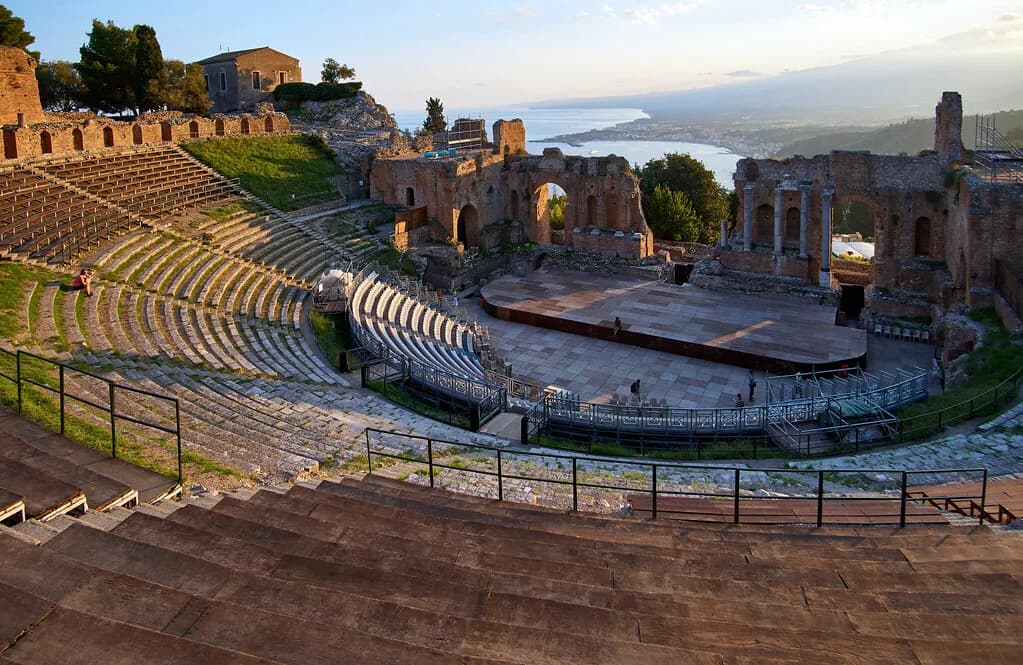
The Teatro Antico sits just off Via del Teatro Greco, a few minutes' climb from the Corso, and it is the one sight on this loop that genuinely deserves an allocated hour or more. Built in the third century BC and later reworked by the Romans, it still frames views of the sea and Mount Etna from its stone seating, and it remains a working performance venue.
Buy your ticket from the official park channel rather than assuming a town-wide pass, because admission is priced separately. The Taormina tourism site states the standard full ticket at 14 euros, with reduced and free categories and a list of free-entry dates, and it notes that tickets are valid only for the date and time chosen at purchase.
Closing time moves with the season, with the site open from 9am until roughly an hour before sunset depending on the period, so check the park's notices for the day you visit instead of relying on a guidebook. Rehearsals and concerts can change both the atmosphere and the access.
4. Coffee or Granita: Where to Break
Bam Bar on Via di Giovanni is the town's best-known granita stop, with sunny yellow tiles and flavours listed on a board outside; you can usually choose two flavours and add cream or a brioche. At the end of the day you can sit outside, and the bar is open every day in summer but closes on Mondays out of season.
If you want food rather than a frozen treat, Rosticceria Da Cristina is the reliable casual option, with arancini a speciality and a branch near Piazza Duomo as well as one close to Bam Bar. Both venues are small, and some cafés in Taormina keep a weekly closing day outside high season, so a quick check before you set out avoids a wasted detour.
5. Piazza IX Aprile: The Balcony View
Halfway along the Corso, Piazza IX Aprile opens onto a terrace with a black-and-white tiled floor and one of the best views in town, stretching over the Ionian Sea toward Mount Etna and the San Domenico Palace. The clock tower and the baroque Chiesa di San Giuseppe frame the square, and the cafés along its edge are priced for the view.
This is the spot to sit for an espresso or a beer if the sun is high, but it is also one of the most photographed points on the walk, so early morning gives you the terrace without elbows. Photographers should note that Etna is often cloud-covered even on clear coastal days.
6. Piazza Duomo and the Medieval Cathedral
At the Catania end of the Corso, Piazza Duomo holds the Cattedrale di San Nicola, a small medieval church with a plain, fortress-like exterior that gives little away from outside. Entry to the cathedral is free, but it is an active place of worship, so cover shoulders and knees and keep voices low if a service is under way.
The fountain in the middle of the square, with its Minotaur figure, is a useful meeting point and a pleasant place to sit before the final stretch. From here Villa Comunale is a signposted walk of a few minutes rather than a hike, which makes the sequence work for tired legs.
7. Villa Comunale: A Free, Calm Finish
Villa Comunale, also called Parco Trevelyan, was created in the late nineteenth century by Florence Trevelyan, a Scottish noblewoman who filled it with rare plants and curious structures now known as the beehives. The garden is free to enter and open daily, with longer hours in summer, and it has benches, shade and a children's playground.
It is quieter than the Corso, and it also serves as a viewpoint over the coast and Etna, which makes it a natural end to the loop rather than an afterthought. Access is the catch: the gardens sit on terraced ground with no lift, so anyone with mobility difficulties should plan to enjoy them from the flatter paths or skip them.
Optional Extension: Madonna della Rocca and Castelmola
Stronger walkers can add the climb from the town to Chiesa Madonna della Rocca, a small church cut into the rock of Monte Tauro, reached by the Salita Castello staircase in roughly twenty to thirty minutes from the centre. The path is exposed with little shade and no shops, so carry water and avoid midday heat.
Beyond Taormina, the village of Castelmola sits higher on the same mountain and offers a natural terrace over the Ionian coast, Mount Etna and the strait toward Calabria. It is a separate place from Taormina, reachable by bus, on foot or by car, and its main square is home to the historic café credited with the village's almond wine.
Castelmola is worth a half-day of its own rather than a rushed add-on at the end of this loop. If you are staying overnight, a dedicated day makes more sense; a two day Taormina itinerary can absorb the town walk and the Castelmola excursion far more comfortably than a single afternoon.
Optional Extension: Down to Mazzarò and Isola Bella
To reach the coast you have two real choices: the Mazzarò cable car from Via Pirandello or the historic stairway down. The cable car runs frequently and takes only a few minutes, but the published fares differ between sources and change with the season, so check the operator's current rates and hours at the station rather than budgeting from a guidebook.
The stairway is free and scenic, roughly half an hour downhill, but it is uneven and not suitable for strollers or anyone with knee problems, and the climb back up is considerably harder. Whichever way you go, the beach at Mazzarò is pebbly and the Isola Bella reserve charges its own separate entrance, so bring water shoes and check the reserve's hours before crossing.
For the best view without the descent, walk to the Belvedere di Via Pirandello above the coast road, which looks straight down on Isola Bella and takes about ten minutes from the centre. Getting to and around Taormina is easier on foot than by car in any case, since the historic centre is a restricted traffic zone and parking is limited. For wider planning, see Getting to and Around Taormina.
Practical Decisions Before You Set Out
Wear shoes with grip for the cobbles and staircases, carry water, and plan the walk for the morning or late afternoon in summer; the Corso has little shade and the theatre is exposed. Church dress codes matter, and the cathedral expects covered shoulders and knees.
Decide in advance which ticketed sites you want, because the theatre, the Isola Bella reserve and any museum interiors are charged separately and none of them shares a ticket with the town's free sights. Check the official park pages the week before you travel for closures, free-entry days and seasonal hours.
If you are staying in Taormina rather than visiting on a day trip, choose your base with the walk in mind: anywhere near the Corso means the flat part is on your doorstep, while stays down at Mazzarò require the cable car or stairs each time you want the centre. Our guide to Taormina neighbourhoods and where to stay explains the trade-offs.
Plan Your Visit
This loop works because it respects the town's shape: flat street in the middle, the one big paid sight early, the free gardens at the end, and the coast saved for a separate outing. Half a day is realistic without the theatre; with it, allow longer or spread the walk over two days.
Confirm the theatre's opening arrangements on the archaeological park's site, check the cable car operator for current fares and hours, and treat the gardens' published times as the authority rather than any blog. Book accommodation and any timed tickets ahead in high season, and keep the plan flexible enough to swap a detour for a granita when the heat or the crowds make the decision for you.
Frequently Asked Questions
Can you walk Taormina without a guide?
Yes. The historic centre is compact and the main street, Corso Umberto, links the two gates and most of the landmarks, so an independent walk is straightforward. The main planning points are the steep side staircases, which paid sights need a ticket, and when to go to avoid the busiest hours.
How long does a self-guided walk around Taormina take?
Allow roughly half a day at a relaxed pace, and longer if you tour the Greek Theatre or stop for a proper lunch. This is an editorial suggestion rather than an official figure; add time for stairs, queues at popular cafés and photo stops at viewpoints.
Is the Greek Theatre in Taormina separately ticketed from the rest of the town?
Yes. The Teatro Antico is an archaeological park with its own admission, and it is not covered by any town-wide pass. Check the official park website for current prices, free-entry dates and seasonal closing times, which vary through the year.
Is Villa Comunale in Taormina free to enter?
Yes, the Villa Comunale, also called Parco Trevelyan, is free to enter and open every day, with shorter hours in the winter period. Note that the gardens are terraced and there is no lift, so they are difficult to visit with reduced mobility or a stroller.
How do you get from Taormina down to Isola Bella without a car?
Take the Mazzarò cable car from Via Pirandello or walk the historic stairway, which takes about half an hour downhill and considerably longer up. Both reach the coast near Mazzarò beach, from where Isola Bella is a short walk. Fares and hours change with the season, so confirm them with the operator.
When is the quietest time to walk Corso Umberto?
Early morning and evening are calmer, once cruise groups and day-trippers have left, and spring or autumn avoids the peak summer crowding. Sources consistently describe July and August as the busiest period, so an off-season visit changes the experience more than any route tweak.
What should I wear and carry for a Taormina walk?
Comfortable shoes with grip for cobblestones and stairs, a hat and water in summer, and covered shoulders and knees if you plan to enter churches. Carry a little cash for cafés and the occasional ticket office, and keep a light layer for the wind at the viewpoints.
Sources
- Magna Via Francigena Self-guided Walking Tour In Sicily, Italy. Independent Inn To Inn Hiking Holidays.
- Castelmola - Visit Sicily
- The Very Best Things to Do in Taormina, Sicily — ALONG DUSTY ROADS
- 2025 - Free and/or Night Opening of the Taormina Ancient Theatre - Taormina
- Mazzarò Cable Car - Taormina - ASM Taormina
- 11 Wonderful Things to Do in Taormina, Sicily
- 23 Best Things to do in Taormina, Sicily - Traveling with Aga
- Villa Comunale 'Parco Trevelyan' | Grandi Giardini Italiani
- Audioguide Ancient Theatre - That's Taormina map
- Taormina-Mazzarò Cable Car: prices, hours,… · MyTaormina
Continue exploring
More guides you'll find useful