Agrigento Viewpoints: Valley of the Temples Panorama Guide
Plan Agrigento's best viewpoints in the Valley of the Temples, from the ridge temples to sunset light and the shade of Kolymbetha Garden.
On this page
Agrigento's best-known viewpoints are not roadside terraces but ridge-and-valley views inside the Valley of the Temples archaeological area, on Sicily's south coast beside the modern town. The temples sit along a ridge above lower ground, so the panorama shifts with almost every stretch of path rather than appearing at one fixed platform. This guide ranks the viewpoints by what each one actually delivers.
The whole park covers roughly 1,400 hectares, with the archaeological area itself around 400 hectares and inscribed on the UNESCO World Heritage List since 1998, according to licensed local guides. Treat a visit as a half-day landscape walk rather than a quick photo stop, and build in time to sit still at one or two points. If you want the wider context of the site, the Valley of the Temples visitor guide covers tickets and logistics. Visitor details: Agrigento, what to see: the 10 places not to miss.
How the Valley of the Temples Is Laid Out
Picture a long limestone ridge running roughly east to west, with the modern town on higher ground to the north and a shallow valley falling away to the south. The temples are strung along that ridge and its edges, so views open up as you move between them. Some look back across the valley floor, others out toward the coastal plain.
That layout explains why there is no single headline viewpoint. You collect the panorama in pieces, and the best moments often come from looking sideways between columns rather than from an official terrace. Walking the site in one direction and letting the elevation build gradually works better than doubling back.
The site can be busy, especially in peak season, and this is an actively visited park rather than a quiet corner. The ridge walks and sunset spots are one of the most memorable things about Agrigento, but they are shared. Plan on tour groups crossing your view at the popular temples and choose quieter edges for lingering.
Viewpoint 1: Temple of Juno, the Highest Point on the Ridge
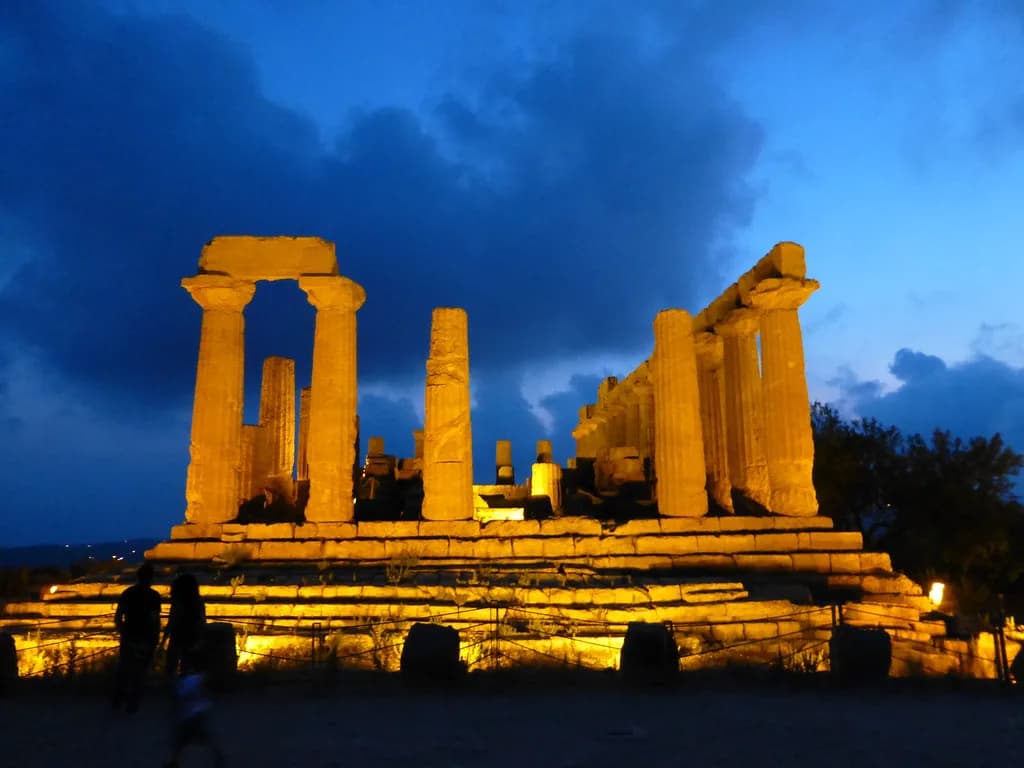
The Temple of Hera, or Juno Lacinia, is the highest temple on the ridge, built around 450 BC and standing at the south-eastern end of the valley. Because of its elevation it is often the first structure you see as you approach from any direction. Several of its columns were reconstructed in 1789.
For a panorama, this is the temple that gives you height and open sky. You look down over the ridge line and across toward the other temples, which makes it a natural orientation stop early in a visit. The surviving sacrificial altar in front of it adds a foreground element that many visitors walk past on the way to the columns.
Come here first if you want to understand the site's shape before the detail overwhelms you. The trade-off is exposure: an elevated, unsheltered position means the wind and sun hit harder than down in the valley. Carry water and don't save this stop for the hottest hour.
Viewpoint 2: Temple of Concordia and Golden-Hour Light
The Temple of Concordia is one of the best-preserved Greek temples anywhere, dated to the second half of the fifth century BC and converted into a church in the sixth century AD. Its colonnade of six by thirteen columns still gives a sense of the original proportions. The dedication is unknown; the name is a later convention.
As a viewpoint, Concordia is less about height than about framing. You want to be close enough for the columns to fill your view and far enough to see the whole facade against the sky. Just before golden hour is the classic window, when low light rakes across the stone and picks out the fluting.
Expect company at that hour. The temple is the site's signature image and it attracts the largest gatherings of the day, so arriving a little earlier helps you find a clear angle. If the crowd is tight, step back along the ridge rather than jostling at the base.
Viewpoint 3: Temple of Olympian Zeus and the Sleeping Giant
The Temple of Olympian Zeus was the largest Doric temple in the world, and only about five per cent of the original building survives. What remains reads as colossal foundation blocks rather than a standing facade. It is a viewpoint of scale, not elevation, and it repays a slower look.
Inside the temple footprint you can see the Sleeping Giant, a 7.65-metre copy of a Telamon shown holding up the world. It gives the ruins a human reference point: you suddenly register how tall the original structure must have been. The original Telamon is displayed in the Regional Archaeological Museum in Agrigento.
Because the fallen blocks invite climbing around the edges for a better angle, take care where you step and follow any on-site signage. The light here works differently from Concordia: the drama comes from deep shadows between stones rather than a glowing facade.
Viewpoint 4: Kolymbetha Garden and the Lower Ground
The Giardino della Kolymbetha is a small restored Mediterranean garden tucked below the temples, with citrus trees, olive groves and ancient irrigation channels. It works as the counterpoint to the ridge: shaded, fragrant and green instead of sunlit stone. Sitting here for twenty minutes resets your eyes before the next temple.
From the lower ground you also get the reverse view, looking up at the ridge and seeing how the temples sit in the landscape rather than against the sky. Photographers often prefer this angle because it includes the terrain. It is also a sensible place to pause during the hottest part of the day.
Ridge Walks and Timing the Sunset
The whole site is laid out on a ridge and valley, so the ridge walks and sunset spots deserve their own unhurried stretch. At dusk the limestone warms and turns golden, and the vista becomes one of the most memorable parts of an Agrigento visit. Build your loop so you finish on high ground.
Don't plan around a precise sunset time from a blog. Day length shifts through the year, and park access can close before the light fades completely, so check the current opening arrangements with the park before deciding on a late finish. Allow more buffer than you think you need.
Weather: Why Midday Is the Wrong Window
Summer in Agrigento is punishing, with highs commonly reaching 32 to 35 degrees Celsius, which makes midday temple visits brutal. Spring and autumn are milder, around 18 to 24 degrees, and far better suited to wandering ruins without overheating. Winter is mild but damp, averaging 10 to 15 degrees.
Crowds follow the same curve. July and August pack the site and turn the ruins into a noisy photo-op zone, while April to June and September to October offer a quieter, more reflective experience. The heat-first rule is simple: start early or arrive late, and use the middle of the day for shade or the museum.
Late April and early October are the sweet spots, with cooler temperatures and manageable crowds. November through March stays workable at a lower intensity, though shorter daylight compresses a panorama-focused day. Whatever month you pick, treat the timing of the Golden Hour as flexible.
Pairing the Panorama With the Museum and the Town
The Regional Archaeological Museum near the site holds the artifacts, pottery and models that make the ruins click into place. Visiting first gives you orientation; visiting afterwards deepens what you have just seen in stone. It is also a sensible midday refuge when the ridge is too hot.
Agrigento itself is worth the half-day beyond the park. The historic centre, rebuilt by the Arabs along alleys and courtyards converging on Via Atenea, is a different kind of wandering from the temples. An old town walking guide helps you connect the two halves of the city. Finestre sull'Arte notes the city's layered history from Akragas in 580 BC to the present.
If you have time for more than the temples, the hidden gems in Agrigento round out the picture with overlooked corners of the city. They pair well with a slow afternoon after a morning on the ridge.
Practical Planning: What to Check Before You Go
Entry is ticketed, and third-party tour operators quote their own group and private tour prices, from around 34 euros per person for a small group up to several hundred for private transfers. Those figures are tour prices, not the official site entrance fee. Check the park's own ticketing for current entry prices and any combined tickets.
Confirm opening hours, any seasonal closures and whether the Kolymbetha Garden or individual temples are open on your date, since parts of a large site can close independently. Look at the official park site or contact the tourist office directly. Booking is not always needed outside peak season, but popular slots fill in summer.
Do not rely on fixed route advice from blogs for getting between viewpoints; paths inside the park and access points can change. On arrival, pick up a map or ask staff for the current recommended loop. Park staff also know which temple areas are closed for conservation.
Should You Add Day Trips?
Agrigento rewards a base of at least two nights so you can split the temples across two visits: one for the ridge and one for the museum, garden or town. A day trips guide can help you plan an excursion if you want more of southern Sicily. But cramming the Valley into a rushed half-day undercuts the whole point of a viewpoint trip.
Plan Your Temple Panorama
Treat Agrigento's viewpoints as one connected landscape: Juno for height and orientation, Concordia for close-up architecture in low light, Zeus for scale, and Kolymbetha for shade and greenery. Move between them slowly and let the heat and crowds decide your pace rather than a checklist.
Before you go, check current entry prices, opening hours and garden access with the park itself, and keep a flexible slot for sunset. Agrigento Attractions collects the individual sight guides if you want to plan around the temples in depth.
Frequently Asked Questions
Where are the best viewpoints in Agrigento?
The strongest viewpoints are inside the Valley of the Temples. The Temple of Juno gives the highest ridge panorama, Concordia offers the best close-up of well-preserved Doric architecture, Olympian Zeus provides a sense of scale, and the lower Kolymbetha Garden gives shade and a reverse view uphill.
What is the best time of day to see the temples?
Early morning or late afternoon, when the light rakes the stone and the heat is lower. The hour before golden hour is the classic window at Concordia. Check the park's current opening hours and last entry before planning a sunset finish.
Is the Valley of the Temples worth visiting?
Yes, if you give it time. It is a large, UNESCO-listed landscape rather than a single monument, and the experience improves when you split it across a half-day or two visits. Visit outside midsummer if you want to avoid the worst heat and crowds.
How many days do you need in Agrigento?
Two nights is a comfortable base: one full day for the Valley of the Temples and one afternoon for the museum and the historic centre. If you only have one day, pick two temples and the ridge walk rather than trying to see everything.
How old are the temples at Agrigento?
Most date to the fifth century BC or earlier, reflecting the ancient city of Akragas founded in 580 BC. The Temple of Hera dates from around 450 BC, the oldest monumental temple, that of Herakles, from about 510 BC, and the Olympian Zeus was started in the fifth century BC.
Should I visit the museum before or after the temples?
Before, if you want orientation and context; after, if you want the ruins to sink in first. Either works. The museum also offers a cool refuge in the middle of the day, and its collection includes the original Telamon from the Temple of Zeus.
Sources
Continue exploring
More guides you'll find useful