Siena Self-Guided Walk: Old Town Loop & Timing Tips
Plan a self-guided walk through Siena's old town, linking Piazza del Campo, the Duomo and medieval lanes with practical timing and free-versus-ticketed stops.
On this page
Siena rewards walkers because the historic centre is compact and largely pedestrian, with its main sights strung along a few arterial streets rather than scattered across a sprawling city. The trade-off is elevation: the town sits on a hill, so any loop involves gentle climbs and cobbles that slow you down more than the distance suggests. This route threads Porta Camollia, Piazza Salimbeni, Piazza del Campo and the Duomo quarter into a single half-day circuit you can follow without a guide. As an editorial suggestion, allow two to three hours of walking plus stops for the core loop; this is not an official timing. Related guide: Basilica di San Francesco in Siena: A Visitor Guide.
Why walk Siena's old town self-guided
The old town is walled, traffic-restricted and walkable, so the pleasure lies in ambience as much as in any single monument. Siena's main streets converge on the shell-shaped Piazza del Campo, and the walk between squares passes Gothic façades, loggias and narrow side lanes. Because you set the pace, you can linger in squares that would be rushed on a fixed tour. If you want to understand how the city divides into its historic thirds, the Siena neighbourhoods guide is a useful companion before you set out.
One useful frame is to treat public squares, churches' exteriors and open loggias as free breathing space between the ticketed interiors you choose to enter. Siena's historic centre is recognised as a UNESCO World Heritage Site and is often described as an embodiment of a medieval city, which is a good reminder to look at streets and buildings, not just museum walls. Palio races are held in the Campo on 2 July and 16 August each year, so the square's role shifts with the calendar.
Before you start: where to begin near Porta Camollia and how to think about timing
Porta Camollia is the northern gateway into the walled city and a sensible start: historically the entry point for pilgrims on the Via Francigena, it was destroyed in the 1555 siege and replaced a few decades later. Step through onto Via Camollia and head toward the centre. Siena's railway station sits outside the walls at the foot of the hill, so you will climb or take local transport up before you begin the loop properly.
Treat timing as a suggestion, not an official figure. A comfortable half-day allows roughly two to three hours of walking plus stops, with more if you enter museums or climb towers. Build in buffer for the uphill approach and for getting briefly turned around in the backstreets, which is part of the experience rather than a failure of navigation.
Leg 1: Porta Camollia to Piazza Salimbeni along Via Banchi di Sopra
Via Camollia joins Via dei Montanini and continues as Via Banchi di Sopra, one of the main walking streets and the spine of this first leg. The route passes through the Istrice Contrada, one of Siena's seventeen districts, and there are restaurants along the strip if you want a later meal stop. Keep your eyes on the façades as much as the shopfronts; the street itself is the attraction.
Piazza Salimbeni opens on the left, flanked on three sides by Gothic and Renaissance mansions including Palazzo Salimbeni, home to a bank that traces its origins to a fifteenth-century pawn operation. A statue of the Sienese economist Sallustio Bandini stands in the square. It is a short, free pause that sets up the rest of the walk.
Leg 2: Piazza Tolomei, Piazza Indipendenza and the Croce del Travaglio crossroads
Continuing down Via Banchi di Sopra, Piazza Tolomei appears on the left with the eleventh-century Chiesa di San Cristoforo, the twelfth-century Palazzo Tolomei and the Column of the She-Wolf. A few minutes off the main street, Piazza Indipendenza holds the Loggia fronting Palazzo Ballati and the Teatro dei Rozzi, a theatre inaugurated in 1817 with roots in a sixteenth-century poetry group. Both squares are free to wander and reward a slower look.
At Croce del Travaglio, Via Banchi di Sopra meets Via di Città and Banchi di Sotto, the three arteries that structure the medieval centre. From here it is only steps to the Campo, but the approach matters: stately buildings screen the square until you pass through one of its passageways. That sudden reveal is one of the walk's best moments.
Leg 3: Entering Piazza del Campo through its passageways
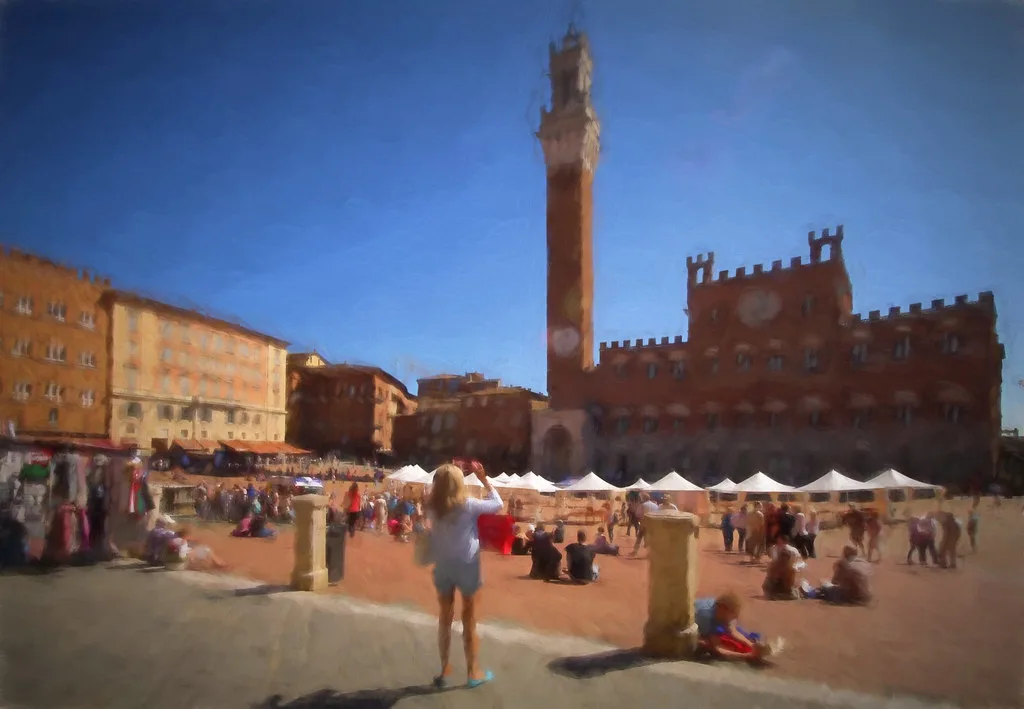
Eleven passageways lead into Piazza del Campo, including Vicolo San Pietro, Vicolo di San Paolo and Chiasso del Bargello near the Loggia della Mercanzia. Pass under a brick arch and the fan-shaped square appears all at once, ringed by late Gothic mansions and sloping gently toward Palazzo Pubblico. There is no ticket to enter; it is public space, and its ground floors have largely become cafés, restaurants and gelaterias.
Look for Fonte Gaia, the fountain fed by an underground aqueduct whose channels still supply local fountains. The marble you see is largely a nineteenth-century replica by Tito Sarrocchi, while Jacopo della Quercia's earlier work is displayed in the Santa Maria della Scala museum. Knowing that avoids the disappointment of expecting an original on the square.
Leg 4: Palazzo Pubblico, Torre del Mangia and the free Cortile del Podestà
Palazzo Pubblico curves around the lower side of the Campo and still serves as Siena's town hall, housing the Civic Museum and the Rinnovati Theatre as well as municipal offices. Beside Torre del Mangia, a doorway opens onto the Cortile del Podestà, a courtyard you can enter without a ticket. Step in, look up at the colonnaded walls framing the tower, and use it as a free breather before deciding whether to pay for interiors.
Inside, the Museo Civico holds Lorenzetti's frescoes on good and bad government, and the tower offers panoramas over the city. Opening times and admission arrangements change seasonally and around the Palio, and the museum's own pages are the place to confirm current details rather than relying on older guidebooks. Decide before you arrive whether interiors are part of your half-day or a separate visit.
Free versus paid: what costs nothing and what you book separately
Public squares, church exteriors, loggias and the Podestà courtyard cost nothing to see, and together they carry most of the route's atmosphere. Ticketed interiors are individual decisions: the Civic Museum, tower climbs, the cathedral complex and Santa Maria della Scala are separate venues, and you should not assume one ticket covers all of them. Check each site's own information before you go.
One church worth noting as free to enter is the Basilica di San Francesco, which is open daily with a midday break by the account of one walking guide, though hours can change and should be verified locally. Its redbrick Gothic bulk and frescoed side chapels make it a good low-cost stop. Treat any published hours as a prompt to check, not a guarantee.
Leg 5: Piazza del Duomo and the cathedral complex from outside
From the Campo, head uphill to Piazza del Duomo, where the black-and-white marble cathedral anchors a complex that includes the baptistery, the museum with its Facciatone viewpoint and Santa Maria della Scala nearby. The square itself is free public space, and viewing the exterior costs nothing. Whether you enter depends on your appetite for queues, tickets and interior time.
Do not assume the cathedral, baptistery, museum and Santa Maria della Scala share a single ticket; plan them as separate stops and confirm access at each. If you have limited time, the exterior and square deliver the visual highlight without committing to a full complex visit. Save the interiors for a longer stay.
Quieter medieval lanes and loggias on the return leg
The return leg is where the walk becomes ambience-led: side lanes off the main arteries wind between Gothic façades and small squares, and street plaques make navigation easier than the maze suggests. Wandering off the main route is safe in the sense that you are rarely far from a landmark, but keep an eye on the time if you have a train to catch. None of this is secret; it is simply quieter than the Campo.
Optional add-ons if you have more time
With a full day, extend southwest to the Santuario Casa di Santa Caterina and the Basilica Cateriniana di San Domenico, both tied to Siena's patron saint and free to visit as churches. Further out, the Fortezza Medicea and the Giardini della Lizza offer open space and views after the density of the centre. These additions turn the half-day loop into a longer, more varied walk.
If rain sets in, the route adapts: shorten the outdoor legs and lean on porticoes, church interiors and the free courtyard. A wet day is a good reason to prioritise one ticketed interior rather than rush between many.
Practical pacing: how long to allow per stop
As an editorial suggestion, budget 10 to 15 minutes for small squares such as Salimbeni, Tolomei and Indipendenza, 30 to 45 minutes in and around the Campo, and 20 to 30 minutes at the Duomo square if you stay outside. Tower climbs and museum visits add substantial time and should be treated as separate commitments. Distances are modest; the hill and cobbles are what stretch the clock.
Break for food on Via Camollia or around the Campo, where the ground floors are largely given over to cafés and restaurants. Carry water for the climbs, and expect the return leg to feel longer than the outward one. If your legs or time are running short, cut the Duomo extension rather than the Campo.
What not to miss checklist for a half-day loop
At minimum, see the Porta Camollia gate, the shell-shaped Campo with Fonte Gaia, the free Podestà courtyard and the cathedral exterior from Piazza del Duomo. Add one interior if you have a specific interest, such as the Civic Museum's frescoes. The checklist keeps a short visit focused without turning the walk into a race.
Plan Your Visit
This loop works because Siena's old town is compact, pedestrian-friendly and rich in free public spaces, with ticketed interiors as optional layers rather than obligations. Start early to enjoy the streets before the squares fill, carry water and wear shoes that handle cobbles. Confirm current opening times and ticket arrangements at each site before you set out, since these change through the year. For related planning, see Forte di Santa Barbara Siena: A Visitor Guide to the Medici Fortress.
Frequently Asked Questions
Can I take a self-guided walking tour of Siena?
Yes. The historic centre is compact and largely pedestrian, and the main sights lie along a few connected streets, so a self-guided loop is straightforward. Start near Porta Camollia, follow Via Banchi di Sopra to Piazza del Campo, then continue uphill to the Duomo square. Bring a map or offline notes, since signals in narrow lanes can be patchy.
How long does it take to walk around Siena's old town?
As a suggestion rather than an official figure, allow two to three hours of walking plus stops for a half-day loop, and longer if you enter museums or climb towers. Distances are short but the hill and cobbles slow the pace. Add buffer for the climb from the station area to the walled centre.
Do I need tickets for Piazza del Campo or the Duomo square?
No. Both are public squares and free to enter, as is the Cortile del Podestà courtyard inside Palazzo Pubblico. Ticketed venues such as the Civic Museum, tower climbs, the cathedral complex and Santa Maria della Scala are separate decisions, and you should not assume one ticket covers all of them. Confirm arrangements at each site.
What should I not miss on a self-guided walk in Siena?
Prioritise the Campo with Fonte Gaia, the free Podestà courtyard framing Torre del Mangia, and the cathedral exterior at Piazza del Duomo. Smaller squares such as Salimbeni, Tolomei and Indipendenza punctuate the route with loggias and palazzi. If time allows, choose one interior that matches your interest rather than rushing several.
Is Siena's old town walkable in a half day?
Yes, the core loop fits comfortably into half a day if you keep interiors optional and accept the uphill sections. The compact centre means you are rarely far from a landmark, so a short detour costs little. If you want museum time or a tower climb, plan a full day instead.
Sources
Continue exploring
More guides you'll find useful