Montepulciano Self-Guided Walking Route: Corso to San Biagio
Walk Montepulciano on your own: through Porta al Prato, along the Corso to Piazza Grande, up to the Fortezza, then downhill to San Biagio.
On this page
Montepulciano rewards walkers because its historic centre has a simple shape: a walled hilltop town threaded by one long main street, the Corso, with alleys peeling off on either side. You do not need a guide to follow it, but you do need a plan for the gradient, because the walk goes up before it comes down.
This route treats the town as a one-way arc rather than a loop. You enter through a gate, climb the Corso to Piazza Grande, continue to the Fortezza for the classic view over San Biagio, then descend to that church in the open countryside, which the visitor source describes as roughly a ten-minute walk downhill. Plan the return climb before you set off, not after.
A suggested duration for the core version, town centre only, is two to three hours including pauses; add an hour if you walk down to San Biagio and climb back. That timing is our suggestion, not an official figure, and no designated or signposted route for this walk appears on the Comune's institutional pages. For wider planning, see Piazza Grande and Palazzo Comunale in Montepulciano.
Why Montepulciano Suits a Self-Guided Walk
The layout does most of the navigation for you. The historic centre sits within old walls and bastions, and a single long street, the Corso, runs through it while smaller lanes branch away, so you can wander without losing the thread. Getting back on the Corso resets your bearings almost anywhere in town.
What the town does demand is respect for height. The Corso climbs, side alleys are steeper still, and the rewarding viewpoints sit at the top. Building the day around one ascent, then a deliberate descent, keeps the effort where it belongs instead of scattering it across the afternoon.
The self-guided format also lets you decide what to skip. A commercial walking tour uses Montepulciano as a starting point with an exploratory walk through the main roads and narrow alleys, which confirms the town is compact enough to cover independently in a morning or afternoon.
Before You Start: Choosing an Entry Gate
Two gates anchor the walk: Porta al Prato and Porta delle Farine. The visitor guide notes that buses arriving from Siena and Florence stop here, so either can serve as your arrival point. Which one you pick shapes how much climbing you do before you have even seen the town properly.
Entering at Porta al Prato puts you straight onto the Corso, with the Marzocco column and the sequence of palazzi ahead of you and the whole climb in front. It is the cleaner narrative, and it is the version this route follows.
Porta delle Farine sits at the other end, so entering there reverses the arc: you walk down along the Corso first and finish at the lower gate, which leaves the Fortezza and San Biagio at the wrong end of your day. Choose it if your transport or accommodation makes it practical, and accept a different rhythm.
Whichever gate you use, start with water and a look at the day's weather, since the upper viewpoints only deliver distance views on a clear day. For broader planning around season and crowds, see the guide to the best time to visit Montepulciano.
Stage 1: Through Porta al Prato onto the Corso
Passing under Porta al Prato, you step onto the Corso and immediately meet the first small landmark: the Colonna del Marzocco, a marble column carrying the heraldic lion of Florence. It is easy to walk past while looking at shop windows, so pause deliberately before the street pulls you uphill.
Beyond it comes a run of grand residences that recall the wealth of noble families in the fourteenth and fifteenth centuries. Walk this stretch slowly and look up at facades rather than at street level; the architecture is the content here, and the shops will still be there on the way back down.
This is the right place to fix the day's shape in your head. The Corso continues upward through the town, so any detour you take now costs you a small climb to rejoin it, while detours taken higher up cost a descent. Save the side alleys for after Piazza Grande if you want to keep momentum.
Stage 2: Sant'Agostino and the Clock Tower
The church of Sant'Agostino, designed by Michelozzo, appears on the Corso and holds a Crucifix attributed to Donatello. Treat it as a short architecture pause rather than a full stop, and check on site whether the interior is open when you arrive, since no reliable schedule is available to plan around.
Just across the street stands a tower house with a clock and a figure of Pulcinella striking the hours. It is a curious, slightly out-of-place detail in a Tuscan town, and the kind of thing that rewards a thirty-second stop rather than a guided explanation.
Keep this pause brief and you protect the daylight for the upper town. If churches are a priority for your trip, the Montepulciano Attractions hub collects the individual visitor guides so you can decide which interiors deserve a longer visit on another day.
Stage 3: Palazzo Cervini and the Renaissance Stretch
Continuing uphill, the Corso passes more Renaissance buildings before reaching the elegant Palazzo Cervini. Shortly before the street bends, you come to the house associated with Poliziano, the humanist poet who taught the Medici children. These are exterior stops, so the walking rhythm barely breaks.
This is the stretch where the town's sixteenth-century prosperity under the Medici is most legible in stone. Read it as a sequence rather than a checklist: the pleasure is in the accumulation of palaces, not in ticking off one facade.
If you are pacing yourself, this is a sensible point to rest for a few minutes before the final push to the square. The remaining climb is short but steady, and arriving at Piazza Grande out of breath is a waste of a good entrance.
Stage 4: Piazza Grande and Its Palazzi
Turning off the Corso brings you into Piazza Grande, the focus of the town, ringed by the Duomo, the Palazzo Comunale, Palazzo Tarugi and Palazzo Contucci. A fountain to one side carries both a lion and a griffon. Stand in the middle for a minute before choosing a corner to explore.
The square is best read as a single composition: the civic palace, the cathedral and the private palazzi face each other in a tight space that makes the town's competing powers visible. Walk its perimeter once, then pick the building you actually want to enter rather than trying all of them.
For the tower and the civic buildings, check current access and any ticket arrangements directly with the operator or the town's official pages on the day, since published conditions change and are not reproduced here. That check takes a minute at the door and prevents a wasted climb.
Stage 5: The Palazzo Comunale Tower
The tower of the Palazzo Comunale delivers the big view. From the top, the visitor guide reports an expansive panorama that on a clear day reaches as far as Siena and Mount Cimone. That clarity is the whole trade: without it, you pay in steps for a grey haze.
Decide before you queue whether the climb fits your day. If you are already planning the Fortezza viewpoint, which is reached on foot without a tower staircase and looks down on San Biagio, the tower becomes optional rather than essential. Skipping it costs you altitude, not the route.
Anyone with limited stamina or a tight schedule can take the Fortezza view and keep moving. Confirm the tower's current opening and admission conditions on site or through official channels before committing, as no dependable published details are available to plan around in advance.
Stage 6: The Fortezza and Santa Maria dei Servi
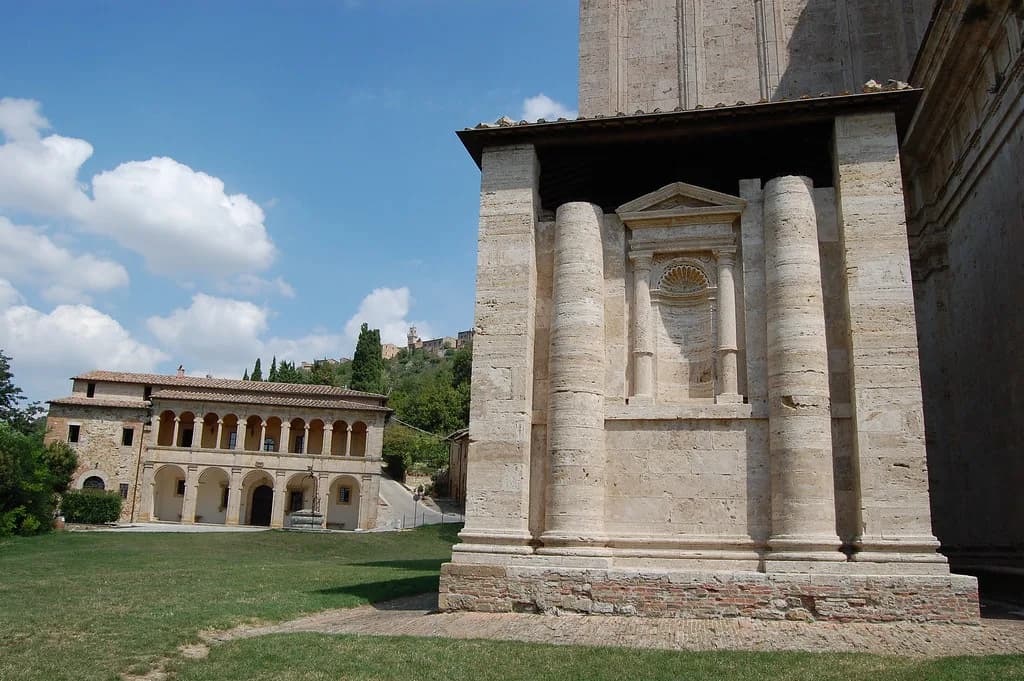
Continue past the tower to the Fortezza and the church of Santa Maria dei Servi. From this upper edge of town you look down on San Biagio and see why the church is worth the descent: it stands in perfect isolation in the countryside, a travertine pilgrimage church and one of the best examples of Renaissance architecture in the area.
Seeing San Biagio from above first is the point of this stage. The building's shape and its setting read clearly from the height, and that image makes the walk down feel like an approach rather than an errand.
This is also a natural pause for a drink or a snack before the descent, since the return leg is the climb. If you want more corners like this one, the hidden gems in Montepulciano guide covers quieter stops around the centre and the surrounding countryside.
Stage 7: The Descent to San Biagio
The walk down to San Biagio takes roughly ten minutes, according to the visitor guide, and it is genuinely downhill. That makes it the easy half of the bargain; the hard half is the climb back up to the town gate, which you should budget for while you are still fresh at the top.
Inside, look at the building's shape and the travertine construction rather than rushing to take photographs from the door. Whether the interior is open when you arrive depends on the day, so check at the entrance instead of assuming access.
If the return climb does not appeal, treat San Biagio as an out-and-back extension you can drop, and keep the town-centre walk as the core of the day. Either way, finish with the downhill stroll along the Corso to whichever gate suits your onward transport.
Suggested Pacing and Pauses
Split the walk into two clearly different versions. The town-only route, from gate to Piazza Grande to the Fortezza and back down the Corso, fits comfortably into a morning; the fuller version adds San Biagio and the return climb and needs roughly another hour. Both figures are our suggestions, not official timings.
Build in three pauses: one on the lower Corso for the palazzi, one in Piazza Grande, and one at the Fortezza before the descent. Spacing them this way means each rest arrives just as the gradient has done its work, rather than at random intervals.
Plan the finish before you start walking. Ending at the gate that matches your bus or parking will save you a final slog across town, and the town's official site is the place to confirm any current transport or traffic arrangements on the day.
Gradient, Terrain and the Return Leg
Expect stone-paved streets, a steady climb along the Corso and steeper gradients in the side alleys. The route itself is short in distance, so the difficulty comes from accumulated height rather than from long stretches, which is why pacing matters more than fitness.
The one-way arc is the key planning decision. Climbing the Corso first and descending to San Biagio last means your hardest walking happens early, when the streets are quieter and you still have energy for the architecture.
Wear shoes with grip, since polished stone and slopes are an awkward combination in damp weather. This article makes no claims about step-free access or official safety guidance for the route; the tourist information office in Piazza Don Minzoni is the place to ask, and the visitor guide lists its address there.
Practical Rhythms: Wine, Food and the Walls
Montepulciano is known for Vino Nobile, and several historic cellars sit inside the walls, dug beneath the palazzi. The visitor guide mentions cellars illustratively rather than as bookings, so treat them as a reason to linger after the walk and arrange any visit directly rather than assuming walk-in availability.
For lunch, look for pici, the hand-rolled pasta served with meat or cheese sauce, in the trattorie of the centre. Many small wine bars have terraces with views, which makes them a sensible final stop once the climbing is done. The Montepulciano food guide goes deeper on what to order.
The tourist information office in Piazza Don Minzoni is a useful first stop if you want current local information on openings and events. The town also publishes its own events calendar, which is the right place to check what is actually happening during your dates.
What This Route Leaves Out and How to Extend It
This walk stays inside the walls and at San Biagio, so it skips the wider countryside. If you want a longer outing, a self-guided itinerary runs from Montepulciano towards Pienza across gravel roads and paths, passing the walled village of Monticchiello, which makes a logical next day rather than an addition to this one.
Beyond the town, the Val d'Orcia and its hill towns reward a separate day. The hidden gems guide and the wider Montepulciano Attractions hub are the places to plan those extensions, especially if you want to link the walk with wine country rather than repeat the centre.
Leave thermal bathing and festival dates out of a walk plan until they are confirmed. The sources describe thermal waters and summer events only in general terms, and no confirmed dates are available, so check the town's own calendar before building a day around either.
Plan Your Visit
Montepulciano works well without a guide because the Corso gives you a spine and Piazza Grande gives you a destination. Enter at Porta al Prato, climb slowly, decide at the tower whether the view is worth the steps, and save the Fortezza for the moment you want to see San Biagio from above.
Then walk down, look at the church in its open setting, and accept the climb back as part of the deal. Check current access and opening details on site or through official town channels before you go, since those conditions change and this route does not depend on any single interior being open.
For the wider trip, pair this walk with the Montepulciano historic centre orientation guide for arrival logistics and the hidden gems guide for quieter stops beyond the main street.
Frequently Asked Questions
Where does the Montepulciano walking route start?
Start at Porta al Prato if you want the classic uphill arc along the Corso, or at Porta delle Farine if you prefer to walk the street downhill first. Both are gates into the walled centre, and the visitor guide notes that buses from Siena and Florence stop near them. Porta al Prato is the better choice for this route because it puts the climb first and the San Biagio descent last.
How long does it take to walk Montepulciano's historic centre?
As a suggestion rather than an official figure, allow two to three hours for the town-centre route with pauses at the palazzi, Piazza Grande and the Fortezza. Add roughly an hour if you include the walk down to San Biagio and the climb back. No timed or designated route is published, so treat these as planning estimates.
Is the walk to San Biagio downhill?
Yes. From the Fortezza and the upper town the church lies below you in the open countryside, and the visitor guide puts the walk down at about ten minutes. The catch is the return leg, which is a climb back to the town gate. Plan your energy accordingly, or treat San Biagio as an optional extension.
Do you need a guide to walk Montepulciano?
No. The centre is compact and organised around one main street, the Corso, with Piazza Grande as its focal square, so it is easy to navigate on foot. A guide adds context to churches and palazzi, but the walking itself needs no booking. Check current opening details for interiors on site before you rely on them.
Is the Palazzo Comunale tower climb worth it?
It depends on the weather. On a clear day the tower gives a wide panorama that the visitor guide says can reach Siena and Mount Cimone, which justifies the effort. In haze the view flattens, and the Fortezza offers an alternative outlook over San Biagio without the staircase. Confirm current access conditions before climbing.
What should you not miss on the Corso?
Look for the Colonna del Marzocco near Porta al Prato, the church of Sant'Agostino with its Donatello-attributed Crucifix, the clock tower with the Pulcinella figure, and the Renaissance stretch around Palazzo Cervini and the house of Poliziano. These are small, easily missed details, so slow down on the lower half of the street rather than rushing to the square.
Is the route officially marked or timed by the town?
No. The Comune di Montepulciano's pages do not present this as a designated, signposted or officially timed itinerary, and the duration figures in this guide are editorial suggestions. Use the gates, the Corso and Piazza Grande as fixed reference points and check the town's official pages for current local information before you set out.
Sources
Continue exploring
More guides you'll find useful