
Santa Maria dei Servi, Montepulciano: Visitor Guide
Plan a visit to Santa Maria dei Servi in Montepulciano: its medieval origin, the Madonna apparition and rebuilding, Andrea Pozzo's work, and the steep walk.
On this page
Most first-time visitors to Montepulciano build their day around Piazza Grande, the cathedral and the Temple of San Biagio at the foot of the hill. Santa Maria dei Servi sits outside that shortlist, yet it carries a more unusual story than either: a medieval foundation, a reported apparition of the Madonna, a rebuild on the spot, and a later renovation touched by one of the great Baroque perspectival painters.
This guide treats the church as its own stop rather than as a footnote. It covers the origin legend, the Sienese artistic layer, Pozzo's contribution and the steep-street context that shapes any church circuit in this hill town, and it says plainly where current visiting details have to be checked rather than guessed.
Why Santa Maria dei Servi Deserves a Place on Your Walk
Montepulciano is dense with churches, and time is limited on a day trip. Santa Maria dei Servi earns a stop because its history is legible in the fabric: a fourteenth-century building, destroyed at some point, then rebuilt where it now stands after a reported miraculous apparition of the Madonna. That sequence, rather than scale or decoration, is what makes the church worth a deliberate pause.
The town's headline religious monument is the Temple of San Biagio, Antonio da Sangallo the Elder's Greek-cross church below the walls, and the cathedral on Piazza Grande holds the celebrated Assumption triptych by Taddeo di Bartolo. Santa Maria dei Servi is a different kind of visit: smaller in reputation, tied to a local devotion, and useful for understanding how Montepulciano's churches accumulated layers across centuries rather than arriving in one campaign.
Orientation: Where the Church Sits in the Historic Centre
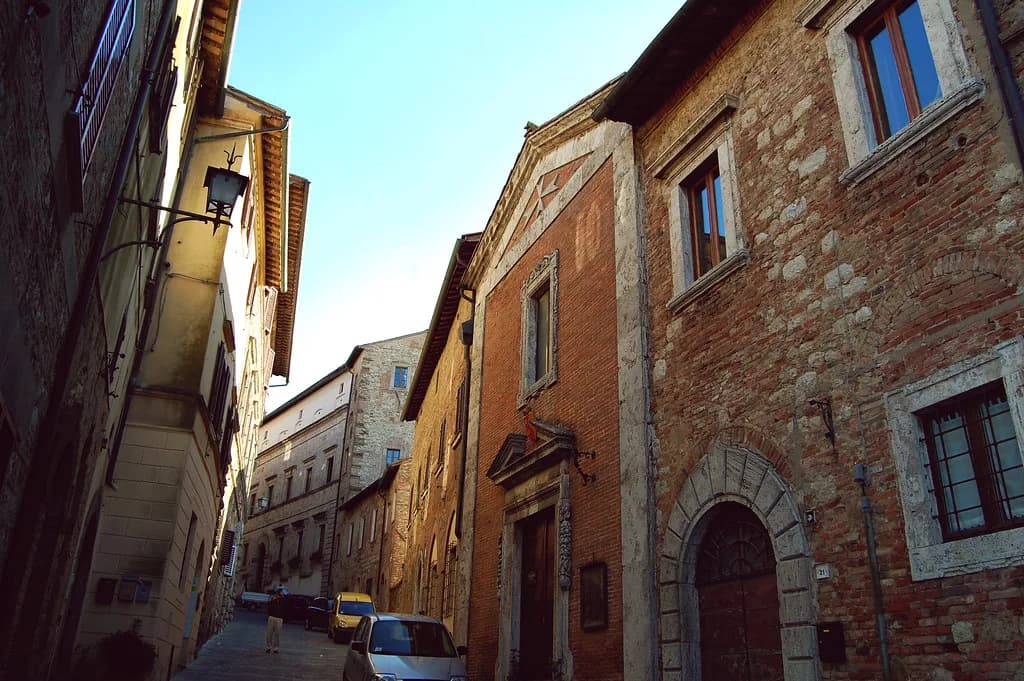
Montepulciano is built along a narrow ridge at roughly 605 metres, and the historic centre is essentially one sustained climb from the lower gate up to Piazza Grande. Streets change name repeatedly along the main axis, so treat Il Corso as a single uphill route rather than a series of separate addresses. Plan your circuit so that the stiffest walking happens once, in one direction.
Because the town stacks upward, a sensible method is to climb to the top early, see the highest sights while your legs are fresh, and let the return leg follow gravity. That approach also puts you in the centre before the busiest hours. Local shuttle services run along the main street, and taking one uphill then walking down is a reasonable compromise on a hot day.
For the broader picture of how the churches, squares and cellars connect on foot, the Montepulciano attractions hub groups the individual guides so you can slot Santa Maria dei Servi into a route that also covers Piazza Grande, the town hall tower and San Biagio without doubling back repeatedly.
Origins and the Apparition Tradition
The church belongs to the fourteenth century, which places its foundation in the period when Montepulciano was contested between Siena and Florence and when religious houses were multiplying inside the walls. The tradition attached to it concerns the Blessed Margherita Funari and a reported apparition of the Madonna; the existing building is described as having been reconstructed on its present site after that event, following the destruction of the earlier structure.
Treat the apparition as devotional history rather than as an architectural fact you can verify on site. What a visitor can actually see is a building whose plan and decoration belong to several periods, which is exactly what a miracle-driven rebuild produces: an older memory carried into newer masonry. Read the account before you arrive and the interior stops looking like a plain parish church.
What Was Destroyed and What the Rebuild Means
The sources describe the earlier structure as lost, with the church rebuilt where it now stands. That matters for how you look at the fabric: you are not seeing a preserved medieval shell but a later construction that inherited an older dedication, an older image and an older story. Look for the points where the building seems to change gear, since rebuilds rarely erase everything at once.
An ancient image of the Holy Mary is said to have been saved from the destruction of the pre-existing structure, which is a common pattern in Italian sanctuaries: the venerated object survives, the building does not, and the new church is organised around the relic's continuing presence. Whether or not you accept the tradition, it explains why a church of this size carries a story larger than its architecture.
The Sienese Artistic Layer
Inside, the church holds works by Sienese artists, and the painter Ugolino di Nerio is named among them. That places the church in the Sienese artistic orbit rather than the Florentine one, which is worth noticing in a town whose Palazzo Comunale was designed by Michelozzo and deliberately echoes Florence's town hall. The painting here speaks to a different allegiance and a different visual language.
A useful comparison is the cathedral on Piazza Grande, where Taddeo di Bartolo's Assumption triptych of 1401 sits behind the high altar. Seeing both in one day lets you read Sienese painting across two very different settings: the civic showpiece and the smaller devotional church. Note that the cathedral's most famous panel is not close to the viewer, so bring the comparison in your head rather than expecting a study-level look.
Andrea Pozzo and the Later Renovation
Andrea Pozzo, the Jesuit artist associated with Baroque illusionistic ceiling painting, contributed to the renovation of Santa Maria dei Servi. That single fact changes how you date what you see: parts of the interior read later than the fourteenth-century foundation would suggest, because later hands reworked an older space instead of replacing it wholesale.
Pozzo's involvement is also a reminder that Montepulciano's architectural story is not confined to the Renaissance names on Piazza Grande. Sangallo, Michelozzo and Vignola dominate the square and the main street, but the town's churches continued to be updated into the Baroque period. If you enjoy spotting those later layers, the church rewards a slow look at altars, stucco and painting rather than a quick photo from the door.
Fitting It Into a Church Circuit
Build the circuit around separate buildings with separate access arrangements. The Temple of San Biagio sits outside the walls at the foot of the hill, Sant'Agostino stands along the main street near the Pulcinella tower, Santa Lucia is a small Baroque church tucked down a side street, and the cathedral closes the climb on Piazza Grande. Each is its own visit; nothing here implies a shared ticket.
A workable order is Sant'Agostino on the way up, the cathedral and Piazza Grande at the top, then Santa Maria dei Servi and the other upper churches as you work back down, finishing with San Biagio if you still have energy for the descent and the return climb. That last leg is the one to cut if the day is hot, since the walk back up from San Biagio is the most punishing part of the route.
If wine is part of your day, the Medici Fortress houses the Consorzio del Vino Nobile and a wine bar, and cellar tastings elsewhere in town usually need booking ahead in busy periods. Keep the church stops and the cellar stops in separate blocks so a tasting does not eat the hour you wanted for the cathedral and the upper churches.
Practical Walking Notes
Comfortable shoes matter more here than in most Tuscan towns, because the centre is steep throughout and the paving is uneven in places. Go up early or late in summer, carry water, and accept that a church circuit is also a hill walk with stops. If mobility is a concern, use the local shuttle along the main street for the ascent and choose a shorter, flatter set of stops at the top.
Pair the climb with the free public space at the top: Piazza Grande is an open square with no admission, and the surrounding buildings hold the cathedral, the Palazzo Comunale, Palazzo Contucci and the Sangallo well. The town hall tower and terrace are a separate paid climb with steep, narrow steps near the summit, so decide in advance whether the view is worth it to you.
Views over the Val d'Orcia and the Valdichiana open up from the upper streets and terraces, and the light late in the day is the reason many visitors linger. Build in a buffer so you are not rushing the last church before closing time, and check sunset timing for the season you travel rather than relying on memory.
What to Confirm Before You Go
Current opening times, days, Mass schedules and any seasonal closures for Santa Maria dei Servi are not published in the sources used here, so this guide does not state them. Before setting out, check the Comune di Montepulciano's institutional site for parish and tourist information, and ask at your accommodation or the local tourist office on arrival, since small churches often open around services rather than fixed visitor hours.
Admission arrangements for the church are likewise unconfirmed here; do not assume a ticket is required or that entry is always possible. Treat any visit as dependent on the building being open when you arrive, and hold the church as a bonus stop rather than the fixed anchor of your day. The same caution applies to other small churches in town.
Plan Your Visit
Santa Maria dei Servi rewards travellers who look past the wine-and-views headline version of Montepulciano. Its value lies in the layering: a fourteenth-century foundation, a rebuilding tied to devotional tradition, Sienese paintings including work by Ugolino di Nerio, and a later renovation associated with Andrea Pozzo. Give it a deliberate slot in your climb, and read the story before you step inside.
Verify the practical details on the day and keep the rest of the circuit flexible. If the church is closed, the walk itself, Piazza Grande and San Biagio still justify the hill, and a return visit is an easy thing to plan once you know the local rhythm. For related planning, see Best Viewpoints in Montepulciano.
Frequently Asked Questions
Where is Santa Maria dei Servi in Montepulciano?
It stands in the historic centre of Montepulciano, the hill town in southern Tuscany between the Val d'Orcia and the Valdichiana. Because the centre is a continuous climb with streets that change name as they rise, plan the church as part of an uphill route toward Piazza Grande rather than as a detour from the main square.
What is the story behind the church's rebuilding?
The church has a fourteenth-century origin. According to the local tradition, an apparition of the Madonna connected with the Blessed Margherita Funari led to the rebuilding of the church on its present site after the earlier structure was destroyed, with an ancient image of the Virgin said to have survived.
Who was Andrea Pozzo and what did he do here?
Andrea Pozzo was a Jesuit artist known for Baroque illusionistic painting. He took part in the renovation of Santa Maria dei Servi, which is why parts of the interior read later than the medieval foundation. Look for later altars and decoration rather than expecting a purely fourteenth-century interior.
How does Santa Maria dei Servi compare with the Temple of San Biagio?
They are entirely different visits. San Biagio is Antonio da Sangallo the Elder's Renaissance Greek-cross church below the town walls, famous for its travertine exterior and dome. Santa Maria dei Servi is a smaller centre-town church shaped by a devotional tradition, a rebuild and a later renovation. They are separate buildings with separate access arrangements, not one combined ticket.
Is the church free to enter?
Admission arrangements are not confirmed in the sources used for this guide. Check the Comune di Montepulciano's site or ask locally on arrival, and plan your day so that a closed door or a service in progress does not derail the rest of the circuit.
How hard is the uphill walk through Montepulciano's centre?
The centre climbs continuously from the lower gate to Piazza Grande, with uneven paving and few level stretches. Wear supportive shoes, start early in warm months, carry water, and consider using the local shuttle up the main street so you can walk down instead of climbing both ways.
Which other churches in Montepulciano are worth visiting?
Alongside Santa Maria dei Servi, the main stops are the cathedral on Piazza Grande with Taddeo di Bartolo's Assumption triptych, Sant'Agostino on the main street, the small Baroque church of Santa Lucia, and the Temple of San Biagio outside the walls. Each has its own access arrangements, so check locally rather than assuming one entry covers all.
Sources
Continue exploring
More guides you'll find useful





