Piazza Grande & Palazzo Comunale, Montepulciano: Visitor Guide
A practical guide to Montepulciano's Piazza Grande and its Michelozzo town hall, covering the buildings framing the square, the Sangallo well and how to plan.
On this page
Piazza Grande sits at the very top of Montepulciano, around 605 metres, and it costs nothing to walk into because it is a public square. What you pay for is the climb: the town is one sustained stone ascent from the gate, with no level alternative route to the summit. That makes the square a reward rather than a stop, and it rewards people who arrive knowing what they are looking at.
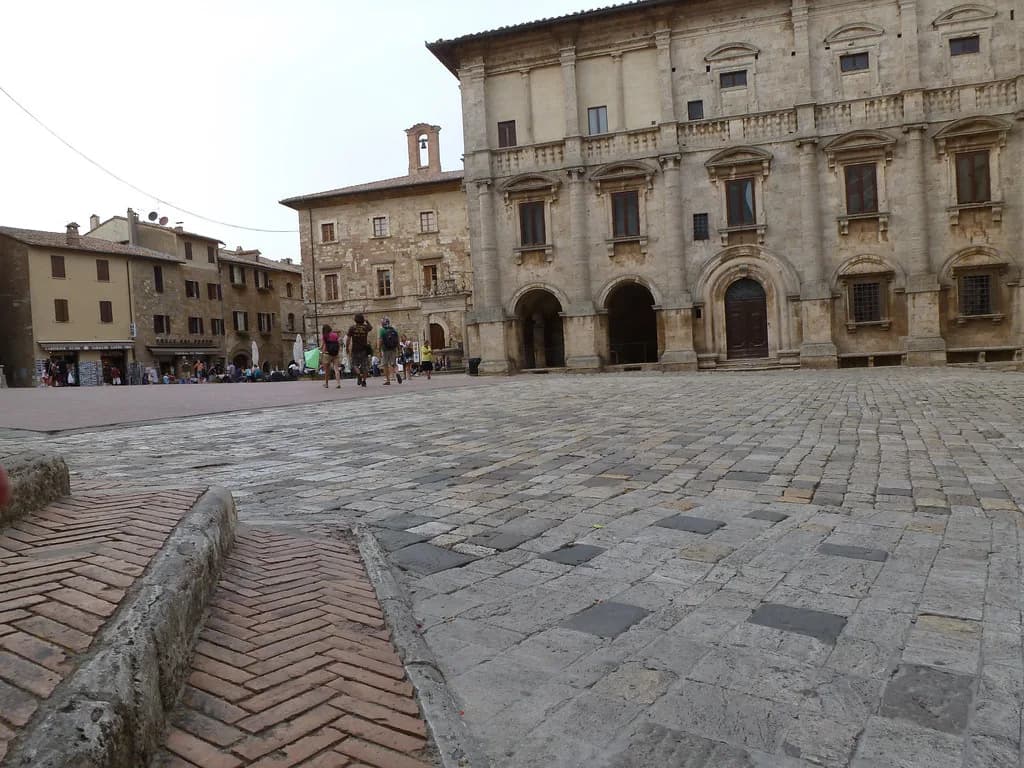
The space is almost empty of objects and entirely defined by the buildings that hold it. Five compact blocks enclose a roughly quadrangular plan: the duomo, the Palazzo Comunale, palazzo Contucci, palazzo Nobili-Tarugi and the palazzo del Capitano. Learn those five names and the square stops being a pretty backdrop and becomes a lesson in how a Renaissance hill town presented itself.
Orientation: A Square Made by Its Edges
Approach Piazza Grande as architecture by enclosure. The square has almost no fabric of its own, and everything about it is the five buildings meeting it as solid masses rather than as thin facades. That is why it feels formal and tight rather than open, and why photographs taken from the middle tend to show walls, sky and very little else.
It was not always this generous. The square was originally smaller and hemmed in by medieval buildings, so the present proportions come from clearance and rebuilding rather than a single design. Look at how the enclosing blocks read as separate set pieces: that patchwork is the visible record of a space that was regulated, cleared and then dressed over several centuries.
The centre holds one deliberate object, a well by Antonio da Sangallo the Elder set in the widening beside palazzo Nobili-Tarugi. It is the only free-standing designed element in an otherwise empty room, and it gives you a natural meeting point if your group splits up. Use it as your landmark when you circle the square and compare the buildings.
Palazzo Comunale: Michelozzo's Florentine Statement
The Palazzo Comunale was designed by Michelozzo, the architect associated with Cosimo de' Medici, and it deliberately recalls Florence's own town hall. That is not a coincidence of taste: from 1390 Montepulciano was Florence's ally and later its possession in country otherwise dominated by Siena, and the square is where that allegiance was made visible in stone. Reading the town hall as an imported statement makes the rest of the square easier to interpret.
The building is still working. The Comune di Montepulciano keeps its offices on the square at Piazza Grande 1, so this is not a museum piece sealed off behind a turnstile. Expect a civic building in active use, with the ordinary traffic of a town hall around it, and treat the ground outside as public space rather than a monument forecourt.
Tower access is the question most visitors ask, and it is the one to resolve before you climb. The organiser has not published verified details of whether the tower interior can be entered, what a ticket would cover, or when it opens, so no honest guide can promise you a rooftop view. Check the Comune's own pages or ask at the tourist office in town on the day, and plan the rest of the square so a closed tower does not spoil the visit.
The Cathedral: An Unfinished Facade and a Survivor's Bell Tower
The duomo on the square was built to a design by the Orvietan Ippolito Scalza and completed in 1680, though sources differ on whether work began in 1586 or 1594. Its facade was never faced in stone, which is why you see bare brick in a salient, projecting form rather than the marble front you might expect. Read it as money running out, not as a rustic style choice.
The bell tower carries the same story upward. Its apex was never completed, and the tower itself is the only surviving structure of the ancient pieve, built with travertine ashlar and brick. So the oldest fabric on the square belongs to a church that no longer exists, attached to a cathedral whose front was never finished. Two unfinished elements on the principal square of a town that had lost its strategic value after 1559 fit together neatly.
Whether you can step inside depends on the cathedral's own arrangements, which vary and are not fixed in any source here. If the interior matters to you, check locally on the day rather than building an itinerary around a hoped-for entry, and remember that the exterior and the square remain free to see regardless.
The Sangallo Well and the San Biagio Connection
The well beside palazzo Nobili-Tarugi was designed by Antonio da Sangallo the Elder during his time in the city, and in the same years the same architect was building the Greek-cross church of San Biagio in the fields below the walls. A well and a centrally planned church by one hand, minutes apart, make a satisfying pairing for anyone interested in Renaissance design. If you have the legs for it, see the church after the square rather than before, so the descent becomes part of the plan.
San Biagio also solves a practical problem. It sits below the walls, so a visit there can end your uphill day rather than extend it, and you avoid re-climbing to the summit twice. Build the route as square first, church second, and use the lower town for whatever comes next.
The Other Palaces: Contucci, Nobili-Tarugi and the Capitano
Three more blocks complete the enclosure, and each is worth a slow look rather than a photograph from the corner. Palazzo Nobili-Tarugi is attributed to Antonio da Sangallo the Elder or to Vignola, a hedge worth repeating because the attribution is genuinely unsettled. Palazzo Contucci and the palazzo del Capitano fill out the set, and together the four palaces plus the duomo explain why the square reads as a room with five walls. Further visitor details appear in Discover Piazza Grande, Montepulciano - Goparoo.
Most of these are private or institutional buildings rather than visitor attractions, so admire the exteriors and do not assume a door is open. The pleasure here is architectural rather than ticketed: mass, proportion, stone colour and the way the blocks meet the pavement. If you want interiors and collections, look elsewhere in town and verify arrangements first.
How a Market Square Became a Formal Stage
The statutes of 1337 fixed the square's boundaries and its use, and what they describe is the opposite of what you see today. It was the centre of public life and hosted a market; crimes committed within it were punished more severely than the same crimes elsewhere; and a column stood there for exposing those sentenced to the pillory. That legal premium on the space tells you how seriously the town took its main square.
Then the market moved to the piazza delle Erbe, and the square changed character. With trade gone, Piazza Grande took on chiefly a representative function, and under the cultural influence of the Florentine and Roman Renaissance that shift gave it the appearance it has now. The formality you feel is the absence of commerce, not the presence of grandeur.
That reframing is useful when you walk the town. Piazza delle Erbe still carries the everyday, market-side role, while the summit performs authority. Noticing which square does which job is a quick way to read Montepulciano's geography without a guidebook open in your hand.
Walking Up: The Climb, the Shuttle and Summer Timing
Getting to Piazza Grande is harder than reaching the centre of most Tuscan hill towns, because the square is the highest point and the route is a sustained stone climb with no level alternative. Local shuttle buses work the main street, so using one uphill and walking down is a sensible division of effort. Save your legs for the square and the palaces rather than spending them all on the approach.
In summer, timing matters more than technique. Go up before 09:00 or after 18:00, when the stone is not radiating heat and the light on the facades is better anyway. A midday ascent in July is possible but unpleasant, and the square offers little shade because it is an enclosed room of stone.
Wear shoes with grip, because polished stone and steep gradients are a poor combination in wet weather or after a market. Carry water if you are climbing in the warm months, and accept that the descent is faster but not easier on the knees. If mobility is a concern, plan around the shuttle rather than assuming every lane is gentle.
When the Square Fills: The Bravio delle Botti
On the last Sunday of August the Bravio delle Botti fills the town, a race run on that day since the 14th century in which the contrade push heavy barrels uphill through the streets and finish in Piazza Grande. It is the one weekend when the square is not a quiet architectural room, and the town is completely full. Book nothing loosely around those dates and expect restricted movement through the centre.
If you want the square itself rather than the spectacle, avoid that weekend entirely and take a weekday morning instead. If you want the race, treat it as an event visit and check the current year's arrangements with the Comune before travelling, since the running of any edition depends on official confirmation.
A Short Square-Focused Plan
For a square-focused stop, allow roughly an hour on the pavement as a suggestion, not an official figure: circle the five blocks, read the cathedral facade from two angles, find the Sangallo well and look down into the streets from the edge. Add time if you get into the cathedral or find the town hall open, and subtract it if crowds or heat shorten your patience.
Give the rest of the day to the lower town and the quieter lanes away from the main street, which is where Montepulciano stops performing and starts living. Pair the summit with a slow wander and a look at the views over the Val d'Orcia, and leave the wine and cellar visits for after you have descended.
If you want a cellar under your feet without leaving the upper town, the fortress area is the obvious add-on and is easy to fold into the same circuit. Just check arrangements for whatever you plan to enter, because a public square being free does not mean the buildings around it are.
Plan Your Visit
Piazza Grande asks nothing of your wallet and everything of your legs. Go early or late, take the shuttle up if you need it, walk down, and give the five buildings the attention they were designed to command. The square is free, public and always there, which is exactly why the climb is worth it.
Confirm the two things that change before you travel: whether the Palazzo Comunale tower is open, and what the cathedral's interior arrangements are that week. The Comune's site and the tourist office are the places to ask, and a quick check saves a wasted ascent. Everything else you can simply look at.
Frequently Asked Questions
Is Piazza Grande free to visit?
Yes. It is a public square and there is no charge to walk into it or around it. The buildings facing it are separate: some are civic offices, some are private palaces and one is the cathedral, and each has its own arrangements for entry.
Why does the cathedral on Piazza Grande have a bare brick facade?
The facade was never finished and never received its stone facing, which is why the bare brick reads as a projecting, salient front rather than a completed marble one. The bell tower's apex was also left incomplete, so the cathedral shows two unfinished elements on the town's principal square.
Who designed the Palazzo Comunale in Montepulciano?
The Palazzo Comunale was designed by Michelozzo, and it deliberately echoes Florence's town hall. Montepulciano was Florence's ally and later its possession from 1390, so the building is a visible statement of that alignment. Civic offices are still on the square at Piazza Grande 1.
What is the well in Piazza Grande?
It is a well designed by Antonio da Sangallo the Elder, set in the widening beside palazzo Nobili-Tarugi. The same architect was building the Greek-cross church of San Biagio below the walls at around the same time, which makes the two worth seeing together.
How hard is the walk up to Piazza Grande?
It is a sustained stone climb with no level alternative route, because the square is the highest point of town. Local shuttle buses serve the main street, so a common approach is to ride up and walk down. In summer, go before 09:00 or after 18:00 to avoid the worst heat.
When does the Bravio delle Botti take place?
It is run on the last Sunday of August, a tradition dating to the 14th century in which the contrade push heavy barrels uphill and finish in Piazza Grande. The town is completely full that weekend, so avoid those dates if you want a quiet square, and confirm current arrangements with the Comune if you plan to attend.
Can you visit the Palazzo Comunale tower?
Access to the tower interior and what any ticket would cover are not confirmed in published visitor information, so do not plan around a guaranteed climb. Ask at the tourist office or check the Comune's own pages before you travel, and build the rest of your square visit so a closed tower does not matter.
How long should you allow for Piazza Grande?
As a suggestion rather than an official figure, about an hour on the square is enough to circle the five buildings, study the cathedral facade and find the Sangallo well. Add time for any interior you manage to enter, and keep the rest of the day for the lower town.
Sources
Continue exploring
More guides you'll find useful